Getting Medieval On Your…

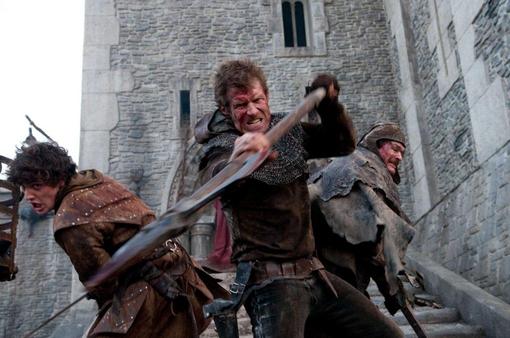
● “Ironclad” (2011)

● “Black Death” (2010)

“Ironclad ” is now available on DirecTV and other on-demand providers (check your service listings) and from Netflix (DVD and Blu-ray) starting on July 26th. “Black Death” is available on Netflix (streaming, DVD and Blu-ray) and Amazon Instant Video.

When I was a kid growing up in the Seattle suburb of Edmonds, WA (aka “The Gem of Puget Sound”), my parents did everything that good, sensible parents should do to shield their kids from violence, both real and reel. I remember being innocently intrigued by the furor over “Bonnie & Clyde” in 1967, but they would never have taken me to see it with them (to their credit, since I was only six). The same held true for “The Wild Bunch” in 1969, by which time the debate over movie violence had reached a fever pitch in our national conversation. Over the ensuing decades, that conversation has become a moot point as movie violence proceeded apace, from Sonny Corleone’s death in a hail of Tommy-gun fire in “The Godfather” (1972), to the slasher cycle of the late ’70s and ’80s (when makeup artists Tom Savini and Rick Baker reigned supreme as a master of gory effects) and into the present, when virtually anything – from total evisceration to realistic decapitation — is possible through the use of CGI and state-of-the-art makeup effects. That’s where movies like “Ironclad” and “Black Death” come in, but more on those later.

If you’re looking for a rant against milestone achievements in the depiction of graphic violence, you’ve come to the wrong place. To me, it’s a natural progression. Movies and violence have always been inextricably linked, and once opened, that Pandora’s Box could never be closed. A more relevant discussion now is how the new, seemingly unlimited gore FX should be used and justified. Horror films will always be the testing ground for the art of gore, and it would be a crime against cinema to cut the “chest-burster” from “Alien” (or, for that matter, Samuel L. Jackson’s spectacular death in “Deep Blue Sea”). But it’s the depiction of authentic, real-life violence — in everything from the “CSI” TV franchise to prestige projects like HBO’s “Band of Brothers” and “The Pacific” — that pushes previously unrated levels of gore into the mainstream.

Don’t get me wrong: I’m not praising this progression so much as acknowledging its inevitability. If you really love movies — and especially if you’ve been lucky enough to make a career out of watching them — you have undoubtedly seen a violent film that was unquestionably vile, unjustified and miles beyond the boundaries of all human decency. I’ve seen violent movies that earned my disgust because (1) the context of the violence was as abhorrent as the violence itself and (2) the intentions of the filmmakers were clearly indefensible. (Context and intention: More on that later.) Tolerances and sensibilities may vary, but every critic has seen a film that appeared to have been written and directed by sociopaths. Check out Roger Ebert’s review of “I Spit on Your Grave” (the 1978 version) and you’ll see what I mean.

December 14, 2012

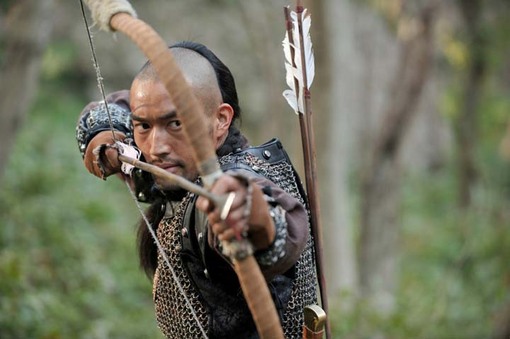
War of the Arrows: Deadly targets

“War of the Arrows” is currently available on Netflix Instant, Vudu, iTunes and Blu-ray/DVD.

By Jana J. Monji

A sudden crush of movies is bringing the sport of archery back into the limelight, and the timing couldn’t be better for the 2011 costume drama “War of the Arrows” from South Korea. This is like a Western movie damsel in distress scenario transported to 17th century Korea with archery instead of gun sharpshooting. The good guys don’t wear white hats, but you’ll easily be able to tell the good guys from the bad guys in this morality tale.

European tradition has William Tell and Robin Hood to tantalize young boys into archery. In America, if children still play cowboys and injuns, then one supposes that the Native Americans still use bows, but that’s usually just the braves according to old stereotypes that places the squaws in the wigwams. More recently, we’ve had “The Avengers” with Clinton Barton’s Hawkeye.

For girls, “The Hunger Games” have given us an alternative reality with arrow-slinging Katniss who like Annie Oakley learned to shoot in order to feed her family. Disney’s newest princess, Merida in “Brave,” performs archery on horseback. Has there ever been a better time for archery?

December 14, 2012

A haunting, in time and space

“The Innkeepers” is streaming online through Amazon Instant and Vudu. It is also offered on some cable systems’ On Demand channels and opens theatrically in a limited release February 3rd. The official website is here.

by Steven Boone

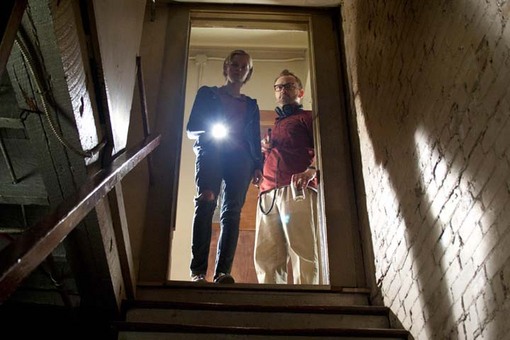
The trailer for “The Inkeepers” betrays a basic insecurity common in low-budget indie films nowadays: They want you to think they’re as loud and hectic as their big-budget counterparts. They’re afraid you won’t show up otherwise. And so this horror film which builds its scares slowly, stealthily and through the peculiar quirks of its characters is sold as just another clangy, generic mainstream fright flick. Mercifully, the actual film shows only a little of this poisonous “ambition.” It’s mostly just a good old-fashioned ghost story, well told.

This film’s wealth of personality is apparent early on, as director Ti West takes his time recording the subtle oddball chemistry between Claire (Sarah Paxton) and Luke (Pat Healy), the only staff on duty at the Yankee Pedlar Inn. Luke is obsessed with documenting a legendary ghost at the Pedlar for his website. He is surprised to find that Claire, his secret geek-girl crush, is just as fascinated by the subject. For a healthy stretch of the film we just watch them goofing off and pranking each other when not rendering poor service to the inn’s only two guests (one played by Kelly McGillis from “Top Gun,” appearing about 15 years older than her actual age–the biggest jolt of the movie, for a viewer over 30).

December 14, 2012

Hara-Kiri: Of courage, compassion & cowardice

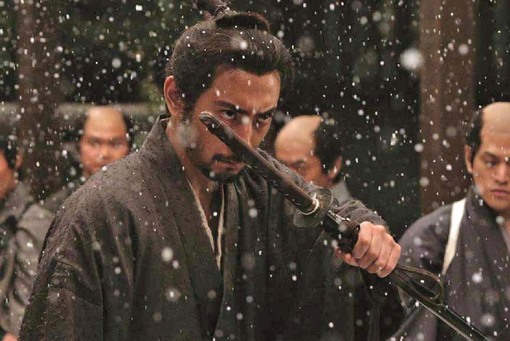
In Takashi Miike’s “Hara-Kiri: Death of a Samurai,” power and tradition crush good people, just as they did in Masaki Kobayashi’s 1962 version. Both films are expressions of social rebellion, but where Kobayashi’s conveyed a spirit of righteous vengeance that anticipated the course of its revolutionary decade, Miike’s is more plaintive and despairing. There are struggles, but nobody wins, ever. Weak and cowardly people who happen to be tending the levers of power simply carry out meaningless rituals that destroy lives.

As in the ’62 film, through flashbacks we get a good, long look at the lives an inflexible Samurai code has destroyed. With the elegance and shyness of an Ozu domestic drama, Miike renders a family formed under bittersweet circumstances: A poor Samurai dies, leaving his son in the care of his old war buddy, a fellow widower with a daughter of his own. Raising these children in early 15th Century peacetime means drawing from meager earnings as an umbrella maker rather than as a soldier of fortune. Hanshiro Tsugumo (Ebizo Ichikawa) might have been tough on the battlefield, but he imparts a gentle nature, not a warrior’s stoicism, to the boy, Motome Chiziiwa (Eita). Motome becomes a schoolteacher and, inevitably, marries Hanshiro’s daughter Miho (played as an adult by Hikari Mitsushima, the radiant star of Sion Sono’s Miike-like masterpiece, “Love Exposure”). He fulfills both obligations with his father’s patient, nurturing ways.

December 14, 2012

The City Dark: Turn out the lights

Do you love the nightlife? During hot summers, evening comes like a cool blessing with a promise of good company. But just what do we mean by the night life? Usually we aren’t talking about dark streets and even the dimly lit dance venues and bars feature glowing and sometimes pulsing lights. As a woman, I prefer well-lit and well-traveled areas of the city. It’s a mattered of safety. Yet in director/writer Ian Cheney’s illuminating documentary, “The City Dark, ” we learn that having a city that never sleeps comes at a steep price. “What do we lose when we lose the night?” he asks.


For the New York City-based Cheney, who grew up in rural Maine, in a small town of about 4,000 people, his boyhood nightlife was spent gazing at the stars. This 2011 documentary is like a plaintive love song to the night skies of his youth with stunning astrophotography (cinematography by Cheney and Frederick Shanahan). I realized that as much as I love nighttime walks under a full moon, I have never truly seen the sky at night. In most cities there’s too much light pollution.


Cheney’s previous documentary, the Peabody Award-winning “King Corn” also appeared on PBS as part of the Independent Lens series. Directed by Aaron Woolf and written by Cheney, Curtis Ellis along with Woolf and Jeffrey K. Miller, the 2007 “King Corn: You Are What You Eat,” followed college friends, Cheney and Ellis, as they moved to Greene, Iowa to grow an acre of corn and learn about the industrialization of farming and why corn is such a high-demand crop even though it’s subsidized by the government.

December 14, 2012

Raccoon Nation: The hep cats of the ‘hood

“Raccoon Nation” premieres on PBS’s Nature series Wednesday, Feb. 8, at 8 p.m., 7 p.m. Central. Coming on DVD/Blu-ray March 13.

Let’s be frank: People watch nature documentaries because they want to see wild animals doing the Wild Thing. This can be shown on regular TV because, as Bea Arthur’s Maude famously said, “animals making love is rated G. People making love like animals–that’s R ” An animal documentary serves to showcase how its subjects survive, hunt, eat, play, and yes, get their freak on. There’s a reason the sexiest piece of music Elmer Bernstein ever wrote used to play over footage of animals gettin’ bizzy on “National Geographic.” A Barry White soundtrack would have been way too hot for TV.

Alas, “Raccoon Nation” is a relatively chaste animal documentary, which is unusual but no less interesting. Its focus is on another popular topic of nature non-fiction: man’s effect on the animal kingdom. Our species is usually depicted as destructive, and rightfully so. Forests and wooded areas are disappearing, leaving animals homeless and upsetting the natural balance by misplacing both predator and prey. “Raccoon Nation” takes a different approach, however, suggesting that humans may be responsible for the continued survival of the misplaced animal. The more we try to get rid of raccoons, the smarter they get. It’s side hustle disguised as adaptation.

As more and more development occurs, the animals start living closer to us. The urban jungle is now literally a jungle. Deer have been spotted in my hometown, and 10 miles away, Irvington, New Jersey saw an episode of “Bearz N The Hood” when a city block’s trashcans were set upon by ursine visitors. My current neighborhood is overrun with rabbits, foxes, possums, squirrels and birds who are decidedly NOT pigeons. I walked out of my house this summer, and there were so many animals in my yard I thought I was in “Song of the South.”

December 14, 2012

Walk Away Renee: You’re not to blame

“Walk Away Renee” is available on SundanceNow’s new Subscriber Video-on-Demand Program Doc Club from June 27, 2012.

When you were young didn’t you think your parents were crazy? Did you swear you wouldn’t turn out like them? For filmmaker Jonathan Caouette, those two worries have defined his life because his mother suffers from bipolar personality and schizoaffective disorders, something that he focused on in his award-winning 2003 documentary “Tarnation.” In his new film, “Walk Away Renee,” Caouette brings us up to 2010 with the focus on Caouette driving his mother, Renee LeBlanc, in a U-Haul from Houston to New York.

For a dysfunctional family, road trips can be filled with emotional landmines. For Caouette, this bonding experience starts out well, but early on, they lose Renee’s 30-day supply of lithium. Without her mood stabilizing meds, you know that things can only get worse. For people who have bipolar relatives, this story might seem heartbreakingly familiar.

Caouette’s “Tarnation” begins with overexposed grainy images. The highlights are blown out to white; this isn’t a technical problem, but an expression of panic. His mother has overdosed and the documentary then shows the events building up to this emergency. Caouette began filming his family in 1984 and in “Tarnation” we see him as a young troubled boy, starved for attention and trying to make sense of his world, his sexual orientation and the mother he loves while being raised by his overwhelmed though well-meaning grandparents, Adolph and Rosemary Davis.

December 14, 2012

From Seattle, with free refills

“The Off Hours” is now available on most on-demand platforms including Comcast, Verizon, AT&T and most major-cable services. NOTE: The film is not available through DirecTV. It will be released on DVD in January and will premiere on Hulu and Netflix later in 2012.

by Jeff Shannon

There’s never been a better time for filmmaking in the Pacific Northwest. Running the entire spectrum from filmgoers and critics to actors, writers and production talent aplenty, the Seattle film community has always been close-knit and cooperative, and its D.I.Y. resourcefulness has resulted in a slow but steady rise of intermingling talent. (Full disclosure: Several of the creative people mentioned below are casual Facebook acquaintances of mine.) Ten years ago and earlier, you were lucky if your micro-budgeted project got finished and accepted by festivals, and for several years it seemed like the Native American drama “Smoke Signals” (written by Northwest author Sherman Alexie and distributed by Miramax in 1998) would be Seattle’s only claim to a locally-produced breakout success.

Undeterred, Seattle’s film community continued to percolate like the coffee that stereotypically defines “The Emerald City” for most of the outside world. Abundant indie-film projects, and the passions that fueled their creation, have led to a natural progression of experience and expertise, and this year alone the Sundance film festival hosted four films shot in Washington state. When you consider the local history that led us from “Gas City” (an obscure, no-budget 1978 slacker drama shot among the aging motels and nightspots of Seattle’s Aurora Avenue) to the international success of director Lynn Shelton’s “Humpday” (2009), it’s no wonder that Seattle has become the Northwest’s answer to Austin, Texas: A film- and music-loving city (per capita, Seattleites are still the nation’s #1 moviegoers) where independent filmmakers can find the talent, resources, and community support to foster their projects from start to finish. Indeed, “Start-to-Finish” is the name of an innovative program, introduced by the Northwest Film Forum in 1998, designed to select and co-produce films with the goal of national and global exposure. Canadian alt-auteur Guy Maddin found NWFF so appealing that he came here to shoot his 2006 film “Brand Upon the Brain!,” now available on DVD from the Criterion Collection (and photographed by the gifted Benjamin Kasulke — see below).

December 14, 2012

Faces that bring their own light

“The First Grader” is streaming On Demand via Amazon and Vudu, and the DVD is on Netflix and on sale.

by Steven Boone

It doesn’t matter that “The First Grader” is as shamelessly, sappily manipulative as that TV commercial where Sarah Mclachlan wails a tune while the camera zooms in on miserable animals peering out of their rescue shelter cages. Nope. It doesn’t even matter that the musical score, which I will give the alternate title “Mother Africa Weeps,” is the World Music equivalent of an Oreo McFlurry — a real pancreas-buster. Never mind all that. The imagery in “The First Grader” places it on par with cinema’s great sentimental masterpieces, “Umberto D,” “Tokyo Story” and “Ikiru.” From the first frame, this film warns that it is working in a universe of pure emotion.

The film’s true story concerns Maruge (Oliver Litondo), a former Kenyan freedom fighter and political prisoner who has been forgotten in the post-colonial age. He walks around the countryside in rags while the new generation of power brokers benefiting from his sacrifices zip through Nairobi in Benzes. When he learns that the government is now offering free education to all, he tries to enroll in a local elementary school. He’s illiterate, it turns out, and he wants to learn how to read an important old letter for himself. Of course, the 84 year-old has a tough time convincing the overcrowded one-room schoolhouse to let him in.

December 14, 2012

Tim and Eric Mediocre Movie, Great Job!

“Tim and Eric’s Billion Dollar Movie” is available for streaming/download on iTunes, Amazon Instant, Vudu and YouTube. In theaters March 2.

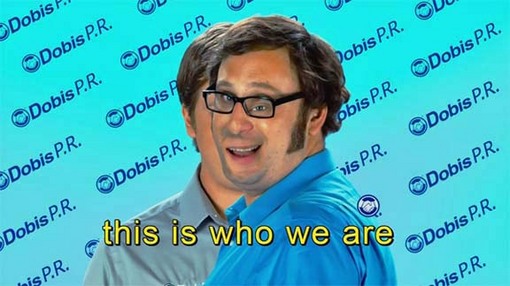
“Tim and Eric’s Billion Dollar Movie” is a lot like “Tim and Eric’s Awesome Show, Great Job!.” They’re both experimental video art posing as sketch comedy. In them you can see DNA from Ernie Kovacs, John Waters, the Kuchar brothers, Robert Downey, Sr., Tom Rubnitz, early Beck music videos, Damon Packard, Aqua Teen Hunger Force (and every other Adult Swim psychotic episode) and Harmony Korine, to name just a random few. But it’s likely that actor-writer-directors Tim Heidecker and Eric Wareheim took inspiration from none of these freaks.

The duo’s work seems to flow directly from three sources: Bad corporate promotional and instructional videos, absurd local TV programming and assaultive blockbuster films. Their collages of chopped-and-screwed sounds with spastic motion graphics and sloppy green screen don’t seem much different (in effect, if not production values) from what’s on cable any given Sunday. It’s just that they put unattractive, demented-seeming people in front of the green screen instead of the usual telegenic emoters. They spout nonsense where platitudes and corporate messages usually go. When celebrities appear on the show, they flub and stutter like robot hologram versions of themselves. It’s as if the show’s editor was a spam bot.

Whether any of it is funny is almost beside the point. The creeping surrealism often takes away your ability to blink, especially, I suspect, when, like me, you have no history with the show.

December 14, 2012

Sleepless Night: Opening up a sixpack of Whup-Ass

“Sleepless Night” (103 minutes) is available on demand through various cable systems,

Vudu, iTunes and Amazon Instant, starting April 17th. It will be theatrically released in New York and Austin, Texas on May 11, 2012.

by Odie Henderson

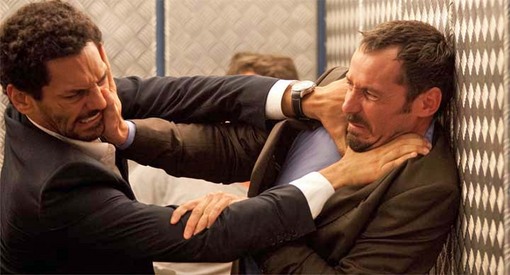
A stolen bag of cocaine, a kidnapped kid, corrupt cops, a shaky camera and a dance club the size of a Super Walmart configure Frederic Jardin’s “Sleepless Night,” a frenetic French action film that will either get your heart or your head pounding. This is a relentless genre exercise, both exhilarating and exhausting. Its numerous showdown set pieces feature foes in gun battles, foot chases and fisticuffs. Our protagonist uses whatever’s handy to subdue his opponents: People’s noggins get hit with doors, bread, dishes, bullets and the cleanest part of the commode. Gendarmes go from corrupt to virtuous and vice versa, film speeds vary from slow motion to sped up, and narrow escapes coexist with near-misses. With this much activity, sensory overload is all but guaranteed.

Vincent (French comedian Tomer Sisley) is a corrupt cop who begins his day by robbing 10 kilos of cocaine from the henchmen of José Marciano (Serge Riaboukine). Marciano’s godson is shot, but not before Vincent is stabbed and both he and his partner are seen by one of Marciano’s men. Marciano knows who robbed him, and he also knows Vincent’s son, Thomas, would make a great bargaining chip for the return of his yayo. The gangster kidnaps Vincent’s son and demands the exchange be made at Marciano’s restaurant-slash-dance club, Le Tarmac.

December 14, 2012

This isn’t your Disney Little Mermaid

“The Little Mermaid from San Francisco Ballet” airs Friday, Dec. 16, at 9 p.m. (check local listings) on PBS’s “Great Performances.” It is currently available on DVD, and will also appear on PBS On Demand.

by Jana Monji

Whenever I say, “Hans Christian Andersen,” in my mind I can hear the voice of Danny Kaye singing out the name of the famous Dane. Kaye played the title role in 1952 musical film, “Hans Christian Andersen. ” For another generation, the Little Mermaid is part of a Disney franchise beginning with the 1989 animated feature “The Little Mermaid. ” Now comes a ballet, recorded for PBS.

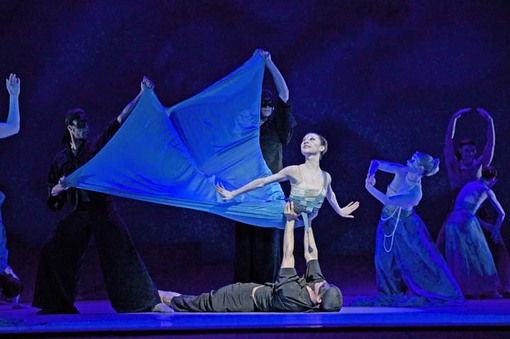
Hamburg Ballet director John Neumeier’s “The Little Mermaid” is a visually rich, emotionally complex ballet that takes the famous Hans Christian Andersen fairy tale from its Hollywood interpretations back to its origins. This is a “don’t miss” production.

In the original story, the Little Mermaid saves and falls in love with a prince. She makes a bargain with a witch, giving up her beautiful voice in order to have legs. The prince likes her, but doesn’t love her and marries another. Given the choice of killing the prince or dying herself, the Little Mermaid dies, but is resurrected in another dimension.

How can you have a franchise if the Little Mermaid dies? You can’t, of course. In the Disney feature, “The Little Mermaid,” Ariel (voiced by Jodi Benson), doesn’t die, and instead, does find love with her prince, Eric (Christopher Daniel Barnes). Roger Ebert gave the movie four stars, and called it “a jolly and inventive animated fantasy” that restored the magic associated with animated Disney features from an earlier era. The Academy voters gave the film two Oscars–one to Alan Menken for Best Music, Original Score and another to Menken and Howard Ashman (lyrics) for Best Music, Original Song (“Under the Sea”)

December 14, 2012

The enemy of my enemy es mi amigo

“Amigo” is playing in selected theaters, including the Siskel Film Center in Chicago.

by Odie Henderson

There is something to be said for the economy in John Sayles’ movie titles. He gets his point across in five words or less. The theatrical films he has written and directed bear the names of locations (“Matewan,” “Sunshine State,” “Silver City,” “Limbo”) or are deceptively simple descriptive statements (“The Secret of Roan Inish,” “The Brother From Another Planet,” “Return of the Secaucus Seven,” “Amigo”). All 17 titles average out to just under 3 words per movie moniker (actually, 2.5), which means Sayles’ 18th movie must star the king of the three word movie title, Steven Seagal. Laugh if you must, but IMDb will tell you Sayles once wrote a film for Dolph Lundgren. Seagal is only a “Marked for Death” sequel away, should Mr. Sayles take my advice.

In the meantime, his 17th film opens September 16th On Demand. “Amigo” follows the path running through much of Sayles’ work: It is politically aware, occasionally melodramatic and maintains a certain intimacy despite sprawling across multiple characters and stories. Bitter irony and blatant humanism peacefully co-exist as Sayles’ heroes, heroines and villains struggle to maintain the dignity he inherently believes they have. The director’s masterpiece, “Lone Star,” is the quintessential example of Sayles expressing his themes and ideas in epic format. Anchored by Chris Cooper, “Lone Star” spins a tale of power, race and class across generations, juggling numerous characters with whom the story invests such weight and interest that I could follow any of them out of the film and into their own adventures.

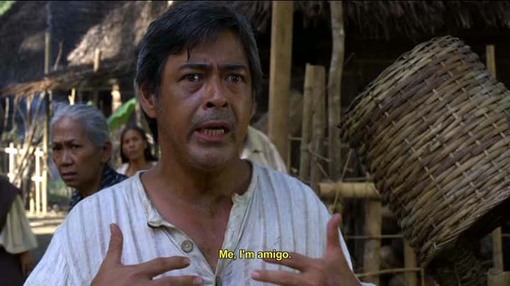
“Amigo” is not as tightly crafted as “Lone Star.” It’s a messier work whose dialogue is at times a tad too purple, its political allusions a little too obvious, and it has a one-note character that is uncharacteristic of its creator. Much of its plot is predictable in an old-fashioned, yet comforting studio-system way. Reminiscent of a sloppier E. L. Doctorow novel, “Amigo” merges real-life characters with fictional ones while plumbing a bygone era for parallels of today. Like Doctorow, Sayles provides numerous details of the period he depicts, culled from the research he did for his book “A Moment in the Sun.” Its U.S. occupation plotline could represent Iraq or Vietnam or Afghanistan, and its soldier characters are good ol’ boys found in many an old war movie (and many an actual platoon, as well). What makes “Amigo” engrossing despite its predictability is the object of its gaze: This is an occupation story, but for a change, “the Other” is us. The occupied people are observing the outsiders who have interrupted their life narrative by invading their country. In “Amigo,” we are entrenched in the Philippine-American War (1899-1902).

December 14, 2012

Serbian porno gang takes show on the road

“The Life and Death of a Porno Gang” is available on DVD and Blu-ray from Synapse films.

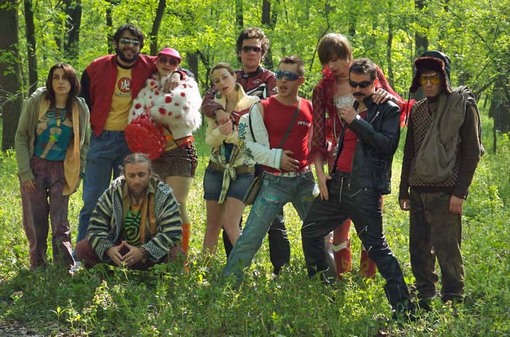
Cinema, that traditionally aristocratic medium, has always found unlikely ways to commiserate with the working man and the poor. In America, King Vidor’s “The Crowd” showed us a man trapped on the treadmill of lower middle class survival in the big city. A few years later, Frank Borzage’s “Man’s Castle” gave us Spencer Tracy as a street hustler who learns that Depression-era struggle is no excuse to turn his back on a chance at family life. It’s the same in every country, every era: Societies that place the bulk of their economic burden upon the low man’s shoulders often send that man scrambling in the opposite direction of happiness, in the name of happiness. A random spin of the world cinema wheel will turn up great directors whose finest work touches on this phenomenon: Ken Loach, Ousmane Sembene, the Dardenne brothers, Ulrich Seidl, the Italian neorealists, the blacklisted Americans, and so on.

December 14, 2012

Margaret Mitchell: Her own brand of rebel

PBS’s “American Masters” presents “Margaret Mitchell: American Rebel” and “Harper Lee: Hey, Boo,” back-to-back documentaries about two white American women who won Pulitzer Prizes for their first and only best-selling novels, Monday, April 2 beginning at 9 p.m. (Check local listings.) Both will be available via PBS On Demand and are currently on DVD.

If you’re hoping for the whirling of petticoats, a colorful Virginia reel and the coquettish fluttering of lashes on the old plantation, you might be surprised by American Master’s “Margaret Mitchell: American Rebel.” By rebel, director Pamela Roberts doesn’t just mean Johnny Reb. On the other hand, if you hope that the author of Gone With the Wind is burning in hell for conjuring up a romantic fantasy of slavery and antebellum plantation life, you might be surprised. Mitchell was a wild young woman who did some shocking dances in her day, but eventually settled down and did good in ways that benefited the citizens of her hometown Atlanta and beyond.

What could be rebellious about a woman who romanticized a plantation lifestyle in which women were raised to be pretty ornaments and good wives in her 1936 novel of the Old South, “a civilization gone with the wind…”? Today, millions of women still live out their Scarlett O’Hara fantasies at their weddings with hoop-skirted bridal gowns, and through Civil War or Southern ball re-enactments. Not so many line up to portray slaves. The documentary uses many clips from the blockbuster 1939 movie, contrasted with photographs of Mitchell in her own wild youth. Even as one might enjoy the sweeping romance of the motion picture epic and attempt to ignore the racism, I suspect most people are more politically sympathetic with Alice Randall’s 2001 parody The Wind Done Gone, which re-imagined Mitchell’s story from the slaves’ point of view.

December 14, 2012

Chaz Bono: On Being and Becomingness

“Becoming Chaz” airs Sunday, November 27 6PM ET/PT on OWN before the 8 p.m. premiere of its follow-up, “Being Chaz.”

Not too long ago, I was planning to marry a woman who was born a man, so Chaz Bono’s story is a bit familiar. It’s pretty simple, really, and you’ve heard it a thousand times by now: A transgender person feels trapped in the “wrong” body. Just for acting upon this lifelong impulse by changing their physical characteristics to better represent their true selves, transpeople are being assaulted and murdered in shameful numbers. The movie “Boys Don’t Cry” might have softened a few bigoted hearts around this issue, but the killing continues worldwide.

Chaz, born Chastity Bono to celebrity couple Sonny and Cher, could have lived through his transition from female to male in private, but it’s clear in the documentary “Becoming Chaz” that he knew the true cost of invisibility in such a transphobic world. He let the cameras roll during some unflattering, raw moments–the idea being that this story shouldn’t idealize his experience any more than it should exploit it for freak show appeal. The aim is to show that Chaz, the man, is as real as you and I, not an illusion to be brought off. It’s hard to imagine that the killers out there might be moved by all this candor, but those whose indifference or unawareness helps perpetuate discrimination should at least get a healthy jolt of recognition. “Becoming Chaz” is as much about the kind-faced “Dancing with the Stars” contestant’s relationship as it is about his metamorphosis. That was my way into the film: I know a little bit about being “the partner.”

December 14, 2012

“How to Fold a Flag”: 12 times,for each of a soldier’s virtues

Beginning a new column devoted to films available via Video on Demand in all its forms.

● “How to Fold a Flag”● “We Are the Night”

To say that Javorn Drummond, Jon Powers, Michael Goss and Stuart Wilf come from different walks of life is something of an understatement. If they hadn’t served together in Iraq in 2003-04, they never would’ve met. Now they’re back home, separated by geography, uneasy peace and haunting memories of what they saw and did during a war they determined to be pointless. They might meet again someday — or not — but they share a bond of life, death and military service that they’ll take to their graves.

These are the guys we got to know in “Gunner Palace,” the superb 2005 documentary co-directed by the husband-and-wife team of Michael Tucker and Petra Epperlein. They defended America as soldiers in the Army’s 2/3 Field Artillery Division, never quite sure what they were killing or dying for. There was a fifth “star” in the film, Ben Colgan, who sacrificed his elite Delta Forces post to join the artillery unit in Baghdad. Then he sacrificed his life to an IED.

December 14, 2012

Ants in Your Pants of 2006

“The Ant Bully” is now available through HBO On Demand and HBO Go until December 18.

A boy, a wizard and a war–that’s the basic formula for many children’s adventure stories. In “The Ant Bully,” as the name suggests, this story takes place in the insect world, but the bully is the boy named Lucas (voiced by Zach Tyler Eisen). This modest morality tale doesn’t go for big laughs but does deal with situations that young kids will inevitably face.

Based on John Nickle’s 1999 book by the same name, this 2006 feature was the first animated film produced by Legendary Pictures. “The Ant Bully” followed two better known 1998 ant-themed films: DreamWorks’ “Antz” and Disney’s “A Bug’s Life.” All three movies have messages, but are aimed at different audiences.

“The Ant Bully,” rated PG for mild violence, is definitely targeted at young children–preteen kids who might feel powerless, so far outside of the adult world. In the movie, 10-year-old Lucas has no friends and is the target of the neighborhood bully. He turns his frustrations on the anthill in his front yard, causing the ants to scurry about when he floods the anthill.

December 14, 2012

Puppet Nazis vs. the Grindhouse Gang!

● Jackboots on Whitehall (DVD/VOD/Digital cable July 26)

● American Grindhouse (DVD/Hulu July 26)

by Steven Boone

The animated comedy “Jackboots on Whitehall” does its best to tweak every British stiff-upper-lip stereotype ever perpetuated in film and popular culture since World War II. This satire employs puppet animation techniques familiar from “Team America: World Police” and classic George Pal puppetoons, but with exquisite production design more akin to Wes Anderson’s stop-motion “Fantastic Mr. Fox.” Instead of marionettes or stop-motion, however, filmmakers Edward and Rory McHenry employ animatronic dolls enhanced with CGI.

The period detail in this account of Hitler’s alt-reality occupation of London is stunning: a convincing re-creation of Whitehall, the road whose major landmarks comprise the seat of British government; the airship Hindenburg, which, in this reality, never blew up and now serves as a Nazi attack vehicle; Hadrian’s Wall and the hills of Scotland; vintage fighter planes, palaces, tanks, luxury cars… Equally meticulous is the costuming, from Winston Churchill’s pinstriped suit to the Raj soldiers’ blue turbans.

While the McHenry brothers’ puppets aren’t articulated beyond some binary limb and neck movements, they are sculpted with such expressive character it’s easy to suspend disbelief. Exuberant character voices help. Timothy Spall as a gruff Churchill, Alan Cumming as a fey Hitler and Tom Wilkinson as a simpering Goebbels play it lip-smackingly broad. Richard E. Grant portrays a tightly wound priest so perpetually furious that its possible he gave his entire performance through clenched teeth. Ewan McGregor lends the unlikely farm boy hero some warmth. Along the way, some downright filthy jokes fly by almost subliminally, under kids’ radar (including a visual joke last seen in “Boogie Nights”). In fact, so much of the humor is adult, whether in raunchiness or complexity, that Jackboots on Whitehall is less a family film than one for liberal parents and their precocious teens. The DVD includes a fascinating behind-the-scenes documentary that details just how much love went into this handcrafted epic.

December 14, 2012

The Electric Dancing of War Babies

Playing in theaters nationwide Thursday, August 4, 2011. Details here.

by Steven Boone

“The Electric Daisy Carnival Experience” captures a dance music scene I tend to find noisy and vapid. But that’s me. If you’re a big fan of DJ-based acts like 12th Planet, Major Lazer, Moby and will.i.am, or just a true devotee of the rave scene, this film is immersive, passionate about its subject and visually striking. Director Kevin Kerslake seems to have as many cameras on hand as the Beastie Boys handed out to concertgoers in their gonzo 2006 music doc “Awesome; I F—-n Shot That!”

It helps that Kerslake is a veteran music video director (R.E.M., Nirvana) whose career is probably older than most of the screaming kids in the crowd. He shows no restraint in dropping the camera deep into the mob like a performer into a mosh pit but doesn’t let the chaos take over. It also helps that, right up front, like Michael Bay showing us a Victoria’s Secret derriere in 3-D at the start of his last Transformers movie, Kerslake crams as many shots of unbelievably gorgeous girls doing cartwheels in clown makeup and lingerie as mathematically possible.

December 14, 2012
subscribe icon

The best movie reviews, in your inbox