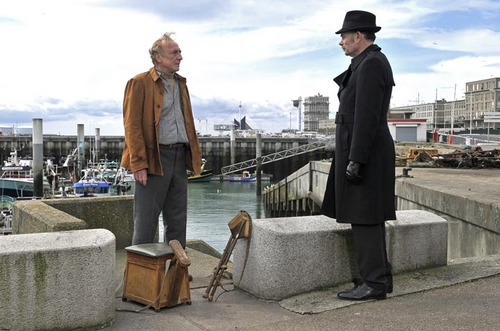
Welcome laughs, courtesy Aki Kaurismaki

Finally Cannes delivers some real laughs! This morning I saw “Le Havre” by Finnish director Aki Kaurismki, screening in competition. After several days of grim and serious films about people who lead grim and twisted lives, I wanted to cry for joy at this funny and good-hearted film. I would normally be wary of a film that anyone describes as heart-warming but this is the real deal.

Kaurismaki (“Lights in the Dusk,” “The Man Without a Past” “Drifting Clouds,” “The Match Factory Girl”) is a master of deadpan comedy. His central characters are often glum, non-verbal types and naive innocents duped by tricksters or beaten down by a world they don’t understand. The humor in his films is rooted in the deepest irony. “Le Havre” blithely portrays life as we might wish it to be, and that is the funniest irony of all.

The shoeshine man Marcel Marx is seen plying his trade at the Le Havre train station in the opening scenes of “Le Havre.” He makes very little money, and the routine of his daily walk home establishes the fact that he has an overdue tab running everywhere he stops–the bakery, the grocery store, and the corner bistro. He can be a bit of a charmer with the ladies, but his long-suffering wife Arletty (Kati Outinen, a longtime Kaurismaki regular) describes him as “a big child” when she cautions her doctor not to reveal that she is about to die.
December 14, 2012

Hush now, baby, don’t you cry

May 17, 2009–Yesterday’s most blazingly good (and funny) film was Bong Joon-ho’s “Mother,” another dark comedy from Korea. Although he had a cult hit in the U.S. with his 2006 film “The Host,” his earlier features “Barking Dogs Never Bite” and “Memories of Murder” have only been seen on the festival circuit or in cinematheques. “Mother” is very likely to open a few more theater doors in the West.

“Mother” opens with actress Kim Hye-ja, a woman beyond middle-age, incongruously dancing in a grassy field, and ends with her even more incongruously carefree dance in the aisle of a tour bus as the full effect of Bong’s narrative sleight-of-hand sinks in. He leads us on, plays with our sympathies, and makes us pay big-time for falling for Kim’s irresistibly eccentric Mom. Mom owns an herb shop in a small town, practices acupuncture without a license on the side, and lives for her grown, but not grown-up, son Do-joon, a young man blessed with a beautiful face and a dim brain. She’s doting and ditzy and given to nonsensical platitudes like “Always eat well after coming back from the police station.”

December 14, 2012

The long and winding road

The sun is finally shining, and Cannes becomes a resort town once again. Aside from the thousands of film industry visitors, this place is clogged with tourists of all nations and in all manner of beach attire, many of them senior citizens. As far as I can tell, the main thing they do is promenade.

They stroll up and down the Croisette on the waterfront side and then the window-shopping side. They walk up and down the town’s main drag, the Rue d’Antibes. They eat ice cream cones; they buy red, caramelized peanuts hot from the vendors’ pans, and gummi bears and licorice; they watch costumed mimes perform under the palm trees; and they walk their little ankle-biter dogs, of which there are hundreds. It’s a people-watching festival in itself.

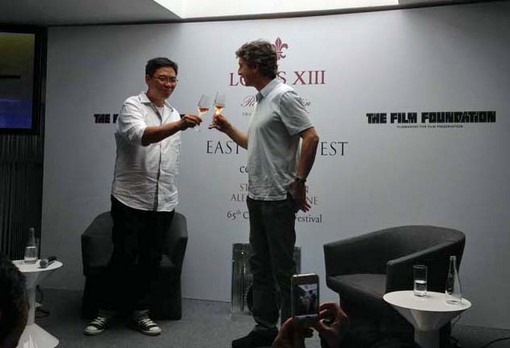
Another invitation appeared in my mailbox. This one was on heavy cream-colored paper with fancy gilt lettering. As a result, I went to “East Meets West,” an afternoon conversation between Hong Kong director Stanley Kwan, best known for “Rouge” and “Center Stage,” and Cannes jury member Alexander Payne, recent Oscar winner for “The Descendants.” Sponsored by The Film Foundation, it took place in a pavilion at the beach of the Majestic Hotel, where the sound of waves lapping at the sand in the background was a constant reminder of the setting.

December 14, 2012

And the Palme d’Whiskers goes to…

Entry to the Grande Theatre Lumiere for the press premiere of Rachid Bouchareb’s “Outside of the Law” was considerably delayed on Friday morning by heightened security. Heavily-armed members of the French National Guard were stationed in the street and on the red carpet. Water bottles were confiscated by guards; men got full-body pat-downs from head to toe; and women had bags exhaustively inspected at two different points. This was in addition to the usual electronic wanding that we are all subject to upon entering any part of the Palais.

December 14, 2012

Mysterious relationships in bits and pieces

By accident or by design, today’s films premiering at Cannes, whether in competition, in the “A Certain Regard” section, or in special screenings out of competition, revolved around relationships, good, bad, or worse. Whether the bond is with a woman who has lost the will to live, an Orca whale (both seen in “Rust and Bone”), a cheating wife-beater (“Mystery”), a ghost (“Mekong Hotel”), or a male prostitute (“Paradise: Love”), things don’t always turn out for the best.

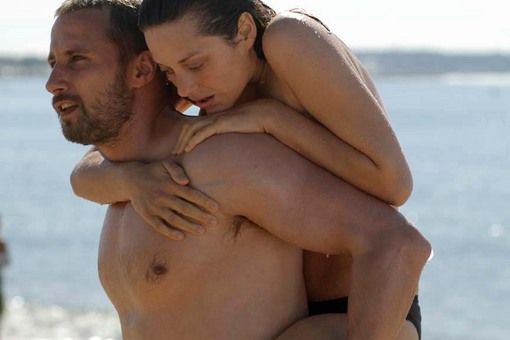
French director Jacques Audiard has enjoyed a high profile since his “A Prophet” made a splash at Cannes in 2009, winning the Grand Jury Prize. It seemed like just another prison movie to me, but others loved it. The film went on to win an Oscar nomination for Best Foreign Film and a host of festival prizes. Audiard is back with “Rust and Bone,” a star vehicle for Oscar-winning Marion Cotillard (“La Vie en Rose”) and Belgian actor Matthias Schoenaerts, who came to new visibility by starring in this year’s Oscar-nominated “Bullhead.”

I was especially looking forward to “Rust and Bone” because Schoenarts had given such a powerful performance in “Bullhead,” for which he had bulked up ala De Niro for his portrayal of a violent man whose life is defined by his steroid use. In “Rust and Bone” he’s Ali, an unemployed guy who moves to the seaside town of Antibes (just down the road from Cannes, actually) to camp out in his married sister’s garage after he’s suddenly saddled with the custody of his five-year-old son. A former amateur boxer, he gets a job as a nightclub bouncer.

December 14, 2012

Pirates of the Riviera

It’s another cool and overcast day in Cannes, but one that promises to be dominated by pirates and outlaws in the morning, and kids in the afternoon. The out-of-competition premiere European screening of “Pirates of the Caribbean: On Stranger Tides” was scheduled for the Grand Theatre Lumiere at 8:30 am. This meant that European critics would flock, but Americans like me were freed up to roam elsewhere for our viewing. For my first film I opted to walk down the Croisette to see a pirate of a very different kind in “Porfirio,” a Colombian film by Alejandro Landes, in the Quinzaine (Directors Fortnight) section of the festival.

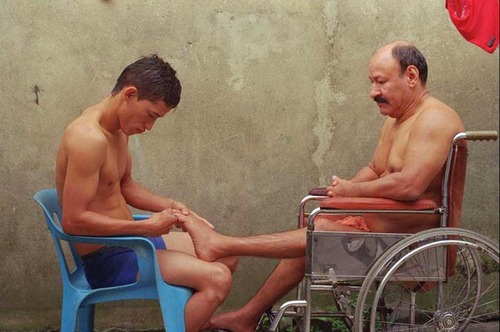
“Porfirio” is a scripted and lightly fictionalized account of the life of a man the Latin American press had dubbed “the air pirate.” Actual events reenacted in the film by non-professional actors, including the original central figure in the story, Porfirio Ramirez Aldana. Porfirio made headlines in 2005 for hijacking a plane to Bogota.

What attracted Landes to the case after reading a sensationalized newspaper account was the fact that the hijacker is paralyzed from the waist down, confined to a wheelchair, and was wearing diapers at the time. The director spent five years working with his subject and his family to develop their trust, and only revealed to the man a few days before shooting began that he would play himself.

December 14, 2012

The first slice of Cannes 2012

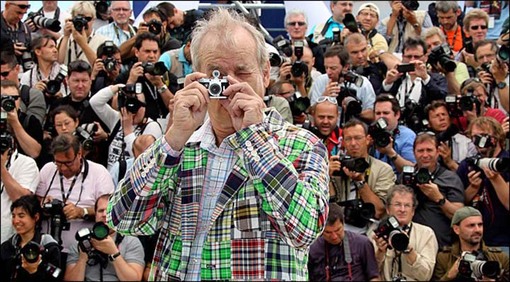
Above: Bill Murray, madras paparazzo. (AP photo)

The pizza they make in Cannes is unique: a less-is-more creation that is flat and crispy, thoroughly Mediterranean and packed with Riviera flavor. Alleged “European-style” pizzas peddled in the U. S. never seem to achieve that micron-thin crust covered by the faintest wash of tomato sauce, a mere garnish of cheese, and earthy ingredients that can include artichokes or thinly sliced eggplant, generous oregano, and tiny Cannes-grown olives (complete with pits). It’s seared in an oven at an impossibly high temperature so that that everything melds into a glorious crackly flatbread that has nothing in common with the doughy excess of American pizza.

The opening day of the 65th Cannes Film Festival is a little like that local pizza, tasty and unique, providing a full range of experiences with just a few carefully chosen ingredients. The various competition events will be in full swing starting tomorrow morning, so today functions as a bit of an appetizer.

Even as festival workers were putting the final touches on the red carpet covering the famed steps up to the Grand Theater Lumiere for tonight’s gala festival opening, the opening film, Wes Anderson’s “Moonrise Kingdom,” was previewing for the international press at the Debussy Theater next door. Although Anderson is the darling of many critics, the only film of his that I’ve previously warmed up to was his droll animated feature “Fantastic Mr. Fox.” “Moonrise Kingdom” had me enthralled from the first frame, and made me think that I need to take another look at his earlier work.

December 14, 2012

A taste of lemon, a whiff of ash…

With departure for Cannes only days away, the specter of drifting volcano ash inspires its own shivery anticipation of the festival, and not in a good way.  Cannes is a convention city year around, and a new festival or international congress moves in pretty much as soon as the previous one moves out.  It’s not like you could extend your hotel stay on the spur of the moment, and at Riviera prices, who would want to?

I’m hoping the only eruptions are of the cinematic kind.  For two weeks every May, the Cannes Film Festival is like a volcano blowing its top, spewing new movies day and night.  In view of this massive flow, it’s a rather silly insiders’ game to speculate on good years vs. bad years.   With hundreds of films to choose from, taking into account the official selections and the film market, this huge festival is what you make it.  Every year is a good year.  Looking for great art?  There’s always some to be found.  Looking for low-down-sleaze?  There’s more of that than you even want to know about.  Looking for new films from Latvia, for instance?  Take your pick, and get the scoop on the state of the Latvian film industry from an eager sales agent while you’re at it.

Every year as Cannes looms, I’m reminded of the puckish advice of British director Mike Leigh (“Happy-Go-Lucky,” “Vera Drake”), pronounced many years ago when he was on the festival jury. At the jury press conference, Leigh was asked about his expectations. “The festival is like a lemon,” he said, “you just have to suck it and see how it tastes.” As luck would have it, Leigh will be premiering his new film “Another Year” in the competition. I’m looking forward to seeing what flavor this one adds to the festival.

December 14, 2012

I have lunch with the mayor

May 20, 2009-The premiere of Quentin Tarantino’s “Inglourious Basterds” will likely dominate the international press for days. The screening itself was a bit less than a crazy event than I had been expecting. After experiencing the wild, all-out adoration of Tarantino fans at a special Cannes screening of “Kill Bill I and II” some years ago, in which the audience consisted largely of French locals, I was prepared for anything.

The guards opened the Grand Theatre Lumiere a half-hour early, and even though I arrive at 7:55 am for the 8:30 am screening, it was already half full. Mild excitement was in the air, some cheers and applause were heard as the lights went down, and another smattering of applause when Tarantino’s name appeared on the screen.

I was waiting for some kind of massive reaction at the end, but there really was nothing out of the ordinary. I’ve never been overwhelmed by Tarantino’s films, although the crazed eclecticism of his work is a lot of fun. “Inglourious Basterds” worked for me as a satisfying whole better than most of his other films. He pulls together everything in his arsenal: action, extreme violence, misogyny, film history, pop music and pop culture, and a plot based on a wild premise that rewrites history.

December 14, 2012

Sex, death, rape, murder:Just another day at the movies

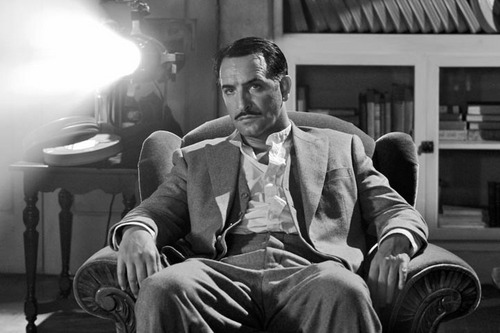
Following a heavy rain in the late afternoon yesterday, this morning in Cannes was gloriously sunny, the sky becoming more perfect and cloudless as the day progressed. I was hoping for a group of films to blow away yesterday’s prevailing images of poverty, oppression, and child abuse. “The Artist” by Michel Hazanavicius, screening in competition, seemed like it could do the trick. It’s a romance set in Hollywood; and strangely enough, it’s conceived as a silent film.

“The Artist” has the most self-congratulatory press kit I’ve ever seen–55 glossy illustrated pages of in-depth interviews with all the key figures involved with the production, everyone congratulating and complimenting everyone else for their fabulous work. Could the film measure up to this? Not hardly. It is indeed a black-and-white silent film with musical accompaniment. Director Hazanavicius has attempted to revive the techniques of the silent cinema to tell a story entirely through acting, with text intertitles replacing spoken dialogue.

December 14, 2012

Window shopping: Best show in town

Window-shopping is daily the source of one of the best free shows in Cannes. There’s nothing quite like walking around this town, even if it’s just a brief walk between screening rooms, and ogling what could be bought if you had millions of dollars at your disposal: the most extravagant flower arrangements, the most colorful and sumptuous pastries, piles of diamond necklaces, strapless cocktail dresses with skirts of white marabou feathers or silver palettes, ice-cream-pastel Chanel suits with glittering sequin trim.  The loot of the world’s fashion runways is displayed in all its theatrical and expensive glory in the shops that face the Croisette, and most of these outfits would look outlandish anyplace but right here in Cannes.

December 14, 2012

Tree of Life: Lyrical, spiritual, kitsch

Terence Malick’s long-awaited “The Tree of Life” premiered in competition today, with an 8:30 am press screening. I anticipated seething crowds, so headed off to the Palais a little early. Entrance areas were jammed, and the Grand Theatre Lumiere was nearly full at only 7:55 am. A friend who had been holding a seat for me estimated that he had been about 200th in line when arriving at 7:30 am.

“The Tree of Life” was announced for last year’s Cannes festival, but withdrawn when it wasn’t completed in time. Although Malick has directed only four features in his more than 40-year career as writer/producer/director (“Badlands,” “Days of Heaven,” “The Thin Red Line,” and “The New World), his cult reputation is such that many here were itching to declare “The Tree of Life” a masterpiece before the first frame ever hit the screen.

I think at least a few hopes were dashed this morning. As the film reached its conclusion there was a fadeout that turned out to be a false ending. People immediately jumped to their feet to exit in the dark, as always happens here, and a few dozen loud boos erupted from points all over the theater. Another image came on and those leaving stopped in their tracks and fell silent until Malick’s director credit appeared. Applause followed, along with an equal amount of booing.

December 14, 2012

Iranian filmmakers take center stage

May 18 — Some Cannes traditions never die. In the years I’ve been coming to the festival, the same music has been playing in the Grand Theatre Lumiere before the early morning press screening. It’s always jazz, and it always seems to be the same selection every morning, every year. I’ve started to imagine that there’s some ancient reel-to-reel tape recorder in a distant control booth, and that a guard is assigned to rewind and start the old tape at 8:00 am each day.

Sound or more specifically, language is central to Jean-Luc Godard’s “Film Socialism.” Roger has commented so thoroughly on that film that I’m not going to add much, except to say that Godard remains one of the grand tricksters of world cinema. With his French dialogue, minimal and cryptic subtitles in so-called “Navajo English” (this in itself seems a tongue-in-cheek fiction on his part), and bits of a few other languages thrown in, he creates a Babel that I believe was made to baffle and intrigue one and all, no matter what your native tongue. It’s a kind of rarefied fun to try to decipher, and maddening at the same time. Meanwhile, Godard the magician, like the wizard in “The Wizard of Oz,” gets to hide behind his screen, sending out big ideas and big images.

Above: Abbas Kiarostami (AP photo)

December 14, 2012

Palme d’Or loves “Amour”

The 65th Cannes Film Festival’s eleven days of prediction, wild speculation and gossip, some of it centering on the notoriously cranky personality of this year’s jury president Nanni Moretti, came to an end Sunday evening in festival’s business-like awards ceremony (or Soiree de Palmares, as the French call it) that traditionally lacks the extended let’s-put-on-a-show aspect of the Oscars. The jury was seated onstage in a solemn group, and the awards given with a modest amount of fancy-dress formality, a bit of unrehearsed fumbling, and acceptance speeches that were short, dignified and to the point.

The foul weather that has marred the usually sunny festival continued to the end, and elite guests and movie stars alike walked a red carpet tented by a plastic roof as the rain fell on the multi-colored umbrellas of the surrounding crowds. Festival director Thierry Fremoux personally held an umbrella for Audrey Tautou, star of Claude Miller’s closing night film, “Therese Desqueyroux,” as she headed up the famous steps in a calf-length ivory lace gown with a bodice heavily embroidered in gold.

Actress Berenice Bejo, an international sensation since her starring role and subsequent Oscar nomination for “The Artist,” performed mistress of ceremonies duties in a white, bridal-looking strapless sheath with long train, her only jewel an enormous heart-shaped emerald ring. Just about the only prediction this year that turned out to be accurate was the one that advised that all was unpredictable under the jurisdiction of the pensive and often-scowling Moretti.

December 14, 2012

Overturning expectations: The ups and downs

May 16 — Sunday was a day of highs and lows, of new discoveries and dashed hopes. Bertrand Tavernier and Takeshi Kitano, two directors whose films I had most anticipated here, did not live up to my expectations with “The Princess of Montpensier” and “Outrage,” respectively. Hungarian Agnes Kocsis, a director who had only made one previous feature in 2006, blew me away with her insightful “Adrienn Pal.”

December 14, 2012

Almodovar’s limp noodle, Panahi’s home movie

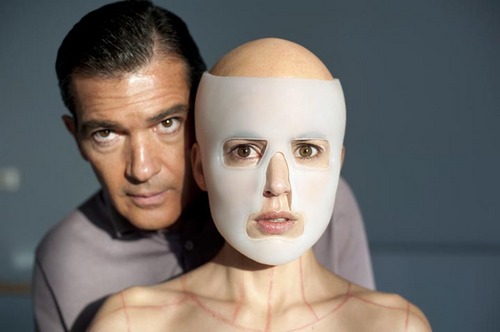
This morning, Pedro Almodovar, Spain’s biggest big-cheese filmmaker, handed us a limp noodle with “The Skin I Live In,” his entry in the Cannes competition. The film stars Antonio Banderas (who began his career in Almodovar’s early films) and Elena Anaya, who looks like a cross between Penelope Cruz and Audrey Hepburn. Even a second-best Almodovar film has its delicious moments, but “The Skin I Live In” is flat compared with his best work, including “Broken Embraces,” “Volver,” and his Oscar winner “All about My Mother.”

Typical of Almodovar, the film is a melodramatic farce. Although it’s based on the novel “Mygale” (“Tarantula” in English) by Thierry Jonquet, the story is also strongly reminiscent of the 1960 French horror classic “Eyes without a Face” by Georges Franju. In the Franju film, a surgeon kidnaps women in order to graft their faces onto the head of his disfigured daughter. In “The Skin I Live In,” a plastic surgeon is engaged in highly experimental work in order to create synthetic skin as a tribute to his dead wife, who was burned to death in a car crash. He subsequently uses the results of his research in service of a unique punishment for his daughter’s rapist.

This story has a lot of twists, and the element of surprise is important. I don’t want to give away too much, especially since it’s due to open in the U.S. in the fall. I haven’t read “Mygale,” but I understand that the narrative is fragmented into sections that all come together in the end. In this, Almodovar appears to have followed the structure of the book, perhaps too closely. One of the principle weaknesses of “The Skin I Live In” is that the story is scattered in pieces. Characters and subplots are introduced then dropped. They are loosely but not completely tied together in the end.

December 14, 2012

TIFF #4: Darwin walks out on Genesis

During the first press screening here of “Creation,” during a scene when Charles Darwin walks out of church during a sermon on the first book of Genesis, an audience member stood up and walked out. Was he offended by the film? There’s no way to say. There were an unusually large number of walk-outs, but who knows if they were leaving for theological reasons, or to get in line for the screenings of “Bright Star” or “Fish Tank,” or because of boredom? I hope it wasn’t boredom. Although it’s a movie with a good deal of talk, at least no one shouted out, “You lie!”

Charles Darwin as Paul Bettany

This will adamantly not be a review of “Creation,” which will await its opening. It will be a discussion of some of the thoughts it inspires. I expected the film to be focused on Darwin’s theory of the origin of species and the controversy it provoked in mid-19th century, but it is primarily about his domestic life, centering on Down House, Bromley, where he and his wife Emma lived from 1842 until until his death in 1882.

December 14, 2012

Cannes #5: Waiting for Godard

When I began as a film critic, Jean-Luc Godard was widely thought to have reinvented the cinema with “Breathless” (1960). Now he is almost 80 and has made what is said to be his last film, and he’s still at the job, reinventing. If only he had stopped while he was ahead. That would have been sometime in the 1970s. Maybe the 1980s. For sure, the 1990s. Without a doubt, before he made his Cannes entry, “Film: Socialisme.”

The thousands of seats in the Auditorium Debussy were jammed, and many were turned away. We lucky ones sat in devout attention to this film, such is the spell Godard still casts. There is an abiding belief that he has something radical and new to tell us. It is doubtful that anyone else could have made this film and found an audience for it.

December 14, 2012

TIFF #6: Oy vey, such a film you should see

There is something about the Jewish way of humor and storytelling I’ve always found enormously appealing. I memorized material by Henny Youngman and Myron Cohen at an age when, to the best of my knowledge, I had never met a Jew. I liked the rhythm, the contradiction, the use of paradox, the anticlimax, the way word order would be adjusted to back up into a punch line. There seemed to be deep convictions about human nature hidden in gags and one-liners; a sort of rueful shrug. And the stories weren’t so much about where they ended as how they got there.

The serious man is consoled by the friend who has stolen his wife

December 14, 2012

TIFF #5: The man who didn’t land

It was two years ago on Saturday night that Jason Reitman’s “Juno” had its world premiere here at Toronto. The standing ovation that night was the most spontaneous and joyous I can remember. Still vibrating, Reitman stood on the stage of the Ryerson Theater and vowed, “I’m gonna open all of my films right here in this theater at Toronto.” True to his word, his new film “Up in the Air” played the Ryerson at 6 p.m., Saturday–same time, same place.

It stars George Clooney in one of his best performances, as a frequent flyer. His ambition is to pass the 10 million-mile mark in the American Airlines Aadvantage Program, something very few ever do. Asked on an airplane where he lives, he replies, “Here.” He’s a Termination Facilitator. He fires people for a living. When corporations need to downsize quickly, he flies in and breaks the news to the new former employees. In a lousy economy, his business is great.

December 14, 2012
subscribe icon

The best movie reviews, in your inbox