Opening Shots: Army of Shadows

View image

View image

From: Andy Horbal, Mirror/Stage:

“Army of Shadows” actually begins with an epigram: “Unhappy memories! Yet I welcome you… you are my long-lost youth… “

Perhaps a French person would immediately recognize the film’s subsequent opening shot as the ultimate unhappy memory, but it took a bit longer for this American viewer to grasp the significance of what he was seeing. The transition from a black screen with white letters to the Arc de Triomphe towering over a frame also marked by a pallid, even sickly, gray morning light is like the shock of abruptly waking up in the middle of a dream. The sound of marching drifts in from somewhere offscreen. …

View image

After a few seconds a column of soldiers emerges from the left of the frame. Dwarfed by the monument, they look like a line of black ants. A few more seconds and the cadence of their footfalls (which seem to grow steadily louder and more ominous) is joined by the sound of a military march. The beginning of the column reaches the middle of the Arc and sharply pivots right towards the camera, towards us.

December 14, 2012

Helvetica is the movie font

See more (“Up in the Air,” “Little Miss Sunshine,” “Madea Goes to Jail”) at The Auteurs, where Adrian Curry writes:

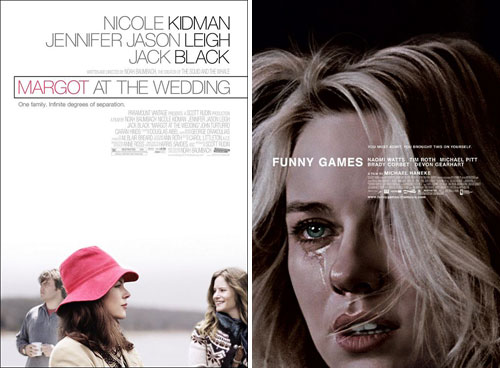
Two of my favorite posters of recent years, those for “Margot at the Wedding” (2007) and “Funny Games” U.S. (2008) both used versions of Helvetica to great effect. “Margot” used a stylish Neue Helvetica Thin in pink, with the actors’ names in the same size and type as the title, while “Funny Games” uses an unusually small point size for a movie poster title to great effect.

See “Why the Helvetica is Trajan the movie font?” from 2007.

December 14, 2012

Oh no! The secret is out!

A trio of guys try and make up for missed opportunities in childhood by forming a three-player baseball team.

A serious breach of security has ripped through the movie industry. Somehow, some way, a critic in Florida (of course) got in to see “Benchwarmers” — and leaked it to the press! Well, OK, so maybe that shouldn’t be considered much of an intelligence leak (more like a diaper leak), but it happened to Roger Moore of the Orlando Sentinel, and he’s going public about it. On his blog, Frankly, My Dear…, Moore says he got an invitation to a screening Monday night at a local theater, where seats were saved for the press. It seems the regional Sony publicist had forgotten to inform him that the press had been uninvited. (He should have read Scanners last week!)

December 14, 2012

The Cheeseburger Phone

View image John Amos in “Coming to America.”

From Odienator’s Black History Mumf love-fest for Eddie Murphy’s “Coming to America” at Big Media Vandalism, “You Ain’t Never Met Martin Luther The King.”

His caption for this photo : “Yeah, Juno got that hamburger phone idea from me. Bitch ain’t even give me credit, neither, Florida!” (Please note: The man’s bun has no seeds.)

Writes Odie:

“Coming to America” may be the Blackest comedy ever made, and it’s little touches like McDowell’s [the low-rent, individually owned McDonald’s knock-off] that elevate it past the mild amusement it seems to garner from White viewers into the upper echelon of hilarity it occupies for us. It crushes us under the weight of familiarity, to the point where a musical cue or a mere image is enough to inspire raucous laughter. There are so many in-jokes that the film is like an old Negro Spiritual: everybody can hear the music, but only we can understand the code in the words.

December 14, 2012

Another take on the Coens & “No Country for Old Men”

View image A way of perceiving the world.

Critic Richard T. Jameson writes about the Coen brothers’ body of work at MSN Movies:

There are hundreds of things thrillingly right with “No Country for Old Men,” the new film from Joel and Ethan Coen, and the temptation to describe a few dozen of them must be resisted at this time. But let’s allow ourselves just one, from early in the movie.

A Texan named Llewelyn Moss (Josh Brolin) has left his trailer-park home in the middle of the night, climbed into his pickup, and driven to a remote area where, the previous day, he happened upon a grisly scene. Moss pulls his truck right up onto the rim overlooking the place, gets out, and starts walking down into the gully where the bad thing happened.

Never mind what he’s up to, especially since he may not be entirely sure himself. He’s come to a lonely and dangerous location where a shocking number of people got themselves killed, and as he descends, somehow it matters that the filmmakers keep his truck in view behind him, crisply silhouetted on the rim. It’s a small thing, but so satisfying. It means that whatever happens down below, Moss still has a way out, a way back to the rest of the world.

But it also means more, is more. Just the sight of the truck is peculiarly thrilling. The truck is unquestionably real, not a special effect, yet there’s a preternatural vividness about its stark black outline against the charcoal night sky. Cinematically, it’s too good to be just a truck — it’s the corner of a pattern yet to be disclosed. And a minute later, after Moss has discovered a gruesome new dimension to the scene in the gully, he looks back up at the rim and sees that alongside the truck’s silhouette is that of another vehicle. And the silhouettes of men who now almost certainly will come to kill him.

I submit that such cinematic moments define the Coens’ artistry, beyond any ideological agendas imposed upon them from the outside.

RTJ (who put “Miller’s Crossing” on the cover of Film Comment when he was the editor of that publication) cites three examples from “Blood Simple” that matter to him, and explains why:

[They] could be found art, shards of experience and texture glimpsed where they lay. What all share is the joy of, “We get to do this” — to put into a film the kind of accidental, trivial, evanescent, but piercingly evocative detail we’ve all noticed, while walking along a lane or registering the tricks of perspective when looking out of a moving vehicle, and thought, “Somebody ought to put that in a movie sometime.”

The Coens put stuff like that in movies all the time. That’s one of the best reasons for valuing them, and for not being stampeded by those critics — professional and amateur — who decry them as heartless ironists and mere connoisseurs of the grotesque.

Given what the Coens’ best movies do, I find the most common and predictable criticisms of them beside the point — like complaining that Jackson Pollack didn’t paint recognizable figures: “Hey, are those supposed to be portraits or landscapes or still lifes? Who’s this guy trying to fool?”

But I think it may come down to one’s view of the world (and of cinema), and whether you recognize it in their films or not. Some of us find beauty and meaning in the absurdity and incongruousness of life, and the ways the Coens capture and shape it; others see only ugliness and amorality that does not conform to their experience (or their view of themselves), so they reject it with disgust and contempt. Both, I suppose, may be understandable responses, as long as they’re acknowledged for what they are. But there’s evidently no bridging the two…

December 14, 2012

Movies 101: Opening Shots Project

“Barry Lyndon” opens with a bang.

Any good movie — heck, even the occasional bad one — teaches you how to watch it. And that lesson usually starts with the very first image. I’m not talking necessarily about titles or opening sequences (they’re worth discussing, too — but that’s another article); I’m talking about opening shots. As those who have been reading Scanners (and my Editor’s Notes on RogerEbert.com) know, two of my cardinal rules for movie-watching are:

1) The movie is about what happens to you while you watch it. So, pay attention — to both the movie and your response. If you have reactions to, or questions about, what you’re seeing, chances are they’ll tell you something about what the movie is doing. Be aware of your questions, emotions, apprehensions, expectations.

2) The opening shot (or opening sequence) is the most important part of the movie… at least until you get to the final shot. (And in good movies, the two are often related.)

The opening shot can tell us a lot about how to interpret what follows. It can even be the whole movie in miniature. I’m going to talk about some of my favorites, and how they work, and then request that you contribute your own favorites for possible publication in future Scanners columns.

December 14, 2012

The 100 Greatest Directors of… what?

View image Number 74.

I was not familiar with TotalFilm.com, until I spotted a link over at Movie City News.

Thanks a lot, guys.

The link was to a pair of articles listing Total Film’s choices for “The Greatest Directors Ever” Part 1 (100 – 49) and Part 2 (50 – 1).

Will I return to this site? I think probably not. Why am I linking to it now? Because it’s my shameless attempt to stimulate discussion, which I hope will be on a more informed level than this list. Or maybe it’s just to have a laugh. Or a moment of sadness. What do I think of the list itself? Well, let’s see:

Baz Luhrmann is #97.

Tony Scott is #74, just edging out Milos Forman, Kenji Mizoguchi, Satyajit Ray, Carl Theodor Dreyer, and Buster Keaton, who comes in at #88.

Bryan Singer is #65, two slots below Robert Bresson, who immediately follows Sam Raimi.

Rob Reiner is #35.

Michael Mann (#28) is on the list, but Anthony Mann is not.

Bernardo Bertolucci is… not on the list.

Otto Preminger is… not on the list.

Richard Lester is… not on the list.

Rainer Werner Fassbinder is… not on the list.

Max Ophuls is… not on the list.

George Cukor is… not on the list, but George Lucas (#95) is.

Andrei Tarkovsky is… not on the list.

Eric Rohmer is… not on the list.

Claude Chabrol is… not on the list.

Luchino Visconti is… not on the list.

Vittorio De Sica is… not on the list.

Michelangelo Antonioni is… not on the list. Not even the top 100.

What’s worse are the little names they have for each director. Sophia Coppola (#99) is “The dreamer” (“Dreamy, brave and cool, this Coppola is doing it for herself”). Singer is “The new Spielberg.” Robert Altman (#26) is “The outsider” — oops, but so is Hal Ashby (#58). Somebody ran out of labels. Well, at least they are not outside all alone; they are outside together. Sam Fuller (#50) is “The hack.” Mike Leigh (#49) is “The grouch.” Quentin Tarantino (#12) is “The motormouth.”

OK, that’s enough. Have at it if you feel like it. If you don’t feel like it, you’ll probably live.

ADDENDUM: A reader, spleendonkey, describes TotalFilm as a British magazine aimed at teens and pre-teens, designed to broaden their film horizons. For the record, here’s the mag’s description of itself on its subscription page:In 2007, Total Film celebrates its tenth year of being the only film magazine that nails a monthly widescreen shot of the whole movie landscape. It’s the essential guide for anyone who’s passionate about movies – whether they’re into Cruise or Cusack, Hollywood or Bollywood, multiplex or arthouse, popcorn or – er – sweetcorn. Each issue is pumped full of reviews, news, features and celebrity interviews on all the latest cinema releases. The all-new home entertainment section, Lounge, is the ultimate one-stop-shop for everything you should care about in the churning world of DVDs, books, videogames and, occasionally, film-related novelty furniture. The mag regularly features highly desirable, Ebay-friendly FREE stuff – exclusive film cells, posters, postcards, DVDs… We’re currently in discussions with Health & Safety operatives about sticking a magical compass to the cover when “His Dark Materials” comes out. Subscribe to Total Film now, or forever be belittled by precocious children in discussions about what’s best and worst in movieland.Doesn’t sound all that different from Entertainment Weekly to me, but there you go…

December 14, 2012

Products of mass distraction (or, Hooray for elitism!)

Revisiting Dwight Macdonald’s famous essay, “Masscult & Midcult,” and other ideas old and new — continued from “When ‘I get it!’ means ‘I don’t get it!’ and vice-versa.”

“It seems to me that nearly the whole Anglo-Saxon race, especially of course in America have lost the power to be individuals. They have become social insects like bees and ants. They are lost to humanity, and the great question for the future is whether that will spread or will be repulsed by the people who still exist…”

— Roger Fry (1866-1930), from a letter quoted “Roger Fry,” a biography written by Virginia Woolf(1940); also quoted by Dwight Macdonald in “Masscult & Midcult”

A while ago I added to the epigraphs in the upper right corner of this page a quotation from writer-actor-director Tom Noonan that echoed something I had long felt to be true, but had never articulated: “I don’t think you go to a play to forget, or to a movie to be distracted. I think life generally is a distraction and that going to a movie is a way to get back, not go away.” I don’t feel that way very often anymore; gone are the days, when I was first discovering the richness of the still very young art of film, when I might see several masterpieces in a week, or even a day — in classes, film series, rep houses, art houses, mainstream cinemas or on TV. But I was inclined to feel that movies,the art form of my time (and literature, music, art of all kinds), brought me closer to my own life by focusing my attention on what it means to be alive. Like millions of others, I found the only religion in which I could whole-heartedly believe in movie theaters, libraries, bookstores, and concert venues.¹

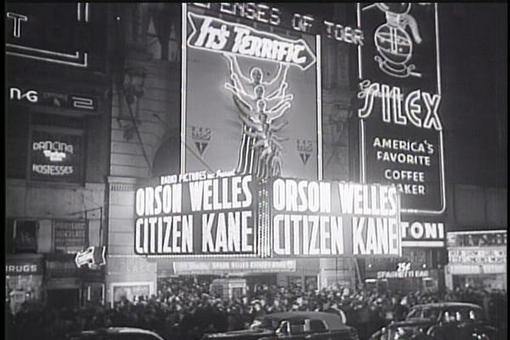
In “Masscult & Midcult” (1962), published when “Citizen Kane” was as old as “GoodFellas” and “Miller’s Crossing” are today, Dwight Macdonald contends that art (movies included) no longer seeks engagement with an audience, but is content to serve as another opiate of the masses: “The production line grinds out a uniform product whose humble aim is not even entertainment, but merely distraction.”

December 14, 2012

VIFF #3: Almodovar gets skin deep

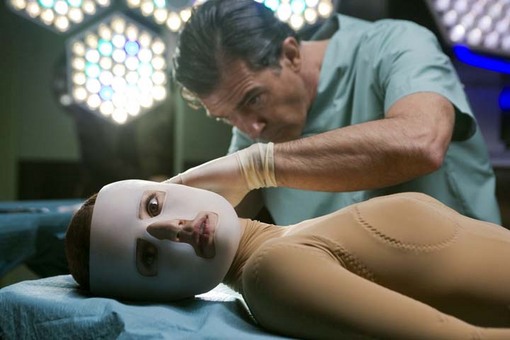
Pedro Almodovar’s movies are so beguiled by lustrous surface textures and colors (fabrics, hair, makeup, architecture, upholstery, jewelry) that the title “The Skin I Live In” (or “The Skin That I Inhabit,” as I’ve seen “La piel que habito” translated elsewhere) would serve well as the name of his artistic autobiography. It’s a shimmering horror-farce-melodrama quilted together from scraps of Georges Franju’s 1960 “Eyes Without a Face,” Andre de Toth’s 1953 “House of Wax” (without the one-eyed 3D) and Douglas Sirk’s 1954 “Magnificent Obsession” and 1959 “Imitation of Life” — though it doesn’t stop there — about a mad doctor, a pioneering plastic-surgeon Dr. Frankenstein named Robert Ledgard (Antonio Banderas, of course) whose personal life has been scarred by tragedy.

That’s all I’m going to say about the plot because stitching together all the parts is so much of the pleasure of watching the movie. It begins in the middle, folds back to fill in a few mysterious spots in the patchwork, and then unpredictably pieces together the rest of the picture, bit by bit, for an absurdly touching and tentative finish.

December 14, 2012

Yes, gayer than “Dreamgirls”

I saw “Top Gun” in 1986 when it came out (as it were), with a few friends, one of whom was gay (still is) and who said before the credits were over: “This is the gayest movie I’ve ever seen.” Eight years later, in “Sleep With Me,” Tony Scott fan Quentin Tarantino explained it all for us. In this YouTube clip (beware the f-word — it’s Tarantino talking), QT’s exegesis is illustrated for the first time with actual clips from “Top Gun.” And remember: This was years before “Don’t Ask, Don’t Tell.”

(Thanks to MCN.)

December 14, 2012

Comedy of Doubt

John Patrick Shanley’s comical film of his four-character Pulitzer-winning play “Doubt” is a flamboyantly theatrical sermon on the virtues of conviction. It should be seen in conjunction with a reading of Malcolm Gladwell’s best-selling “Blink” because, no matter what the dialog may tell you, it’s more an affirmation of gut instinct than an exploration of the title commodity.

You can see why all the adult principals — Meryl Streep as Sister Aloysius, Philip Seymour Hoffman as Father Flynn, Amy Adams as Sister James and Viola Davis as Mrs. Miller — have been nominated for Oscars (but is Hoffman’s a supporting performance or the male lead?). This is juicy stuff, played to the hilt as you’d expect — and as much for laughs as for melodrama (which I hadn’t expected, but which came as a happy surprise).

If it remains more of a theatrical experience than a cinematic one (despite being photographed by Roger Deakins), that’s probably because Shanley’s ambitions are limited to delivering the “movie version” of his own hit play. I can imagine “Doubt” working more convincingly in the abstract setting of the stage (though I haven’t seen it performed that way), where it sported the subtitle: “A Parable.” But there’s no doubt it’s a bake-sale bonanza for the movie actors, who give overtly stylized performances in realistic settings, all goosed-up with stage flourishes — thunderstorms and balcony-pitched arias and surprise entrances and exits timed to build tension and frustrate satisfaction. (It’s said Shanley added some of these devices just for the movie — which, if you think about it, is you might expect somebody with an intrinsically theatrical sensibility to do to “open up” a play for film.)

What I didn’t expect was the outlandishly broad comedy of Streep’s “The Devil Wears a Bonnet” performance. I think that is probably a compliment, and I don’t think she’s getting enough credit for how funny she is. “Doubt” may be a work that touches on Serious Issues (sex abuse in the church, the evils of gossip, the weighing of greater and lesser sins, the obligations of that come with intuition and experience — and the paradoxes of doubt) but it’s also by the guy who wrote “Moonstruck” and “Joe Versus the Volcano.” Streep attacks it with sketch-comedy gusto, and there were whole scenes, memorably the inspection of Sister James’ classroom and the high-voltage showdowns between Sister Aloysius and Father Flynn, when I couldn’t stop chortling like a schoolboy. I don’t believe my laughter was inappropriate:

Flynn: “Where’s your compassion?”

Aloysius: “Nowhere you can get at it.”

That’s a doozy of a punch line, and Streep knows it. (If I’m wrong about that, then there hasn’t been a performance this misconceived since Faye Dunaway in “Mommie Dearest.”)

But where does the “doubt” come in?

December 14, 2012

Robert Altman (1925-2006): Moments

View image The Dangerous Woman pays a final visit — with a smile. From the ending of “A Prairie Home Companion” (2006).

I’m off this week, but I needed to personally acknowledge the death of Robert Altman, the first great director I ever met, and the filmmaker whose work (particularly “Nashville,” “3 Women,” “The Long Goodbye” “California Split” and “McCabe and Mrs. Miller” — all of which were originally released, and encountered by me, when I was in my ultra-impressionable teens), most inspired my love of movies and my determination to devote my life to them. I first met Altman in person when I was 18 or 19, in the living-room-like lobby of the Harvard Exit Theatre in Seattle at the world premiere of “3 Women” (or, possibly, Alan Rudolph’s “Welcome to L.A.”). He was standing by the grand piano, by himself, and I, shaking and sweating, forced myself to go over and talk to him. He spoke back. I couldn’t believe it: To me, it a “Sherlock, Jr.” moment, as if I’d somehow passed through the screen and was interacting with someone on the other side. Over the next 20 years or so, I would interview him a number of times in a professional capacity, and I relished these sharp, thoughtful, intelligent, funny conversations. I don’t remember much of anything about that first chat, though, except that my end of the exchange would not be described by any of the adjectives in the previous sentence. But it had a huge impact on me.

View image

Two anecdotes: 1) Shortly before the release of “The Player,” when I was working in Los Angeles, I went to interview Altman — I think it was at the Beverly Hills Hotel, or maybe the Chateau Marmont, I’m not sure. When I arrived, Altman was on the phone with Fine Line, cussing them out about the advertising budget. I was talking to the publicist about my trip to Europe, from which I’d just returned, and saying how I found it exhilarating and liberating to be in a strange city, and to be out in public, and not understand the conversations that are taking place all around you.

View image

The instant Altman got off the phone he practically leapt to the other side of the room: “I heard what you were saying about being in Europe and that’s exactly the way I’ve felt! I lived in Paris for years and never learned French. You realize there’s just so much extraneous bullshit you don’t have to listen to if you don’t know the language!”

This from the man who pioneered the multi-track Lions Gate Sound System, and whose movies are known for their almost contrapuntal background dialog (wrangled, in some of the ’70s films, by assistant director Rudolph), finely tuned babble that picks up on little bits of character from the edges of the frame (or even beyond it) and makes a scene come to life as an immersive experience.

2) Years later, at a then-rare screening of “Nashville” I attended at the Walter Reade Theater in New York (yes, by the mid-to-late-1990s it was virtually impossible to find a showable 35mm print of “Nashville,” one of the greatest films of all time), actor Scott Glenn (who played Pfc. Glenn Kelly) told a story about how the actors were individually miked and, in crowd scenes, often didn’t even know if they were within the scope of Paul Lohman’s wide-screen Panavision frame.

“How will I know if I’m on camera?” Glenn recalled someone asking.

“You won’t,” Altman said. “Just do something interesting and you might end up in the picture.”

* * * *

Roger Ebert’s Altman Home Companion: Reviews and Interviews with Robert Altman, 1969-2006

Richard T. Jameson’s appreciation of Altman at MSN Movies

Dennis Cozzalio: Goodbye, Mr. Altman

Matt Zoller Seitz’s 2006 Altman Blog-a-Thon, with many links here and here and here.

Keith Uhlich: Robert Altman (February 20th, 1925-November 20th, 2006)

David Hudson at GreenCine compiles Altman tributes

UPDATE: 11/22/06: A.O. Scott has the finest Altman obit I’ve seen in the MSM, using the ending of “California Split” as a way of discussing Altman’s career:

Mr. Altman thrived on the shapelessness and confusion of experience, and he came closer than any other American filmmaker to replicating it without allowing his films to succumb to chaos. His movies buzz with the dangerous thrill of collaboration — the circling cameras, the improvising actors, the jumping, swirling sound design — even as they seem to arise from a great loneliness, a natural state that reasserts itself once the picture is over. A makeshift tribe gathers to produce a film, or to watch one, and then disperses when the shared experience has run its course. Everyone is gone, and the only antidote to this letdown is another film….

But if [“A Prairie Home Companion”] was a last gathering of the troupe, after which the lights dim forever, and the audience disperses, it was also just another movie in a career like no other, and when it was over — in the ending I like to imagine — American cinema’s greatest gambler shrugged his shoulders and walked away.

December 14, 2012

QT, the critics, the ‘fanboys’ and the best movies ever

From a Quentin Tarantino interview with Ella Taylor in the Village Voice:

Film criticism is in a strange place. Talk about 17 years later! [After “Reservoir Dogs.”] I could never have imagined that print film reviewing would be dying. It’s unfathomable to me. I don’t like reading film criticism on a laptop. I like holding it in my hand.

You’re a geezer, Quentin.

Exactly. It seems to me from reading a lot of the film criticism that came out of Cannes this year that the few print critics that are left writing are so busy combating these Internet bozos that there’s a new formalism, a new self-seriousness among remaining critics, to prove they’re professionals. Even some of the younger critics who are still writing in print–well, they’re not that young–are coming across like young fogies. There are some good online critics, but then there’s these fanboy types: “Ooh, this sucks balls.” It’s a little bit like ’78, ’79, ’80, where exuberance in filmmaking is not getting its due anymore. For example, “The Blues Brothers” never got any respect. Now, it truly is beloved, as it goddamn well should be. I mean, it’s sad to think of what happened to John Landis after “An American Werewolf in London,” but in those two movies, he was the first fanboy director making movies out of his head.

And, regarding his favorite movies of all time in life:

I can tell you now. This got picked up on from [your] piece [17 years ago] for the next five years, those top three in particular: “Taxi Driver,” “Blow Out,” and “Rio Bravo.” I’ve changed. I know I was cagey about it before, but my favorite movie of all time is “The Good, the Bad and the Ugly.” That’s the best movie ever made. I can’t even imagine myself doing better; that’s how much I love it. I would also throw “His Girl Friday” in there. The fifth will always be however I feel at the moment. So I’ll throw in “Carrie,” give De Palma a shout-out.

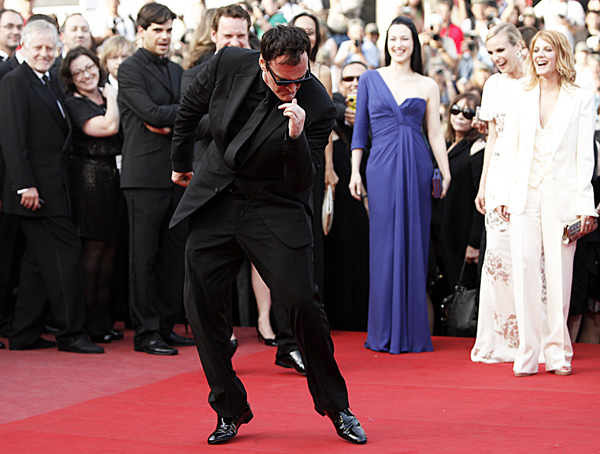
(Above: Tarantino dances up the red carpet at Cannes, 2009. AP photo.)

December 14, 2012

Critics analyze sex & symbolism in uncut HBO debate

… and what was that ending supposed to mean?

WARNING: HBO-rated profanity and imagery discussed — including language previously restricted to top-level government officials, mostly during the Nixon and Cheney administrations.

(tip: Andrew Sullivan)

December 14, 2012

Arthouse suspense: My month with Abbas and Joe

For the last month, I’ve been watching almost nothing but Abbas Kiarostami and Apichatpong Weerasethakul movies — and it’s been the best run of good-to-great movie-watching I’ve had in years. How did this happen? Well, I was beguiled by their most recent pictures: Kiarostami’s “Certified Copy” and Weerasethakul’s “Uncle Boonmee Who Can Recall His Past Lives” — both prize-winners at last year’s Cannes Film Festival (best actress for Juliet Binoche, and the Palm d’Or, respectively). For reasons I’ll get into in a bit, the only Kiarostamis I’d seen before were two of his biggies, “A Taste of Cherry” (1997) and “The Wind Will Carry Us” (1999); and the only Apichatpong (just call him “Joe”) movie I’d seen was “Blissfully Yours” (2002).

The films of both these directors have been widely (mis-)characterized as “difficult” (please see Girish Shambu’s excellent rumination on that term here, if you haven’t already), but that’s not why it’s taken me so long to familiarize myself with more of their work. I don’t have any good reasons, but I’ll be honest: I was put off by the critical hype for Kiarostami, which in the art-cinema world was exceeded (in my perception) only by that for Quentin Tarantino in the pop-art-cinema world. Also, I remember the press screening for “The Wind Will Carry Us” at the Toronto Film Festival and, during the final shot (which was nice but a little too on-the-nose for me), a critic behind me let out a rapturous sigh intended to be overheard by everyone in the vicinity: “Masterpiece!” I admit (I’m only human) that made me a little nauseous, and some of my critic friends who were much more involved in the festival scene than I was at the time were outspoken Kiarostami naysayers, so I didn’t feel particularly motivated to seek out more of his work.

December 14, 2012

The Cruise-ible

Tom Cruise with his “Miiii” squeeze.

What do we talk about when we talk about Tom Cruise? What are our images of him really based upon, besides his own publicity stunts and some headlines? And just how did the top movie star in the world become so unlikeable in the public eye, an object of scorn and derision in the media, and a punch line for stand-up comics? Normally, a movie star’s fall from gross — er, grace — wouldn’t interest me much (although I am still trying to figure out how Burt Reynolds’ 1970s career flamed out). I’ve interviewed hundreds of actors and filmmakers over the years and I’ve always made it a personal policy never to ask them, or speculate in print, about what they euphemistically call their “private lives,” mainly because I really don’t think it’s any of my (or your) business. I’m interested in their work, not in what they do in their off hours.

But the fascinating thing about Cruise is how he’s made a public commodity of his so-called “private life” (or his own image-manipulation version of it, presented for your entertainment). You’d think he would have learned something from the tabloid headlines generated by the sudden and mysterious split with his superstar wife Nicole Kidman, and tried to keep his personal affairs as private as he can. But no. When somebody boasts about details of his alleged off-screen love life on the most popular talk show in the world, goes on TV to say a pregnant actress (Brooke Shields) was wrong to seek medical treatment for her postpartum depression, and acts as a public spokesperson for his supposed “religion” in interviews (if you grant Scientology that status) — even to the point of having Scientology tents set up on the set of Steven Spielberg’s “War of the Worlds” in case cast or crew wanted to take a Free Personality Inventory — well, that’s when the “personal” becomes part of the star’s public branding. And Tom Cruise is a brand name, every bit as much as Apple or Starbuck’s or Subway or Volkswagon.

December 14, 2012

Oscar Gold Diggers of 2009: Follies and Scandals

The charges have been raised: Exploitation! Historical inaccuracy! Quantitatively insufficient acting! Must be Oscar season. Will any of them stick?

This year’s Academy Awards nominations were met with a near-universal ho-hum. Critics yawned (“the most dispiriting and beside-the-point Academy Awards race in decades,” wrote Richard T. Jameson) and sneered, while pundits anticipated another plummet in the ratings for the televised ceremony.

So, how do you pump up interest in a desultory Oscar year? With Hollywood scandals, of course — real or manufactured! Here are some of them (with links to source stories):

December 14, 2012
subscribe icon

The best movie reviews, in your inbox