Roger Ebert on Joel Siegel’s death

Joel Siegel, 1943 – 2007.

Although I didn’t approve of the way “Good Morning America” movie reviewer Joel Siegel reportedly walked out of a screening of Kevin Smith’s “Clerks II” last summer (announcing: “Time to go! First movie I’ve walked out of in 30 [effin’] years!”), I realize now that Siegel — who was diagnosed with colon cancer in 1997 — was speaking as a man for whom life was, indeed, too short and too precious to waste on cruddy movies. (Even though we may not share the same definition of “cruddy.”) Mainly, I just liked that he cared enough to say “NO!” Roger Ebert shares some thoughts on Siegel, who died Friday at age 63:

His cancer spread, then went into remissions, and his friends received regular medical updates. There were four kinds of e-mails from Joel: (1) Good news; (2) Bad news; (3) Encouragement involving your own problems, and (4) Jokes. Mostly we got jokes. If all else had failed, Joel could have been a stand-up comic; in early days, he was a joke writer for Robert Kennedy. On the other hand, he ran a voter registration program for Martin Luther King, Jr., in Macon, Georgia.

The rest of Ebert’s piece is at RogerEbert.com, along with some of Siegel’s own advice for cancer patients.

December 14, 2012

Hurt Locker: Georges Bataille and the visceral cinema of Kathryn Bigelow

Is there a more achingly resonant movie title than “The Hurt Locker”? Fortunately, the movie lives up to it. To say that Kathryn Bigelow’s film is the most accomplished white-knuckle action movie of this young century, or that it is the most fully realized Hawksian picture in recent memory, is not to say that it’s a movie about chases or explosions (though it features both, and puts the last several years of big-budget summer “spectaculars” to shame) or that it is anything other than a Kathryn Bigelow movie. It’s all those things.

On “My Life as a Blog,” Reid Rosefelt recalls how he became friends with Bigelow in the late 1970s (that’s him below, after the jump, between Hannah Schygulla and Bigelow!) and how he knew from the beginning that she was destined to make intelligent, gut-wrenching, boundary-bursting, medium-expanding movies:

She had a tremendous fascination with how violence could be portrayed in the cinema, particularly as seen through the filter of a French writer and philosopher I had never heard of named George Bataille. I got the sense that Bataille was some kind of mélange of surrealism and eroticism and de Sade-like cruelty, but the precise way he blended them and what he put in of his own was vague to me then, and even more vague to me now. But what I did understand was that Kathy wasn’t just looking back to the styles and techniques of Hitchcock, Peckinpah, Romero, Argento, etc.–she was attempting to build on a highly aestheticized foundation. She didn’t want to ape anybody else, she wanted to make a kind of movie that hadn’t been made before. This I understood well, as it was a commonplace in European cinema for filmmakers like Godard and Resnais to use literary ideas as a means to “reinvent” cinema. The difference, and it was a huge one, is that Kathy was reading different books. What she wanted to create was more visceral and stomach-churning–more of a punch to the stomach and a battering of the subconscious than a detached and modish Brechtian challenge for the mind. […]

December 14, 2012

Bordwell Does Vancouver

Kristin Thompson and David Bordwell at the 2006 Overlooked Film Festival. (photo by Jim Emerson)

The Vancouver International Film Festival is now underway: 300+ films in 16 days (September 28 – October 13). Be sure to check out dispatches from the fest from David Bordwell and Kristin Thompson on their new blog!

From David’s initial VIFF entry:

The festival is particularly strong in Asian cinema, programmed by the indefatigible Tony Rayns; the festival also gives the “Dragons and Tigers��? prize to young Asian filmmakers. It was while serving on that jury last year that I came to fall in love with this festival. There are over 40 Asian programs this time, including Ann Hui’s “My Postmodern Aunt” (starring Chow Yun-fat), Tsai Ming-liang’s “I Don’t Want to Sleep Alone,” and Hirokazu Kore-eda’s “Hana” (his last film was the very touching “Nobody Knows”). A special treat is Bong Joon-ho’s “The Host,” already a cult monster movie that has Hollywood studios fighting for the remake rights.

Vancouver is also very strong in Canadian cinema, as well as documentary, experimental, and international work. Like all great festivals, it’s actually several festivals in one: No way you could see everything you want to see. It was so exciting last year that I determined to return and try to see even more new films.

Festivals are important to us film lovers, because you want to keep up with creative work being done all over the world. Living in the US makes it hard, because so many wonderful films–sometimes masterpieces–don’t get released theatrically. Marketing a film in a country as large as the US requires massive amounts of money, and many interesting films just won’t attract a big enough audience to pay back costs. Also, I’m afraid that some Americans are narrowing their tastes in movies, so that they won’t give a “foreign film��? or a “little movie��? a chance. Festivals exist to do just that.

December 14, 2012

Bin Laden Offers Mel Gibson Anger Management Lessons

Mel’s mug, shot.

Believe it or not, there are still a few good Mel Gibson jokes left to tell. This one’s from Andy Borowitz. EXCERPT:

“Listen, I’m all for blaming things on the Jews, but this guy went too far,” said Mr. bin Laden.

The al-Qaeda leader said that the next time Mr. Gibson feels the urge to spew hateful rhetoric, “count to ten first.”

“There’s a time and a place for everything,” Mr. bin Laden said. “And the time to launch into an anti-Semitic tirade is when you’re speaking on al-Jazeera from the comfort and safety of your cave — not when you’re stopped by the cops.”

Yes, by all means, count to ten first. That way you won’t say anything you mean that you might have to apologize for later.

“I’m not an anti-Semite. I just talk like one when I’m drunk!”

UPDATE (8/2/06): Maureen Dowd offers a brief overview of The Bigotry of the Mel (sober, and in his movies) in today’s New York Times. Mostly he’s on record (in interviews and on film) as anti-gay and anti-Jew, with perhaps an especially low tolerance for gays of the Hebrew persuasion and Jews of the homosexual persuasion. Dowd turns over the last half of her column to Leon Wieseltier, a major Jew and by implication one of the Hebrew-American leaders Mel has asked to help him through anti-Semitic rehab. Wieseltier, literary editor of The New Republic, who says Mel has been “a very bad goy.”:

“It is really rich to behold Gibson asking Jews to behave like Christians. Has he forgotten how bellicose and wrathful and unforgiving we are? Why would a people who start all the wars make a peace? Perhaps he’s feeling a little like Jesus, hoping that the Jews don’t do their worst and preparing himself for more evidence of their disappointing behavior. […]

“Moreover, it is the elders’ considered view that whereas alcoholism may require a process of recovery, anti-Semitism is a more intractable and less chic failing. This was not a moment of insanity, even if Gibson is insane. His hatred of Jews was plain in his movie and in his twisted defense of it, which was made when he was sober under the influence of his primitive world view. Perhaps he thinks that all he needs to do is spend a few months in AA — Anti-Semites Anonymous — and find some celebrity sponsor and run for absolution to Larry Zeiger, I mean Larry King, where he can say with perfect sincerity that the Holocaust was a terrible thing and gut yontif.

“We understand that Gibson cannot do it alone. But why do we have to do it with him? We would find it hard to be in a room with him unless, of course, he wants to count some money with us. Why doesn’t he turn to the vast number of his Christian brothers and sisters who show no trace of anything resembling his disgusting prejudice?

“Mad Max is making Max mad, and Murray, and Irving, and Mort, and Marty, and Abe. But we’re not completely heartless. If he wants to do Shylock at dinner theater, fine. If he agrees to fill his swimming pool with Kabbalah water, fine.��?

Truth is, I didn’t interpret “The Passion of the Christ” as anti-Semitic, although I see how others could. But as a director, Gibson has taken stories based on Jesus and William Wallace, and stripped them down into nothing more than bloody tales of martyrdom and revenge. (Even his performance in Franco Zeffirelli’s film of “Hamlet” was less a man tortured by doubt than an avenging angel.) The primary emotion all these films express — and, especially, evoke — is outrage, hatred. And that speaks just as loudly as anything he himself has said off-screen.

December 14, 2012

The Huckabees Harangues

Why is this stuff coming out now? Coincidence?

Sergio Leone and the Infield Fly Rule has the best coverage anywhere of the whole “I (Heart) Huckabees” on-set “maelstrom” (as proprietor Dennis Cozzalio calls it), including the now-infamous YouTube clips of the battles between Lily Tomlin and writer-director David O. Russell. There’s also an excerpt from the Playboy interview with George Clooney discussing various meltdowns during the shooting of “Three Kings,” and an appearance by Tomlin and co-star Dustin Hoffman on “Good Morning America,” promoting “Huckabees.” Plus, there’s a fantastic string of comments that you won’t find anywhere else.

Dennis wonders:

Can working with a volcanic director actually be good for the creative process? If not, why (besides the money) would actors and crew members tolerate such behavior? Is this kind of threatening, off-the-rails, abusive behavior somehow actionable? And if not, why would anyone want to work with Russell again? “Huckabees” may be brilliant, it may be a mess, but one could hardly call it complacent—it’s in there scrapping for slivers of enlightenment and understanding right along with the people who made it and the audiences who choose to see it and run with it, and perhaps some of this striving, searching, reckless clashing of tones and spirits that are vital to the movie can be directly traced to this kind of passion, however misplaced it might seem. These are the questions. I have no answers.Over at The Hot Blog, David Poland cites a few excerpts from Sharon Waxman’s 2004 New York Times set-visit piece on the turmoil of “Huckabees” (“The Nudist Buddhist Borderline-Abusive Love-In”). Here’s another piece from that story that sets the scene for one of the clips:

December 14, 2012

In context

Two Three observations:

“I couldn’t tell if it was a fable or if it was badly written.”

— couple leaving theater in Bruce Eric Kaplan New Yorker cartoon (1/19/09)

* * * *

“I think a record is something to be consumed and to be experienced by tons of people in different ways and in different lights. Context is everything for some people. Context isn’t everything for other people.”

— Justin Vernon, aka Bon Iver, on his album “For Emma, Forever Ago,” which he recorded during a winter spent living alone in a remote cabin in the Wisconsin woods

* * * *

“Framing is everything. I remember [someone] asked Erland Josephson, who worked with Bergman, ‘How did he direct you? What did you do?’ And he said, ‘He didn’t really direct us that much. It was just really where he put the camera.’ I think that’s true. It’s really how, suddenly, the image takes a kind of energy. I’m fascinated by the visual language.”

— Sophie Fiennes, director of “The Pervert’s Guide to Cinema”

December 14, 2012

Is reality off-limits in American political reporting?

A great, cut-through-the-crap piece by NYU journalism associate professor Jay Rosen at PressThink asks why reality has been declared off-limits in American political journalism. Rosen zeroes in on one key line in David Barstow’s fair and balanced New York Times piece on the Tea Party movement, “Tea Party Lights Fuse for Rebellion on Right”: “It is a sprawling rebellion, but running through it is a narrative of impending tyranny.”

If tyranny is impending, Rosen asks, why isn’t that a story? Is it enough to report that somebody is making serious allegations? Or might it be the duty of the press to report whether any evidence can be found to substantiate those allegations?

It kept coming up, but David… did it make any sense? Was it grounded in observable fact, the very thing that investigative reporters specialize in? Did it square (at all) with what else Barstow knows, and what the New York Times has reported about the state of politics in 2009-10? Seriously: Why is this phrase, impending tyranny, just sitting there, as if Barstow had no way of knowing whether it was crazed and manipulated or verifiable and reasonable? If we credit the observation that a great many Americans drawn to the Tea Party live in fear that the United States is about to turn into a tyranny, with rigged elections, loss of civil liberties, no more free press, a police state… can we also credit the professional attitude that refuses to say whether this fear is reality-based? I don’t see how we can. […]

December 14, 2012

Vacancy: Filled

I saw Oliver Stone’s “W.” a week or two ago, and I almost forgot. Believe me, it felt even more worn out before the election. I kept thinking I’d seen it before in some other form. Not just as in every day for the last eight years, or as in some other slab of Stone. This one reminded me of Woody Allen’s “Zelig” or Robert Zemeckis’s “Forrest Gump” — about a nobody who stumbles into history. Then I realized it was more like a reworking of Hal Ashby and Jerzy Kosinski’s “Being There” — the story of a vacancy.

That impression was magnified Tuesday night as I watched Barack step up to fill it. In that one solemn but hopeful election night speech in Grant Park he did more to steady, strengthen and solidify the union for tough times than I’ve seen any president do in my lifetime. It wasn’t just a matter of commanding screen space or being ready for his close-up (although the camera loves him). But after so many years of looking at a skittish hamster-in-the-headlights, squinting or staring blankly into the lens, how dramatic it was to see somebody there at last — a solid somebody with a firm sense of who he is, and what it means to lead and to strive and to inspire. No smugness, no self-congratulation, no condescension, no desperation. A grown-up. I felt an enormous sense of confidence and relief. And I didn’t feel alone in feeling that.

Which brings me back to the hollowness of W. and “W.”…

December 14, 2012

Prepping for Errol Morris’s Standard Operating Procedure

View image From the official “Standard Operating Procedure” web site, which mirrors the film’s mosaic-like treatment of its raw material.

“…the fault, dear Brutus, lies not in our photographs but in ourselves…”

— Errol Morris, paraphrasing Shakespeare, in a footnote to an October 4, 2007, New York Times Zoom column about a pair of Roger Fenton Crimean War photos

* * * *

Errol Morris’s new film, “Standard Operating Procedure,” is not about the Abu Ghraib prison scandal. It is about the photographs themselves, and what went on in and around them, before, during and after they were taken. Perhaps the most baffling question surrounding them is why they were taken at all.

The film reflects Morris’s desire to make another “investigative film” in the vein of “The Thin Blue Line.” “I think of the film as a nonfiction horror movie,” he says in a Q&A on the official web site. The imagery is designed to take the viewer into the moment the photographs were taken, as well as to evoke the nightmarish, hallucinatory quality of Abu Ghraib.”

December 14, 2012

Climb on up into the Movie Tree House!

You’re invited to climb up the ladder and into the Movie Tree House with Dennis Cozzalio, Sheila O’Malley, Jason Bellamy and me to talk about… guess what? Movies! All kinds of movies, from the ones we saw in 2010 (and are still catching up with) to the beginnings of the medium to the future. Dennis is our host at Sergio Leone and the Infield Fly Rule, and we’ve just finished our first round. Yes, we know that the format is basically the same as the Slate Movie Club, but ours is in a tree! And we want you to join the discussion.

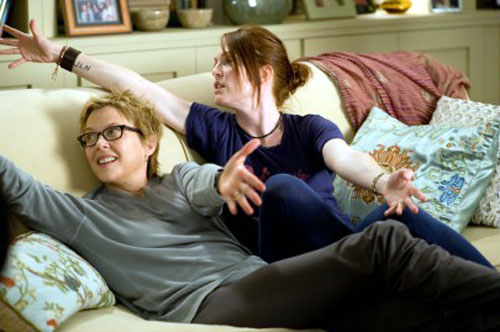
We all come at movies from slightly different perspectives, which is what makes it interesting. I love what Sheila says about Annette Bening’s eyewear in “The Kids Are All Right”:

I told Jason in a comments thread on his site, that Annette Bening’s “glasses behavior” in that film is worthy of an entire thesis paper. Her business with her glasses is so subtle, so character-driven, that you might not even notice it, or you might take it for granted, but there is some great great acting going on there. Bening’s adjusting of her glasses, her freedom with that prop, her specificity in using those glasses was some of the best acting done this year.

December 14, 2012

Opening Shots: ‘Kiss Me Deadly’

Enlarge image: Slapping flesh and heavy breathing.

From Kim Morgan, Sunset Gun:

When reading the request for greatest opening shots, the first film that popped into my head was immediate and almost too easy — “Kiss Me Deadly.��?

And then I reflected more.

There are so many masterful opening shots, some I find works of genius or some I simply love. But the more I thought about it, the more I drifted back to where my mind always manages to drift back to — stark, hard-boiled cruelty, paranoia, insanity and psycho sexual angst — so there it was again, “Kiss Me Deadly.��?

But for good reason. Robert Aldrich’s masterful noir hits you with a hysterical bang that sets its frenzied tone with such balls-out experimental élan; you can’t believe the film was released in 1955:

Before any credit sequence, the film begins with a pair of naked feet running down the middle of a highway in the black of the night.

December 14, 2012

Cracking the codes: More ways of looking at The Social Network

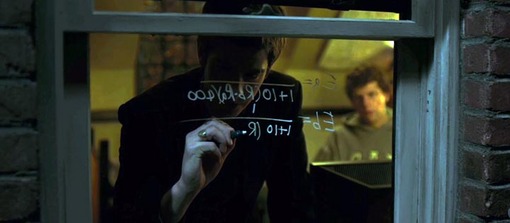
Since I saw “The Social Network” Friday and filed my first post about it, I’ve had a chance to read what some other people are saying. Some most intriguing angles, and all of them more or less valid. My take was that it’s a movie about codes of communication. At Time Out, screenwriter Aaron Sorkin said he thought of it as a movie “about a guy who is an antihero for the first hour and 55 minutes of the movie and a tragic hero for the final five minutes of the movie.” Matt Zoller Seitz offered a way of reading it as a horror film, and led me to Richard Brody, who compares it to “Amadeus” (with the Winklevii as Salieri) and interprets it as a new media tale of outsider entrepreneurs and Jewish assimilation, along the lines of Neal Gabler’s book about the original movie moguls, “An Empire of Their Own: How the Jews Invented Hollywood.” (That book is essential reading for lovers of American movies, by the way.)

Harvard Law professor and “free culture” advocate Lawrence Lessig comes at “The Social Network” from a legal perspective:

December 14, 2012

Opening Shots: The Player

From Jason Haggstrom (haggie), Reel 3:

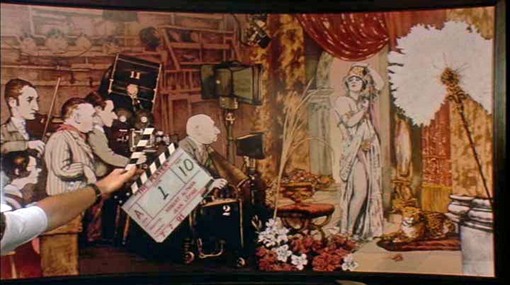
The opening shot of Robert Altman’s “The Player” establishes the film as a self-reflexive deconstruction of the Hollywood system and those who run it. With its prolonged shot length, the take is also designed as a means to introduce the bevy of players who work on the lot and to setup the film’s general plot–or at least its tone–as a thriller/murder mystery.

The first image in this extended opening shot is of a film set–a painting of one, to be precise. We hear the sounds of a film crew before a clapper pops into the frame. The (off-screen) director shouts “And… action” informing the audience that the film should be viewed as a construct, a film. The camera tracks back to reveal its location on a Hollywood studio lot where movies are described not in accolades of quality, but of quantity with an oversized sign that reads, “Movies, now more than ever.”

The lot is filled with commotion. Writers come and go (some invited, some not) as do executives, pages, and assistants. The political hierarchy is highlighted through dialog and interactions that expose the value system of Hollywood. The most powerful arrive by car; high-end models pervade the mise-en-scène in all of the take’s exterior moments. An assistant is made to run (literally, and in high heels) for the mail, and then — before she even has a chance to catch her breath — to park an executive’s car.

December 14, 2012

Chris Rock: Blacks more electable than retarded

My problem with Chris Rock (who belongs with Dane Cook and Carlos Mencia in the category of Comics I Don’t Think are Funny) is that he too often fails to base his shtick on accurate or meaningful observations. It’s just dumb shtick, and he’ll say anything (no matter how pointless) to get a laugh. It’s all about his hacky delivery rhythms — Catskills via Brooklyn. What he says hardly matters as long as he sounds like he’s being funny. He could be speaking Ancient Greek and he hits you so hard you’d still know exactly where you’re supposed to laugh, whether it’s funny or not.

Take the following, from his “SNL” appearance to promote his already-vanished movie, “I Think I Love My Wife.” Most of his jokes are older than John McCain (and in the ’80s these same jokes were told about Reagan and in the ’90s about Bob Dole). His stuff about Giuliani being good in a crisis is fine, but the pit bull analogy is stretched to the point of desperation.

Then Rock sets up the race for the Democratic nomination: “Everybody’s saying the same thing: Hillary or Obama? A black man or a white woman? It’s so hard to make up my mind! Like it’s a suffering contest. And even if it was, how can you compare the suffering of a white woman to the suffering of a black man?” I don’t know, Chris. How can you? And who’s making the comparison? Well, Rock is: “I mean, white women burned their bras. Black men were burned alive!” Lame set-up, phony-outrageous non-sequitur punchline. That’s Rock in a nutshell. (This might have been funny, in a Colbert-esque way, if Rock had been in character as Nat X. Does Rock know the difference? If not, what’s the point? Is anybody saying Hillary is more oppressed than Obama? It might have worked if Rock had cited an example that he could riff on.)

The line about nobody hating white women as much as white women do is pretty good. Women are certainly Hillary’s main problem. And the crack about how blacks would elect Halle Berry for half a term was kind of clever, but the audience was still laughing at the idea that black voters would elect OJ.

I’d love to know what would happen if someone else — say, Joseph Biden or Hillary or Obama — were to toss off this line: “Is America ready for a black president? I say: Why not? We just had a retarded one!” Hey, folks: What the hell — even black politicians are better than retarded ones, right? I wish I could say that Rock is an articulate comedian. Or an insightful one. Or a funny one. But I don’t think he is. Does anyone want to explain if/why they think this monologue is funny?

December 14, 2012

Three new Ebert articles

We have three new pieces by Roger Ebert on RogerEbert.com this week:

Ebert’s review of “The Queen”

An interview with director Michael Apted regarding “49 Up”

PLUS: Roger’s latest recovery update

(And I have a review of “Infamous,” the new Truman Capote movie.

December 14, 2012

Eastwood, now and Hereafter

When I stepped up to buy my ticket for “Hereafter,” the woman in the booth (who has worked there for many years) said, “This movie’s directed by Clint Eastwood.” I know, I said. “He’s not in it,” she said. “I guess it hasn’t been getting very much publicity.”

I don’t know if it has or hasn’t, but it got me to thinking: I’m not sure I could identify a Clint Eastwood movie on sight. Is there an identifiable Eastwood directorial vision or style, apart from a certain willfully “classical” gloss applied to a professional reserve that sometimes borders on indifference? Is he like a William Wyler or a Robert Wise, a journeyman, capable of making some very good movies, whose sensibility is identifiable primarily through the combined talents of his collaborators? Who is Clint Eastwood, the director?

Eastwood hires top-of-the-line folks (after all, he can), has them do their things, and prides himself on shooting the script as written, on time and on (or under) budget. Some very good directors I know don’t consider what he does to be direction so much as project management, because they don’t see anything particularly distinctive in the results, film after film. Still, Eastwood can get movies made that perhaps nobody else could, based on the strength of his commercial reputation and long association with Warner Bros.

Some critics I greatly admire find his work impressive and moving. Many of those who’ve worked with him describe the atmosphere Eastwood fosters on the set as his greatest contribution to the picture: He creates the conditions he needs to get the movie he wants from he people he’s hired — which is, to a lesser or greater extent, what all good directors must do. (See Robert Altman for a striking example.) But, when watching a post-“Unforgiven” Eastwood picture, I frequently detect a peculiar detachment, a feeling that I’m watching something coasting along on auto-pilot without any particular human or artistic vision to guide it.¹ I respond to directors who have been accused of glacial misanthropy — from Antonioni to Kubrick — and that is integral to their worldview. With Eastwood, I simply sense an almost mechanical disengagement from his material. Parts of some of these movies seem to have been made by robots.

December 14, 2012

Revulsion

Screeeeech! The “jewel”-encrusted Sidekick doesn’t help.

Edward Copeland asks: Do certain performers affect you like the sound of nails on a chalkboard? He lists Danny Huston, Kevin Costner, Kate Capshaw and Kim Cattrall among his most shudder-worthy. Some have charisma on the screen, and some don’t. Or, at least, some of us are mystified by what others see in them (I could never understand the whole Ronald Reagan-as-president thing; he always seemed to me like a minor audioanimatronic attraction at Disneyland: Doddering Moments With Mr. Reagan, the Non-Communicator).

For me, it really is an involuntary, visceral response. I’m not sure I can adequately explain my instinctive revulsion for the following (in some cases the reaction has developed over time, like an allergy, as if I’ve built up antibodies against them), but here they are, in no particular order:

Tom Cruise. Incapable of convincingly expressing any emotion beyond grim determination. Unless it’s intensely focused ambition.

Adam Sandler. Pauly Shore, but with a more limited range. Always looks as though he’s going to start laughing at how funny he thinks he is. (Yes, I make an exception for “Punch Drunk Love,” but I still would rather have been watching someone else. And that one had Mary Lynn Rajskub. She saves America every week on “24,” and she saved Sandler’s behind in this movie.)

Robin Williams. Not well-cast in human roles. (See all of the above.)

Cuba Gooding, Jr. His career after he won an Oscar for “Jerry Maguire” has made it almost impossible to sit through any of the good stuff he did before then. Tried to watch “Boyz N the Hood” recently? It’s so preachy and sanctimonious it almost looks like a Matty Rich film now, but in fairness that’s probably more John Singleton’s fault than Gooding’s alone.

That blonde heiress with the dead-trout eyes who’s famous for her night-vision porno video and being in the tabloids a lot. Perfect example of “horrisma.” She’s like Ann Coulter in drag. Or not in drag. I’m not really sure which. But both have all the appeal of impetigo.

Chris Rock. The comedy version of Tom Cruise. Always trying way too hard to convince you… of something.

Sandra Bullock. Like watching a coconut on a stick.

Mel Gibson. “Braveheart” finally did it for me (and that was a whole five years before “What Women Want”). He enjoyed torturing himself way, way too much. Just as there is Young Elvis and Fat Elvis, there’s Young Mel (pre-“Lethal Weapon 2”) and Creepy Mel (“Air America” forward). Watching “The Road Warrior,” it’s hard to comprehend what later became of that cool guy who once played Mad Max.

Harrison Ford. Once he had a sense of humor about himself — on screen, at least. It doesn’t help that he hasn’t made a decent movie (“Clear and Present Danger”) in 13 years. He’s great in “The Conversation,” though.

Katie Holmes. Zombified. Why do I even know who she is?

Shaved vagina girl. Has she made any movies or is she just on the Internets?

Lindsay Lohan. From Mean Girl to Lucky Girl (cast with Meryl Streep and Lily Tomlin in an Altman movie). Now it’s over. She’s the Alicia Silverstone of tomorrow, but without the comic timing. Ten years ago, John Waters might have been able to salvage her career. Now it’s too late. (OK, I’m sorry: That Alicia Silverstone crack was too mean — to Alicia Silverstone.)

Jim Carrey. See Chris Rock, above.

Natalie Portman. It’s as though she aspires to be forgettable, like generic “citrus”-flavored Pixy Stix. For some reason she reminds me of Veruca Salt on Xanax and I want her to swell up into a big blueberry. But I feel that way about nearly everyone who appeared in the “Star Wars” prequels.

More comments at Copeland’s place.

December 14, 2012

Blurb-a-thon 2007

View image The funniest scene in the funniest movie of the year. I think.

Instead of a “ten best list,” Armond White makes an annual “Better Than List” which, in principle, I’m all against — simply because of the formula: He uses a few adjectives and a “greater than” symbol to bash selected movie titles with selected other ones, like Daniel Plainview bludgeoning someone with a heavy object.

Then again, any “ten best list” (or “top ten list” or “favorites list”) represents a preference for some movies over some other movies, seen by somebody under certain circumstances during a period of time. And, to not-quite-paraphrase Jean Renoir, “Everybody makes his own rules.”

So, perhaps White is really just doing what (I hope) any list-maker does: Making a claim for his/her own critical taste and values, while recommending some movies. That he assumes the attitude of a bully over the approach of a critic or movie lover is, perhaps, not so important. (Quote: “‘No Country for Old Men’ > better than ‘There Will Be Blood,’ ‘Zodiac.’ The Coen brothers hauntingly mythologize Americana, while P.T. Anderson and David Fincher make it morbid, sadistic and self-congratulatory.” Is there an inverse relationship between “morbid, sadistic and self-congratulatory” and “hauntingly mythological” — Americana-wise, I mean?)

But look: Now I’m using other top ten lists to bash White’s. Is there no getting around this? I fell ill (think of the scene with the old lady on the street in “The Orphanage”) just as I was about to annotate my own 2007 list, after submitting various rankings to critics’ polls at MSN Movies, indieWIRE and the Village Voice/LA Weekly poll, each of which had slightly different rules, categories and deadlines. (Then I posted a list in video form in late December). Consequently, I missed reading a lot of other peoples’ lists (though The House Next Door and David Hudson at GreenCine, and the folks at Movie City News have put together invaluable lists of lists — and/or lists of links — that have helped me in my efforts to catch up, because, as I am fond of repeating, I actually learn from browsing these things).

Oh, yes, and I also posted the 2007 Exploding Head Awards as a kind of top-ten alternative. (Let me add that I have enjoyed no 2007 overview more than Dennis Cozzalio’s at Sergio Leone and the Infield Fly Rule.)

Now, just to wrap up this whole 2007 wrap-up thing, I’m going to recommend some movies and (in munchable blurbs of 150 words or less — I hope) give you some idea of what I liked about them, without the intention of over-selling them. If I’ve written more extensively about them, I’ll link their titles to a more detailed review or posting.

December 14, 2012

Is this Halloween costume racist?

This “Illegal Alien” costume has been pulled from a number of stores because, in the words of one immigration rights activist, it is “distasteful, mean-spirited, and ignorant of social stigmas and current debate on immigration reform.” I don’t know what its designers and manufacturers intended, but I can see how it could be viewed that way.

On the other hand, this particular costume (unlike some others that have been removed from shelves) doesn’t single out any particular ethnicity. As someone who is unabashedly pro-immigrant rights, I can also see it as a scathing satirical comment on the mindset of those who view immigrants as non-human. When I saw a photo of this costume, my first thought was of this summer’s science-fiction hit “District 9” (and 1988’s “Alien Nation”), which used extra-terrestrials as a metaphor for the treatment of illegal aliens and the ghettoization of black South Africans under apartheid. Roger Ebert wrote:

December 14, 2012
subscribe icon

The best movie reviews, in your inbox