Opening Shots: Keep ’em coming!

It’s really not that difficult.

I’ll be publishing your Opening Shots submissions all this week. And I’ll provide the answers to both my Opening Shots Pop Quizzes (and further appreciations of the shots themselves) on Friday or over the weekend. While nobody’s correctly identified all the shots on either of the quizzes, all shots except one have been identified by at least one person. The Most Mysterious Shot: Number 8 on Quiz #2. Also, I thought some of the images were showing up dark on my desktop PC (though not on my PowerBook), so I lightened ’em up a bit.

Remember, send quiz entries and your nominations for great Opening Shots (along with your explanations for why they work at setting up the film) to jim at scannersblog dot com. (Link above.)

Also, if you want to discuss individual shots, I’ve enabled Comments on some of these new posts. I still have to approve them before they’re published (Sun-Times policy), but I’m hoping it will help generate more lively and informative discussion hereabouts.

December 14, 2012

Bergman: Sawdust and Tinsel?

View image Harriet Andersson in Ingmar Bergman’s “Summer with Monika” (1953). US tagline: “A Picture for Wide Screens and Broad Minds.”

Jonathan Rosenbaum puts another nail in Ingmar Bergman’s coffin in today’s New York Times (“Scenes From an Overrated Career”). As important as Bergman was to the rise of European “art film,” especially in the 1950s and ’60s, Rosenbaum says, Bergman — who was more a theatrical director than a cinematic one — wasn’t really adding anything new to the art of film, and his work hasn’t held up over time:

Sometimes, though, the best indication of an artist’s continuing vitality is simply what of his work remains visible and is still talked about. The hard fact is, Mr. Bergman isn’t being taught in film courses or debated by film buffs with the same intensity as Alfred Hitchcock, Orson Welles and Jean-Luc Godard. His works are seen less often in retrospectives and on DVD than those of Carl Dreyer and Robert Bresson — two master filmmakers widely scorned as boring and pretentious during Mr. Bergman’s heyday.

What Mr. Bergman had that those two masters lacked was the power to entertain — which often meant a reluctance to challenge conventional film-going habits, as Dreyer did when constructing his peculiar form of movie space and Bresson did when constructing his peculiar form of movie acting.

The same qualities that made Mr. Bergman’s films go down more easily than theirs — his fluid storytelling and deftness in handling actresses, comparable to the skills of a Hollywood professional like George Cukor — also make them feel less important today, because they have fewer secrets to impart. What we see is what we get, and what we hear, however well written or dramatic, are things we’re likely to have heard elsewhere.

So where did the outsized reputation of Mr. Bergman come from? At least part of his initial appeal in the ’50s seems tied to the sexiness of his actresses and the more relaxed attitudes about nudity in Sweden; discovering the handsome look of a Bergman film also clearly meant encountering the beauty of Maj-Britt Nilsson and Harriet Andersson. And for younger cinephiles like myself, watching Mr. Bergman’s films at the same time I was first encountering directors like Mr. Godard and Alain Resnais, it was tempting to regard him as a kindred spirit, the vanguard of a Swedish New Wave.

It was a seductive error, but an error nevertheless. The stylistic departures I saw in Mr. Bergman’s ’50s and ’60s features — the silent-movie pastiche in “Sawdust and Tinsel,” the punitive use of magic against a doctor-villain in “The Magician,” the aggressive avant-garde prologue of “Persona” — were actually more functions of his skill and experience as a theater director than a desire or capacity to change the language of cinema in order to say something new. […]

It’s strange to realize that his bitter and pinched emotions, once they were combined with excellent cinematography and superb acting, could become chic — and revered as emblems of higher purposes in cinema. But these emotions remain ugly ones, no matter how stylishly they might be served up.

Michael Atkinson, who I quoted earlier in the week, makes some similar criticisms, yet comes to a different conclusion: “[N]owhere… is there a lazy, unambitious or unoriginal directorial moment.”

I think there’s some truth in both Rosenbaum’s and Atkinson’s assessments, but Rosenbaum seems more interested in asserting his own personal pantheon than in evaluating Bergman’s oeuvre. Yes, the reputation of Bergman’s work, and its former sense of vital importance, has undeniably receded. After all, it had practically nowhere else to go, given Bergman’s overwhelming stature in the ’60s and ’70s. (On a personal note, I haven’t felt compelled to watch or re-watched any of his films in years — except “Persona” — although I still treasure “Fanny and Alexander,” and have fond memories of his early, funny pictures like “Smiles of a Summer Night” and “The Devil’s Eye.”) That’s why, honestly, I haven’t been able to write about Bergman myself this last week: He feels like an indistinct memory to me, safely enshrined as “classic” but almost taken for granted. Nevertheless, I’ve put some of his films at the top of my Netflix queue (“Shame,” “Hour of the Wolf”) in hopes of getting reacquainted.

December 14, 2012

Opening Shots: ‘Stranger Than Paradise’

View image Eva in The New World.

View image

View image

From Christopher Long, Reviewer and Features Editor, DVDTown.com:

In terms of narrative structure, the opening shot of Jim Jarmusch’s “Stranger than Paradise” is a perfect “mini-movie.” The film opens with a shot of Eva (Eszter Balint, seen from behind) standing to the far right of the frame; in the background, we see a plane park on an airport runway. Eva watches a plane land, very slowly picks up her luggage (a ratty suitcase and a shopping bag), turns around (glancing around in almost a full circle) then walks (again, very slowly) left and towards the camera until she exits the frame.

The shot lingers, however, long after Eva has departed to witness the parked plane as it begins its takeoff. Here is the entire story laid out in miniature: “Stranger Than Paradise” begins with an arrival by plane (Eva coming to America from Hungary) and ends with a departure by plane (Willie [John Lurie] flying to Budapest).

December 14, 2012

Roy Scheider (1932-2008)

View image Roy Scheider in “If I Didn’t Care” (2007).

From the Associated Press:

Scheider was nominated for a best-supporting actor Oscar in 1971’s “The French Connection” in which he played the police partner of Oscar winner Gene Hackman and for best-actor for 1979’s “All That Jazz,” the autobiographical Bob Fosse film. […]

“He was a wonderful guy. He was what I call ’a knockaround actor,”’ [Scheider’s “Jaws” co-star Richard] Dreyfuss told The Associated Press on Sunday.

“A ’knockaround actor’ to me is a compliment that means a professional that lives the life of a professional actor and doesn’t yell and scream at the fates and does his job and does it as well as he can,” he said. […]

View image A few moments before Scheider utters the now-famous line that he must have known would be quoted in his obituaries.

Dreyfuss recalled Sunday a time during the filming of “Jaws” when Scheider disappeared from the set. As the filming was on hold because of the weather, Scheider “called me up and said, ’You don’t know where I am if they call.’

“He’d gone to get a tan. He was really very tan-addicted. That was due to a childhood affliction where he was in bed for a long time. For him being tan was being healthy,” Dreyfuss said.

December 14, 2012

What they say and what they mean

“I much prefer the kind of story where the reader is left wondering who’s to blame until it begins to dawn on him (the reader) that he himself must bear some of the responsibility because he is human and therefore infinitely fallible.”

— Richard Yates

“Madame Bovary, c’est moi.”

— Gustave Flaubert

A follow-up to my previous post on “Revolutionary Road”:

I’m reading Blake Bailey’s 2003 biography of Richard Yates, whose “Revolutionary Road” and “The Easter Parade” are among the novels I hold dearest. It’s called “A Tragic Honesty,” and I think Yates would hate the title. But maybe there are layers to it that I haven’t yet discovered. I’m only up to 1959 and, despite a lifetime of alcoholism, emphysema, bipolar depression and a host of other physical and mental troubles, Yates survived until 1992. Perhaps the notion of “tragic honesty” is illustrated below, in Yates’ sharp observations about the interplay between story and character in his own work and that of artists he admired. They’re applicable to just about any narrative form:

“Another thing I have always liked about [“The Great Gatsby”] and [“Madame Bovary”],” he wrote, “is that there are no villains in either one. The force of evil is felt in these novels but never personified — neither novel is willing to let us off that easily.” […]

December 14, 2012

Mourning (and assessing) Bergman

View image

Some of the best things I’ve read about Ingmar Bergman’s place in cinema, written since his death (UPDATED 8/01/07):

E-mails to Roger Ebert from filmmakers and writers including David Mamet, Paul Schrader, Sally Potter, Haskell Wexler, Paul Theroux, Richard Linklater, Gregory Nava, Studs Terkel, David Bordwell, David Gordon Green, Paul Cox…

Gregory Nava: This was not the escapist fare of Hollywood, or the pat spirituality of Biblical epic films where God spoke in hallowed tones from a burning bush. With Bergman, God was a spider that lived in the upstairs closet! A shocking and necessary jolt to my Catholic sensibilities. Yes, these films changed me forever — they cemented my dream to become a filmmaker because if film could do this — then surely it was the greatest art form of our time. I will never forget the first time I saw the horses standing in the surf against a setting sun, and death with his black cape raised approaching the world-weary knight.

“I hope I never get so old I get religious.” — Ingmar Bergman

Peter Rainer, Los Angeles Times:

He worked out of his deepest passions and, for many of us, this made the experience of watching his films seem almost surgically invasive. He pulled us into his secret torments. Looking at “The Seventh Seal” or “Persona” or “Cries and Whispers,” it’s easy to imagine that Bergman, who died Monday, was the most private of film artists, and yet, no matter how far removed the circumstances of his life may have been from ours, he made his anguish our own.

Another way to put this is that Bergman — despite the high-toned metaphysics that overlays many, though not all, of his greatest films — was a showman first and a Deep Thinker second. His philosophical odysseys might have been epoxied to matters of Life and Death, of God and Man, but this most sophisticated of filmmakers had an inherently childlike core. He wanted to startle us as he himself had been startled. He wanted us to feel his terrors in our bones. A case could be made that Bergman was, in the most voluminous sense, the greatest of all horror movie directors.

“If Jesus came back and saw what’s going on in his name, he’d never stop throwing up!” — Bergman actor Max von Sydow, in Woody Allen’s “Hannah and Her Sisters”

View image Woody Allen’s “Love and Death”: A Bergman (and Dostoyevsky and Tolstoy…) parody from someone who loved Bergman.

Roger Ebert, RogerEbert.com:

What he saw as God’s refusal to intervene in the suffering on earth was the subject of his 1961-63 Silence of God Trilogy, “Through a Glass Darkly,” “Winter Light” (a pitiless film in which a clergyman torments himself about the possibility of nuclear annihilation) and “The Silence.” In his masterpiece “Persona,” (1967), an actress (Liv Ullmann) sees a television image of a monk burning himself in Vietnam, and she stops speaking. Sent to a country retreat with a nurse (Bibi Andersson), she works a speechless alchemy on her, leading to a striking image when their two faces seem to blend.

So great was the tension in that film that Bergman made it appear to catch in the projector and burn. Then, from a black screen, the film slowly rebuilt itself, beginning with crude images from the first days of the cinema. These images were suggested by a child’s cinematograph which his brother received as a present; so envious was Ingmar that he traded his brother for it, giving up his precious horde of 100 tin soldiers.

December 14, 2012

My First 2011 “Ten Best” List

(Picture the headline above in Comic Sans.) MSN Movies contributors have selected our Top 10 Movies of 2011. What does that mean? Whatever you want it to mean. Are these movies “the best”? Are they our favorites? Are they “movies we got to see before the deadline”? In my case, it’s some combination of all three — but I’m really quite happy with the aggregate results. As for my own contribution, as usual I hadn’t seen everything I wanted to by the deadline (“A Separation,” “Hugo,” “The Artist,” “Mysteries of Lisbon,” “Midnight in Paris” among them), and still haven’t, but them’s the breaks. My lists will evolve in coming days (Village Voice/LA Weekly poll, indieWIRE Critics Poll, and so on), but I do want to say that I went all-in with my emotions. I picked these movies ’cause I love ’em, not because I merely admire them or appreciate them.

The Big List starts here; the individual lists start here.

Of course, as much as we love lists, the best thing about the MSN feature is that we have short appreciations of the top 10 movies, written by some very perceptive and eloquent people. And me, too. You will find the Group List, with excerpts and links to the full mini-essays, below — and my personal ballot at the bottom. Let me know what you think — and be sure to read the previous post (“Idiocracy and the ten-best trolls”) for a good laugh:

December 14, 2012

Bow down to Babs

“You’re certainly a funny girl for anybody to meet who’s just been up the Amazon for a year.”

If you are in Chicago the next few weeks, and you feel like taking in a weekend matinee, then you are fortunate indeed because the Music Box Theatre is presenting a centennial celebration of the toughest, sexiest, smartest, snappiest dame ever to sashay across a cinema screen. By that, of course, I mean none other than Sugarpuss O’Shea, Phyllis Dietrichson, Lily Powers, Lora Hart, Stella Dallas, Jean Harrington, Jessica Drummond, Leona Stevenson, Sierra Nevada Jones, Martha Ivers, Thelma Jordan, Norma Miller Vale, Mae Doyle D’Amato… in other words, Barbara Stanwyck.

View image Sugarpuss presents the ball of her foot in “Ball of Fire.”

Stanwyck is my favorite movie actress. Ever. I built a virtual shrine to her in 1998 (complete with a gallery of rare images and Babs’ Foot Fetish Page), in which I wrote:

Stanwyck could make you believe she was part of the everyday world we all live in, not just a fantasy on the silver screen. She could easily be the woman down the aisle in the supermarket, driving that car in the next lane, or working in the office down the hall. While other stars went for the “larger than life” roles, Stanwyck — as an all-American working girl or a cunning seductress — generally kept her feet planted firmly on the ground. In fact, she enters “Double Indemnity” feet-first, sauntering down the staircase wearing an anklet that snags Walter Neff (MacMurray) by the libido. (The anklet may be the hook, but she’s the bait.) Stanwyck used that foot to lure Gary Cooper and Henry Fonda, among others. It’s a peculiar erotic pattern in her work (see Babs’ Foot Fetish Page for more details and images), but men who stooped to take her foot in hand found themselves on their knees before a passionate woman, not an unapproachable goddess — and they fell, instantly and irrevocably, under her spell. (Fonda almost faints when she gets him to slip a pump over her tootsies!)

View image Will this plan provide full coverage?

In both “The Lady Eve” and “Ball of Fire” — two of her most dazzling and endearing comic performances, from the same year! — Stanwyck acts as a leveling life-force, puncturing all pretensions and knocking her co-stars’ bumbling intellectual noggins out of the hazy cerebral clouds. What she achieves is not unlike what a much ditzier, flakier, upper-crust screwball heroine, Katharine Hepburn, does for/to bespectacled paleontologist Cary Grant in “Bringing Up Baby.” But Stanwyck brings salvation from the streets rather than the penthouse. Jean Arthur in “Easy Living” (1937) — written by Sturges — is a delightful working gal, but Stanwyck is far more streetwise. Tough, strong, and smart, but no less feminine than some of her screwball sisters, she has learned to survive in a cut-throat world, living by her wits. She’s at her best when she’s in control, and she usually is. In many of her most famous movies the unspoken truth of any given scene is that she knows exactly what she’s doing — until, perhaps, her emotions sneak up on her and overthrow her instincts, by unexpectedly allowing her to fall head-over-heels for her (relatively) naive and helpless male prey.

Stanwyck slices right through class conventions and social formalities, immediately addressing Gary Cooper’s Professor Bertram Potts by the more casual nickname of “Potsy.” Likewise, Fonda’s Charles Pike, heir to the Pike’s Ale fortune, becomes “Hopsie” (after a key ingredient in the family brew). The very notion of someone with such a direct, spontaneous, and unrefined disposition masquerading as a blueblood is, as Preston Sturges realized, a terrific premise for comedy.

December 14, 2012

We could shoot a Russian unicorn

“I got a porcupine called ‘Zazoom’

He leaves his scent on people’s graves.”

— “Russian Unicorn”

You know the Kuleshov Effect, illustrated by the famous Soviet montage experiment in which an actor’s performance seems to change, depending on whatever image (a bowl of soup, a child in a casket, a beautiful woman) appears before identical footage of his face in close-up. Performances in the movies only begin with what the actor does on the set. They are created and re-created every step of the way, from editing to final sound design and mixing (effects, looping, punching, music, etc.). There’s also what I would propose we call the “Russian Unicorn Effect,” after the amazing music video parody by Bad Lip Reading.

OK, it’s already kind of got a name — the McGurk effect — and it was “discovered” in 1976 by cognitive psychologist Harry McGurk and his research assistant John MacDonald — and it explains how sounds can change perceptions of images and vice-versa.

I saw and heard the parody above (“Russian Unicorn”) a few months ago, which led me to check out the original Michael Bublé video (“Haven’t Met You Yet”), below. I could not believe the difference. Try it yourself — first the parody, then the original here (embedding disabled, unfortunately).

December 14, 2012

Tina Fey is a genius

I defy you to tell the difference between her character and the Governor of Alaska, who has been busy lowering expectations all week. The main difference, of course, is that Fey is still in front of TV cameras, while Palin can no longer be found. Anywhere.

And the most brilliant stroke: Palin herself provided much of the material. She writes her own comedy and all Fey has to do is perform it the way Palin does. Fey isn’t doing a caricature (like Dana Carvey’s George HW Bush), but is giving a performance of uncanny accuracy (closer to, say, Helen Mirren in “The Queen“).

December 14, 2012

“There is no god!!!”

View image “There is no god!!!”

Thanks for all the terrific, thoughtful suggestions for my hypothetical Atheist Film Festival (below) — “Freddie Got Fingered” (either “proof” of the absence of god, or a devastating comment on the divine sense of humor), “Contact,” “Wise Blood,” all of Buñuel, “Grizzly Man,” “Crimes and Misdemeanors”… Don’t stop now!

View image [Reverse zoom.] Whimpering: “I’m so sorry. Forgive me.”

I think a slam-bang opening for such a festival would be one of my favorite underrated films of the 1980s, Anthony Perkins’ 1986 “Psycho III,” which begins with a black screen and a hair-raising scream of anguish: “There is no god!!!” What’s more, we soon learn that it is the cry of a devastated novice, and that (even better) she’s played by Diana Scarwid! (That’s Christina Crawford to you “Mommie Dearest” fans — and something tells me Perkins was one, too.)

View image [Reverse zoom, cont.] Stronger: “Give me a sign. Help me.”

View image [Static shot.] Silence.

Before we know it (in the third shot — or the fourth, if you include the blackness between the Universal logo and the statue of the Virgin), we’ve smudged the line between “Psycho” (1960) and “Vertigo” (1958), looking up into a California mission belltower. A few vertiginous shots and a maniacal sniveling nun (and a few nice ones) later, and the movie is off to a rip-roaring psycho-vertiginous start.

View image Psych– er, Vertigo?

The nuns approach Maureen (the hysterical novitiate) and attempt to coax her down from the archway where she is poised to throw herself, Kim Novak-like, from the tower. “There is no god!” Maureen cries again — not in rage but in despair, as if she’s just discovered a shattering, horribly disappointing truth.

The crazy nun raves: “You wretched girl! How dare you!”

The eldest nun tries to snap her out of it: “Please Maureen, you mustn’t. You have an obligation to Him!”

“I have nothing,” Maureen says dejectedly. “I am nothing!”

View image Another blonde, another belltower…

And then all hell breaks loose.

That’s just the first four minutes, before the titles. And it’s not giving too much away to say that Maureen becomes Norman Bates’ very first girlfriend. They’re a match made in… wherever.

View image Inverted crosses, anyone?

“Psycho III” is a joy, a sequel that understands the original from the inside out. It’s a celebration, a satire, a revisitation, and a deeply felt, detail-perfect homage to Hitchcock’s bleak masterpiece. (I’d say “Psycho” is not so much an atheistic work as a nihilistic one. The specificity of the opening sequence perversely indicates the randomness of the particular story the movie chooses to tell. And Simon Oakland’s psychobabble wrap-up at the end mocks not only psychology but any and all belief systems.)

View image Nun: “You have an obligation to Him!”

Novice: “I have nothing. I am nothing!”

I’ve always thought of “Psycho” as a family black-comedy — a horror sitcom. And, from the perspective of 1986, Perkins reminds us of how funny “Psycho” (and Norman) is. “Psycho III” strikes the perfect balance between horror, tragedy, and camp.

The screenplay is by Charles Edward Pogue, who is also credited with co-writing David Cronenberg’s horror / comedy / romantic version of “The Fly” (“Be afraid — be very afraid”) the same year — and the clever, underrated remake of “D.O.A.” in 1988. And the rest of the crew is top-of-the-line, including such Clint Eastwood vets as D.P. Bruce Surtees (“Dirty Harry,” “Night Moves,” “Risky Business,” “Pale Rider”) and the late production designer Henry Bumstead (“Topaz,” “Mystic River,” “Flags of Our Fathers,” “Letters From Iwo Jima”). The score is by Carter Burwell (“Miller’s Crossing,” “Barton Fink”) and the producer is Hilton A. Green — second unit / assistant director on “Psycho” and “Marnie.”

If you want to discover Maureen’s fate — and see just how wittily and poignantly “Psycho III” pays attention to the details of its source — check after the jump.

Meanwhile: Any more candidates for the Atheist Film Festival? (I’ve tried to refine what I mean by an “atheist film” — as opposed to an anti-god or anti-Christian film — in a comment here.)

December 14, 2012

What is your favorite Scorsese Picture?

Martin Scorsese and a big gold pizza. (DGA photo)

In honor of Martin Scorsese’s victory at the Director’s Guild over the weekend, here’s another poll using a different software application. This one’s more compact: Just use the drop-down box and enjoy. When you view the results, you have to click your browser’s “back” button to return here. This isn’t an easy choice for me (probably between “New York, New York” and “King of Comedy”)…

What is your favorite Martin Scorsese Picture?

Mean Streets

Italianamerican

Alice Doesn’t Live Here Anymore

Taxi Driver

New York, New York

The Last Waltz

Raging Bull

The King of Comedy

After Hours

The Color of Money

The Last Temptation of Christ

GoodFellas

Cape Fear

The Age of Innocence

Casino

Kundun

Bringing Out the Dead

Gangs of New York

The Aviator

The Departed

View Results

Free poll from Free Website Polls

December 14, 2012

TIFF: The war over there

View image Christian Bale in Werner Herzog’s “Rescue Dawn.”

For the first half of Werner Herzog’s “Rescue Dawn,” the fictionalized movie based on his documentary 1997 “Little Dieter Needs to Fly,” I wasn’t sure if Herzog had tamed the commercial feature or if it had tamed him. By the end, I felt it was the most harrowingly realistic and unsentimentalized P.O.W. film I’d ever seen.

The story is “inspired by” Dieter Dengler, an American Navy pilot (born in Germany) whose plane crashed in 1965 in Laos, where there wasn’t supposed to be any bombing and before there was a “War in Vietnam.” U.S. “military advisors” were there, supporting the South Vietnamese, but as far as most Americans were concerned, “war” hadn’t broken out. Dengler survived the crash, was captured by Laotians, and held in what he and his fellow captives believed to be a Viet Cong camp. By the time Dengler arrived, some of the handful of Americans and Vietnamese interred there had been detained for more than two years already.

December 14, 2012

Hannibal Lecter, critic eLectercuted at Super Bowl

View image “Electrifyingly terrorific!”

From MediaPost:

Famed film producer Harvey Weinstein, now co-chair of The Weinstein Company, formerly the co-founder of Miramax Films, was worried about the copy in a commercial for his forthcoming film “Hannibal Rising.” The spot featured a voiceover saying, “The most terrifying thriller of the new year.”

Weinstein changed his mind late on Saturday night and called Les Moonves, chief executive of CBS. Weinstein thought it better to change the word to “electrifying,” so as not to scare the kids on Sunday Bowl Sunday. […]

The comment “the most terrifying movie of the new year” was from Maxim magazine’s film reviewer, Pete Hammond. But Moonves and Weinstein said they “worked” with the critic to change it to “electrifying.”

Worked with the critic? You mean that they changed his mind concerning what he said? This is shocking — critics can “change” their quotes for some movie commercials, or in the case of Sony Pictures Entertainment some years ago, studios can completely make a quote up — as well as the critic….

December 14, 2012

Altman: Life beyond the frame

“Nashville” 25th reunion. (photo by Jim Emerson)

When the doctor says you’re through

Keep a’goin!

Why, he’s a human just like you —

Keep a’goin!

— Haven Hamilton (Henry Gibson) in “Nashville”

View image 24 of your favorite stars.

Give me a Leonard Cohen afterworld

so I can sigh eternally

— Kurt Cobain, “Pennyroyal Tea”

It’s true that all the men you knew were dealers

who said that they were through with dealing

every time you gave them shelter

— Leonard Cohen, opening lyrics for “McCabe & Mrs. Miller”

View image “Nashville” 25th reunion. Note gigantic Oscar at right; Altman got his own, regular-sized one six years later. (photo by Jim Emerson)

“However, the cortex, which is dwarfed in most species by other brain areas, makes up a whopping 80 percent of the human brain. Compared with other animals, our huge cortex also has many more regions specialized for particular functions, such as associating words with objects or forming relationships and reflecting on them. The cortex is what makes us human.”

— John J. Ratley, M.D., “A User’s Guide to the Brain: Perception, Attention, and the Four Theaters of the Brain”

I’m not sure what, if anything, meaningfully connects these fragments to the passing of Robert Altman — or his films, as alive now as they ever were — but they were all things I encountered during a day spent thinking about Altman and, to my surprise, not wanting to speak out loud about him to anyone. I talked to my mother on the phone. She asked hesitantly, “Have you heard any news today?” “Yeah,” I said, and changed the subject. What can I say that isn’t trivial? (Rhetorical question, please.)

In this state of grief, nothing I’m writing or thinking about Altman is adequate, or even makes much sense, in large part because a whole moviegoing lifetime of engagement with his movies (beginning at age 15) has so profoundly shaped who I am and how I experience the world. Like hundreds, thousands (millions?) of cinephiles and cinephiliacs, I found life (and, paradoxically, shelter) in Robert Altman’s movies. “Nashville” is my church, to which I return again and again for joy, insight, inspiration and sustenance. (I haven’t written about it for years, but I also know that I’m almost never not writing about “Nashville.”)

To this day, I am in some deep but irrational sense convinced that the characters in “Nashville” (even though I know they’re played by 24 of my very favorite stars!) continue to exist outside the parameters of the movie itself. I’ve met and interviewed, for example, Ned Beatty, but there’s Ned Beatty the actor and then there’s Delbert Reese, who is someone else entirely. Delbert exists, imaginatively independent of the great actor (one of my all-time favorites) who inhabited him in “Nashville.” (This is most unlike the other most-influential movie in my life, Roman Polanski’s “Chinatown,” made just the year before “Nashville,” which is as “closed” a film as “Nashville” is “open.” “Chinatown” ends so definitively that, “Two Jakes” aside, any life beyond the final frame is unthinkable.)

Right now I just want to share another fantastic memory: In 2000, I heard there was going to be a 25th anniversary reunion screening of “Nashville” at the Academy of Motion Picture Arts and Sciences’ Samuel Goldwyn Theater in Beverly Hills. I’d moved back to Seattle by this time, but I bought tickets the moment they became available (for five bucks apiece) and went to LA for the event: My favorite movie, in a pristine print, in one of the finest movie theaters in the world, with most of those 24 favorite stars in attendance. It was… transplendent (as a Shelley Duvall character once said). I’ll post an update with IDs later, but for now, see if you can identify the people onstage (taken with a now-primitive, but still beloved, Canon Digital Elph)

Pauline Kael’s famous, ebullient review of “Nashville” here reminds us how exciting and innovative the movie was in 1975.

Principal population of “Nashville” after the jump:

December 14, 2012

The Golden Age of Cinemania is Now

View image I like to watch and learn.

Alas, Manohla Dargis wasn’t fond, as I was, of Eric Rohmer’s “Romance of Astrée and Céladon,” Juan Antonio Bayona’s “The Orphanage” or Ira Sachs’ “Married Life” — all of which (and more, as usual) are being repeated after their Toronto showings at the New York Film Festival.

But in her overview of the NYFF, she reminds us of the importance of film festivals — and the word-of-mouth generated on the web — to the viability of world cinema in the US market:

[The NYFF’s] willingness to go beyond its comfort and perhaps even its geographic zone feels especially urgent now because it won’t be long before the old art-house faithful start slipping away like Antonioni and Bergman. Cinemania is alive and well on the Internet, notably in blogs, where young movie nuts rant and rave and help cultivate one another’s cinematic interests. This is heartening, but film — especially the kind that distinguishes this year’s edition of the New York Film Festival — needs more than passion. It needs an audience, a paying public. If we don’t cultivate a new generation of movie lovers who get excited at the very idea of a Hou Hsiao-hsien film, we may as well hold a memorial service for foreign-language-film theatrical distribution right now.All too true. When I was in college, programming the student film series, local art-house exhibitors understood that showing foreign and specialized films (even older Hollywood movies)to students on campus for a buck-and-a-half per double bill on Friday and Saturday nights wasn’t a form of competition or a threat to their ticket sales. It was a way of building an audience for them. Today, that kind of evangelism is happening right here, on the World Wide Internets. (That was the goal of the recent “Top Foreign-Language Films Poll — to spread the word, get people started..)

I was relieved, and gratified, that so many cinephiles younger than me still cared about Bergman and Antonioni, and still had so much to say (and even more they were willing to discover) about them when they died. I wonder, in fact, if perhaps the giants (or dinosaurs) like Bergman and Antonioni matter more to people in their 20s, 30s than they still do to people of their own, or my, or Jonathan Rosenbaum’s generation.

Which (by free association) reminds me of this essay by Rick Perlstein (“What’s the Matter with College?”) in Sunday’s New York Times Magazine.

You used to have to go to college to discover your first independent film, read your first forbidden book, find freaks like yourself who shared, say, a passion for Lenny Bruce. Now for even the most provincial students, the Internet, a radically more democratic and diverse culture — and those hip baby-boomer parents — take care of the problem.I’m one of those people who never wanted to stop going to college. Make that “never wanted to stop taking classes” — because, even though it took me a while to consciously realize it, the day I stop learning (or wanting to, anyway) is the day I’m dead. I submit that the greatest classroom the world has ever known is now (literally) at your fingertips. My class schedule isn’t temporally or geographically definable, but it’s virtually round ’round the clock, just about wherever I am. How about you?

December 14, 2012

Journey to the Center of the Dump:Wall-E, color & close-ups

Color can be used sparingly — even in family-friendly animation.

I don’t hear NPR’s movie critic Bob Mondello all that often anymore (’cause I’m not in my car as much as I used to be), but I’ve never heard him more excited than when he reviewed “Journey to the Center of the Earth” last week. Not the new Brendan Fraser 3D one, but the 1959 version with James Mason, Pat Boone, Arlene Dahl and Diane Baker.

Although Mondello’s greatest enthusiasm by far is for the 1959 film, his best lines describe the 2008 production: “It’s considerably more “real”-looking — in a differently fakey way…. It’ll just show you what Hollywood used to do, and do well, done well.” Well put. As I was saying about movie blood, what we accept as “realistic” isn’t necessarily realistic at all. It’s as much a convention of the times we live in as anything else. Much of the groundbreaking CGI of today isn’t much better than it was ten years ago, and a lot of the old CGI — which seemed so convincing at the time — now looks… well, better than the rubber octopus in “Ed Wood,” but dated nevertheless. Even some of the great special effects movies like “Jurassic Park” (1993) don’t look much more sophisticated than “King Kong” (1933) these days.

Meanwhile “Wall-E” (and “Finding Nemo”) writer-director Andrew Stanton sounds like a really savvy filmmaker. He told Terry Gross on Fresh Air about a lot of the brainstorming that went into “Wall-E,” and I had another one of those NPR “driveway moments” during this part of the interview:

December 14, 2012

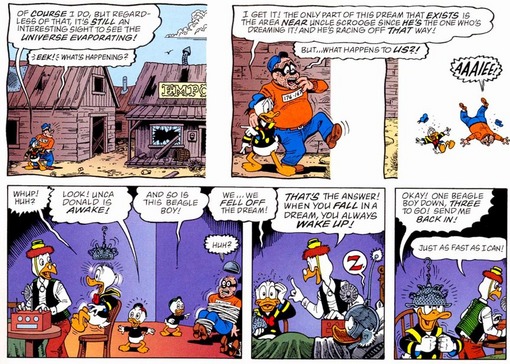
Inception of Inception: The Scrooge McDuck comic

Is this where it all began? Did Disney really implant this idea in Christopher Nolan’s subconscious, the way it implants things in everybody’s? Read the full comic here, or download as a .pdf. Don’t stop reading in the middle or you’ll get stuck in limbo.

(via I Watch Stuff)

December 14, 2012

Former President Jar Jar

What would pundits and stand-up comedians do without their “Star Wars” analogies? Maureen Dowd liked to refer to the former vice president as “Darth Cheney.” She recently asked George Lucas if that comparison was a mischaracterization:

Lucas explained politely as I listened contritely. Anakin Skywalker is a promising young man who is turned to the dark side by an older politician and becomes Darth Vader. “George Bush is Darth Vader,” he said. “Cheney is the emperor.”

Amy Davidson, at the New Yorker’s News Desk, is having none of it (“Close Read: Dark Forces”):

December 14, 2012

The Re-forgotten Lost Devil Girls Trailer of Ed Wood!

Now, for the penultimate time! Ten years in the development vault! Dripping wet from the subcutaneous epidural labs! Writer-Producer-Director-Hyphenate Andre Perkowski and Terminal Pictures Presents the previously unclaimed, unfulfilled trailer for Edward D. Wood Jr.’s “The Devil Girls”!!! You’ll thrill to their prevailing sex urges for lust, dementia and forbidden entertainment!

December 14, 2012
subscribe icon

The best movie reviews, in your inbox