Ebert has another surgery

Ebert takes the stage at the Overlooked Film Festival.

Roger Ebert, who has been under treatment for slow-growing, non-life-threatening tumors on his thyroid and salivary glands for some years, will be having another surgery in June. Roger’s energy level has certainly not flagged in recent months (he just got back from covering the Cannes Film Festival — and was out late at the Steak & Shake after the movies at his Overlooked Film Festival in April).

More details from a report in the Chicago Sun-Times by Robert Feder:

“It is not life threatening, and I expect to make a full recovery,” [Ebert] said. “I’ll continue to function as a film critic during this time.”

Ebert had surgery to remove a malignant tumor on his thyroid gland in 2002 and two surgeries on his salivary gland in 2003.

Unlike those earlier procedures, Ebert is not expected to require radiation therapy this time.

“This is known as a slow growing and persistent cancer,” he said. “You live with it.”

December 14, 2012

Gasp! Choke! As film criticism lay dying…

Clint Eastwood, a Caucasian American, made a movie about Japanese soldiers on Iwo Jima in WW II. How “liberal” of him!

2006 was a big year for stories about the “death of movie criticism” — which were really just bandwagon-jumping trend pieces about the increasing numbers of studio products that the studios themselves don’t deem worthy of the expense of advance critics’ screenings. How can this be tied to some mythical decline in the influence of film critics? Have critics ever had the power to sell a stinker to the public? Or to warn a substantial portion of moviegoers away from a bad movie with a monster ad budget, marquee names and/or genre appeal (horror, comedy, action)? Would “You, Me and Dupree” (which was pre-screened for critics) have done substantially better at the box office if it had gotten good reviews? Of course not. Word-of-mouth travels fast.

So, if American film criticism is wounded or dying, it’s not because of any publicity department’s policies. It’s because of the crap some of the critics — even some of the most reputable — are writing.

If you want to watch film criticism writhe in agony from a mortal wound, if you want to see critical standards expire pitilessly before your very eyes, you need only read Jonathan Rosenbaum’s four-star (“Masterpiece”) review of Clint Eastwood’s “Letters from Iwo Jima” last week:

One reason I wasn’t sure what to think of “Letters” the first time I saw it was that I didn’t know how it would be received in Japan. I wondered if it would seem accurate to most viewers there. I’ve since learned that the response has been very favorable and that it’s been near the top of the box-office charts since it opened.

A Japanese film critic and friend, Shigehiko Hasumi, who was around eight years old when the Americans landed on Iwo Jima, admitted to me that even though he likes “Letters from Iwo Jima,” he prefers “Flags of Our Fathers.” I suspect he prefers it for the same reason I prefer “Letters from Iwo Jima” — because it tells a less familiar story. (I’ll concede that “Flags of Our Fathers” is stylistically more ambitious — in its exploration of how images are made and turned into emblems — but that doesn’t necessarily make it more successful.) I told Hasumi I worried that “Letters from Iwo Jima” might define the humanity of the Japanese characters only in terms of American traits (a bias I see in spades in “Lost in Translation”), but he assured me the film is true to a “certain Japanese reality.” He added that he found the portraits of the pro-American Japanese officers in the film a bit “romantic,” comparing them to John Ford’s depictions of Confederate officers in such films as “The Horse Soldiers.”

Critics be warned: Don’t form your opinions about a movie until you’ve checked the box-office charts and the critical and popular reaction from the region in which it is made or set! (I did a Google search for 腐ったトマト, but I couldn’t find a Japanese rottentomatoes.com — what am I to do?)

If Rosenbaum wanted to include the critical opinions of this “close friend” Shigehiko Hasumi, why didn’t he ask him what those opinions were? We learn that Hasumi preferred “Flags of Our Fathers,” but Rosenbaum can only “suspect” why. He says Hasumi “assured me that the film is true to a ‘certain Japanese reality'” — but what “certain Japanese reality” might that be? And is there only one?

I share Rosenbaum’s concern about films that “might define the humanity of the Japanese characters only in terms of American traits” (but I don’t see how it applies to the deliberately jet-lagged, discombobulated, “stranger in a strange land” sensibility of “Lost in Translation” — which, heaven forbid, was not popular in Japan!) But I don’t read Jonathan Rosenbaum to find out how a picture is being received in Japan, or anywhere else. I’d like to know how he sees the movie.

December 14, 2012

Movies that allow you some breathing room

View image Ramin Bahrani on the set of “Chop Shop.”

Ramin Bahrani’s first two features, “Man Push Cart” and “Chop Shop,” live and breathe like few other films these days. (That’s why they’re two of my favorites of the current century.)

In an interview at IFC Blog, Bahrani gives a beautiful description of the kinds of movies he values — and, in the process, indicates what makes him such a fine filmmaker. Of course, I also happen to feel the same way about movies, so no wonder I like his so much:

Film is really 24 frames a second in the present, and I realize when you leave certain gaps, it allows space for the viewer to enter the film. That requires a viewer who wants to be engaged, who wants to have an emotional connection to a film, which should not be confused with films that elicit emotions like weeping and whatnot. You watch a certain movie, and the director puts you in a headlock through ways of dramaturgy, music, camera moves and excessive acting. It hits certain synapses in your brain and makes you cry, then you leave, and the next day you’re having a hamburger and you don’t really remember what the film was. Despite that those are the kinds of films that get lots of accolades and attention, it doesn’t attract me as a person nor as an artist. I’m more interested in the ones — because of your participation — [that] seep into you, and two months later, are still a part of you. I don’t know if I’ve accomplished this, but it’s what I’m striving for.What he describes — that space that allows the viewer to enter the film — is a quality I particularly treasured when going through “No Country for Old Men” with the audience at the Conference on World Affairs last week. Although the first time you see it you’re aware of pulse-pounding tension, suspense and unforseen eruptions of violence, the movie is really full of breathing room. Long wordless sequences encourage you to get inside the heads of the characters and see things through their eyes, to experience what they’re thinking and feeling moment by moment: the opening sequence (which I played once without sound so we could simply look at the progression of images, then see and how they play off of Ed Tom’s voiceover); Lleweylyn following the trail of blood to the two trees in the desert; Llewelyn methodically assembling the tools he will need to place the satchel in the vent; Chigurh tending to his wounds in the motel bathroom…

December 14, 2012

Sick days

Wow, am I sick. Barely strong enough to stand up. I was standing in line at the pharmacy yesterday and the next thing I knew I was waking up on the floor, with my head spinning. All I can do is sleep through it…

December 14, 2012

My scene with Kristofferson

We have in the past examined my stunning and unforgettable cameo appearance in David Mamet’s 1987 directorial debut feature “House of Games.” What you may not know is that I also co-starred with Kris Kristofferson, Keith Carradine, Genevieve Bujold, Lori Singer, Joe Morton and Divine in Alan Rudolph’s 1986 “Trouble in Mind,” which was also shot in Seattle. Well, OK, I appeared in the background of a few shots. But I did share screen space with Singer (“Footloose,” “Short Cuts”) — and Kristofferson, for at least a few 24 fps frames. As you can see above.

Here’s the behind-the-scenes set-up: I was having the time of my life booking first-run “art films” at my friend Ann Browder’s 250-seat Market Theater, formerly the Pike Place Cinema in the cobblestone Lower Post Alley in Seattle’s historic Pike Place Farmer’s Market. I can’t remember how I had met Alan Rudolph, but I had interviewed him a few times and he had the world premiere his first film, “Welcome to L.A.” (1977) in Seattle at the Harvard Exit Theater. (Robert Altman made one of his many trips to Seattle for that premiere, and hosted the world premiere of “3 Women” at the same theater.) “Choose Me” had also been a smash at the Seattle International Film Festival, of which I was a co-director/programmer. Anyway, this all comes together, trust me…

December 14, 2012

Opening Shots: ‘2001: A Space Odyssey’

View image

From Jonathan Pacheco, Anna, TX:

Seemingly too easy of a choice, this film’s first shot meets your criteria perfectly. After a slightly creepy overture, we are blessed with shot of a barely visible moon. It slowly moves down as the earth rises above it, and even more distant, the sun rises above the earth.

All of this happens as “Also sprach Zarathustra” beams in the background, a song and tone poem based on a book that spoke about the journey in the evolution from ape to man to superman. Already, Kubrick is telling us exactly what will happen in the next couple of hours with just the music. The visuals are telling us exactly how his film should be approached: as a slow but massive epic, a film with concepts and visuals that should be pondered and revered, much like one is awed when looking up at the heavens. As an added bonus, the final shot in the film uses the first shot and takes it to the next level.

JE: Right you are, Jonathan. Kubrick composed his films with a thoroughly musical technique unlike any other director I can think of. (I’ve said it before: “Eyes Wide Shut” is ridiculous if seen as a straight narrative [it is, after all, based on a “Traumnovella” — or, “Dream Story”]; it’s magnificent when you look at it as a musical composition, using imagey the way musicians use sounds — thematic statements, colors, tempos, structure, repetition, development, variation…)

When we see the image of the planets and the monolith in alignment at the beginning of the film’s last movement (the psychedelic star trip into inner/outer space), we have that momentous sense that this is the climax of the picture, and it could take us anywhere — even if we don’t understand exactly what’s going on. And then, in the last few moments of the film, the spherical, planet-sized Star Child drifts into view…

I saw “2001” at the Cinerama Theater in Seattle when I was 10 years old. My life has never been the same since. Kubrick finds expression for the mystery and awe of being alive in this universe, at this time, by invoking images of the unimaginably distant past (“The Dawn of Man”) and the unimaginably near future (“Jupiter and Beyond the Infinite”).

December 14, 2012

I am pleased to do Kevin Smith a small favor

I believe Kevin Smith has said all this before, but now he’s got another movie to promote (called “Red State,” due in 2011), so he’s evidently saying it again. WorstPreviews.com reports that Smith is “taking to Twitter and radio” with this message:

Smith says that he doesn’t hate critics, but simply disagrees with the fact that they get to see movies for free in order to write a review. His argument is that critics are just doing their jobs and sometimes don’t want to see a certain movie, which means that they probably go into the theater hating it. He adds that he would rather show his movies to 100 fans and let them write reviews even if they don’t have a newspaper.

Makes sense to me. Smith would prefer to have his movies reviewed by his fans — those who’ve seen his other movies and who are predisposed to like them — rather than by critics who have seen his other movies and therefore may be predisposed to not like them, so that sounds like a good proposition for him. (And I agree he should let the fans write reviews even if they don’t have a newspaper, or a blog or a keyboard or a napkin and a Bic.) Not screening his movies for critics (or making them pay) also sounds like a pretty good deal for the critics who don’t want to see or write about his work. They could watch or write about something else instead — and not have to worry about all the ethical dilemmas involved in paying or not paying to see a Kevin Smith movie. The world would be a cleaner and more orderly place.

December 14, 2012

Moments Out of Time 2007

View image Matt Damon and Julia Stiles scope out the situation in “The Bourne Ultimatum.”

Kathleen Murphy and Richard T. Jameson present their much-anticipated annual list of indelible memories-at-24-fps, Moments Out of Time, at MSN Movies. They’ve been sifting through the fragments of movie-time for these shining moments for many years, beginning in Movietone News and continuing through the 1990s in Film Comment.

Beginning when I was in high school, I would read through them religiously, looking for moments I’d treasured, too — or maybe even ones I hadn’t spotted or properly appreciated. Then I’d re-read, again and again, as if I were holding gems to the light and examining them through a magnifying glass, for the sheer pleasure of how they caught the rays. I’d pore over every turn of phrase, teasing out the meanings, even for the movies I hadn’t seen with my own eyes (yet).

Here are a few of my favorites for 2007:

In “Ratatouille,” the remembrance of things past courtesy of the eponymous dish: the critic’s flashback to childhood

When Bourne (Matt Damon) wonders why the CIA operative (Julia Stiles) who once set him up is helping him now, she answers with what passes for a declaration of love in the killing environs of “The Bourne Ultimatum”: “You were … hard for me.” …

In “The Assassination of Jesse James by the Coward Robert Ford,” the pebbles sliding away from the vibrating rail as Jesse’s boot rests there, waiting to stop his last train

Leaving her friend to wait out her abortion, Otilia (Anamaria Marinca) attends an obligatory birthday party in “4 Months, 3 Weeks and 2 Days.” The camera holds and holds as she sits frozen, claustrophobically hemmed by babbling guests, until she and we nearly explode with tension

The first getting-to-know-you-and-your-music duet in “Once,” one of the purest distillations of rapport ever

In “Starting Out in the Evening,” confronted by a redheaded beauty (Lauren Ambrose), the elderly gentleman (Frank Langella) involuntarily covers his face with his hand — to hide his age or to shield his eyes from her bright heat

Night birds: Chigurh, the raven, and the gunshot reverberating off the otherwise deserted bridge, after which the two bend their separate ways in “No Country for Old Men” …

“There Will Be Blood”: Killing God in a two-lane bowling alley: “I’m finished.”…

Hungry for more? Devour all of ’em here.

December 14, 2012

TIFF 2007: Casa of Horrors

View image Belén Rueda revisits “The Orphanage” of her youth. Or is it the orphanage that’s revisiting her?

As I was leaving the theater after watching Juan Antonio Bayona’s “The Orphanage,” still in the movie’s thrall, I thought for a moment that maybe I’d seen my favorite of the festival. It was only the second film I’d seen (and the movies ahead included the Coens, Cronenberg, Rohmer, Herzog, De Palma, Rivette, Greenaway, and who knows how many other big names), but I figured this had to be a good omen. Because in that moment I believed it to be possible — and if movies mean anything, they renew and inspire hope for the medium itself.

Guierrmo Del Toro’s “Pan’s Labyrinth” was my favorite film of last year’s fest — and, as it turned out, my best picture of 2006. “The Orphanage,” produced by Del Toro, isn’t the seamless masterpiece that movie was, but it’s another strong, dark fantasy-fable and horror movie about mothers and children — that is absolutely made for adults and not for children. I’d venture to say there are more goosepimply moments and well-earned jolts in this picture than in your average year’s worth of commercial shockers. And yet, it’s also the only horror film in recent memory that brought me to tears. (The last one may have been Nicolas Roeg’s “Don’t Look Now” — but that was nearer the beginning of the movie.)

View image Child’s play.

“The Orphanage,” as the title suggests, is an Old Dark House ghost picture (haunted by “The Haunting” and other shadowplays), with “Peter Pan” at the center and the specter of Roman Polanski repeatedly glimpsed around the edges, as if in tricks of peripheral vision. A ghastly face contorted into a permanent scream invokes “The Tenant” (and the open jaw will return in another horrifying image); a woman alone in rooms that play tricks on the mind, recalling “Repulsion”; a shot peering around a corner that, like the famous moment from “Rosemary’s Baby,” had me leaning to see what was in the blackness around the bend.

The revealing camera movement, in which you anticipate the sight of something (awful) beyond the edge of the frame, is the film’s signature. You know Bayona has gotten under your skin when Laura watches a 16mm silent home movie of what we’re told is a boy with a deformed face. We see the child from behind in an underlit room, studying at a desk. The hand-held camera slowly moves up behind him, but all we can see is the back of his head, so that we both dread the reveal and can’t wait for it. That’s the essence of suspense, and it’s a standard trick in the thriller repertoire. It just happens to be exceptionally well done here. And although I’ve touched on a half-dozen movie references already, it’s not because “The Orphanage” goes through the usual motions of offering shout-outs to its influences. They are well-absorbed here. (Oh, and did I mention “The Descent or “Dead Calm” yet? Think of the mothers driven to psychological extremes in those movies…)

Laura (Belén Rueda, from “The Sea Inside”) plays a fiercely devoted mother, raised in the institution of the title, who returns to the decrepit building with her husband and son. The boy begins to draw away from his parents in favor of new imaginary playmates he discovers in and around the house — and the beach cave beneath the lighthouse that can be seen from his bedroom window. Or, maybe, it’s they who discover him.

All due respect to “The Sixth Sense” (which I think is a nifty movie), but this isn’t exactly, “I See Dead Children.” “The Orphanage” takes its characters to the deepest, darkest places imaginable and dares them to fight their way back. There’s a distinctively Spanish/Mexican sensibility at work here, in which the gruesome realities of loss and death and decay are acknowledged in the open, a part of life as it is lived, and there are no guarantees of a fairy-tale Happy Ending for anyone. That’s because, as these cultures understand in their bones, the genuine, non-Disnified fairy tales don’t necessarily have happy endings.

Rueda’s performance is fearless and ferocious. Laura’s own orphan past returns as a deadly children’s game, a test to see how far she’s willing to go, how much she’ll risk, for her child. In some respects, her journey is not unlike the otherworldly plunge JoBeth Williams’ character takes in “Poltergeist,” to reclaim her daughter from the Other Side. There’s a scene with a psychic (a pale and spectral Geraldine Chaplin, looking like a Day of the Dead Catarina skeleton in Victorian dress) that also quite deliberately conjures up “Poltergeist.”

To describe this mother’s descent into the underworld as “bone-chilling” is not hyperbole. It’s just a starkly accurate description.

+ + +

An afterthought: Why are the sing-song rhymes and games of children so spooky? (One, two, Freddy’s coming for you. Three, four, better lock your door…)

December 14, 2012

This show could be your life

View image Judge Padma and Junior Chef (and Mad Molecular Gastronomist) Marcel, from Season 2, on location in Hawaii.

Because I enjoy the confessional aspect of blogging, I’m going to admit to you something shocking. It’s shocking to me, anyway. I have fallen under the spell of Bravo’s “Top Chef” program.

Here’s the thing: I don’t normally watch “reality shows” (though I saw the first few “Survivors” and the bizarre American debut season of “Big Brother”) and I don’t cook and I rarely eat in “fine dining” restaurants and I don’t know anything about food.

But I stumbled into one episode by accident, and that led to another, and then I ordered the first two seasons downloaded to my TiVo from Amazon Unbox and plowed through four or five episodes at a time into the wee hours of the morning. The damn show is like a bag of potato chips.

So, why have I gotten into this show so much? Well, for one thing, I like looking at and hearing about the pretty foods and how they got to be that way. (A friend of mine used to enjoy describing recent meals in loving detail. I called him “The Food Descripter” and he went on to work in a top San Francisco restaurant for a while, where writing the menus was one of his specialties.)

The format “is what it is,” to use a favorite expression of the competing cooks. The beats are as comfortable and familiar as those in a genre movie, and they don’t pretend to be anything else. (They also recycle the same few music cues again and again, just like early-’60s Godard and similarly irritating and addictive.)

But most of all, I think, I enjoy watching how the producers develop the characters and shape their relationships into “stories.” Every carefully cut line and selected mannerism — tics, gestures, glances — underlines (and in some cases I mean underlines) which role(s) the individual chefs are supposed to embody: The Outrageously Pretentious Sommelier-Diva-Geek, The Nervous Nelly, The Crunchy Granola Gal, The Egomaniacal Pest Who Annoys Everybody, The Big Sweet Lunk, The Betty Blue Unpredictably Temperamental Foreign Wacko Chick, The Hot-Headed Italian Bulldog Bully, The Mean Mean Bitch Bitch Queen, The Male Model-Lookalike Who Takes Everything Way Way Too Seriously Including Himself, and so on. And, of course, The Guy With The Hair. That one describes at least half the men on the show. I assume the hairdos are good attention-getters when everybody has to wear he same white jackets most of the time.

The cutaways are hilarious, emphasizing each cast member’s most memorable personality quirks over and over and over. The off-set interviews (a staple of MTV’s “The Real World” — oops, I also saw some of those, back in the ’90s) are chopped up like onions and sprinkled through the show. And sometimes they’re supposed to make you cry, too.

December 14, 2012

British film Philistines

No they didn’t. Did they?

Oh, those ignorant Brits! The Guardian recently published the results of its public poll for the “40 Greatest Foreign [sic] Films of All Time.” Of course, we love these silly consensus games because they offer such a terrific opportunity to express outrage. Like this fellow, who denounces his limey countrymen (and -women) for their cretinous taste in a letter to the editor:

Your list of the top 40 greatest foreign films, voted for by readers (Films and music, May 11), serves only to expose the paucity of foreign-language films in the UK, together with a chronic loss of knowledge or appreciation of cinema history. What we get is a hotchpotch of well-worn classics and recent international hits of dubious merit. Your film writers chide the voters too gently. There is only one silent film (“Battleship Potemkin”): no “Napoleon,” “Metropolis,” “Passion of Joan of Arc” or “The Last Laugh. ” Only one other title from before 1945 (Renoir’s “Régle du Jeu)”; and no room for Dreyer, Lang, Murnau, Gance, Vertov, Mizoguchi, Rossellini, Antonioni or Visconti (where is “The Leopard”?). Then to find Roberto Benigni’s inane and offensive “Life is Beautiful” included is the final insult.Clyde Jeavons

LondonYikes! Those Brits should be barred from the cinema! Why, if USA Today were to conduct such a poll, the results would be… probably very similar. (But how do you tell what language the actors are speaking in a silent film when the intertitles have been swapped out? Best Films Not Lip-Read in English?) I have a better idea. Let’s do a poll of the 40 best films of all time that were not made in any of the Romance Languages. Or how about the best films of all time in which nobody speaks Welsh. That ought to be comparably enlightening…

December 14, 2012

Opening Shots: ‘The Crying Game’

Enlarge image: Your eye just naturally alights on the figure to the right of the support…

Enlarge image: …who moves slowly along the shore in the opposite direction of the camera. (Here, the person is dead center in the frame.)

From Edward Copeland:

When Jim asked me to submit something about my favorite opening shot from a movie, I was at first flummoxed — it seemed all the best ones were obvious and would have been written on to death, so I dug through my memory to try to find a less-obvious choice.

What I settled on was “The Crying Game.” I was fortunate to see “The Crying Game” for the first time long before the hype about the “twist” kicked in, so I was genuinely surprised at the direction the film went in and I think, upon rewatching its opening, that the beginning was helpful to that end.

Percy Sledge’s great “When a Man Loves a Woman” plays on the soundtrack (the irony of that song will only sink in later) as the camera moves slowly under a bridge across a lake where on the other side sits an amusement park with Ferris wheels and various rides going round and round. If you had no idea going in where this film was headed, you certainly couldn’t have figured it out by these images, though you’d be mesmerized nonetheless.

December 14, 2012

Critics and ‘crackpots’

Photo from The Reeler: VanAirsdale and Zacharek on the right; Edelstein and Gleiberman on the left.

In other Contrarian News:

The Reeler (aka S.T. VanAirsdale) moderated a critics’ panel on the best and worst films of 2006 Wednesday in New York. The critics: David Edelstein (New York Magazine), Owen Gleiberman (Entertainment Weekly) and Stephanie Zacharek (Salon.com). According to The Reeler’s own account of the evening, Zacharek said, “…I think there is some sort of unspoken sort of pressure. Like, ‘If I put something really weird on there, people are just going to think I’m cracked.’ ” Writes VanAirsdale:

I couldn’t control myself. “Exactly!” I said. “So how long before we admit that Top 10s are completely intellectually bankrupt exercises?”

“I think what Stephanie has captured, though — if what (she’s) saying is true — is that these lists have become very political,” Gleiberman said. “But in a strange way; not in the way of people putting on these big commercial movies so they please their editors and to show that they’re on the side of the people. But even in picking idiosyncratic films, it’s films that all the critics kind of collude on deciding are good; therefore, maybe they can get away with putting those films on their list in terms of their editors. But the point is that they’re not reflecting 100 percent themselves. And I don’t get the idea of any critic who reflects anything other than himself. What’s the point of going into this profession? It’s not really that important anyway. I mean, it’s all about your own reaction. I think if you take that out of it, you’ve lost the reason for doing it.”

“That’s why you should all treasure the crackpots,” Edelstein told the crowd. “You know? Don’t look for the people who are just going to rubber-stamp the Oscar-winning movies. Seek out minority points of view — even insane points of view — that maybe will help you do some fresh thinking, because it’s amazing how easily we settle into this conventional wisdom. Even critics, in our splendid arrogance, I mean… I can’t tell you how lazy my thinking is and how often, and how I need great critics to shake me up. Like, you know, the people on this panel.”

OK, this exchange strikes me as peculiar (and a little disturbing) in several respects:

December 14, 2012

Opening Shots: Memento

From Andrew Davies:

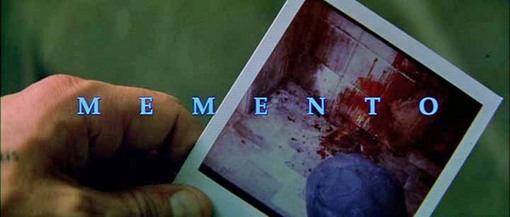
I think the first shot of Christopher Nolan’s Memento could be best described as the film in miniature because of how the subject of the shot establishes several important elements of the film. The credits begin on a dark screen. The title “MEMENTO” is still there as the shot fades in, placing the title over the image of a hand holding a photograph. Placing the title over the image of the photograph links the word and the image, telling the audience this photograph is a memento of…something.

The photograph, which is that of a man dead on the floor, his blood on the wall and floor, establishes several important things about the film. The photograph first establishes the narrative structure of the film because as it is shaken, the picture fades instead of develops. This represents how the film begins at the end of the story and progresses, so to speak, to the beginning. The fading of the photograph also establishes the mental state of its main character, the man holding the photograph, Leonard Shelby (Guy Pearce). Like the photograph, Leonard’s memory fades. He has short term memory loss, caused by an intruder who raped and murdered his wife in a home break in. His mission through the film is to find “John G,” the name he gives to the intruder. The photograph, in of itself, establishes one of the ways in which Leonard tries to keep track of people and places he will forget is to take photographs of them, writing captions underneath the picture.

December 14, 2012

Everything that’s wrong with the world in two examples

View image Forget it, Jim. It’s Whatpassesfor- logicandreasonintheworld-town.

“Something is happening here but you don’t know what it is, do you Mr. Jones?”

— Robert Zimmerman, 1965

I do not believe that the greatest evil is done by people who necessarily think of themselves as evil. Because evil doesn’t often recognize itself. In “Chinatown,” Noah Cross says: “Most people never have to face the fact that, at the right time and the right place, they’re capable of anything.” Implicit in this statement is his refusal to accept responsibility for what he has done. As he says, “I don’t blame myself.” There’s great truth in Cross’s words, and also in a corollary I’ll propose, which goes like this: “Most people refuse to face the fact that, at the right time and the right place, they can rationalize anything.” (See this post for more on that score.)

I think the most inherently “evil” person I’ve ever known, the one who did the most careless damage to people around him, was not a mere malevolent creep but someone who was pathologically clueless and could not conceive of anything or anyone beyond himself. He was a parasite, sucking the life blood out of those closest to him. His hosts — er, “friends” — eventually came to see that he considered them (if he considered them at all) insignificant — unintended consequences of himself — while people who knew him only casually (which was the best, and perhaps only, way to “know” him) thought he was just a really nice guy. He needed symbiotic relationships to feed his sense of self, and any harm to others as a result of his appetite was nothing more than acceptable collateral damage. If he was aware of it at all.

I see these patterns not only in everyday life, but in the behavior of governments, bureaucracies, businesses, public officials, and tyrants of all stripes. And I think it all comes down to that common quality of cluelessness — either obliviousness to the consequences of one’s words and actions or reckless disregard for them. Woody Allen (who, by the way, made a great movie about cluelessness, “Another Woman”) divided the world into the “horrible and the miserable.” For the sake of this essay, I would like to propose that we divide rampant worldwide insanity into Two Kinds of Cluelessness: 1) Literalism: Those who are certain they know something, but don’t know that they don’t understand it; and 2) Über-Solipsism Narcissism: Those who are certain they understand something, but but don’t know — and don’t care — that they don’t, because everything is only about them anyway.

I will always remember reading “Catch-22” at the tender age of 15, because I was already aware of this kind of insanity in people around me (family, friends, schoolmates, teachers, President Nixon and Vice President Agnew, the Watergate crew, and even — in my craziest moments — myself), but I’d never seen anybody else recognize it — and play with it — so hilariously. It was a huge catharsis for me, an acknowledgment of my pent-up frustrations, and I laughed until I cried and cried until I started laughing again.

Let me give you a pair of examples from the “Cinema Interruptus” I did with “Chinatown” in April at the Conference on World Affairs in Boulder, CO. First, let me say it was a fantastic experience for me, and that the participants in the audience were inquisitive and incisive and generally brilliant, as always.

And then there were these other two…

December 14, 2012

Akzidenz Grotesk

“Question: how many manufactured objects did you touch this morning, between waking up and leaving your house?”

— from the “Objectified” web site

Might be easier to estimate how many non-manufactured (organic and otherwise) you made contact with. From Gary Hustwit, the director of “Helvetica,” one of my favorite films of 2007, comes the most anticipated movie of the year. For me, anyway. Spring, 2009: “Objectified.” From the official site:

About the trailer: the voices belong to Jonathan Ive, Andrew Blauvelt, Marc Newson, and Karim Rashid. The song is “I Like Van Halen Because My Sister Says They Are Cool” by our friends El Ten Eleven, from their new record “These Promises Are Being Videotaped.” And the font used in the trailer is… Akzidenz Grotesk!

That would be the lead designer of the iPod and other Apple machines, the head of the Design Studio at the Walker Art Museum, the designer of Ikepod watches, and the industrial designer Time called “the poet of plastic.” It’s a movie about… design — “our complex relationship with manufactured objects and, by extension, the people who design them.” El Ten Eleven did the music for “Helvetica,” too. And Akzidenz Grotesk is, of course, a close progenitor of Neue Haas Grotesk.

Great poster, too. As you would demand from a film about design. Click below… and find the title.

(tip: MCN)

December 14, 2012

Maher vs. Mohammed

Here’s what Bill Maher said on his HBO show last Friday night:

MAHER: The most popular name in the United Kingdom, Great Britain — this was in the news this week — for babies this year was Mohammed. Am I a racist to feel alarmed by that? Because I am. And it’s not because of the race, it’s because of the religion. I don’t have to apologize, do I, for not wanting the Western world to be taken over by Islam in 300 years?

MARGARET HOOVER: If you were with NPR you’d be fired.

MAHER: Right. That’s so similar to Juan Williams, who said last week, ‘I’m nervous –‘

LAWRENCE O’DONNELL (MSNBC): No, it’s worse. It’s way worse than what Juan Williams said.¹

December 14, 2012

Sven Nykvist, 1922 – 2006

View image Sven Nykvist, behind the camera.

Roger Ebert interviewed the late master cinematographer Sven Nykvist in a fascinating visit to the set of “Face to Face” in 1975:

Sven Nykvist photographs Bergman’s films. He is tall, strong, fifty-one, with a beard and a quick smile. He is usually better-dressed than Bergman, but then almost everyone is; “Ingmar,” a friend says, “does not spend a hundred dollars a year for personal haberdashery.” Nykvist first worked for Bergman on ‘The Naked Night’ in 1953, and has been with him steadily since ‘The Virgin Spring’ in 1959. This will be his nineteenth title for Bergman, and the two of them together engineered Bergman’s long-delayed transition from black and white to color, unhappily in “All These Women” and then triumphantly in “A Passion of Anna” and “Cries and Whispers.”

Nykvist is in demand all over the world, and commands one of the half-dozen highest salaries among cinematographers, but he always leaves his schedule open for Bergman. “We’ve already discussed the new film the year before,” he says, “and then Ingmar goes to his island and writes the screenplay. The next year, we shoot — usually about the fifteenth of April. Usually we are the same eighteen people working with him, year after year, one film a year.”

At the Cannes Film Festival one year, he said, Bergman was talking with David Lean, the director of “Lawrence of Arabia” and “Dr. Zhivago.” “What kind of crew do you use?” Lean asked. “I make my films with eighteen good friends,” Bergman said. “That’s interesting,” said Lean. “I make mine with 150 enemies.”

December 14, 2012

TIFF: Monsters

Take me to the river, drop me in the water…

“The Host” (or “Gue-mool,” which sounds better) is a South Korean monster movie in which a mutant amphibious creature swims beneath the Han River, scampers among the girders beneath its bridges, prowls its sewers, and occasionally leaps onto its banks to grab some human souvenirs. The creature is just doing whatever it’s bred — or mutated — to do, but the monsters who created it, and who mischaracterize the nature of the threat, thereby making the thing practically impossible to catch or contain, are Americans — portrayed as the world’s most aggressive exporter of bureaucratic incompetence and misinformation.

In the first scene, set in 2000, a U.S. military official in scrubs (Scott Wilson — setting the funny/horrific tone for the entire movie) directs a reticent Korean subordinate to empty potently toxic chemicals into the Han. After all, it’s a big river. By the end of the film, a Senate investigating committee finds that the U.S. bungled the whole thing, and then compounded the damage by covering it up. Imagine.

Of course, the lives affected by this particular adventure in imperialistic hysteria aren’t Americans, but Koreans — in particular, the comically fractured Park family whose patriarch runs a riverside refreshment stand. On the political as well as the horror/science-fiction level, this time it’s personal. The marvelous creature (part squid, part gecko, part salamander, part sandworm, part vagina dentata, created by San Francisco’s The Orphanage), snatches the youngest Park (a uniformed schoolgirl of 13), and the rest of the clan reunites to avenge her.

Director Bong Joon-ho shifts tones with quicksilver dexterity, cannily keeping the audience (and the film) just on the edge of losing its balance and splashing into the Han. Humor turns to horror and back again in a flash, while generic requirements are both fulfilled and cleverly overturned. Even the pathos works, because it’s a little bit cock-eyed. How does the movie do all this? Must be something in the water…

December 14, 2012
subscribe icon

The best movie reviews, in your inbox