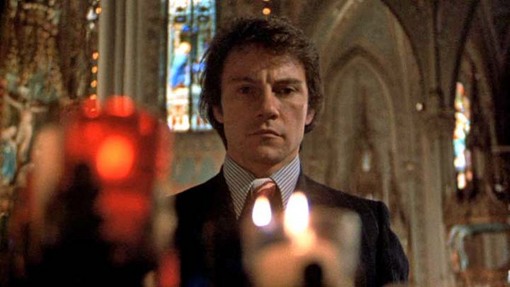
Goodfellas & badfellas: Scorsese and morality

[This was originally published at MSN Movies in 2006, but MSN has taken down their archives.]

“You don’t make up for your sins in church. You do it in the streets. You do it at home. The rest is bullshit, and you know it.”

— Charlie (voiceover by Martin Scorsese) in “Mean Streets” (1973)

If I do bad things, am I a bad person? Can I be a good person despite the bad things I’ve done? Can I compensate for the sins I commit in one part of my life by doing good works in another? Is forgiveness possible? Is redemption achievable? Or does it even matter if there’s not really anyone, or anything, watching over us and keeping track?

Those are some of the Catholic concerns that have preoccupied filmmaker Martin Scorsese throughout his career. His latest film [circa 2006], “The Departed,” is based on “Infernal Affairs,” a 2002 Hong Kong thriller directed by Andrew Lau and Alan Mak, about two moles: an undercover cop who has infiltrated a criminal gang, and a crook who is embedded in the police department. So, who’s the good guy and who’s the bad guy? Frank Costello, the gangster kingpin played by Jack Nicholson, says: “Cops or criminals: When you’re facing a loaded gun, what’s the difference?” And what about when you’re pointing one? In the cosmic sense, we’re all facing that loaded gun, and brandishing one, every day. And the difference — if there is any — is what Scorsese makes his movies about.

Watching certain Scorsese pictures today (“Mean Streets,” “Taxi Driver,” “Raging Bull,” “The Last Temptation of Christ,” “GoodFellas,” “Casino” and others), you can appreciate the ways they both reflect and question the prevailing moral climate in early 21st-century America. It’s a topsy-turvy universe in which the President of the United States himself insists that judgments about “goodness” and “badness” are not to be based upon actions, but are simply pre-existing existential conditions. Good or bad, right or wrong — it just depends on which side you’re on.

December 14, 2012

Listening to language: Our dumb media

First off, I agree with Angus T. Jones — well, about one thing, at least. The child actor of whose existence I hadn’t been aware until a few days ago said on digital video that he was employed on a lousy sitcom that was basically “filth.” Who’s going to argue? Really, is he wrong? Have you ever seen Two and a Half Men? (I admit I’ve only witnessed bits and pieces, but that was enough to get the tenor of the show. And I knew there was a “half” involved — the title tells me so — but I didn’t know Jones was it.) So, the young man says this:

December 14, 2012

Study: George W. Bush was not unintelligent

A scholarly study finds it was the 43rd president’s personality, not brain capacity, that limited his functional abilities. This is an important distinction. It is not that the former chief executive was incapable of learning (the “Bush is dumb” meme), but that he did not want to learn, and did not believe it was something he needed to do. From the research paper, “Bush’s Brain (No, Not Karl Rove):‎ How Bush’s Psyche Shaped His Decision-Making,” included in the Stanford University Press anthology, “Judging Bush (Studies in the Modern Presidency),” authors Robert Maranto and Richard E. Redding find:

… [The] best studies, in which raters evaluate statements without being aware of their source, suggest that Bush lacks integrative complexity and thus views issues without nuance. The leading personality theory (the “5-Factor Model”), as measured by the NEO Personality Inventory, suggests that Bush is highly extroverted but not very agreeable or conscientious. He also rates low on “Openness to Experience.” Similarly Immelman (2002) had expert raters judge Bush’s personality using the Millon Inventory of Diagnostic Criteria. Raters identified Bush as fitting the “Outgoing,” “Dominant (Controlling),” and “Dauntless” personality patterns, which together constitute a style given to lack of reflection, superficiality, and impulsivity.

So, in essence, what did he lack? Critical thinking skills.

December 14, 2012

Contrarian dispatch: Are critics patronizing Scorsese?

View image Critics gather ’round to watch “The Departed” on their laptops.

Is there anybody who doesn’t want Martin Scorsese to win an Oscar? Even if you don’t think “The Departed” approaches his best work? For me, his best films are “Taxi Driver,” “GoodFellas,” “King of Comedy” and “New York, New York” (and I’m very fond of most of his others, including “After Hours,” “The Last Waltz,” “The Last Temptation of Christ” and “The Color of Money”) — and I’ve written at some length about all of them over the years explaining why I think so. If I had to get hierarchical, I’d probably rank “The Departed” somewhere below “Color of Money” and above “Boxcar Bertha” — mainly because it strikes me as one of his most mechanical, least personal films. I just didn’t get the feeling his heart was in it all that much.

But, so what? Unquestionably, Scorsese deserves recognition from the Academy of Motion Picture Arts and Sciences — and, as is often the case in Oscar history, he may get it for something that does not represent his finest work. Or even the best of the year. And that’s OK. The Oscar doesn’t really have anything to do with artistic merit, but Scorsese’s a real moviemaker (he thinks in images), a longtime pro, and a movie lover to his core. The Academy should recognize him for everything he’s done for movies, not just for “The Departed.” (This would be one of those “career Oscars” — like when Henry Fonda won for “On Golden Pond” — or Al Pacino for “Scent of a Woman.”)

Which brings me to the latest issue of cinema scope (a publication with a web site that’s more attractively designed than the print version), in which Managing Editor Andrew Tracy makes an argument about “The Departed” and Scorsese that might be called, oh, I don’t know, contrarian, perhaps? Here’s the gist:

Do we really need Martin Scorsese? Heresy though it may appear, the question interrogates not so much the man’s work as its reception—and in light of his recent output, the latter is far more interesting than the former. As Scorsese’s ambitions continue to wane in the belatedly careerist, Oscar-seeking course upon which he has set himself, there is a manifest refusal to let him go the way of other filmmakers whose efforts no longer match their ability. Good filmmakers naturally inspire proprietary feelings, but Scorsese has become less a going concern than a public trust, his secular sainthood guaranteed even further by his laudable contributions to film preservation and restoration. At stake here, it seems, is not simply the fate of one director but of the cinema entire—or at least of American cinema, which in this particular discourse amounts to the same thing.

December 14, 2012

Opening Shots: ‘Accident’

View image: It starts here…

View image … and ends here. And nearly everything that happens, except for a slow movement in on the house, happens off-screen.

From Richard T. Jameson, Editor, Movietone News, 1971-81; Editor, Film Comment, 1990-2000:

The opening shot of Joseph Losey’s “Accident” (1966) begins under the main-title credits and runs for a minute or so after they have concluded. We’re looking at the front of a good-sized but hardly palatial house in the English countryside — the home, as it happens, of an Oxford don whose academic career has been less than stellar. It’s nighttime, tangibly well into the wee hours. No lights are burning, no activity within is apparent. The credits roll without musical accompaniment. On the soundtrack we detect an airplane passing overhead; onscreen, a slight alteration of perspective on the surrounding tree boughs makes us aware that the camera is slowly nudging closer to the house. After a moment, there is the sound of an automobile approaching. The noise grows loud; the engine is racing. Then, a screech of tires and the sound of impact and shattering glass, abruptly cut off. There is a further pause. Then the front door of the house opens, only a hint of light glimmering in the interior. Hesitantly, a man steps out, then begins advancing into the night. Cut to several murky shots impressionistically marking his progress as he moves toward the scene of the titular accident.

The shot, though plain as, uh, day, is remarkable for several reasons. One, of scant concern to most of us, is that with it the director and his first-time cinematographer Gerry Fisher achieved their goal of shooting a color scene that actually looks like what it’s supposed to be: a nighttime exterior as seen by moonlight, rather than a day-for-night fakeroo or some other conventional attempt to imitate nighttime via filters and technical trickery. Losey and Fisher went to extreme pains with the film lab to get the shot to look exactly as they wanted it — even though, as Losey ruefully observed in interview, they knew most theaters would bathe the screen with mauve houselights for the benefit of late-arriving seat-takers, and in any event a few passes in front of the projector’s carbon arc would soon alter the image on the emulsion.

So, technically, a real, if effectively unnoticed and ephemeral, coup.

December 14, 2012

Alien vs. Predator, Chigurh vs. Plainview

View image Is Daniel Plainview really “finished”?

I know, I’m sorry, that’s two Entertainment Weekly covers in a row, but how was I supposed to avoid mentioning this? Where’s the YouTube mash-up? I’d make it myself, but I don’t really want to. I never thought of Anton Chigurh or Daniel Plainview as “Bad Boys,” but…

From “Three Kinds of Violence: Zodiac, No Country for Old Men, There Will Be Blood” (January 25, 2008):

Like the chess-playing avatar of Death in Ingmar Bergman’s “The Seventh Seal,” to whom he has been compared, Chigurh exhibits the occasional glimmers of personality — pride, arrogance, annoyance, determination — as do Zodiac and Plainview, but he never succumbs to the latter’s fits of dudgeon. He kills not from anger, or even for money, but because it is his nature. Plainview is a petty bully, his unmanageable fury a sign of weakness that Chigurh would consider frivolous and self-indulgent. (That said, let no one suggest a “Chigurh vs. Plainview” sequel, please.)The “Alien” and “Predator” franchises are owned by Fox. Both “NCFOM” and “TWBB” are Miramax/Paramount Vantage releases (and they were both shot in Marfa, TX!). Will Javier Bardem’s and Daniel Day-Lewis’s people return the studio execs’ phone calls?

December 14, 2012

Chinatown, My Chinatown: An Andalusian Doglove poem in images and music

Eyes, frames, lenses, doorways, windows, photographs, mirrors, smoke, hands, flesh, water, power…

There are movies I count among my best friends, with whom I have loved, learned, and grown. This is one I treasure most. (Only for those who know their way around “Chinatown.”)

[notes to come]

a labor of deepest love, for Mrs. Mulwray and Gina Namkung (1937, 1974, and counting…)

… and, of course, for Matt Zoller Seitz, Kevin B. Lee, Steven Boone…

December 14, 2012

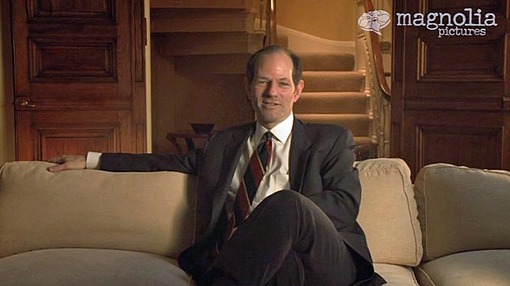
My capsule review of Client 9

“Client 9: The Rise and Fall of Elliot Spitzer” is a kind of whodunnit. Spitzer makes formidable enemies in his rise to power as New York Attorney General, stepping in to police Wall Street when the feds refused, and we meet a number of furious financial barons (some convicted, some not) who say they would have done anything in their power to bring down the bullying, egomaniacal Spitzer. In the end, though, Spitzer admits he has no one to blame for his downfall but himself. He patronized a fancy call girl service when he was governor, and resigned when he got caught.

The sad thing is that while Spitzer was a paranoid john, many of his Wall Street enemies were pimps and dealers and capital criminals. Spitzer’s crime is puny compared with the ones his opponents have gotten away with — crimes that have ruined so many lives and nearly destroyed the economy, while still making a mint for themselves.

December 14, 2012

No Country for Old Literalists

View image Something dark and shapeless approaches in “No Country for Old Men.”

“Adapted from what is generally considered a minor Cormac McCarthy novel, ‘No Country for Old Men’ is a very well-made genre exercise, but I can’t understand why it’s been accorded so much importance, unless it’s because it strokes some ideological impulse.”

— Jonathan Rosenbaum, Chicago Reader

Here’s where I agree with Jonathan Rosenbaum on the Coen brothers’ new movie: 1) it is based on a (“minor”) novel by Cormac McCarthy; 2) it is a very well-made genre picture; and 3) Rosenbaum does not understand why it has been accorded so much importance. When Rosenbaum says the only way he can account for the critical response to “No Country for Old Men” (and “The Silence of the Lambs” before it) is to assume it’s “because it strokes some ideological impulse,” I believe he means what he says even though I don’t know what he thinks he’s trying to say. [Rosenbaum responds, in comments below that “the core of my argument [is] the occupation of Iraq and the daily killings and torture that we simultaneously support and strive to ignore.”]

His review is based on the assumption, stated in the third paragraph, that “No Country For Old Men,” is a “psycho killer” movie like “Silence of the Lambs,” which it most emphatically is not. It is a genre movie, but Rosenbaum gets the genre(s) wrong. It’s a noirish crime thriller and a western and a detective story. (The Library of Congress catalogues the book under “drug traffic,” “treasure-trove,” “sheriffs” and “Texas.”) But the motives of Chigurh (Javier Bardem’s character) have nothing to do with the psychology of a serial killer like Hannibal Lecter or Norman Bates or Michael Meyers. There’s no psychologist on the scene to explain him (“What does he seek?,” as Lecter puts it), because he is not compelled to kill and he derives no pleasure from it and he does not choose his victims or his methods according to some profile or pattern.

Chigurh is out to retrieve a MacGuffin (briefcase full of cash), and he simply eliminates anything or anyone that gets in his way, using whatever means are available to him. The plain fact that he favors an efficient tool for quickly dispatching cattle (something not uncommon in Texas ranch country) reinforces how little emotion he attaches to the killing of most of his victims. He’ll just as soon strangle them or shoot them. Or maybe he won’t, if he has nothing to gain. He doesn’t fit Rosenbaum’s profile any more than he fits the ones Law Enforcement initially tries to impose upon him in the movie.

As for Rosenbaum’s confession — “I can’t understand why it’s been accorded so much importance, unless it’s because it strokes some ideological impulse” — I can only wonder what that ideological impulse might be, but it’s clear Rosenbaum does not succumb to it. Do those who accord the film importance even know that their response is based on an ideological impulse?

I remember writing something similar about “Rambo: First Blood Part II” and “Back to the Future” in the 1980s, when Ronald Reagan presented us with “Morning in America,” which meant that the way to face the present and the future was to return to an idealized fantasy version of the past. Heck, it wasn’t even too late to retroactively win in Vietnam! (Never mind that John Rambo was a psychologically disturbed Vietnam vet in the first movie.)

Rosenbaum compares Chigurh to the Misfit in Flannery O’Connor’s “A Good Man Is Hard to Find,” which is an illuminating comparison, though not necessarily for the reasons he gives:

In O’Connor’s vision, perfectly captured in a mere 16 pages, the Misfit is an emblem of religious despair, but in the less considered genre mechanics of Cormac McCarthy and the Coens, religious despair is nothing more than an alibi for violence. It’s invoked as a way of covering all the bases, tapping into fundamentalist fatalism without really buying into it.”Religious despair”? “Fundamentalist fatalism”? Loaded terms, but they reflect a very limited reading of O’Connor and McCarthy and the Coens, of “A Good Man Is Hard to Find” and “No Country for Old Men.” Perhaps if Chigurh needs to be reduced to an “emblem” of something, it’s ruthless, indifferent force in the single-minded pursuit of any goal (religious, financial, political, genocidal). Some people would define that as the nature of “evil.”

I’ve read two or three other bewildered reviews of “No Country for Old Men” that concentrate on the plot and/or Javier Bardem’s haircut, or how the stuff they think is supposed to be funny isn’t funny to them. And everybody — even those who really don’t approve one bit — want to assure their readers that the Coens and DP Roger Deakins are technically proficient, which tells us almost exactly nothing except that they think it has “beautiful cinematography” or something equally meaningless. But, fine, if that’s what somebody feels the need to write about in response to this movie, then that is evidently what they have to say about it, and that’s that.

I have more to say, but I would like to refresh my memory of the movie, which I saw once last September near the beginning of the Toronto Film Festival. Here’s something from my initial (preemptively defensive) response back then:

“No Country for Old Men” is one of those movies I think provides a critical litmus test. You can quibble about it all you like, but if you don’t get the artistry at work then, I submit, you don’t get what movies are. Critics can disapprove of the unsettling shifts in tone in the Coens’ work, or their presumed attitude toward the characters, or their use of violence and humor — but those complaints are petty and irrelevant in the context of the movies themselves: the way, for example, an ominous black shadow creeps across a field toward the observer (“No Country” has a credit for “Weather Wrangler”); or a phone call from a hotel room that you can hear ringing in the earpiece and at the front desk, where you’re pretty sure something bad has happened but you don’t need to see it; or the offhand reveal of one major character’s fate from the POV of another just entering the scene; or… I could go on and on. To ignore such things in order to focus on something else says more about the critic’s values than it does about the movies. It’s like complaining that Bresson’s actors don’t emote enough, or that Ozu keeps his camera too low.Those words were written in the thrall of the movie, and I stand by them. Rosenbaum begins his review with a quote from George Orwell:The first thing we demand of a wall is that it shall stand up. If it stands up, it is a good wall, and the question of what purpose it serves is separable from that. And yet even the best wall in the world deserves to be pulled down if it surrounds a concentration camp.So… “No Country For Old Men” should be pulled down because it is a cinematic concentration camp? What of those who don’t recognize a good wall when they see it, and mistake it for something it is not? What if they think they’re pulling down a concentration camp wall, but it’s actually a New Orleans levee and there’s a hurricane on the way? What if they think it’s a terrorist outpost and they bust down the walls only to discover it’s really the home of an Iraqi family? What if the sturdy walls and magnificent arches of the Mezquita de Cordoba are left standing after the Moors are vanquished and the Christians build an elaborate Baroque Cathedral smack in the middle of the mosque?

Enough word games. More later…

December 14, 2012

Don’t forget it, Jake: It’s Chinatown in Boulder!

View image: My Polish “Chinatown” poster, designed by Andrzej Klimowski.

For more than 30 years, Roger Ebert has led a theater full of people in a group analysis of movies at the Conference on World Affairs at the University of Colorado in (the People’s Republic of) Boulder. The film is shown in its entirety on Monday, the first day of the Conference (this is called the Uninterruptus), and then Roger goes over it with the audience — shot by shot, as it were — for two hours a day, Tuesday through Friday. This is called the Cinema Interruptus. Anyone can shout out “Stop!” to make an observation or ask a question or back up (slightly) at any time, and it’s amazing what people come up with. As Roger always says: “Someone in this room has the answer to any question you can come up with.” Or, if they don’t, they will have it the next day.

Over the last few years — at the CWA and on the Floating Film Festival — I’ve seen Roger go through “Citizen Kane,” “The Third Man,” “La Dolce Vita,” “The Long Goodbye,” “Adaptation.” (there’s a period in the title) and others. Other films he’s presented and analyzed with the audience in Boulder include “Amarcord,” “Taxi Driver,” “Casablanca,” “Raging Bull,” “3 Women,” “Out of the Past,” “The Silence of the Lambs,” “The Treasure of the Sierra Madre,” “JFK,” “Pulp Fiction,” “Fargo,” “Fight Club,” “Vertigo,” “Mulholland Drive,” “Floating Weeds,” “Dark City” and “The Rules of the Game.”

It’s a priceless experience to really watch a movie this way — and it increases (sometimes exponentially) your appreciation of the film, because even if you’ve seen the movie before, there’s always something you’ve never noticed, or some dots you hadn’t previously connected.

Although it’s hard for me to imagine the CWA without Roger, he won’t be able to attend this year. So, I’m filling in, and will be guiding the Interruptus through one of my favorite films, Roman Polanski’s “Chinatown”, — among the all-time great movie masterpieces and the ultimate Los Angeles film noir, in sun-baked Panavision color (and no less sinister for it). So, if you happen to be near Boulder, Colorado in a few weeks (April 9 – 13, 2007), come by Macky Auditorium on campus at 4 p.m. and join us to sit in the dark and talk about detective movies, noir, the history of LA, the Department of Water and Power, William Mulholland and the St. Frances Dam catastrophe, Johnny LaRue, eyes, doors and windows, venetian blinds, orange groves, fish, monstrous evil, kitty-cats, and the nose on your face. (And that’s just for starters.) It’s free, and, as they say, so much fun it’s a wonder it’s still legal.

December 14, 2012

The Ultimate Movie Quiz (and Free Personality Inventory!)

The Van Helsing Quiz at Sergio Leone and the Infield Fly Rule.

Some of you thought my “101 102 Movies You Must See Before You Die” list was a little too, well, rigorous. I still think it only covers the basics of what you need to have seen (and appreciated) in order to hold your own in intelligent conversations about movies these days. Maybe that makes me (shudder) an “elitist.” Ahem. I think it just means I have standards.

But whether you find my list off-putting or not, you may enjoy “The Van Helsing Quiz” over at one of my favorite personal movie blogs, Sergio Leone and the Infield Fly Rule, which you will also find in my permanent list of favored links in the column at right.

Owner/proprietor Dennis Cozzalio posted the quiz itself back in April. There, you can see it in its un-filled form. But a month later, Cozzalio himself submitted to the quiz, and his answers are even more entertaining and provocative than the naked quiz.

December 14, 2012

It’s not nice to call a superhero a “unitard”

Or: Do comic-book movie blog posts display traffic superpowers?

New York Times film critics A.O. Scott and Manohla Dargis held a discussion of comic-book movies and that subset known as “superhero movies” in advance of the Marvel re-boot, “The Amazing Spider-Man,” which opens Tuesday, July 3. (The article will appear in the paper July 1, but is now online.) This, I think, goes to the heart of the matter:

SCOTT:What the defensive [superhero] fans fail or refuse to grasp is that they have won the argument. Far from being an underdog genre defended by a scrappy band of cultural renegades, the superhero spectacle represents a staggering concentration of commercial, corporate power. The ideology supporting this power is a familiar kind of disingenuous populism. The studios are just giving the people what they want! Foolproof evidence can be found in the box office returns: a billion dollars! Who can argue with that? Nobody really does. Superhero movies are taken seriously, reviewed respectfully and enjoyed by plenty of Edmund Wilson types.

I’ve made some of these arguments many times before, but the one that really stands out for me here is the seriousness with which mainstream critics and intellectuals now approach comic books and comic-book movies. That’s unprecedented. Distinctions between popular culture and high culture aren’t nearly as rigid as they used to be. Movies that would once have been treated as nothing more than commercial entertainment products are now given serious consideration as artistic achievements. Because they can be both at the same time.

December 14, 2012

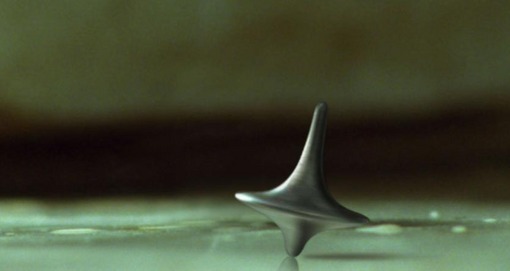
Inception theories: Two key shots and others’ thoughts

“If the career of Christopher Nolan is any indication, we’ve entered an era in which movies can no longer be great. They can only be awesome, which isn’t nearly the same thing.”

— Stephanie Zacharek on “Inception”

Well, people certainly want to talk about “Inception” on the Internet. The opening lines to Stephanie Zacharek’s review above may sound flip, but she’s zeroing in on something crucial about the kinds of spectacle movies to which we have, perhaps, become accustomed. I remember having an argument with some younger friends back in 1994 over Roland Emmerich’s “Stargate,” which I found inert and lugubrious, but my friends enjoyed for what they called “visual splendor.” (I don’t remember how baked we were at the time.) As I believe I said back then, I’m all for visual splendor, but I don’t go to narrative movies for (just) a light show, no matter how splendiferous. (I’d rather watch Stan Brakhage for that kind of thing.)

In my hastily keyboarded notes after seeing “Inception” last weekend, I began by saying the biggest disappointment for me was that it was so contrived and remote — like a clever mechanical puzzle, but not at all dreamlike. Even more disappointing for me, I didn’t feel I had much of interest to say about it. Now, more than 200 reader comments later, I find it more fun to theorize about than it was to watch. (Seems awfully anal and pedantic for a “summer movie.”) In that post and the previous one about “Signs” and “The Prestige,” I wound up writing more in response to comments than I did in the original post, and I really enjoyed the back-and-forth. (But if you want to spare yourself my expanded thoughts — and others’ — here about what doesn’t work in the movie and read more about the implications of two of the most important shots, spoilers and all, feel free to skip to the numbered boldfaced headings below…)

December 14, 2012

Opening Shots: ‘Cat People’ (1982)

View image

From Andrew Wright, The Stranger:

Cinematic brimstone manna for pubescent Cinemax viewers, Paul Schrader’s unjustly neglected 1982 remake of “Cat People” leaves the watcher uneasily poised somewhere between needing a wet-nap and a steel-wool shower. Working again with “American Gigolo”‘s visual consultant Ferndinando Scarfiotti, the director’s interpretation of the wittily Freudian source material is chock full with the promise of tantalizing sex and violence, which is ultimately delivered so nastily that it’s difficult not to feel guilty for enjoying it. Schraeder, a dude who knows a thing or three about temptation himself, here delivers one lulu of a cautionary tale: What you want to see may not really be what you want to see, no matter how much you think you want to see it.

Nowhere is this poisoned voyeurism more evident than in the opening shot, which quite literally unearths the film’s joint fascination with turn-ons and snuff-outs. Beginning with a patch of hallucinatory, nuclear-Antonioni colored desert, a wind slowly, sensually, blows across the surface of the sand to reveal a polished human skull, and then another, and another, and yet another, until an entire boneyard is uncovered. All this, while David Bowie and Georgio Moroder are moaning orgiastically on the soundtrack. Just writing about it, I want a cigarette. And a hairshirt, possibly.

JE: Muchas gracias, Andy. That ultra-lapsed Calvinist Schrader does indeed know something about putting out a fire with gasoline. I haven’t seen his “Cat People” in, let’s see, 24 years, and all I remember about it is the Bowie song and the way somebody jumps, catlike, onto a table or something. That image you sent sure is purrty, though…

December 14, 2012

Chasing the image: Office spaces

View image: “The Crowd” (King Vidor, 1928)

View image: “The Apartment” (Billy Wilder, 1960)

View image: “The Rapture” (Michael Tolkin, 1991)

View image: “Fight Club” (David Fincher, 1999)

View image: “Office Space” (Mike Judge, 1999)

Ken Wiley, a jazz historian and musician, has a radio show called “The Art of Jazz” that airs Sunday afternoons on my favorite station, KPLU-FM in Seattle (and online at Jazz24). He has a reocurring feature in which he chases down a musical element — a melody, a set of chord changes, developments on a solo — through a number of records. I’ve often wanted to do something similar with movies, and in researching my MSN Movies feature, “Wither While You Work” (Dave McCoy came up with that headline; I wish I had), a few ideas occured to me.

This one starts with King Vidor’s great 1928 “The Crowd.” The camera climbs up the side of a skyscraper (a miniature) looks through a window and a dissolve takes us to an overhead shot of an enormous diagonal grid of desks, emphasizing the regimentation and depersonalization of working life in the big city.

In one of the most famous homages in movies, Billy Wilder paid tribute to Vidor at the beginning of 1960’s “The Apartment” with a tilt up the side of the building and a dissolve to the famous image of the sea of desks. Wilder shoots it straight on, from above desk level, but keeps both floor and ceiling in view, the receding lines of desks and fluorescent light fixtures converging into infinity. The scale is so immense, it’s funny. Later, when 5:20 p.m. arrives and the bell rings, everybody gets up, places covers over their adding machines, puts on their coats and goes home… and another dissolve shows us C.C. Baxter (Jack Lemmon) all alone in this vast office space, knowing there’s no point in heading back to his apartment just yet.

Michael Tolkin’s “The Rapture” opens with a maze of modern cubicles at a directory assistance facility. (And, yes, this is soon to be an Opening Shots entry.) Tolkin actually moves into the maze, rather than simply surveying it from above. The camera begins by rising above a cubicle wall in the foreground, then moves across to the left, down one of the paths, then back to the right until it floats over another cubicle wall and comes to rest nearly on top of Mimi Rogers’ monitor. (You may be able to spot her if you enlarge the accompanying image here — she’s in the fourth box back, just right of center.) Notice how Tolkin also uses the overhead lighting to add forced perspective, a sense that the room extends even further than it actually does. And the lighting is so muted that the shot almost seems to be in black and white.

In “Fight Club,” Edward Norton’s anonymous narrator stands in front of a copier and describes experiencing the world through his depression as being like seeing “a copy of a copy of a copy.” He’s placed his Starbuck’s coffee on the copier in front of him, and it rides back and forth on the top. When we look out at the office from his POV (fixed perspective), his copier lid moves back and forth in the foreground. Three people, also standing in front of copiers at perpendicular angles to the camera, are drinking their Starbuck’s simultaneously, moving every bit as mechanically as the office machines. A man pushing a cart comes in from the left and moves in perfect sychronization with the foreground copier motion. The whole world has become a grid, populated by monochromatic automatons.

That’s the same feeling conveyed by the relatively short, stationary shot in Mike Judge’s “Office Space,” where Peter (Ron Livingston) comes to work and passes across the screen in the foreground from right to left (not unlike the copier lid in “Fight Club”). This one, especially, reminds me of newspaper newsrooms I’ve worked in. Again, the lines of the cubicles and the fluorescent ceiling lighting converge in the distance. Whenever I see this image now, I’m reminded of dominoes — how one thing leads to another and Peter and his friends from the office eventually knock down these walls, literally and figuratively.

December 14, 2012

Dexter: Putting it together

View image

View image

View image

(December 7, 2007: Re-submitted as a contribution to the ‘Short Film Week’ Blog-a-thon co-hosted by Only the Cinema and Culture Snob.)

(This is another contribution to the Close-Up Blog-a-thon at the House Next Door.)

Creating, assembling, integrating, asserting, and maintaining a personality is routine for most of us, but there’s no denying it’s hard work. Some of us have to do it from scratch every day. That’s what so chillingly magnificent about the opening credits sequence for Showtime’s “Dexter.” It shows a man putting himself together (piece by piece, close-up by close-up) in the course of enacting his morning rituals. Yes, there are plenty of playful groaners about knives, flesh, and blood. Dexter is a serial killer — albeit one who’s trying to use his control-freak instincts to keep his habit manageable, within certain ethical boundaries, even as he daylights in forensics for Miami homicide. (He’s a blood-spatter expert, naturally.)

View image

View image

We recognize his daily rites as things we all do every day, but they’re rendered in such garish (Miami!) colors and macro-close-ups that they appear to us grotesque and purified, ultra-specific and abstractly universal, at the same time, like Pop Art. Even the messy parts look like Abstract Expressionism (like the blood spatters Dexter hangs as art above his desk at work), from the collection of Dexter Morgan. His most valued collection, however, consists of the blood slides of his victims, which he keeps neatly and discreetly filed in a box inside the air conditioner.

The credits gallery is accompanied by jaunty/menacing music that’s both spicy Latin in flavor and creepy Gothic in sensibility. A guitar/kalimba/harpsichord sound. Sassy/sinister horns punctuate the mocking melody with bleats, cackles and growls. It’s like the “Addams Family” theme played by a Mexican Day of the Dead band of mâché skeleton musicians. Who are, no doubt, Cuban immigrants.

View image A dash of Abstract Expressionism.

View image

View image

The first time you see it (the titles sequence wasn’t used in the initial pilot episode), it tells you everything you need to know about the character. Every time after that, it immerses you into the world of the show, like the best opening montages that took you by the eyelids and pulled you into “Twin Peaks,” the New Jersey of “The Sopranos,” the muddy shit-hole mining town of “Deadwood.”

It begins with an extreme close-up of a mosquito (like Dexter, a blood-sucking predator). SMACK! Dexter swats it and we rack-focus down his extended forearm and notice his face — still fuzzy, abstract, in semi-darkness, cheek against the mattress. The hint of a satisfied smile. Another kill, another day. Good morning! Time to rise and shine. Let’s begin with a shave: Huge fingertips brush over wire stubble; the flesh beneath the bristles is elastic, alive. Shaving gel: Yes, it looks like semen. This is a show about bodily fluids. (And about performing.) A trickle of blood runs flows into the top of the frame and down the tender skin of the neck. A drop — twothree — splatters near the drain in the sink. (We have other Jungian — er, Hitcockian — memories of blood and drains, don’t we?) A piece of tissue soaks up the red from the nick…

December 14, 2012

Re-imagining the fate of the Holy Grail of cinephilia

Dave Kehr’s blog (where you’ll find some of the best discussions about film on the web) is sub-titled “reports from the lost continent of cinephilia.” As far as I’m concerned, the Holy Grail of the lost continent of cinephilia is the vanished footage from Orson Welles’ “The Magnificent Ambersons.” (You know the legend: The studio re-shot and re-cut the film to make the ending more, uh, “upbeat” while Welles was off in Rio shooting Carnival footage for “It’s All True.” The discarded portions of Welles’ “Ambersons” were lost — possibly dumped into the ocean.) Well…

At MUBI, Doug Dibbern has composed a magnificent meditations called “Cinephilia, the Science of Hope, and the Sacred Ground beneath the Grapeland Heights Police Substation in Miami, Florida” in which he fantasizes about obscure objects of desire — movies seen and unseen (and perhaps unseeable) — including the lost “Ambersons.”

Dibbern begins with Dario Argento fantasies and works his way to Ambersons and a police station in Florida:

December 14, 2012

En garde! Blood on film

Blood on film (representational). From “The Wire.”

Girish Shambu has proposed an “Avant-Garde blog-a-thon,” and there are some terrific entries, all of which are linked to from girish’s own illuminating post about the films of Joseph Cornell, who, he writes, “is sometimes cited as the foremost American Surrealist artist but he was never a card-carrying member of the movement, but instead more of a fellow traveler.” I knew nothing about Cornell, except that he is among the filmmakers represented in the spectacular box set, “Unseen Cinema – Early American Avant Garde Film 1894-1941” (which I have seen — it’s a pretty package! — but not yet watched). Now I’m going to go straight to his stuff when I get the box. You should check out Richard T. Jameson’s thrilling introductory essay on Amazon.com, which begins:

Avant-garde cinema remains unseen for all sorts of reasons. Because it’s rare. Because it’s elusive. Because the mainstream distribution and exhibition apparatus is not designed to serve it (and, arguably, to a large extent is designed to suppress and deny it). Because people–that vast army of us proud to be unpretentious “regular moviegoers”–basically don’t want to see it, fearing that it’s esoteric and challenging and probably boring. These are excellent–which is to say, very real–reasons. Except that, as of autumn 2005, they’re obsolete. All but the personal-resistance part, anyway. Now, thanks to Anthology Film Archives, curator Bruce Posner, and the cooperation of the world’s foremost film museums, anybody with a DVD player can make the acquaintance of 20some hours of definitive avant-garde film experiences through this often dazzling seven-disc set. And whaddaya know: a lot of “unseen cinema” turns out to be fascinating, thrilling, spectrally beautiful, tantalizingly mysterious–in a word, eye-opening, to both the art of film and the world we all share.Perhaps the most deceptively avant of the Avante-Garde blog-a-thon entries, though, is Andy Horbal’s at No More Marriages!. After a three-part introduction (“I made a mess, but in the spirit of solidarity I’ve decided to just post the mess!”), he writes about three works:1: Turner Classic Movies’ “Sunny Side of Life” Intro

2: The CBS Broadcast of the 2005 NCAA Men’s Basketball Tournament Elite Eight game in which Patrick Sparks hits a buzzer-beater three to send the game into overtime

3: The “Good Eats” episode “Raising the Bar”

Horbal began with more traditional avant inspirations:My original idea was to write about “non-vegan films.” I was thinking about Thorsten Fleisch’s rather shocking “Blutrausch” (“Bloodlust”) which Fleisch made by applying drops of his own blood directly to film stock and Stan Brakhage’s “Mothlight,” which Brakhage made by affixing bits of dead insects and leaves directly onto a film strip. Then my friend Brian Taylor (Don’t Kick Food!) reminded me that celluloid used to be made with gelatin, so in a sense all films made before a certain point were “non-vegan films.” And then I thought, Where am I going with this?Where he goes is a journey worth taking.

December 14, 2012

Anne Boleyn vs. Abbie Hoffman vs. the Nazis

View image Activism as political cartoon: “Chicago 10.”

My reviews of “Chicago 10, ” “The Counterfeiters,” and “The Other Boleyn Girl” are in the Chicago Sun-Times and RogerEbert.com. Guess which review this is from:

Mary Boleyn: “You know I love him.”

Anne Boleyn: “Well, perhaps you should stop.”

Sassed her, Pussycat! Kill! Kill!

If Russ Meyer had made “The Other Boleyn Girl,” Anne and Mary Boleyn would have yanked some hair, scratched some eyeballs, walloped each other in their respective kissers, and the movie would have been all the better for it. Just imagine: “Beneath the Valley of the Tudorvixens”: Meee-oww!

As it is, “The Other Boleyn Girl” is a sullen genre picture, hardly as vivacious as Meyer’s uncategorizable sexploitation films, and not as edifying, either. It’s built on sturdy old generic conventions, as familiar as those in any slasher film or naughty-nurses potboiler.

December 14, 2012
subscribe icon

The best movie reviews, in your inbox