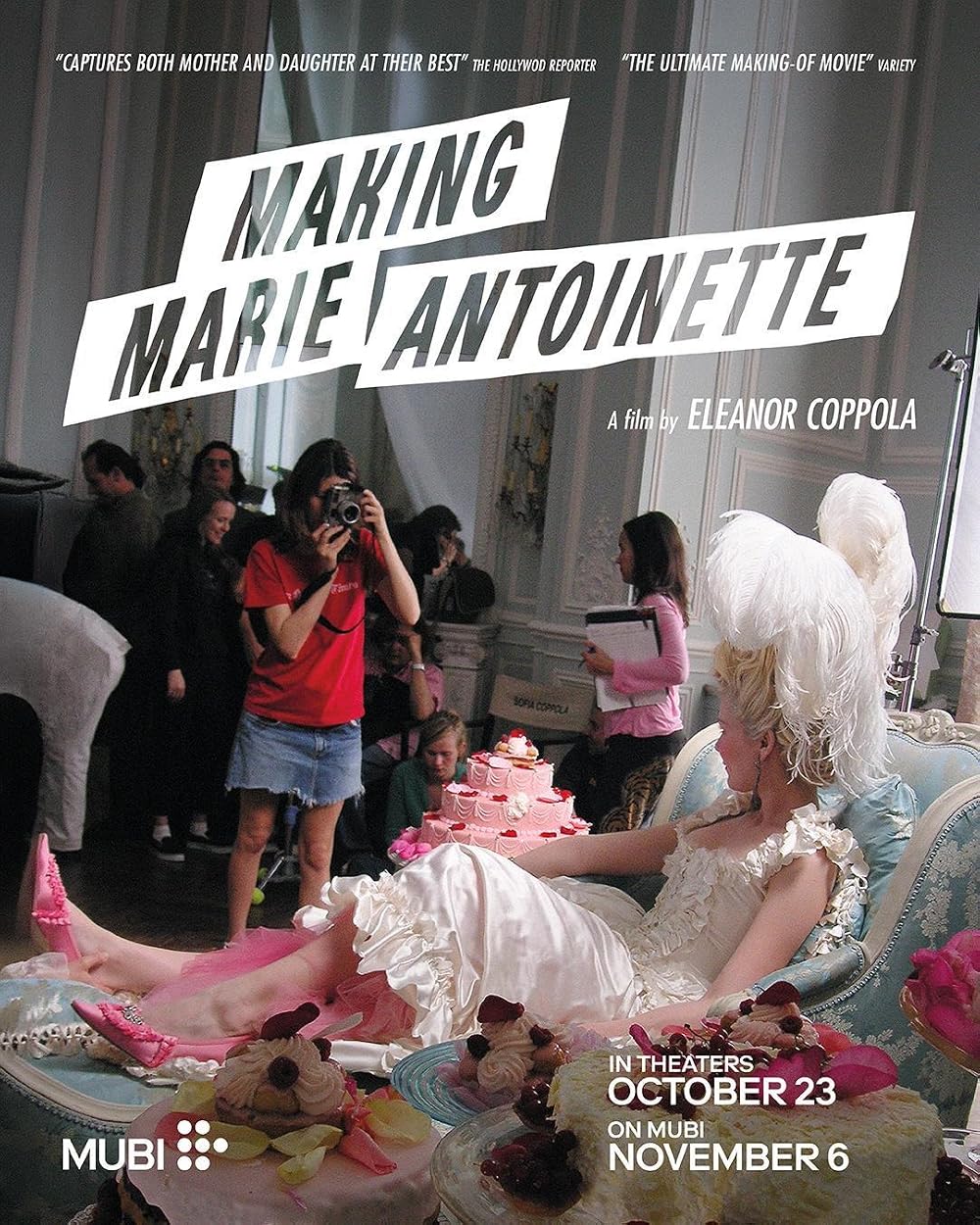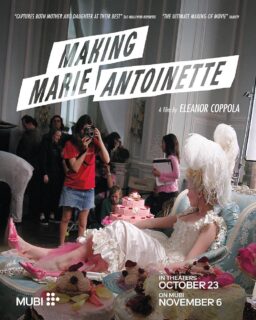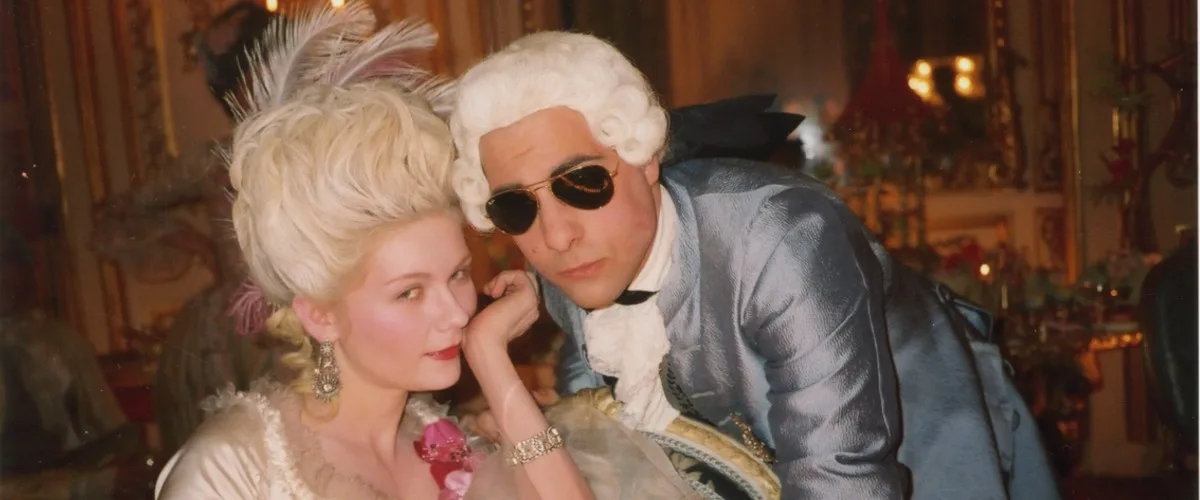
In 2005, Eleanor Coppola shot about 80 hours of behind-the-scenes footage chronicling the production of “Marie Antoinette,” the third film directed by her daughter, Sofia. While a bit of that footage eventually turned up in a making-of feature that appeared on the film’s original DVD release following its 2006 debut, the vast majority of it sat unseen and unused until 2020, when the two decided to take advantage of the COVID lockdown to go through the footage and assemble it into a feature film, with Sofia bringing the project to completion after Eleanor’s passing in 2024. (Eleanor is given sole directorial credit.)
Although the resulting film, “Making Marie Antoinette,” may initially seem like a peek behind the well-appointed curtains aimed primarily at the original’s fan base that has grown over the past two decades, it proves to be much more than that. It quietly, and at times movingly, offers observations ranging from the artistic process to the struggles female filmmakers still face even after theoretically proving themselves. We also see the bond between the two Coppolas, both as mother and daughter and as artists pursuing their respective crafts.
As was the case with Sofia’s first two films, “The Virgin Suicides” and “Lost in Translation” (for which she won the Oscar for Original Screenplay), “Marie Antoinette” was, at its heart, a character study of an isolated young woman trying to find her place in the world, a theme that continues to crop up in her subsequent works.
Unlike those other projects, this one would be produced on a far grander scale than anything she had previously experienced—not only would she be working under the auspices of a studio for the first time and playing with a $40 million budget, but she had been granted permission by the French government to shoot at no less of a locale than the actual Palace of Versailles.
In addition, she would be working with a large and absolutely stacked cast of actors led by Kirsten Dunst in the title role and an equally impressive army of people behind the scenes ranging from costume designer Milena Canonero (whose creations would win the film its only Oscar) to those charged with creating the elaborate floral arrangements.
Eleanor previously filmed behind-the-scenes footage chronicling the legendarily difficult production of “Apocalypse Now,” the 1979 Vietnam War epic directed by her husband, Francis Ford Coppola, which served as the foundation for the jaw-dropping 1991 documentary “Hearts of Darkness: A Filmmaker’s Apocalypse.” On the surface, what she captures here is nowhere near as tumultuous as the previous film.
That said, for all of the relative serenity that we see, including moments where we see Jason Schwartzman noodling away on an organ, Asia Argento reading palms between takes, and the always-awesome Marianne Faithfull inducting Sofia in the “Marianne Faithfull School of Bad Living,” there are tensions at hand that Eleanor ends up capturing with unerring clarity.
For Sofia, Marie Antoinette was someone she could genuinely relate to in several ways, including growing up as part of a cinematic royal family and enduring intense, largely undeserved public scorn after appearing in “The Godfather Part III.” As a result, she wanted her take to be personal, not just another typical costume drama. (“I’m scared of making Masterpiece Theatre,” she remarks at one point.)
Early on, we see Sofia try to adapt her admittedly low-key directorial approach to this much grander production, with the usual production snafus, plus a case of bronchitis that hits her early and saps her energy. She also faces the kind of obstacles women in overwhelmingly male-dominated industries face. The same people who are theoretically there to help serve her vision instead second-guess certain creative decisions and offer ideas that, however benignly intended, would end up diluting her very specific approach.
In a voice-over comprised of journal entries written during the production and read by Diane Lane, Eleanor worries about whether Sofia will be able to stand up to all this and then looks proudly as her daughter manages to persist in her aim to make what she herself refers to at one point as “the girliest movie ever.” (That said, towards the end, Sofia admits “I’ve learned not to make big movies.” Indeed, her subsequent projects, even period pieces like “The Beguiled” (2017) and “Priscilla” (2023), have all been considerably smaller in size.)
One of the more intriguing elements of “Making Marie Antoinette” is that, beyond observing one artist at work, it also shows, through Eleanor, the stirrings of another. She muses about spending nearly her whole life on the sidelines in a family filled with artistic types, never really considering doing anything of her own. But watching Sofia at work, she sees not just a proud parent watching her child create, but a female artist quietly but firmly determined to make her voice heard. This makes her wonder why she has set her own creative impulses aside and whether it is too late to finally explore them.
Indeed, the spark we see struck here would bear fruit a decade later, when Eleanor, at 80, released her first narrative feature, 2016’s “Paris Can Wait,” and followed it four years later with “Love Is Love Is Love.” In the end, the film celebrates as much Eleanor and her indomitable spirit as it does Sofia’s, and it’s all the better for it.
For the most part, “Making Marie Antoinette” is just that. It concludes with the end of production and does not go into the film’s tumultuous reception (including those who critiqued its use of modern touches and a soundtrack filled with fizzy New Wave hits to underline the notion that Marie was essentially just an ordinary teenager thrust into an extraordinary situation) or the reappraisal it has received in subsequent years.