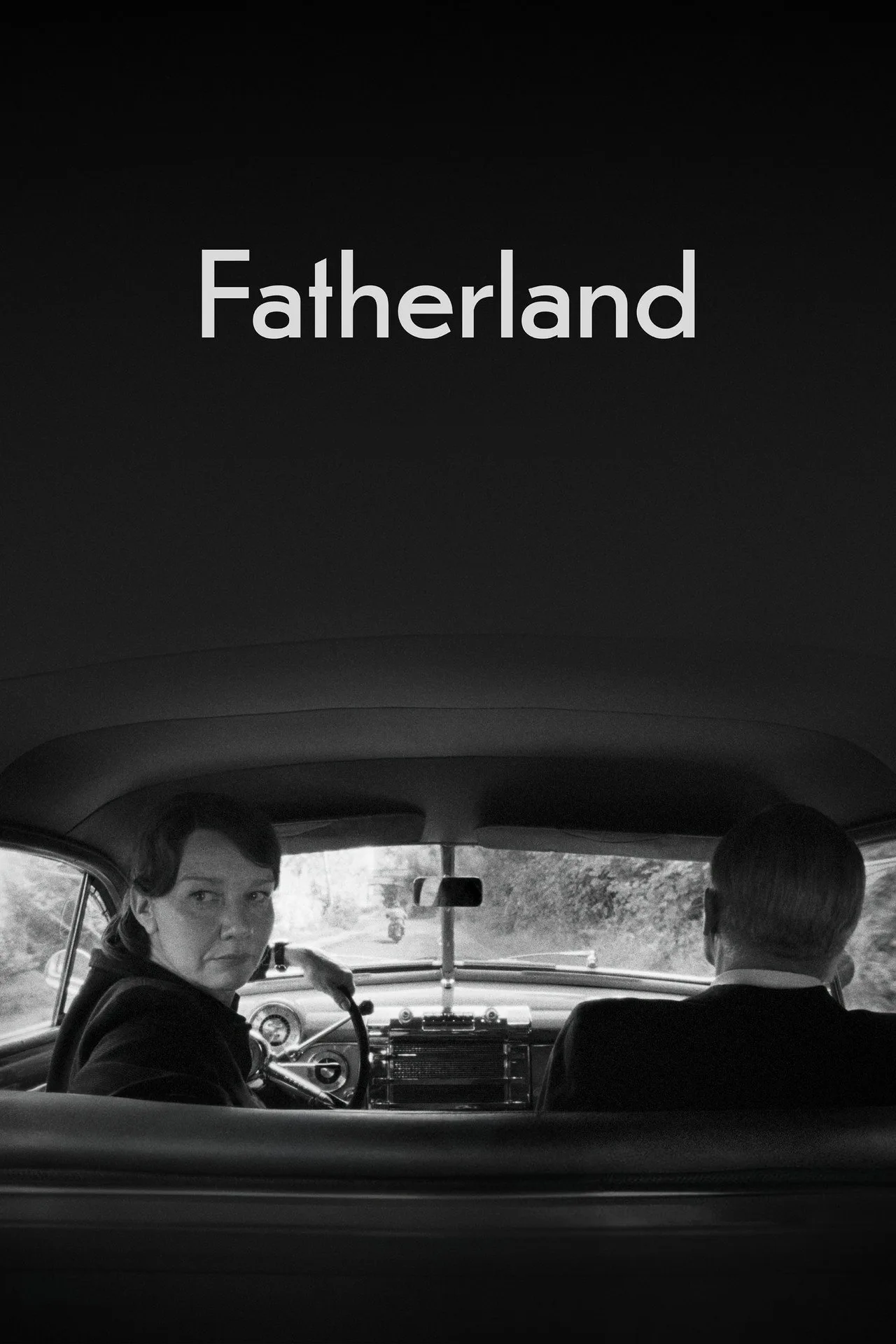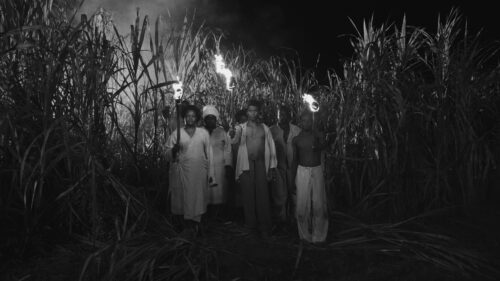

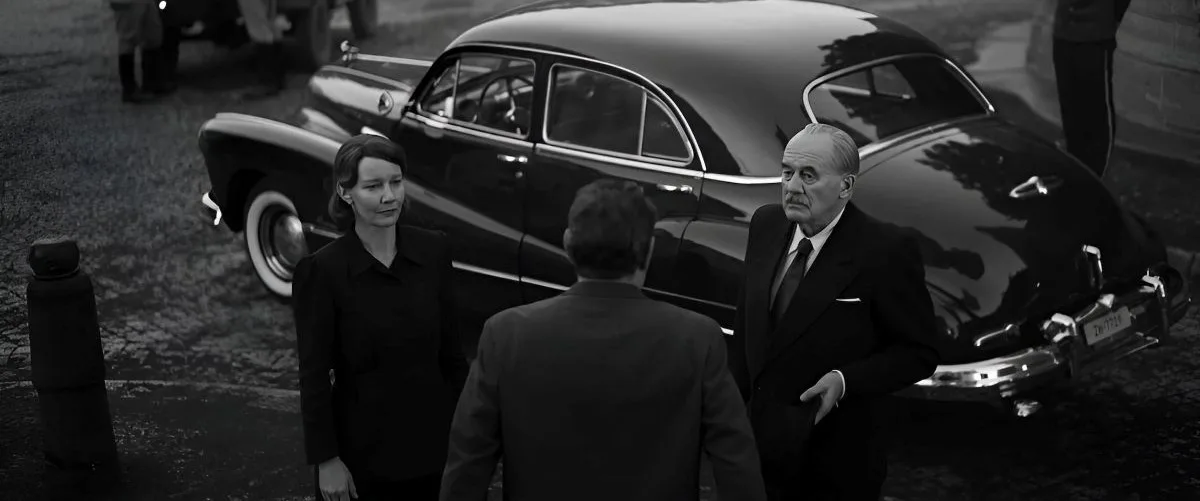
To watch Paweł Pawlikowski’s eloquent drama “Fatherland” is to commune with an artist in full command of his medium. The film, shot in luminous gray scale, continues the director’s recent interest in the damage present in post-World War II Europe, as expressed earlier in “Ida” and “Cold War,” and which finds greater urgency in “Fatherland.” Its simple bifurcated structure belies its complexity: Pawlikowski locates today’s pains in the fractured past and considers the parallels between a country’s separation and the ineffectual rootlessness of both family and intellectualism.
Taking place in 1949, the historically inspired story sees the self-exiled Nobel Prize-winning writer Thomas Mann (Hanns Zischler) returning back to Germany to accept the Goethe Prize. Mann and his family last stepped foot in Germany in 1933 before leaving to America to escape Nazism. Since then, he’s become an American citizen, and Germany has not only lost the war, but it’s also been split into a communist-socialist East and a capitalist West. That bisection also divides Mann—a thinker who often contemplates the difference between what we call home and where we belong—and therefore causes a schism between himself and his children. That instability animates the film’s metaphorical title: when belonging is severed, the younger generation can only become lost, disaffected and nihilistic.
While Mann is the symbolism that frames the film’s philosophical questions, the story’s heart actually resides in his dutiful daughter Erika (Sandra Hüller) and her wayward brother Klaus (August Diehl). Pawlikowski and Hendrik Handloegten’s subtle script quietly gives both siblings their backstories without pounding us over the head. Erika is a former war correspondent whose current anti-capitalist politics make her persona non grata in the US (she’s been denied citizenship three times, despite living there). Klaus is based in Cannes, having seen his writing, he penned Mephisto—a novel about an actor who gives himself to Nazism—banned in Germany. Both are miserable in their own way, but Klaus, who’s openly gay and a drug addict, appears to feel especially hopeless.
The film’s opening scene, in fact, is a portrait of emotional isolation and political anguish. A naked Klaus in Cannes sits bedside on his phone, talking with Erika in America. She wants him to return to Germany to celebrate their father, but Klaus is resistant. He doesn’t respect his father, and he certainly doesn’t abide with his now-divided country. The camera remains fixed on Klaus in a wide: we see his male lover lying and waking from sleep in the background and Klaus’ naked, contorted body trapped in the foreground as the rain beats down outside (a sonic queue that’ll become paramount later). Upon hanging up, he promises Erika he’ll think about it. The action then cuts to Erika, sitting alone in the dark in her family’s sleek, modern LA apartment. She gets up to go to her father’s room; the camera smoothly pans with her. This is one of the few times Pawlikowski and his trusted cinematographer Łukasz Żal will move their gaze. “Fatherland,” tellingly, is a visually static film, matching the trapped nature of its characters.
Pawlikowski and Żal instead derive psychological and thematic meaning from the striking compositions they compose. When Erika and her father arrive in West Germany, they are greeted by an adoring crowd and reporters. In East Germany, they’re greeted by state-backed choirs and propagandists. On its face, the differences are stark between the mostly intact but worn political and physical architecture of the West and the crumbled designs of the East. Both sides, nevertheless, see Mann as a symbol capable of granting legitimacy to the way of life of each region.
Mann, Erika, and Klaus are all emblematic of the ineffectualness of intellectualism within governments and systems that are, in their own way, rotten. Mann, for instance, is usually captured sitting in corners of the room, looking small, his visage split by the chiaroscuro. Erika is similarly isolated in frames that are parted by columns. Klaus, meanwhile, remains confined in his few scenes and separated from his family in others by distance and existence. All of them watched their country reject their work only to now see these same governments twisting their writing to burnish their own nationalistic legitimacy. In that sense, not much has changed on either side of Germany. Through these people, Pawlikowski is questioning what role and how much power the artist and the thinker hold among people devoid of true curiosity.
Hüller translates that ineffectualness in a forceful performance, which, initially, might appear to be not as impressive as her transformative turn in this year’s “Rose.” Here, her guarded physicality and pensive relationship with the camera give each frame the meaningful weight of mourning. Her work with Zischler also provides the full breath of this father-daughter relationship through action rather than dialogue, explicating her devotion to him and the pain and feebleness he feels in the face of these governments and in the loss of Klaus.
Both actors lay the groundwork for what might be Pawlikowski most beautiful ending, which takes place in a derelict church in no man’s land, where an organ plays Bach’s chorale “Jesu, Joy of Man’s Desiring.” Only here can the family be reunited; only here can Mann and Erika acknowledge what was lost, the casualties of censorship, rootlessness and homophobia; only here does everything feel whole. Elegantly told and rich in meaning, “Fatherland” is a beautifully derived piece of heartbreaking art.
This review was filed from the Telluride Film Festival. It opens on October 23, 2026,