

Early on in Alex Prager’s “DreamQuil,” we watch as Carol (Elizabeth Banks) signs away her life rights—as we all do when ignoring those pesky terms & conditions on everything—in order to sign up for the titular program that claims to be a solution to all of life’s problems. This magical treatment, sold to women in the film’s universe through targeted, highly fantastical pharmaceutical ads, offers them a chance to get their lives back on track.
This wellness retreat and treatment comes with a bonus: an artificial wife who can handle things while Carol learns to be a better version of herself. By the time she’s back home, Carol realizes her husband (John C. Reilly) and son (Toby Larsen) have fallen for her replacement.
If the premise sounds familiar, it’s because everyone has either read Ira Levin’s classic novel The Stepford Wives or, at the very least, seen an adaptation (or variation) of the text at some point in their lives. By now, it’s such a well-worn work that even the characters in this very film reference it directly. But doing something over and over doesn’t mean someone can’t bring something new to it; sadly, Prager doesn’t have much to offer in that department.
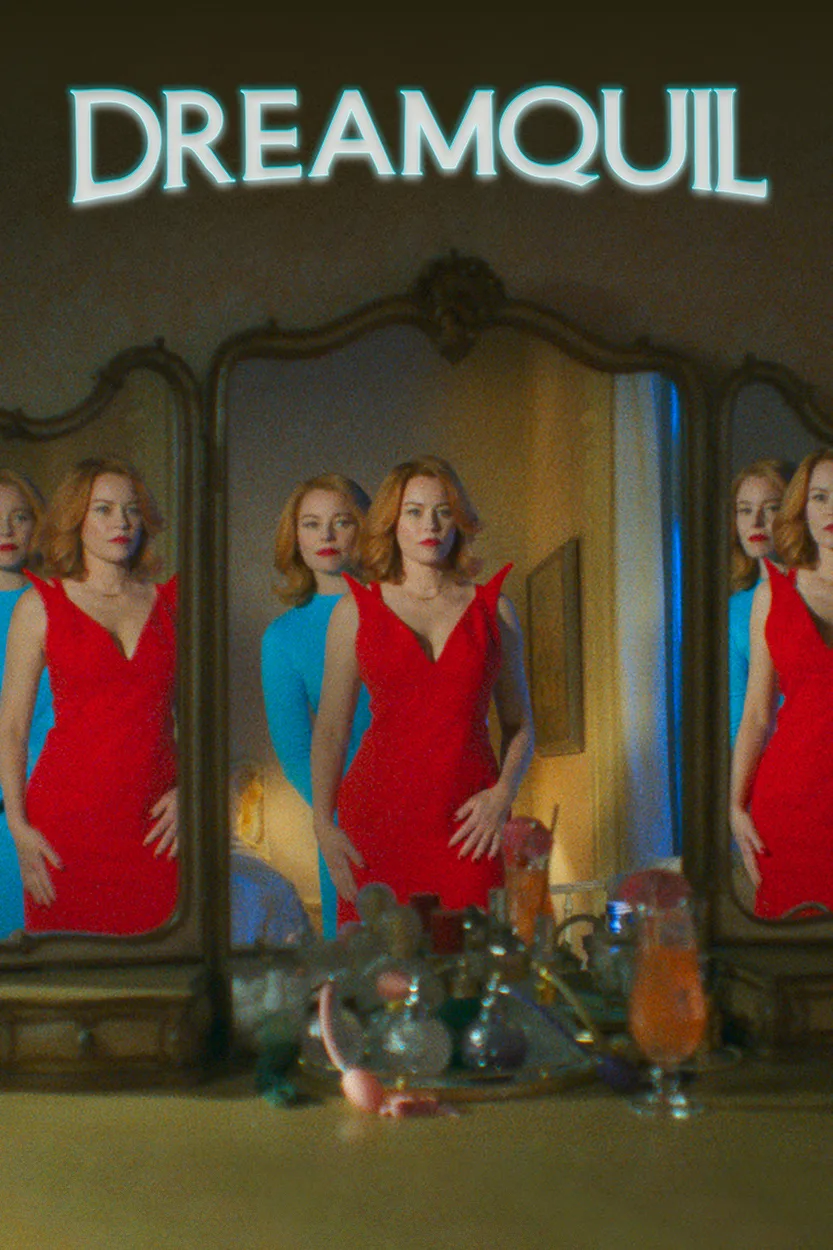
Much of the pleasure of “DreamQuil” comes from watching Banks play dual roles as both Carol and her artificial replacement, Carol 2, so much so that she renders almost every supporting actor (including Sofia Boutella, Kathryn Newton, Juliette Lewis, and Lamorne Morris) completely forgettable by comparison. It’s impressive to watch Banks shift between the two modes: one a perfectly flawed, earnest performance as a real human being, and the other a truly soulless one that emphasizes this being’s threat. She can nail the stiff enunciation of products Siri and Alexa (and the robotic movements we imagine they would have) while, in the same scene, delivering the quiet rage stirring in the real Carol.
Everything about how Prager presents and shoots Banks seems intentionally designed to recall a very classical image of a woman: the kind of 1950s movie star Hitchcock would have loved to capture suffering on screen. So much of “DreamQuil” is gorgeously curated and manicured, beyond Banks and her perfectly fitting dresses, in the stark primary colors that pop on screen. Its production design is entrancing (most notably the miniature sets that emphasize dreaminess), and it’s all modeled on a modest-budget approximation of retrofuturism that feels like someone colorized a “Twilight Zone” episode. Even the digital effects feel appropriately cheap and built into the world, because the tech that impedes humanity’s progress and exists solely to sell us faulty products should look grotesque.
But at what point does Prager’s film start to feel like a carbon copy of the artificial intelligence it seems terrified of? As a filmmaker, her fixation seems to explore the anxieties of being a woman Living In Society, extending beyond this debut feature and into shorts like “Despair.” Both of these are specifically about women being trapped in a world that seems to have no place for them other than death or commodification. It’s a bleak sentiment, and not entirely unreasonable given the state of women’s rights today, but it’s also a bit limiting when so many filmmakers who came before have explored these same themes through similar narratives in a more intriguing way.
In some ways, Prager’s film exists somewhere between the obviousness of Olivia Wilde, with “Don’t Worry Darling” being a very clear sibling to “DreamQuil” in influence and scripting, for better or worse, and the entrancing worlds of Amanda Kramer, each boasting a shared fixation on exploring how artificiality and performance enhance real emotion. In its first hour, “DreamQuil” fairly well mines contemporary anxieties around artificial intelligence and machine learning through its robot, even if its thesis and execution are thuddingly obvious. It’s also explicitly about one woman contending with her insecurities as she faces a family with different desires than her own and a robot that presents itself as the perfect alternative.
But when the film reaches an expected climax, Alex and Vanessa Prager’s script makes one of the most baffling gear shifts in its final twenty minutes, actively undercutting everything that made the film compelling in the first place. This kind of last-act fumble is hard to ignore, and particularly tragic given how charming, if predictable, what came before it was. Still, there’s enough to enjoy in this frivolity, certainly more than many “Black Mirror” episodes this feels in conversation with. At the very least, “DreamQuil” will and should serve as a calling card for Prager, a filmmaker with real style and skill who just needs a better script.