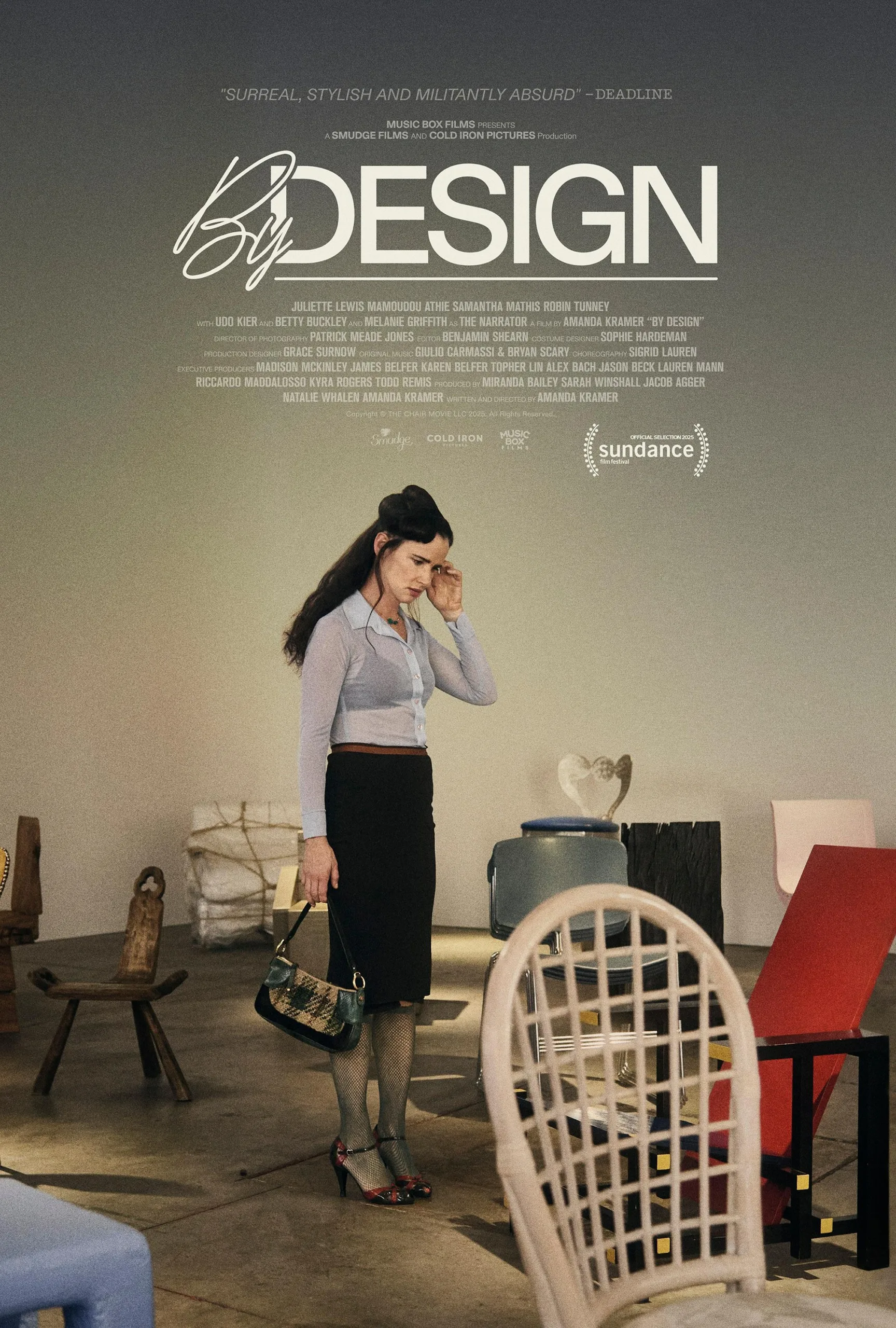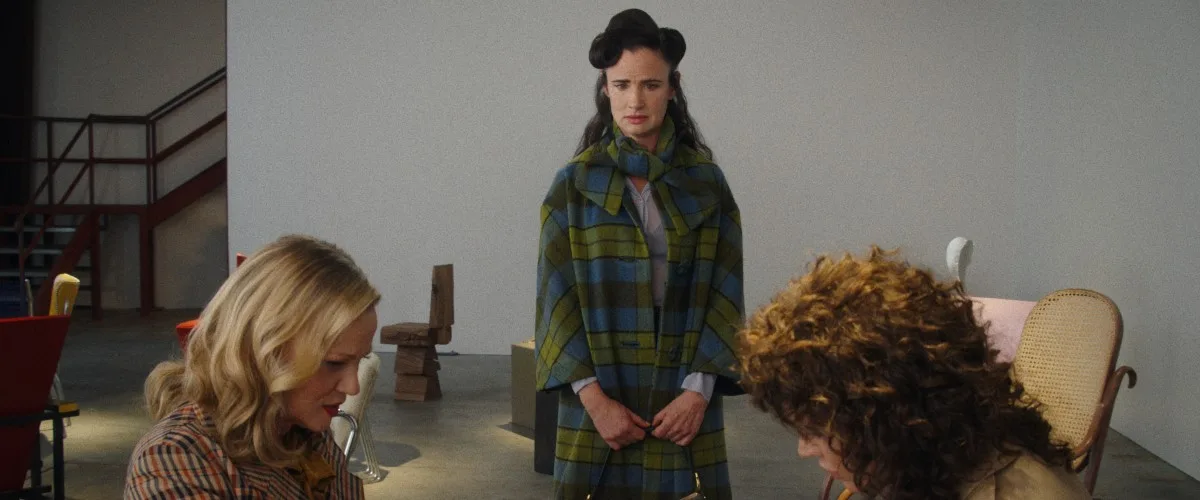
Amanda Kramer’s “By Design” is an oddball, almost-love story that has more to say about human dejection and desire than a lot of more conventional tales. Camille (Juliette Lewis) spends her weeks longing, not even for love, but for any semblance of emotion that extends beyond her own deep, downcast depression. She’s a bit of a shell, made sympathetic by the minute yearning in her eyes that reveals a woman on the brink of personhood.
Her weekly lunches with friends Lisa (Samantha Mathis) and Irene (Robin Tunney) are no respite: their vapid conversations are consumed by envy and passive-aggressive rivalry. It’s the kind of trio that asks: with friends like these, who needs enemies? Each conversation between the trio feels more like Irene and Lisa are talking at Camille rather than with her; meanwhile, whispered narration (Melanie Griffith) outlines her inner monologue.
When the friends visit a high-end furniture store after one of their weekly outings, Camille becomes enamored with a one-of-a-kind wooden chair. She is overcome with desire, running her fingers over the curved back end. Envying the chair’s usefulness, beauty, and “deserving of praise,” she has to have it. But due to the price tag, she has to go home for the night to coordinate her finances. When she returns at opening time the next day, the chair has already been sold. Dropping to her knees in front of it like a mourner at an altar, she desperately clings to it, longing to be one with it. And so, in a surreal moment of choreography, it happens. They body swap, leaving Camille in a wooden catatonia, and her spirit in the curvatures of the chair.
It (and therefore, Camille) has been gifted as a breakup present to the fly-on-the-wall pushover pianist Olivier (Mamoudou Athie). Like Camille, Olivier is depressed, feeling more like an object than a person (making this union all the more ironic). As Olivier falls in love with the chair, Camille’s spirit falls in love with him, while her body (relocated from the furniture store by her friends) lies in her apartment, flimsy and voiceless, visited by friends and family who don’t even seem to notice that she’s not really “there.”
Kramer’s direction is theatrical and often dreamlike, with Griffiths’ narration and the blocking of each scene’s tableaus operating like a piece of performance art. In Kramer’s ultra-shallow, hyperstylized world, aesthetics are primary. Sophie Hardeman’s costume design is stunning, crafting creative and colorful wardrobes for its characters that project a confidence none of them have: walking facades. Dialogue is filled with projection, and everyone is treated primarily for their function rather than their individuality.
The love between Olivier and the chair (and Camille’s own infatuation with the object) speaks to the act of consumerism as coping and identity. Kramer’s characters are tragic because they desire to be desired, but they don’t know how to put themselves out in the world. They’re desperately insular. They latch onto beauty for beauty’s sake, pawns in a social structure that does not value them. Olivier and Camille’s spirits fulfill each other’s needs: to have somewhere to place their love, and to be useful and desired.
Kramer raises many unnerving questions about the nature of love and friendship, with a zany sense of humor. Whether it’s Olivier bringing the chair to a dinner party or Camille’s mother bonding with her chair-possessed body, Kramer inserts us into ludicrous (while deeply sad) circumstances. “By Design” is not laugh-out-loud funny, but tragically comical, prompting us to laugh at the superficiality and emotional displacement of its existential questions.
The film kind of meanders through its run time, which, despite being a brief 90 minutes, feels longer. But buoyed by committed performances, deadpan and dissociated, the film inspires enough curiosity to hold attention. Kramer’s questions about literal self-objectification as a means to discover desire are fascinating, and “By Design” is a refreshing, wholly original by-proxy romance.