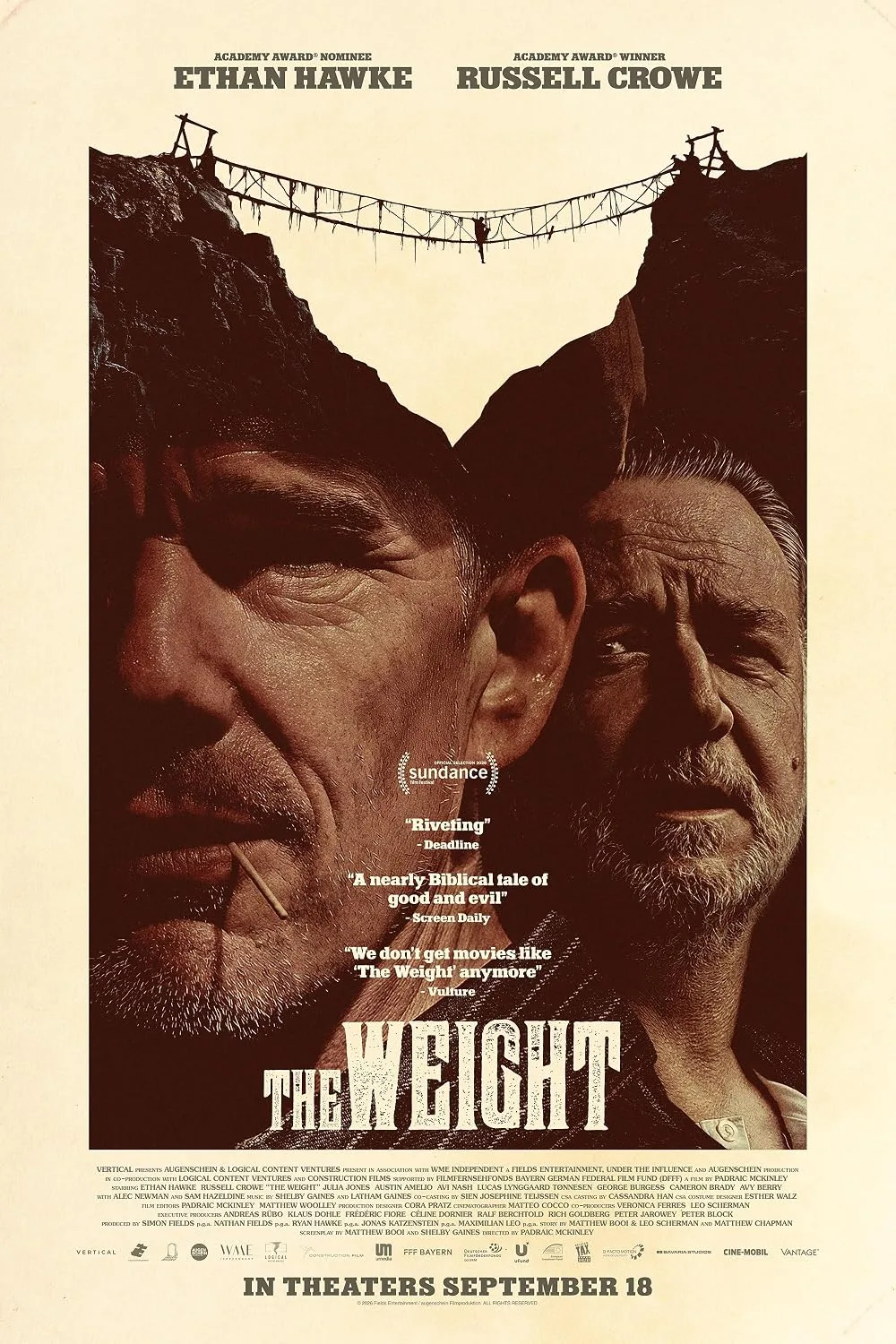

“The Weight,” about a 1933 heist of gold bars from the Federal Reserve’s remote storage facility by inmates from a labor camp, is a prison movie about a loner who becomes a leader. It’s a wilderness adventure filled with relentless action sequences and a psychological thriller about men trying to manipulate other men to gain money or freedom. And it’s a political fable about capital and labor. It’s successful in every department.
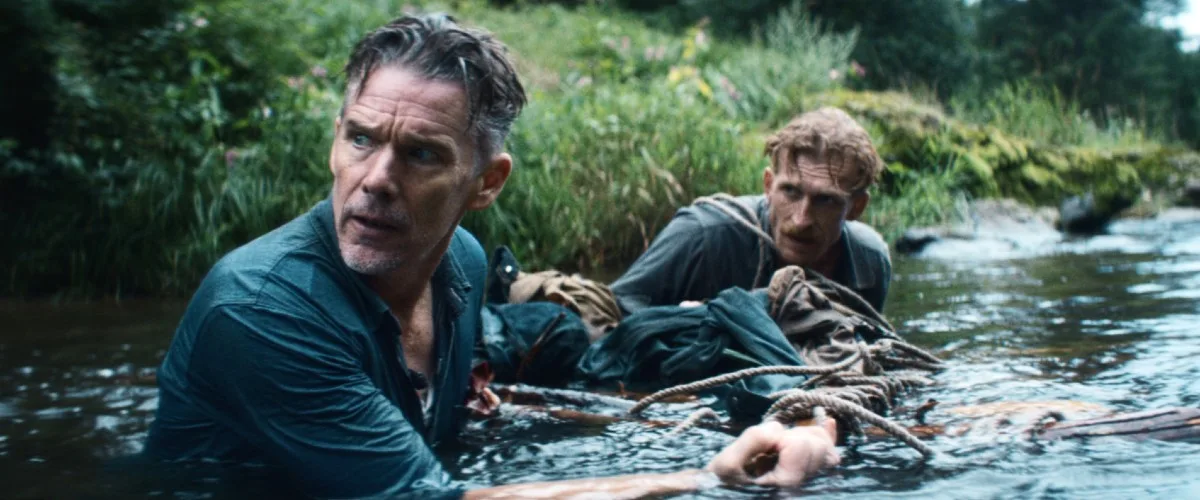
But that last one is the most intriguing. A lot of movies flaunt a supposedly anti-authoritarian streak that runs no deeper than “Don’t tell me what to do.” “The Weight,” in contrast, is straightforwardly progressive–a movie that speaks to its time and ours. The best comparison point might not be another genre movie, but John Steinbeck’s novel The Grapes of Wrath and the subsequent John Ford film adaptation, which defined the nightmare of the Great Depression in our cultural memory. The main character, Ethan Hawke‘s Samuel Murphy, might be Steinbeck’s plainspoken Tom Joad reimagined as an action hero who thinks before he acts, and can read a situation more plainly than anyone else who’s in it.
The story begins when Murphy, a recent widower with an outlaw’s spirit, gets evicted from the apartment he shared with his young daughter Penny (Avery Perry) and must find them a new place to live. In an alley, with Penny knocking on a prospective door, three men storm in, demand to know what they’re doing, and warn them against “squatting.” The ensuing confrontation escalates into a brawl, with Murphy treating three men’s heads like punching bags. Turns out one of the men Murphy struck was a cop. The authorities put Penny in a home for wayward children and sentenced her father to one year in a work camp run by Warden Clancy, a bearded, thick-necked boulder of a man who loves breaking other men’s spirits through intimidation, punishment, and the assignment of tasks that he knows are impossible.
Then Clancy puts Murphy in charge of one such task, moving a boulder that, in his words, would defeat Hercules himself, and the movie shifts gears. Murphy surprises Clancy by taking charge and getting the job done with ingenuity, cracking the rock into sections by jamming metal tools into pre-drilled holes and force-lifting the larger fragments with what appears to be a jack. (The scene is reminiscent of similar tests in genre fiction in which very different men bond by completing a strenuous task, such as the uprooting of a stump in “Shane” and the relocation of a rock pile in “The Last Castle.” Watching Murphy in action, Clancy realizes he’s a good leader with many useful skills who keeps his word and gets things done without fuss.
So he offers Murphy a mission: Then-president Franklin Delano Roosevelt had recently announced that, in an attempt to slow or halt the currency deflation that was prolonging the Depression, his administration had decided to take the United States off the gold standard, and has been sending federal marshals around the country to withdraw the gold held in vaults by the Federal Reserve Bank. Murphy will lead a team of inmates to steal the gold bars kept in a cave deep in the forest and bring them back to Murphy, who will divide them between himself and his unseen patrons. In return, Clancy will give the participating inmates early release papers dated to the moment they turn over the gold. Murphy can’t say no because his daughter will be put up for adoption five months, long before the end of his sentence. “I want my daughter back,” he says simply.
The character lineup is what used to be called a “bomber crew” in post-World War II action films: lots of distinctive faces representing segments of the viewing public. Anna (Julie Jones) is an indigenous woman who ends up traveling with the crew and working as a cook and medic. There’s a Eugene V. Debs-quoting Indian-American socialist named Singh (Avi Nash, a tremendous screen presence who Zippo-lights his cigarettes like Burt Lancaster) who is in prison for resisting arrest during a protest. At least, that’s the official reason. When another inmate states that he’s here “for being a Socialist,” he concedes that their description is more accurate. A Scandanavian immigrant named Olson (Lucas Lynggaad Tonnesen) is there for crimes committed while defending his community against native-born, immigrant hating land thieves and the local government they controlled. The troublemaker of the group is Rankin (Austin Amelio), a sneering jackass who bullies anyone he considers different while defending a status quo that holds down men like him, too, even though he doesn’t see it.
Finally, there are the crew’s armed handlers (Alec Newman and Jeffrey Lee Hallman), who are loyal to the warden and enjoy hurting people. These people are so well defined that you feel like you’ve gotten to know them even before they start walking through the forest with empty knapsacks. That knowledge gives you a sensitivity to small changes in the group’s dynamics, and after a while, you start sizing everyone up the way Murphy does, looking for threats, weaknesses and potential alliances
Hawke’s performance is one of the best he’s ever given, and certainly the one least likely to have been predicted by a 1993 moviegoer who just finished watching “Reality Bites.” First, there’s the voice: deep, gravelly, sometimes broken. This is a recent development in Hawke’s acting, and may be an unintended consequence of the Old Testament growl he used for John Brown in the miniseries “The Good Lord Bird.” It sometimes evokes the broken-glass-caught-in-a-garbage-disposal voices of the characters Clint Eastwood played in the 1980s and ’90s, and it has a similarly minimalist aesthetic.
The mission to and from the gold storage facility is broken up by title cards (rendered in a modern New York Times headline font, strangely) telling us how close the group is to the projected end of the job, but its sections could have just as easily been identified by their center of dramatic interest, which is always some type of challenge or contest: The Boulder, The Rope Bridge, The Rapids, The Boats, The Fight.
Director Padraic McKinley, a producer on “The Good Lord Bird” making his feature debut here, stages and shoots all the action with simplicity and force. Cinematographer Matteo Cocco is always in the perfect spot to capture a given image or action, and it’s rarely the obvious one that others would probably have chosen. Mid-century action directors like Budd Boetticher (“The Tall T”) and Anthony Mann (“The Naked Spur”) used to crank out B-pictures that felt like this, and those movies often carried a current political subtext as well. That’s a way of saying that “The Weight” is of its time but also timeless, or out of time, like the retelling of real events from which multiple morals can be drawn.
The synthesized score often stays in a long, bass-heavy hum that suspends our sense of time, so both the victories and defeats have epic heft even though these hardheaded characters would never think of them that way. The movie lets itself speak while also setting the stage for a nonliteral reading.
One example is the moment when Murphy, whose mutual attraction with Anna is based on respect, picks shotgun pellets out of her bare back, describing each wound as he goes. Anna helps Murphy with his wounds as well. These scenes fall where sex scenes normally would be placed, and have a similar goal: to show a man and woman who trust each other enough to be completely vulnerable, in a situation where showing vulnerability is the equivalent of placing a target on one’s own back.
Some scenes consist mainly of a long, unbroken close-up of Murphy listening to a nearby conversation he’s not part of, or sitting alone and thinking. These are among the most gripping moments in a film packed with prison picture mayhem and wilderness adventures, thanks entirely to Hawke’s careworn face and hard stare.
Like Eastwood (and Keanu Reeves in the “John Wick” movies), Hawke understands that in movie acting, sometimes the best approach is to let your face do the talking. His performance anchors the movie and grounds the action. Just when you start to worry that the movie is veering away from real-world believability (like the way Murphy devises a gold bar version of a water bucket brigade, to get around the problem of the rope bridge being too unstable to support a group carrying massively heavy knapsacks), Hawke makes sure it stays on the right track. It’s the kind of performance that only helps a movie when the audience trusts the actor enough to feel that he somehow represents them. Hawke is our guy from frame one. His keen judgment keeps a heavy movie light on its feet.