There’s an exchange between three men late in “Manhood,” Daniel Lombroso’s documentary about penis enlargement procedures, that rings with surprising compassion. Two doctors patiently sit with David, once a gay adult content creator, who’s suffering after an unscrupulous charlatan’s botched job left him with a malformed member. He comes to them hoping they can fix the cosmetic issues and help him regain his confidence.
“Everything is done as if you are our brother or our son,” says one of the doctors, reassuring the young man that they care about his predicament as if he were family. The moment transcends the clinical setting to resonate like a sincere embrace between these men.
While the subject matter and title of Lombroso’s film inherently invite the expectation of a salacious, even humorous piece about guys desperate to grow the size of their penises, he instead presents a humanistic study of why some men believe this is their path to fulfillment. Lombroso argues that the rise of these procedures correlates with the impact of the “manosphere,” a term for numerous online creators who “teach” men how to maximize their masculinity.
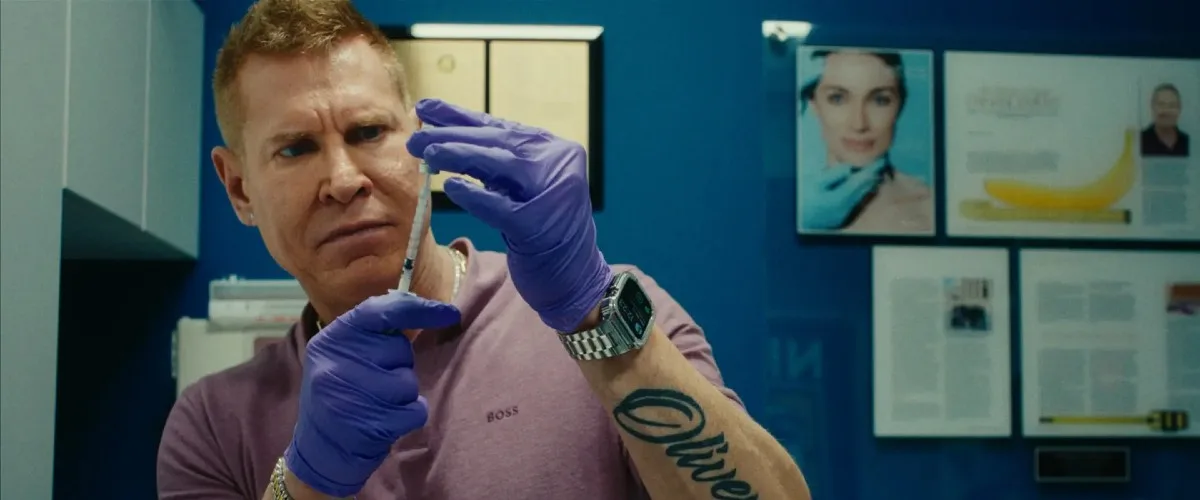
Lombroso’s main subject, clinician Bill Moore, a gay man obsessed with his physical appearance and the preservation of youth, is a peculiar character. After years of providing a variety of cosmetic procedures to people in Dallas, Texas, he introduced his own Phallofill filler injections to increase the girth of the penis, which come with a sleeve to maintain the appendage’s shape. Moore’s paintings depict him as a king, and all manner of devices to keep his body in shape surround both his office and home.
But for all the self-esteem Moore now claims, when he shares his upbringing of feeling unwanted, his lifelong dedication to superficial beauty seems like a reaction to that foundational inadequacy.
Ruben, one of his clients, learned of Moore’s practice through a podcast. Throughout Ruben’s increasingly despondent interview segments, the voices of hosts who purport to help men become “alpha males” blare from his cell phone or car. On more than one occasion, Ruben claims his wife enjoys the results, even though she has never said so, to justify his irresponsible decisions. With multiple children and only one income, spending money on penile injections would seem ludicrous to most—not to Ruben, though.
It would be easy for Lombroso to punch down and expose Ruben as a pathetic manchild. But the filmmaker digs deeper, discovering that Ruben’s background as a Mexican American man made him feel different in his mostly white environment. And though he might not see it, he’s been dragging those feelings of not belonging and being different since childhood. And so, what Lombroso gets at via the men he focuses on is that it’s never solely about the penis, but rather the promise of acceptance and positive reinforcement.
When Lombroso and cinematographer Vittoria Campaner choose to display full-frontal nudity (when Moore’s patients are getting injections), the images don’t come across as grotesque, much less erotic, but are handled with tact. The vulnerability of the men goes beyond showing their genitals, but in the words that accompany the scene. The camera remains on their faces as the needle punctures their penis, as they try to engage with questions about why they are subjecting themselves to this ordeal or the results they’ve enjoyed. There’s truth to the notion that men will do anything but go to therapy.
Pornography, Lombroso suggests, also plays a role in how the self-image of modern men has been warped. The bodies on screen rarely matched the viewer’s, often creating a feeling of inadequacy. That’s part of what pushed David to seek enlargement while making a living as an adult content creator. His desire for a more pronounced penis and the provider’s lack of ethics resulted in a horrible outcome. The layers Lombroso peels back again reveal a difficult upbringing. In David’s case, as a gay person in a conservative, religious family, unaccepting of his sexual orientation and unaware of his career choice.
Though it offers a small sample of men, the trio that Lombroso found taps into a variety of backgrounds, mindsets, and insecurities, making “Manhood,” if not comprehensive, definitely representative of what men at large experience in relation to the part of their bodies that carries such symbolic importance. Tacitly, Lombroso points to manhood not as inches or volume, but as the empathy one can show others and the willingness to take accountability for one’s mistakes to change course.
It’s not about the bulge, but about the bravery to look beyond it.