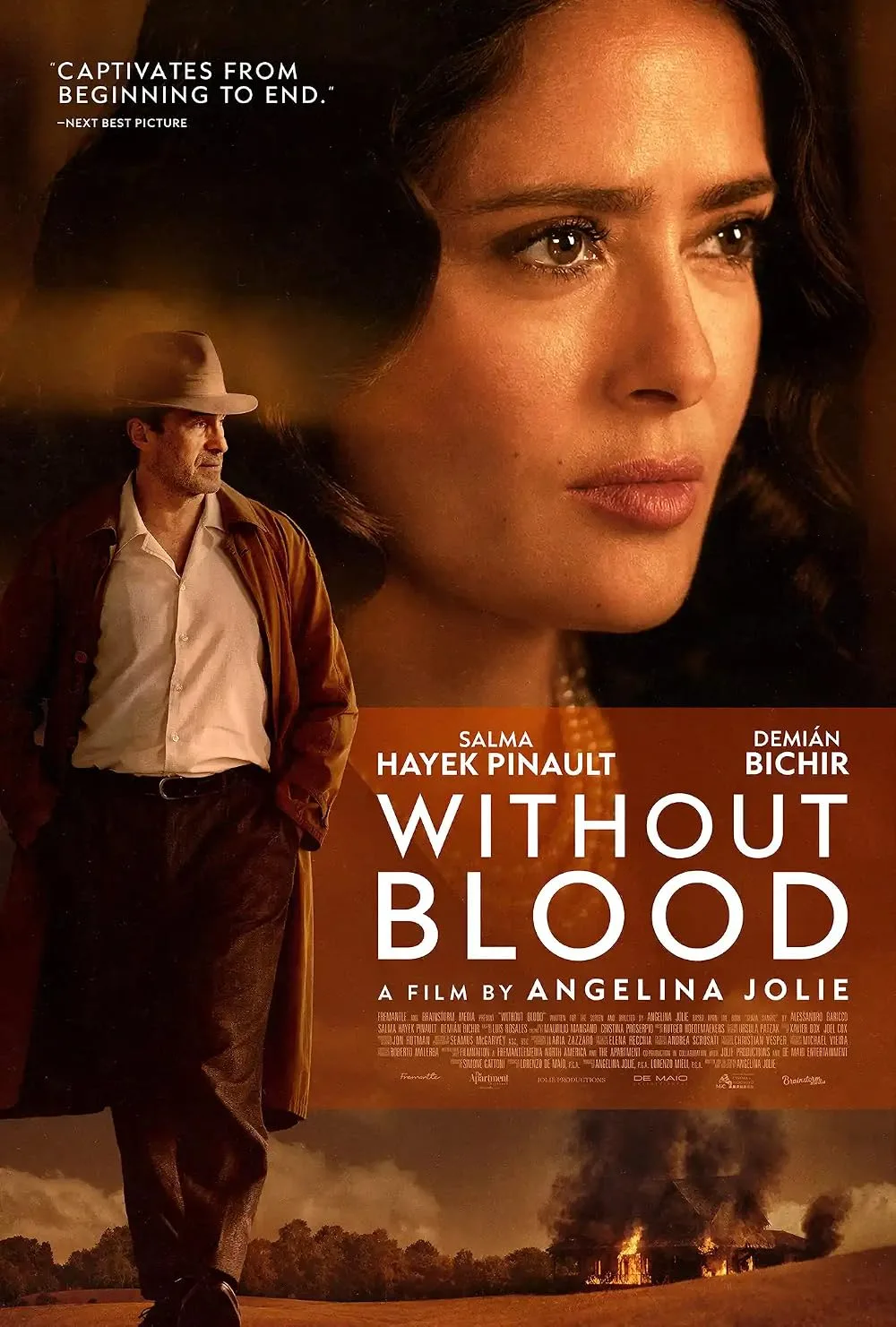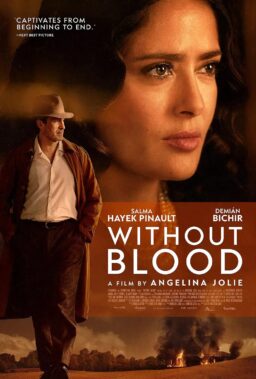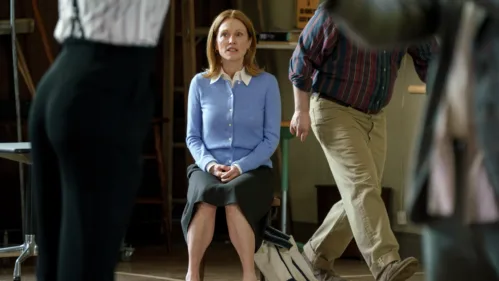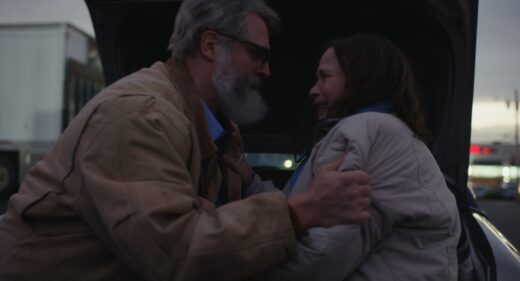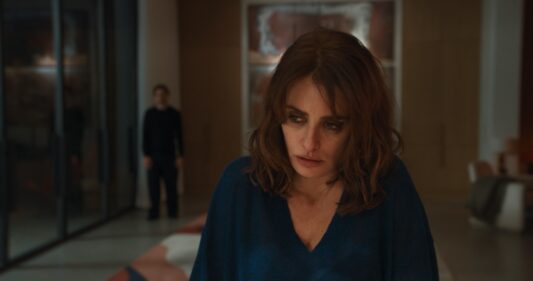
“Without Blood” is a meditation on violence, grief, memory, trauma, and locating the line between justice and revenge. Angelina Jolie wrote and directed it, based on the novel Senza Sangue by Italian author Alessandro Baricco.
It begins in an idyllic setting. A barefoot young girl in a white dress swings on the porch of a comfortable house, looking out at a pristine countryside. We get a few quick glimpses of her happy, safe life with her father and brother. And then three men with guns arrive. The girl’s father hides her under the floorboards. The men kill her father and brother and burn down the house. We are never told where this is or what war they refer to, only that while technically it is over, the men still feel they have a score to settle with the girl’s father and that they are justified in killing him. While their plan was to catch him alone, when the teenage son shows up, they kill him, too.
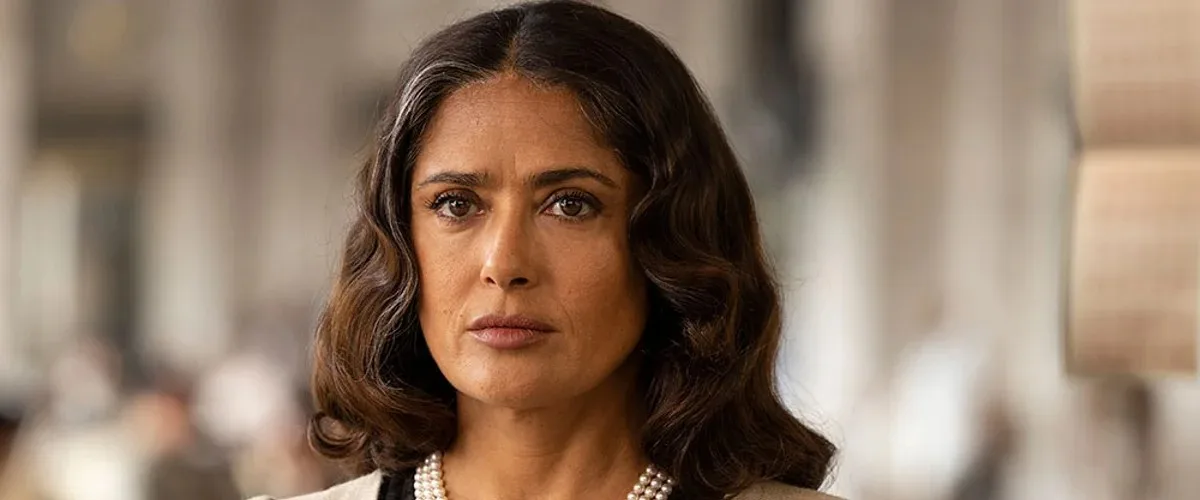
Years later, an expensively dressed woman (Salma Hayek Pinault) stops by a kiosk to buy a lottery ticket. It is not a random encounter. She was Nina, the girl under the floorboards. The man in the kiosk is Tito (Demián Bichir), the youngest of the three men who killed her father and brother, and the only one still alive. They go to a restaurant, and much of the film is Hayek and Bichir giving powerhouse performances as the two characters who were in the same room only once before, but who have thought of each other constantly in the decades since.
Jolie, who has explored issues about the devastation of war and the trauma of violence in the fact-based “First They Killed My Father,” “In the Land of Blood and Honey,” and “Unbroken,” continues this theme here, in a more impressionistic, lyrical mode, with golden-hued cinematography from Seamus McGarvey throughout. Some of the more poetic touches work well, like the young Nina’s bare feet and white dress, gently swinging as she looks at the beautiful countryside, in contrast to the adult Nina’s expensive high heels, black dress, and triple strand of pearls as she walks with confidence along the city sidewalk.
In the restaurant scene, Jolie lights Hayek like an old-school movie star. The key lights on her eyes glow, sometimes illuminating tears, sometimes emphasizing her laser-like focus. The sound mixing in that scene is also excellent. At times everything is silence but their two voices and a few gentle clinks of spoons and china; then we hear the ambient sounds, and at other times the quiet score from Rutger Hoedemaekers. There is a mesmerizing balletic quality to Hayek’s hands as she moves her cigarette and teacup.
The repeated images of the girl under the floorboards, with her father’s blood dripping onto her bare feet, though, are heavy-handed, as is the shot of the older Nina, by then a wife and mother, looking at birds in a cage. The conversation in the restaurant is so engrossing that the frequent flashbacks are more intrusive than illuminating.
From the very beginning, at the kiosk, in what first appears to be a casual encounter, Hayek and Bichir fully embody their characters, both so changed by the murder of her father and brother that they have constantly imagined meeting again, believing it was inevitable. At the kiosk, she says three words, “Come with me” twice and the change in her tone is subtle but significant, first an invitation, then a command. Bichir says one word after the first one, “Please,” quietly but carrying enormous weight.
Nina points out the surreal aspect of having this conversation in a setting of comfort and elegance and wonders if the other customers might think they were siblings or even a couple. In another version, their meeting might be emotional, angry, violent. But their meeting is civil.
They both talk about how their memories of the past are always present and they are both compelled to share their stories, to have the other hear what they experienced. She wants him to know what happened to her after she was left alone, including being married at age 14 and later committed to a mental hospital. She learns that he not only knows much of her story but can add significant details she doesn’t. She has spent a lot of time with her own version and is not entirely ready to recontextualize. “Why should my truth be less true than your story?”
They talk about revenge as “the only drug for the pain that can keep you from going mad.” But what that means for the two of them is not clear to them or to us. That is Jolie’s point. She is not trying to say that there is any equivalence of responsibility, though he was a teenager who had been fed a lot of propaganda and she might possibly have been responsible for some murders as well.
What we and her characters have to consider, as in films like “Death and the Maiden” and documentaries like “The Act of Killing” and “My Neighbor, My Killer,” is whether there is some resolution that lessens pain instead of perpetuating it.