The “screenlife” technique of telling a story entirely or primarily through desktop and laptop visuals has been put to effective use in films such as “Unfriended” (2014), “Host” (2020) and “Missing” (2023), as well as in a batch of TV series, e.g., the clever and innovative “Connection Lost” episode of “Modern Family” in 2015. (We also got a spate of mostly forgettable screenlife films and streaming series during the pandemic.)
Full download disclosure: I feel like the gimmick is played out at this point—and by the halfway mark of the screen-popping and kinetic but ultimately tiresome and borderline dopey AI thriller “Mercy,” I found myself yearning for a wireless mouse so I could log off.
Timur Bekmambetov is a screenlife-pioneering producer, and as a director, he has taken some admirable gunslinger swings with the likes of “Night Watch” and “Abraham Lincoln: Vampire Hunter,” but his latest effort comes across as an uninspired mashup of “The Fugitive” and “Minority Report.” The screenplay by Marco van Belle raises legitimately disturbing questions about our utter lack of privacy in today’s world of social media profile sharing, surveillance cameras, “citizen journalists” wielding smart phones, Gemini, ChatGPT, body cams, etc., etc., but those issues are quickly swept aside in favor of drone-fueled chase sequences and plot reveals we can see coming three scenes in advance. (The script drops breadcrumbs with all the subtlety of a Spring Breaker letting a giant water balloon plummet from a hotel balcony.)
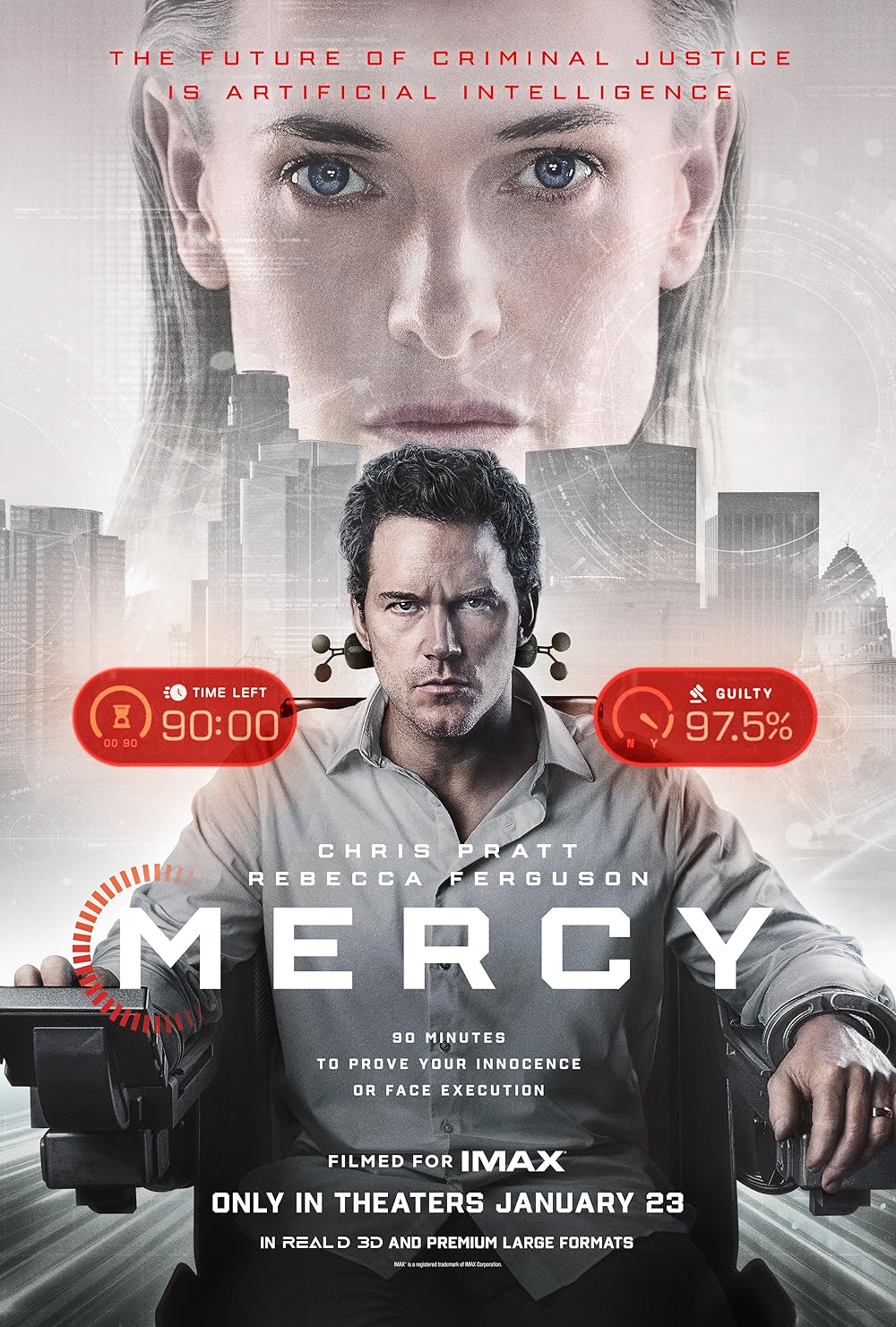
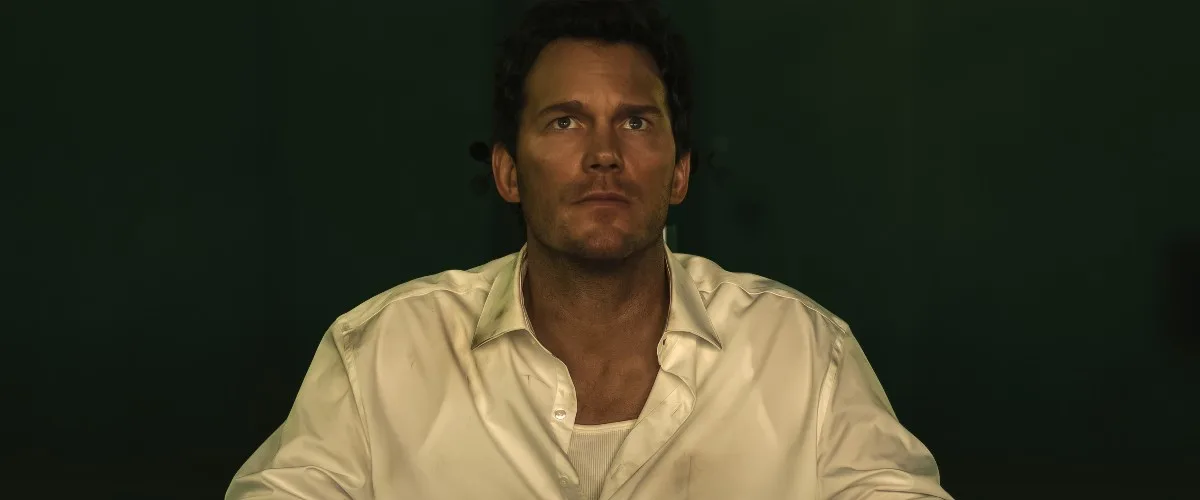
“Mercy” is set in the obligatory dystopian near future—in this case, the crime-ridden Los Angeles of 2029—where lawmakers have recently voted to activate the Mercy Capital Court, a judicial system powered by Artificial Intelligence. Chris Pratt’s gung-ho LAPD detective Chris Raven was one of the architects of the system—but now he finds himself the target. Hungover, disoriented, and strapped to a chair at Mercy Capital Court, Chris is charged with the brutal stabbing murder of his wife, Nicole (Annabelle Wallis), in the kitchen of their home. On an oversized screen opposite him is Judge Maddox (Rebecca Ferguson), an AI program who walks Chris through the rules, which he of course already knows, so the rules are really for our edification:
The Mercy Court acts as judge, jury, and executioner.
Chris will have the city’s “Municipal Cloud” at his disposal, giving him access to every camera, cell phone, and database.
There’s a handy onscreen Guilty Meter that displays the probability that Chris committed the crime, and right now it’s in the high 90s. He has 90 minutes to get that number below 92%, or he will be executed on the spot.
Let the games begin!
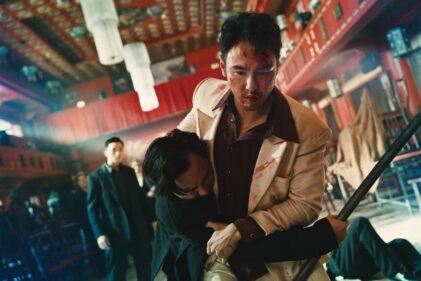
The story unfolds in real time, with the clock ticking down from 90 minutes, and that makes for some admittedly effective dramatic tension. Chris is an experienced detective, but his investigation is hampered because he was wasted at a local tavern in the hours just after the crime was committed, got into a nasty barroom brawl, and then blacked out, only to regain consciousness after he was arrested and strapped into that chair.
Therein lies one of the problems with “Mercy.” Pratt can be a forceful and convincing actor with the right material, most notably the “Guardians of the Galaxy” series, but his physicality is a key component of his best performances. For the great majority of time here, Pratt is immobilized, and his emoting isn’t always entirely convincing. You can see him…trying. That same limitation applies to Ferguson, one of the best actors around, who is reduced here to playing what is essentially a talking head—an emotionless program, speaking in a robotic voice. They’re never in the same room together, because Judge Maddox isn’t actually in any room.
That static dynamic between Chris and Judge Maddox is countermanded with an endless barrage of images shot in varying styles. Private cell phone clips, police drone footage, visuals captured by restaurants, street corner cameras, a neighbor’s “bird cam,” you name it. We’re introduced to a handful of key players, including Chris and Nicole’s teenage daughter, Britt (Kylie Rogers, who has to do a lot of on-the-phone crying), his LAPD partner Jaq (Kali Reis, stuck with a role that makes little sense), and his AA sponsor Rob, well played by the reliable character actor Chris Sullivan.
We’re fairly late in the story when things take a kind of “Breaking Bad” turn that seems wildly arbitrary—before it becomes almost laughably over the top. The last act of “Mercy” is anything but merciful to the viewer.