

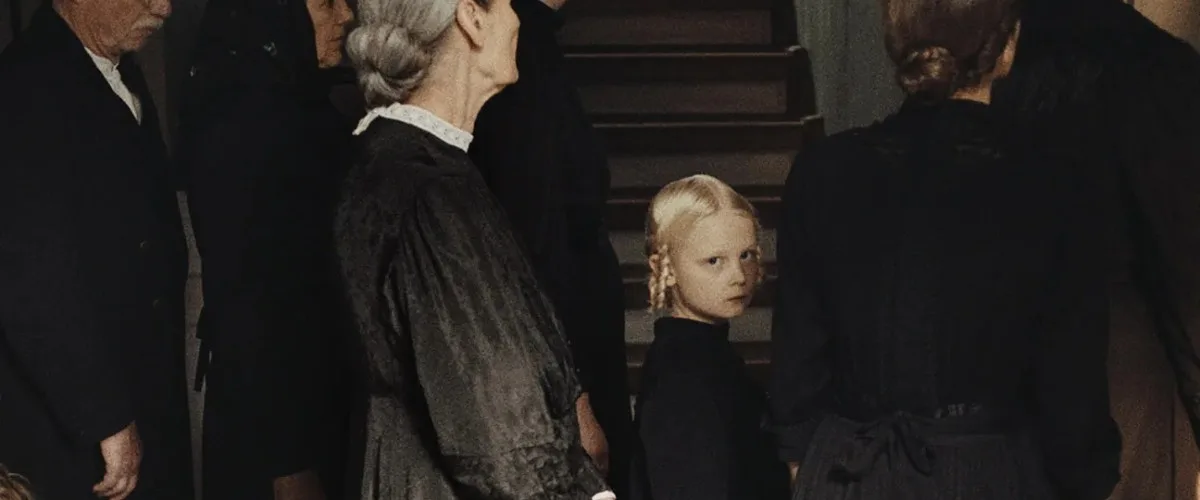
Mascha Schilinski’s “Sound of Falling” spans nearly a century, following multiple generations of a family living in the historic Altmark region of Germany. The family’s huge farmhouse and servants’ quarters, huddled around an inner courtyard, serve as the film’s sole location. We watch the location change beyond recognition from the 1910s up until the present day.
This description is far too linear for what Schilinski actually does with this vast material. She does not present the events chronologically; she mixes up the generations, connecting them through the location and its visual motifs—keyholes, door frames, a hole in the barn door. “Sound of Falling” is impressionistic in its approach: the timeline fragments, the past overlays the present, the present perches over the forgotten past. But the continuum is severed somehow. The location, though, knows what happened there. The farmhouse remembers. “Sound of Falling” operates like a ghost story, complete with a haunted house, but the ghosts aren’t supernatural. The ghost is history.
In each generation, there’s an alert, curious young girl, hemmed in on all sides by death’s nearness. Sometimes she is aware of it, sometimes she flirts with it, sometimes she has no idea of her own peril. The sense of peril is always there.
The film starts with the teenage Erika (Lea Drinda), who, in the extraordinary opening scene, binds her leg up underneath her in imitation of her uncle Fritz (Martin Rother), a bedridden amputee. Outside in the courtyard, a man (her father?) screams for her to come help with the pigs, but she stands over Fritz as he sleeps, looking at his hairy chest, riveted by the drops of sweat in his belly button. Each generation is clogged up with similar forbidden unspoken longings, so intense they are nearly corporeal, or at least have substance enough to be passed down. Erika’s clothing suggests the 1940s, and later, we will learn who Erika grew up to be.
The earliest generation’s central figure is the child Alma (Hanna Heckt), living with her older siblings in a very severe, repressed household. The adults are incomprehensible and wordless, and little Alma tries to understand the undercurrents surging through the silence. Alma’s older brother Fritz (Filip Schnack) is an amputee, moaning in his room over his fresh wound, as Alma peeks through the keyhole at him. Continuity is withheld from us, and we have to piece together not just who people are, but when we are.
There are glimpses of what is probably the Great War, with soldiers coming by to pluck men into the Kaiser’s service. Alma doesn’t understand what is happening; she’s too young. She is troubled by an old photograph of her mother standing over a dead child, holding a doll. The child is named Alma. There are many such destabilizing doublings in “Sound of Falling,” as if the bottom had dropped out of time itself. Alma’s oldest sister, Lia (Greta Krämer), is no longer a child, but still lives at home. What are the options for a farm girl in 1915? There are many haunting images and stories in “Sound of Falling,” but I haven’t been able to get Lia out of my mind.
There’s this mesmerizing awareness of lives “lived in vain” (the phrase is said multiple times). Fritz, lying in a bed for what appears to be 25 years… what was his suffering for? Was his thwarted life in vain? What was Lia’s journey even for? Was there a purpose or a design in any of it? Women die without telling their stories, they vanish into marriage, they die in childbirth, they change their names, making them hard to track. “Sound of Falling” is haunted by the silent dead.
This region of Germany was passed back and forth among empires for centuries. After WWII, it ended up under Soviet occupation. In the GDR ’80s, Angelika (Lena Urzendowsky) visits her uncle and aunt at the farmhouse, which is now a rowdy communal living situation. Angelika is a restless teenager, provocative and sexual, something her uncle Uwe (Konstantin Lindhorst) obviously notices. While nothing, of course, is said outright, it seems obvious Angelika is being groomed by him. She “acts out” in all kinds of ways. Uwe’s wife seems harassed and upset, the butt of everyone’s jokes. At one point, she swims across the small nearby river to what is western Germany. It’s forbidden to be over there, of course. Freedom should be Angelika’s milieu. Her world is too small and too dangerous.
By the present day, the farmhouse and its other buildings have been broken up into apartment units. A couple with two small daughters moves in. It is as though Alma and Lia never existed. The modern family is open and with more options in life, but the undercurrents remain. Young Lenka (Laeni Geiseler) feels an anxious longing for her glamorously depressed new friend Kaya (Ninel Geiger), whose mother died. Lenka’s younger sister feels left behind, and her experience is one of frightening dissociation.
The film’s sound design is such an important contribution. Floors creak, silence is loud, flies buzz, and, intermittently, a muffled tone crescendoes into a massive roar. It’s terrifying. What is it? All the feelings we never acknowledge? The mercilessness of time? Walter Benjamin’s “angel of history”, moving forward but looking backwards, agape at mankind’s horrors?
As Stephen Dedalus says, famously, in James Joyce’s Ulysses: “History is a nightmare from which I am trying to awake.” The past does not illuminate in “Sound of Falling.” History doesn’t incorporate itself into the present. We are cut off from it, and yet we still feel its presence. This speaks to one of the central concepts of the film: time does its work, and people are forgotten, but they remain, as a feeling in the air, or a flicker at the edge of sight, gone when you look at it directly. These people existed once, even if the only evidence of them is a blurry smudge on the edge of an old photograph. The ghosts of the dead far outnumber the living, and they are all around us.