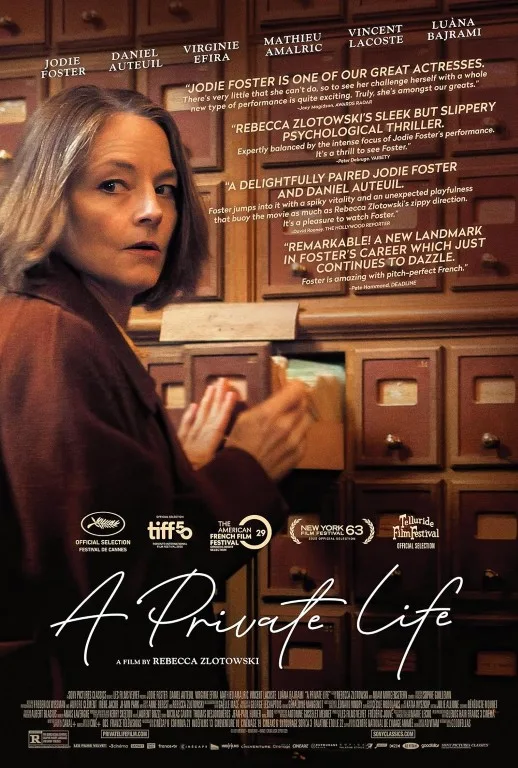


Jodie Foster’s newest role as an American in Paris is not the chic or splendorous tale that so often accompanies that trope. Rather, in Rebecca Zlotowski’s “A Private Life,” Lillian (Foster) is a stiff psychiatrist who, after learning about the suicide of one of her patients, Paula (Virginie Efira), becomes convinced she was actually murdered. Lillian then becomes deeply entwined in the details of Paula’s life, following leads ranging from pure suspicion to hypnosis to uncover the truth.
At first challenged by the fact that she potentially overlooked the warning signs that could lead to a patient taking their own life, Lillian hardly has any time to reflect before another patient, Pierre (Noam Morgensztern) is practically knocking her door down. He’s furious, claiming that after years of therapy and tens of thousands of dollars, it was not her who kicked his smoking habit, but a one-time appointment with a hypnotist. She also has a fraught relationship with her son, Julien (Vincent Lacoste), and suddenly, despite never being quick to emote, she can’t stop crying.
Lillian is losing grip of her own stable stoicism, and it’s throwing her for a loop. Her faith in her ability to do the job that defines her is faltering, and her journey to prove herself wrong masquerades as the film’s murder mystery. This flimsy confidence shows in her investigative pursuits, as she hops and skips between theories, pursuing them wholeheartedly, but never considering that she might have missed something. Enlisting the help of her ex-husband, Gabriel (Daniel Auteuil), the fractures in Lillian’s personal world come even further to light, coloring what may simply be one woman’s hunt for a purpose.
She even sees Pierre’s hypnotist, who takes her across numerous psychic landscapes, from being in utero to a past life as a cellist (and Paula’s former lover), eventually curing her of her crying fits, but perhaps inflicting her with new excuses, as she begins to use her own hypnosis as fodder for her theories. Yet simultaneously, a staunch skeptic of the process itself, she finds her mind changed, prompting her to question her beliefs about her own practice.
Foster’s performance is almost entirely in French, and (to my American discernment) sounds impressively authentic (Foster started learning the language at a young age), coupled with the English expletives she uses when particularly frustrated. Her rendition of Lillian is tight and stubborn, but also determined, and she plays her vulnerability well, showcasing a roughened exoskeleton worn for protection against doubt.
“A Private Life” veers off into territories that hint at the potential for more developed contexts, but never really do so. For example, the film teases a sapphic element that, had it been indulged a hair further, would’ve deepened the film’s stakes. In addition, there are numerous references to Judaism, antisemitism, and Jewish folklore that aren’t entirely coherent. And each time Zlotowski’s film skids off course and into these realms, it raises a flag more than it enhances the fabric of the story. Exploring these peripheral aspects of the story would illuminate more of the world Lillian lives in. She’s relatively enigmatic (aside from the denial that motivates her), and while Foster keeps us engaged, the script could’ve cared more for the extraneous details that truly make a person.
“A Private Life” concerns itself with the need for answers. Introducing patterns of thought regarding transference, the spiritual, and also the sheer vanity of constantly keeping oneself at the center, the pursuit is always going to be flawed. It wonders how much trust can be put in others, in ourselves, and in the metaphysical flurry that surrounds us, constantly asking to be questioned. And despite an overall unsatisfying resolution to these inquiries, the ideas that the film prompts, coupled with Foster’s nuanced performance, make for a compelling enough character study.