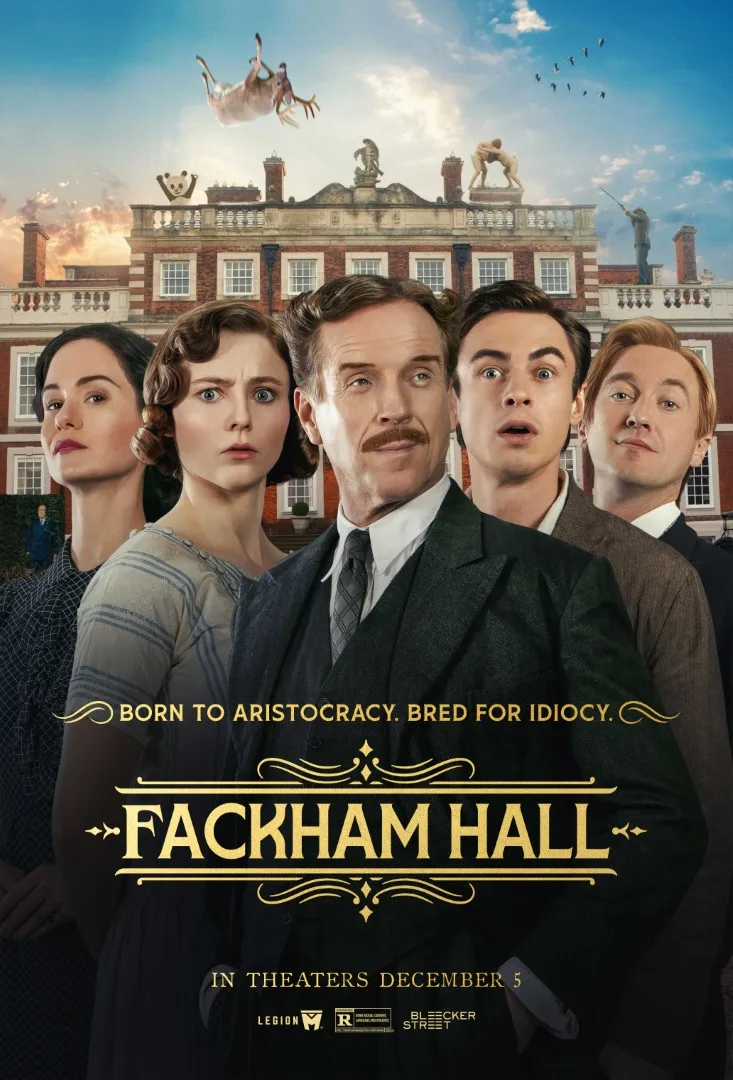

You’d think it would be easy to parody beloved period British dramas because they have so many guilty pleasure repeated tropes: huge historic houses, romances within and between upper classes and their servants, swooningly fabulous clothes, luscious meals, fabulous furnishings, and dialogue that sounds witty even when it isn’t because it is delivered in heavenly aristocratic accents with exquisite, RADA-trained diction. But the secret to the really great parody is truly loving whatever it is you’re making fun of. Thus, on a scale from the top (by Grabthar’s hammer, that would be “Galaxy Quest”) to the sloppy (I love you, Wayanses, but noticing something is not the same as being funny about it), “Fackham Hall” comes in around the middle.
Its watchability comes from the very elements it is trying to undermine: the fairy-tale setting of a huge country house, antique furniture, and beautiful people wearing gorgeous period clothes, speaking in accents ranging from elegant upper-class to cute commoner. Most of its jokes are based less on observing what makes these works so popular than on what is silliest or most outrageous. But what’s funny in the writers’ room does not always work on screen. An example of the tone is the title, the name of the characters’ residence, which a character says aloud to make sure we know it sounds like a crude insult to everyone involved.
The story is set in 1931, or, to put it in context, after the end of “Downton Abbey” and around the third of the ensuing films. We are informed, in case you have no exposure of any kind to this genre, in which case, why are you even watching this, that “England was a nation divided by class.” The country is suffering through a depression, but the Davenport family, who have occupied their ancestral home for 400 years, have no such concerns. (The 2,500-acre estate of Knowsley Hall, also featured in “Peaky Blinders,” plays the part of the ancestral home.)
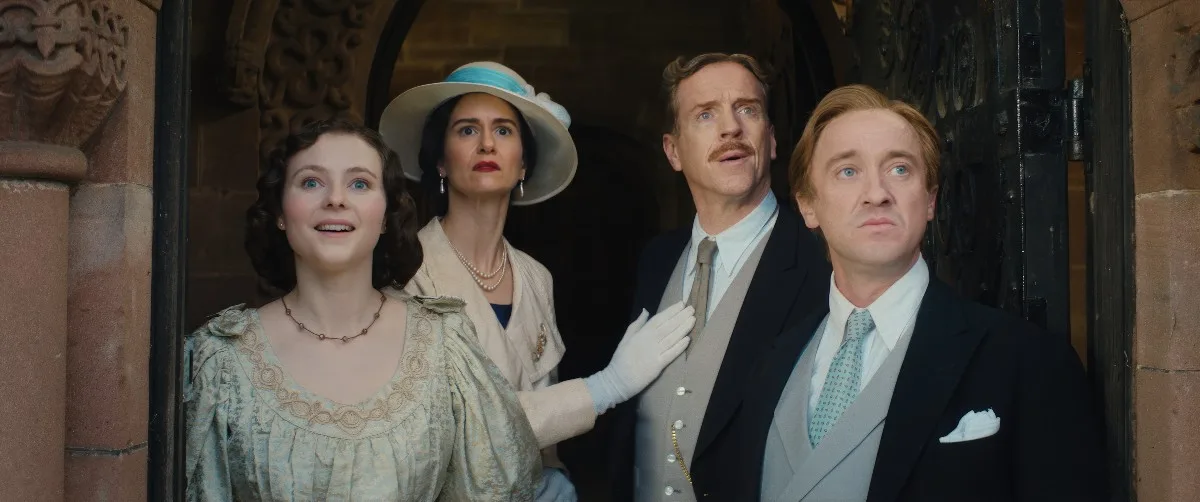
“The sheer grandeur of Fackham Hall was a testament to splendor and an enduring family legacy,” we are told by a narrator whose identity we will not discover until the end. “They led a decadent life and barely had to lift a finger.” Indeed, Lord Davenport (Damian Lewis) is sipping a cocktail from a glass held to his lips by a servant. He and Lady Davenport (Katherine Waterston) are congratulating themselves on the upcoming wedding of their daughter, Poppy (Emma Laird), to the presumptive heir to the property, Archibald (Tom Felton). “I’m just delighted she’s finally found the right cousin,” Lord Davenport smiles. As anyone who knows this genre understands, only males can inherit the land. Since the Davenports’ four sons, John, Paul, George, and Ringo, all died, this marriage is the only way they will be able to stay in their home. Thus, the motto on the family crest is “Incestuous ad Infinitum.”
The Davenports’ other daughter, considered too old and independent-minded at 23 to be likely to find a husband, is Rose (Thomasin McKenzie). She will soon meet a plucky orphan lad and kind-hearted pickpocket named Eric Noone (as in “no one”), played by Ben Radcliffe, handsome and charming enough to play the lead in any period romantic drama, and wisely calibrates his performance as though he is doing just that.
Noone is sent to deliver a message to Fackham Hall just as Poppy and Archibald are about to get married, except they don’t, because Poppy makes a dramatic race from the church to the arms of her low-born beloved. This puts the pressure on Rose to take over as Archibald’s fiancée and save the family home.
This is one of those “throw everything at the screen and by the time you realize that one wasn’t funny, four more will have come at you” movies. These include running jokes, anachronisms, sight gags, potty humor (in one case, chamber pot-y humor), slapstick, an extended dick joke, an extended “who’s on first”-type joke involving a character named Watt, sight gags, and verbal misunderstandings, e.g., “You fought [in WWI] with my father.” “No, we were on the same side.” And a tailor shop called “Tailor Swift.”
One element of this film that works well is that the actors understand the assignment, no winking at the audience, except for British comedian/presenter and co-writer of the screenplay, Jimmy Carr, playing a vicar who cannot help running the liturgy texts together to make them sound dirty. The score by Oli Julian and the costumes by Rosalind Ebbutt are also perfectly suitable for the kinds of movies this one spoofs. It’s just the jokes that, like British cocktails, are to American taste lukewarm.