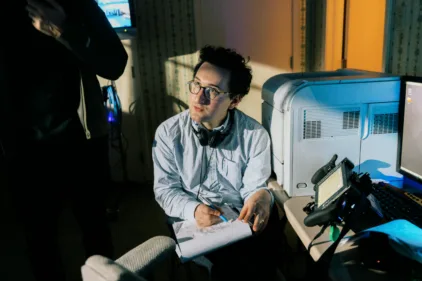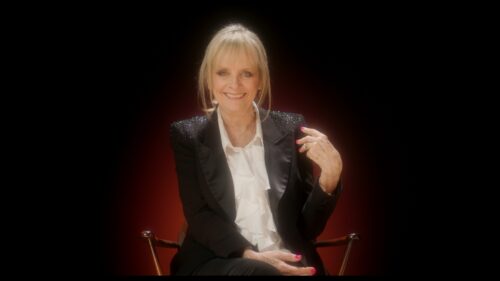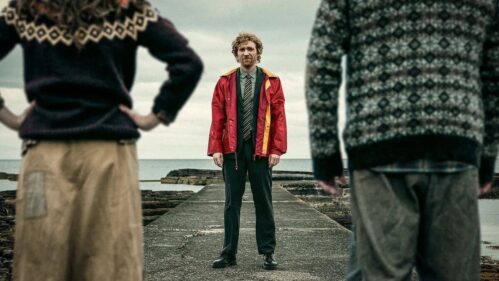
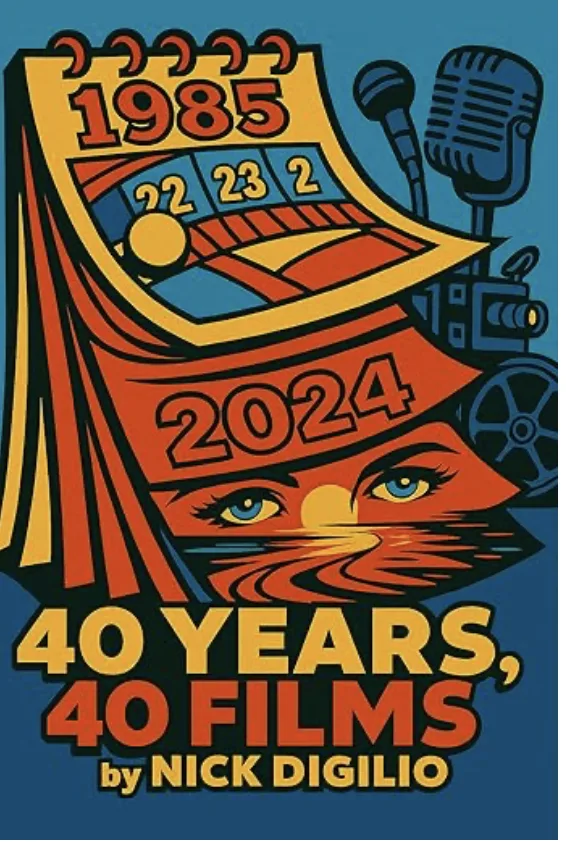
Nick Digilio has been a movie critic for 40 years, for many of those years on WGN radio, now with a popular podcast and hosting screenings in Chicago. And I’ve been talking to him about movies for 25 of those years. I still remember our first conversation, which included a discussion of “Donnie Darko” and the mid-century Hollywood director Douglas Sirk. He usually interviews me, but in honor of his new book, 40 Years, 40 Films, we switched, and I got to interview him.
In the book, he discusses one favorite film from each year since he began reviewing, provides details about what he was doing, and then lists some of his other favorite films of that year. The films he covers range from widely seen Oscar winners and blockbusters to underseen indies, often tending toward the disturbing (he loves horror, psychological to blood-spattered), but with some comedies and even one about a cute little pig and another about a gentle little post-apocalyptic gardening robot, from “Blue Velvet” to “Barton Fink” to “Dune: Part Two.” There are films from Spike Lee, Paul Thomas Anderson, Peter Jackson, Alfonso Cuarón, Alexander Payne, Christopher Nolan, and Clint Eastwood. He discusses his favorite actor, Jeff Bridges, in “Fearless,” and tells us about his all-time favorite movie, “Magnolia.”
As always, Nick and I had a wide-ranging discussion, this time including his mentor, Roy Leonard; the shift from terrestrial radio to podcasts; and how working in live theater and getting sober have both changed the way he thinks about the movies he sees.
Your tribute to Roy Leonard is very touching. What was his impact on you?
Roy was a special person, a rarity. He was a really genuine, sweet, caring man. And you don’t find that in the entertainment world or the business that I’ve been in for years. And he embraced me at a very young age. I was just this goofy kid who would call his radio show and ask him, “Why did you like Caddyshack?” because I had this stupid encyclopedic knowledge of movies, and he found something in me. He liked me, and I would call his show regularly. Eventually, he started sharing passes with me to movie screenings that WGN Radio and Roy would sponsor and host.
I was always taken by how knowledgeable he was, how funny, how approachable. I started reading film criticism at a pretty early age, Gene Siskel and Roger Ebert here in Chicago, but you couldn’t call Gene and Roger and ask them questions. You could call Roy. He was accessible, and I thought that was really neat.
He asked me to come in and interview for the job as producer of his radio show. I didn’t get the job. Obviously, I wasn’t qualified for it, and I didn’t deserve it. And he called me personally, and he said, “Look, I think you’ve got something. Maybe you’re not suitable to be my producer, but I’m at the point now where I’m tired of seeing crap. You go see the crap. You like those horror movies, and you like those kung fu things. Why don’t you review that crap and do it on my show?”
That was in March of 1985. And the first movie that I officially reviewed as a professional film critic, thanks to Roy Leonard, was ‘Friday the 13th, part 5.”
So that is the kind of guy that he was. He found something he liked in this goofy kid who dropped out of Columbia, worked at Jewel grocery store, and was like, “Yeah, you can review crappy movies for me.” And that’s how it started. Eventually, it evolved into me guesting on other people’s shows on WGN, and then me becoming the official co-film critic on his show. And then it all led to an over-35-year run at WGN as a host and what I’m doing now. So I owe everything to Roy.
So, from just how to be a pro in broadcasting to how to be a better person, that’s what I learned from Roy.
You’ve worked as an actor, director, and playwright. What did you learn from that about storytelling that you bring to your perspective as a critic?
I talk a little about that in the book because when I started working in theater, I took improv classes at Players Workshop and later graduated from Second City. That was in the late ’80s and early ’90s. And then I joined the Factory Theater in 1993. I started looking at movies a little differently. When that happened, I realized firsthand how difficult it is to tell a story clearly.
And then with my stage work and working with actors, especially when I started directing and working with actors, which is my favorite thing, I found myself appreciating performances more, and I also found myself kind of instinctually knowing when a director had a hand in the performance, which I really didn’t know in the ’80s. When I realized what it was like to—the difficulty and the passion that you have to have and the time you have to have to put up a show, especially in storefront theater when you have no money, and you’re basically putting up a show so that you can pay the rent, there’s a passion in that.
So, I was much more forgiving, and I admired low-budget movies a lot more. I knew how difficult that was on a smaller level, doing storefront theater. Doing theater really gave me a better appreciation of how hard it is to tell a story and what it’s like to work with actors, and I was forever grateful for that experience.
You’ve had a front-row seat to the massive changes in the different eras of radio. What was that like?
What we used to love about the radio is gone now. There are talk radio stations that you can find up and down the dial, but most of them are filled with syndicated shows that aren’t local and that are very, very, very political. A lot of them fly completely far right, and I can’t listen to that. Roy Leonard was liberal, and his politics were well known, but he would have to do crosstalk with Bob Collins every day. And Bob Collins was absolutely conservative, as conservative as you can get. And so was Spike O’Dell. And yet, everybody coexisted at that place. Everybody was kind to each other.
I think that’s a reflection of where we are culturally, not just the radio business, obviously, because things have gotten to the point where you can’t have a political conversation with anybody anymore, especially if you’re labeled on the left or you’re labeled on the right. But there was a time in terrestrial radio when people from completely different political or cultural backgrounds could find a place to talk together without anger or sacrificing friendship. The whole idea of making radio sound like a village where you could call in that doesn’t really exist anymore. That was my favorite part of doing a radio show. One reason I love doing overnights is that I get to talk with listeners and build a relationship with them.
Then I switched over to podcasts, which is what you have to do now. I’m thrilled and honored. And I love that I’ve been doing a podcast with Radio Misfits since early 2022. I love doing it, but we don’t have that immediate gratification of talking with a stranger. I still have guests on, and I still get to do a lot of the elements that I did on the radio that were pre-planned, which are great, and it still has the vibe and the feel of the radio show that I did on WGN, but that element of natural connection with your audience is gone, and I miss that terribly.
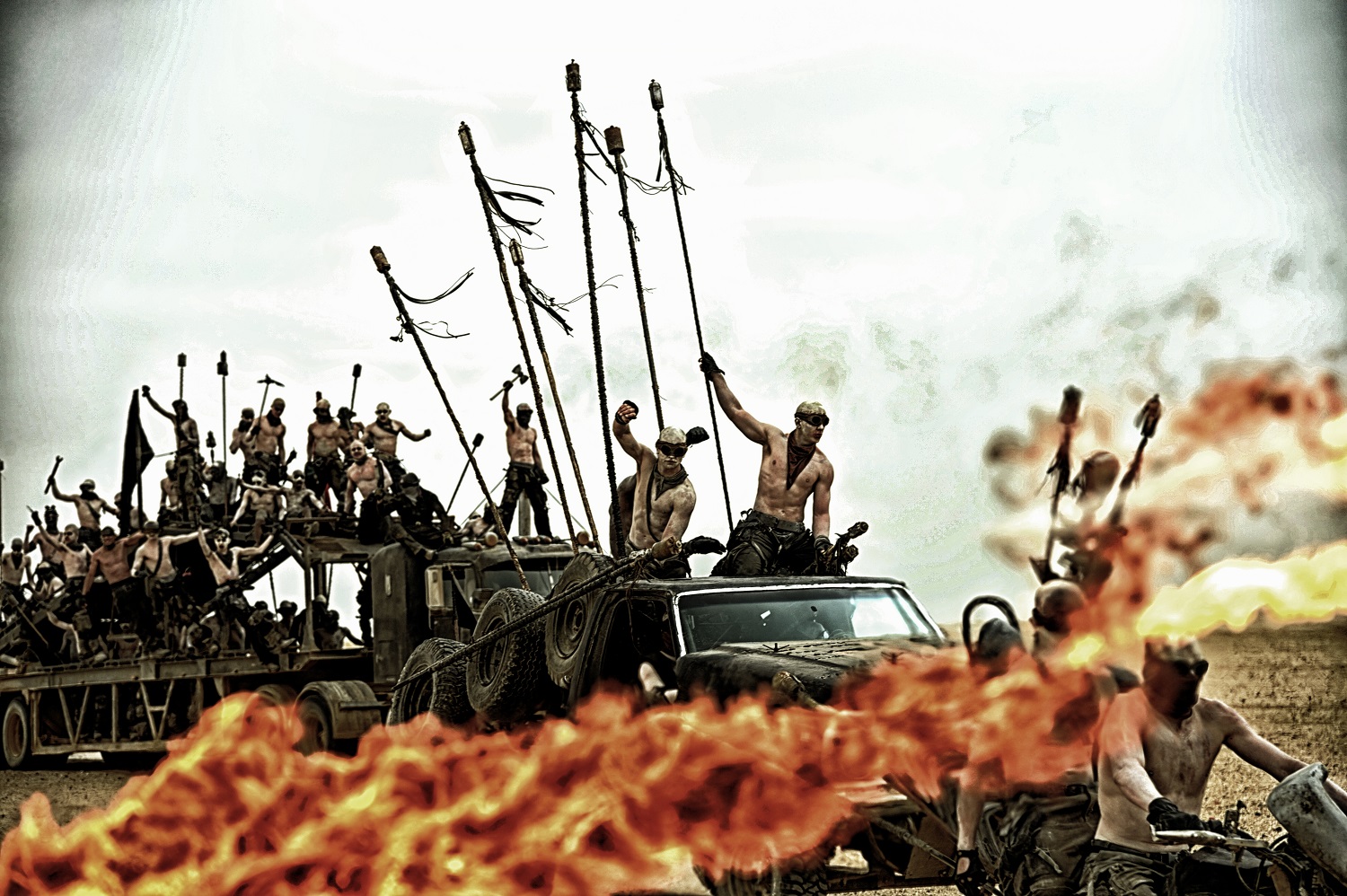
You’ve been very open about being a recovering alcoholic. One very affecting thing that you write about in the book is in your essay about “Mad Max: Fury Road,” which you first saw when you were still drinking, and then saw it again later after you stopped drinking.
I am an alcoholic. I share that in the book, and I’ve shared that with my listeners on the radio. I want to be as honest about it as possible. If being honest about it can help other people, and it has, you have no idea how gratifying and happy that makes me.
I was a functioning alcoholic, never drunk on the air. When I saw “Fury Road,” I had had a few pops. It blew my mind. Then I had some more to drink, and I saw it again, literally two hours later. And I was a little bit drunker, and I was a little bit wilder, and I walked out and loved it even more. The next day was a Saturday. I had a few drinks, and then a whole bunch of us went to see it, my third time, everybody else’s first time. I saw it three times in less than 24 hours.
But the three times I saw it, I wasn’t bombed; I had a few. And I saw it a bunch of times during that period: I would see the movie and drink afterward, or maybe have a couple beforehand. I got sober on June 15th of 2015. And after I recovered, I was in the hospital for a while, and after I got my crap together, I went back to the theater and saw it fresh. I had been sober for about a month when I went back to see it, and it struck me how much more detail I could see, how much more I could appreciate the craftsmanship, and how that movie. I was like, “Oh, my God, it’s better not to drink when watching movies.” And I know that’s a simplistic and obvious statement, but that movie hit me like a ton of bricks on a lot of levels just because it’s one of the best movies ever made, maybe the greatest action film of all time, an astonishing piece of work. But to watch it either a little bit tipsy or knowing that I’m going to get drunk afterwards is completely different from sitting there stone sober, watching it, and appreciating every frame of it.
And it hit me even deeper, and then that was when I realized, wow, maybe I should go back and watch a ton of movies that I saw while I had had a couple of pops in me. It made me change my viewpoint a lot. Getting sober in 2015 actually altered how I looked at movies in general. Like, everything changed after I got sober. It just so happened that monumental film was in theaters while I was first getting sober.
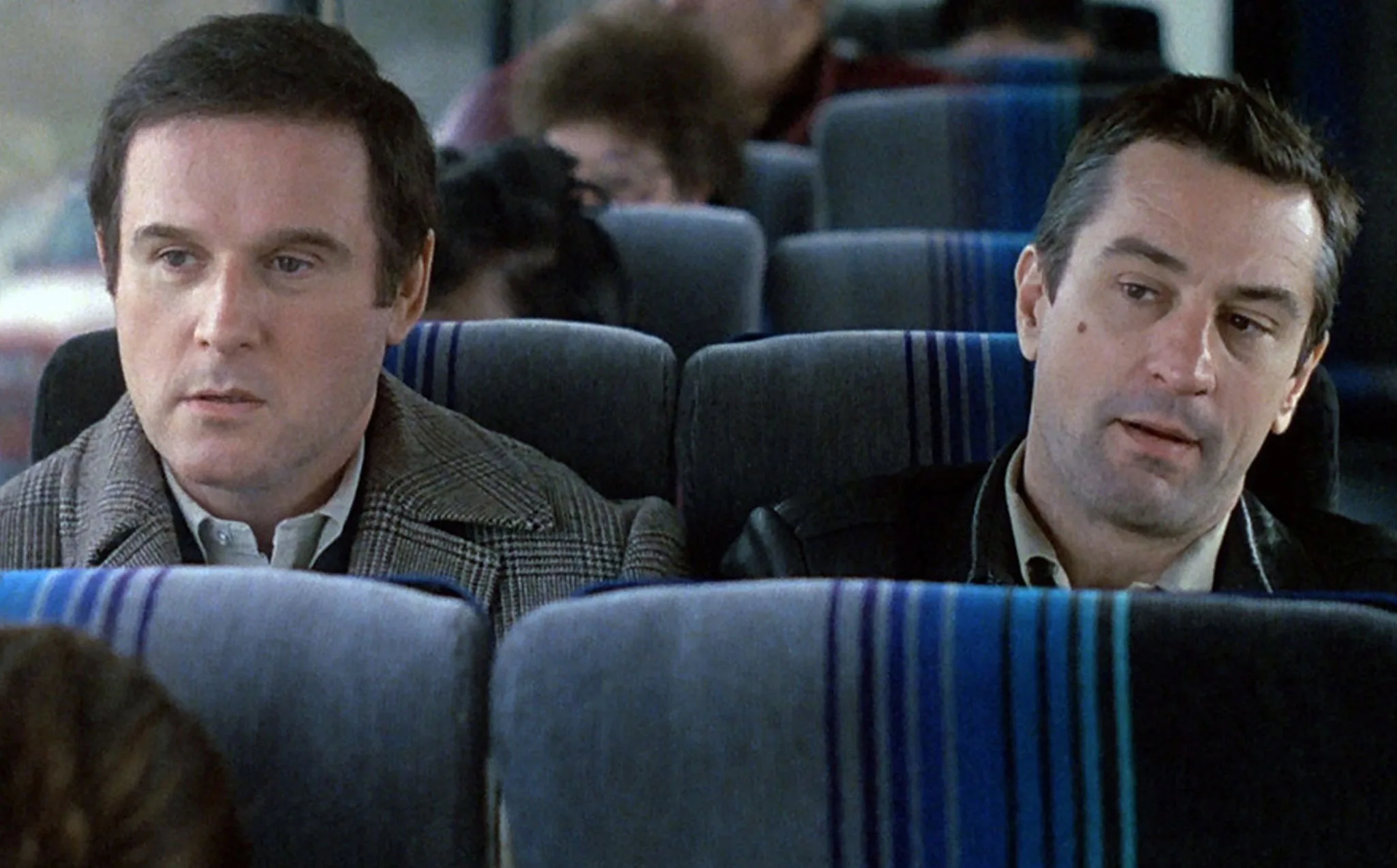
Speed round. I’m going to name some of my favorite movies in the book and ask you for a quick reaction. First is “Midnight Run.”
It is the ultimate remote dropper. Late at night, you’re flipping through the channels, and then a movie pops up, and you drop the remote. It’s endlessly entertaining. It’s a very funny movie and a great road movie, and the supporting characters are fantastic, but there’s one scene in that movie that knocks me on my ass every time I watch. Robert De Niro’s character has to go back to his ex-wife, asking for help. And then, after the scene with the daughter, as they go out to the car, he puts Charles Grodin in it. But before he closes the door, I get a little choked up every time. Grodin’s coat is hanging out of the car. And De Niro picks up the coat and puts it back in before he closes the door. And it’s just this little detail. For the entire movie, he’s been grabbing Grodin, shoving him, throwing him around. But after this devastatingly beautiful scene with his daughter and his ex-wife, he puts him in the car and then makes sure that his coat doesn’t get caught in the door.
I love the entire cast, and I love the director, Curtis Hanson.
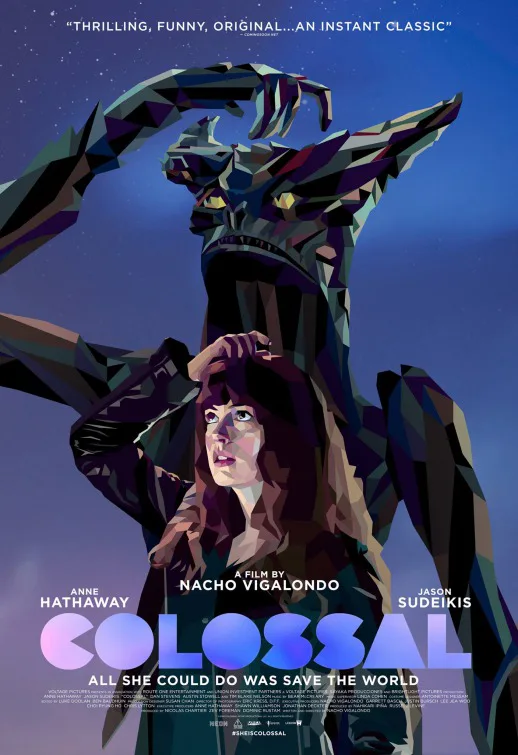
That movie is, in my opinion, one of the most, if not the most, accurate personification of alcoholism that’s ever been put on film. I think it’s Anne Hathaway’s best performance. I think Jason Sudeikis is astonishingly scary and good in it. It’s also a really kick-ass kaiju movie, and I’m good with that, but to take alcoholism and turn it into a kaiju monster is inspired. It’s funny, and it’s deeply moving and horrifying in what Anne Hathaway’s character goes through. And it also has one of the funniest and bitterly funny final lines and final moments in movie history, especially if you’re an alcoholic.
Gosling is amazing. I happen to be a huge fan of the director, Craig Gillespie. I find it unique and interesting, deeply moving, and weird. But, like, all of the acting in it is stellar.
“Hamlet 2”
Nobody’s seen this movie. I think it’s one of the funniest movies ever made. It helps that I’ve done theater. Steve Coogan is great, the songs are great, the kids are funny, and it skewers theater. Some of the funniest physical comedy I’ve ever seen is Coogan on the roller skates going into the liquor store.
“Tuesday”
Oh, my God. Boy, that movie was wildly original, obviously. And Julia Louis-Dreyfus is incredible. The way they bring death to life through this large bird. I was deeply moved by it. I cried like a baby during that one, too. It’s so fearless. It doesn’t get more original than “Tuesday.” I can understand why people are put off by its absolute oddness. But I remember being so excited about the movie. Anything that’s weird, even if it’s bad and original, I appreciate it more than a reboot or a sequel.