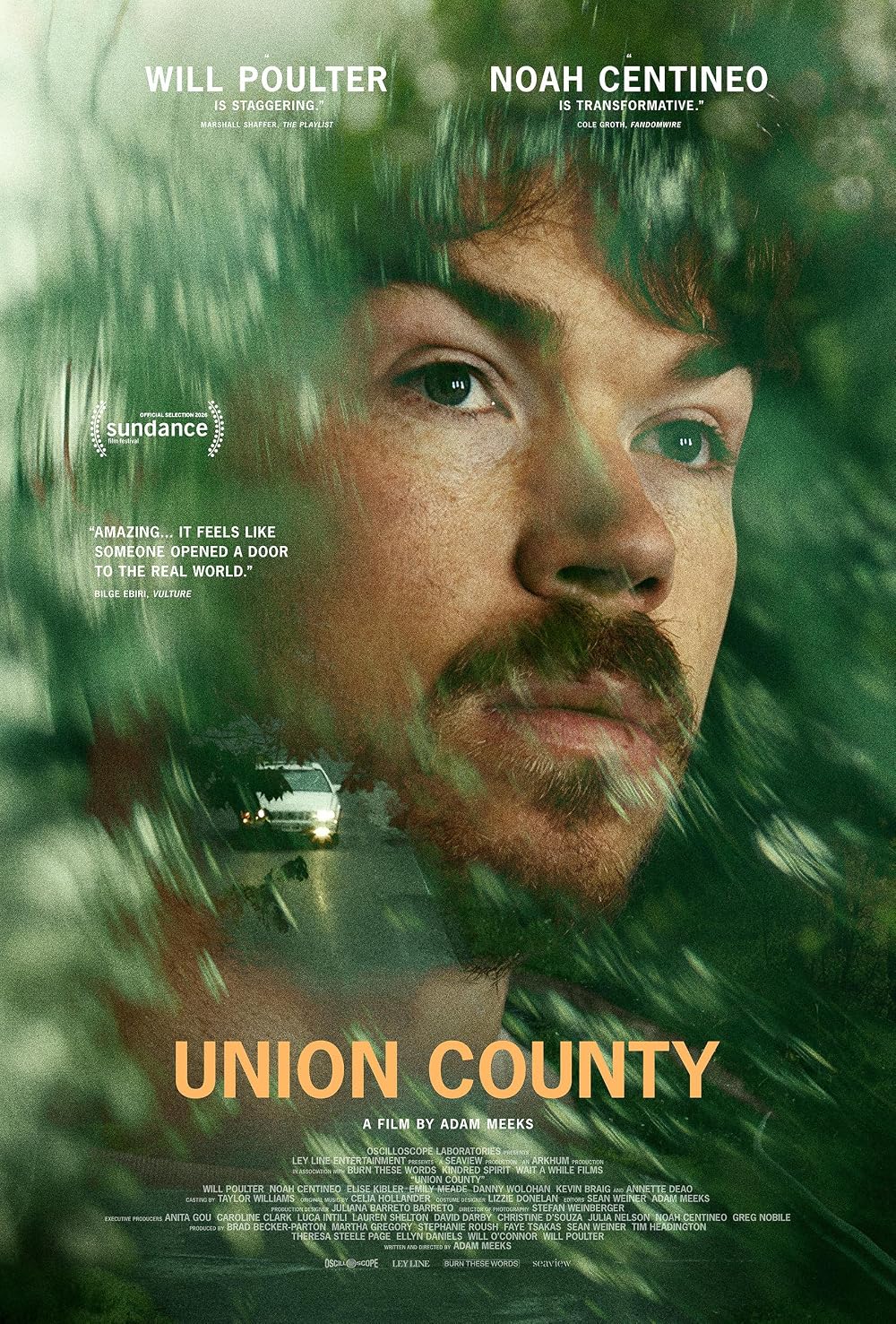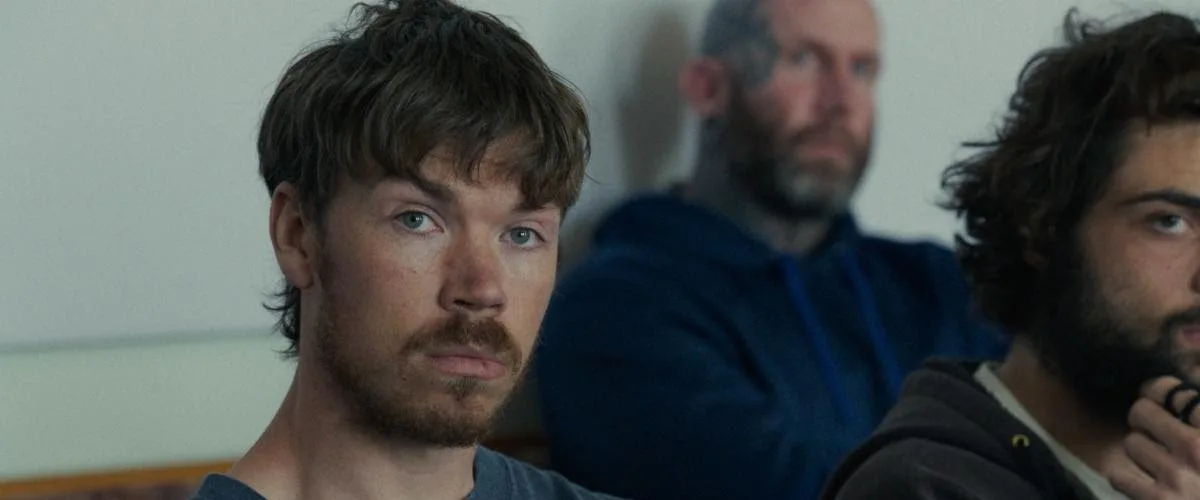
You rarely encounter features as tight (97 minutes), soft-spoken, and straightforward as “Union County,” a film about rural Ohio drug addicts in court-ordered rehabilitation. And when you do, they don’t tell the story of a character who rarely speaks. This film does that, and a lot more.
The young man is Cody Parsons (Will Poulter), a drug offender who must pass through a three-stage, supervised process to prove he’s committed to getting clean. The government will return him to prison if he fails. His erstwhile partner is his foster brother Jack (Noah Centineo), who’s as hyperactive and ingratiating as Cody is introverted and watchful. Jack, whom Cody simply refers to as his brother, is a magnet for trouble. Or maybe trouble’s a magnet for Jack. They try to keep each other honest. It’s hard. Temptation is everywhere. Sometimes it’s right there beside them in the passenger seat of a car, smoking meth and shooting dope while the other guy’s trying to keep his eyes on the road.
Poulter has long been one of those “I know that guy—what’s his name?” actors, but hopefully won’t be for long. Like a lot of English actors, if you didn’t know he was English, you’d never guess. I lived in Ohio for nearly five years and visited it regularly for another 25. Cody is as real as dents in the tailgate of a pickup passed down through generations. So is everyone and everything else onscreen, including real-life residents of Union County who act with the pros and hold their own.
Cody is the kind of character who comes across more vividly in film than any other medium, provided he’s played by someone who understands that the best screen acting comes from staying as blank and open as possible and letting the story flow through that stillness, through the lens, off the screen, and into the viewer’s minds. Poulter gets this. Watch his performance long enough, and you start to feel everything Cody is feeling, even what he’s trying to hide.
You may also empathize with Cody’s predicament for reasons unrelated to drugs. This is a great movie about what it feels like to live month-to-month in America, with no steady job, no government-funded safety net, poor to nonexistent healthcare, and leaders who enjoy making people suffer. Having alienated close friends and family—including his sister Katrina (Emily Meade), whose home was his safe space until she caught him stealing–Cody is unwilling to trust those still actively using. He has only himself to lean on.
Some of his lowest moments happen in his car, which is also his home. The scene where Cody tries to get a decent night’s sleep while rain splats on his roof is a snapshot of contemporary American life as blunt as the hip-hop the brothers blast as they’re driving around. Cody is flirting with another recovering addict, a witty young woman named Anna (Elise Kibler) who lives in the rooming house across the street from his. They click as a potential couple, but they’re both reluctant to hook up because neither knows where they’ll be in six months, or whether they’ll be sober. Their story doesn’t end the way you expect. No one’s does.
Written and directed by Adam Meeks, “Union County” is a fact-fiction hybrid shot in Bellafontaine, Ohio, a town northwest of Columbus that, like so many communities, has been affected by illegal drugs, from crack to meth to fentanyl. It’s a shining example of Neorealism, a school of movie storytelling that originated in post-World War II Italy, filmed scenes in actual places rather than on sets, and cast trained actors alongside nonprofessionals who usually played versions of themselves. This is Neorealism at its finest. Even if you’ve never encountered filmmaking of this type, you’ll grasp everything it stands for after watching “Union County.”
A closing title card states that “Union County” would not exist without the participation of Ohioans who either worked in or moved through Bellafontaine’s Adult Recovery Court. The movie’s roots in real life seem to have centered the project and kept it honest. The story begins with a series of reports (or testimonies) from people enrolled in the program, directed towards Judge Braig (Kevin T. Braig, an actual judge of the Logan County Court of Common Pleas in Ohio) and Annette, the social worker assigned to help them (played by Annette Deao, a licensed chemical dependency counselor and the Grants and Specialized Docket Administrator for the Logan County Court of Common Pleas).
Many Western filmmakers have invited everyday people into their fictions, including Martin Scorsese (who did an entire documentary championing Italian filmmakers, the Neorealists especially); Spike Lee; Ken Loach; Sean Baker; Josh and Benny Safdie, and Hal Ashby (whose Vietnam drama “Coming Home” features real disabled veterans in group counseling. aka rap sessions). You can usually spot the nonprofessionals because they have more enthusiasm than skill, and the pros are the ones holding the scene together. That’s not the case here.
The filmmaking smooths out skill differentials by giving real people who are trapped in a real system a chance to tell their stories, whether the delivery mechanism takes the form of a full character or sixty seconds at a podium talking with the judge . They’ve found a way to bring out the artist in everyone involved. That’s why “Union County” succeeds as an intimate story about addicts fighting inner demons that ended many lives, but also as austere cinematic object that draws on cinema’s past for inspiration but never feels imitative or coldly theoretical.
Meeks, his cinematographer Stefan Weinberger, and his editing partner Sean Weiner stick to a small number of shots per scene, sometimes just one. They get in and out just in time to make a point, without rushing the story or omitting details that are crucial to understanding. Sometimes the camera will observe characters from the other side of a room, or through a doorframe, while others’ voices are heard offscreen, but you still feel the action keenly, in a way that is different from, but as intense as, movies where the camera is constantly in people’s faces.
Celia Hollander’s electronic music, more a soundscape than a traditional dramatic score, doesn’t just echo or amplify the emotions conjured by the story, but somehow seems as if it’s conducting them, not as a person with a baton conducts an orchestra, but as copper wire conducts electrical current. All this craft fuses to create a sense of commonality and interrelation, with government workers connecting citizens, their public servants, their local institutions, and the economic and chemical forces bearing down on them, and the movie connecting all of them to us.
Paintings and still photos have negative space, the area that surrounds the main subject of an image. That term applies to cinema as well, but in a more complex and elusive way. In cinema, the negative space isn’t only pictorial. It can also be sensed in the room tone that fills up pauses in conversation; in an over-the-shoulder shot of a man walking a woodland path, accompanied only by the sounds of birds, insects, and his own footsteps; and in the uneasy moment between a fade to black and the start of a new scene. “Union County” is as much a study in negative space as it is a thoughtful rendering of people trying to move beyond addiction. At the center of each frame is an individual, and all around them, life.