
Matthew McConaughey was a star to connoisseurs of up-and-coming actors long before his official ascension into the firmament in March 2014, when he won an Oscar for “Dallas Buyers Club” before “True Detective” premiered on HBO. Cinema made room for his specialness before most folks knew his name. He bestowed “all right, all right, all right” on Wooderson, the twenty-something still hanging out with high schoolers in his breakout film “Dazed and Confused.” He also contributed Wooderson’s motto “j.k living,” a saying he attributes to his late father, and that became the motto of a teen-focused charity he co-founded with his wife Camila. McConaughey says the latter is an abbreviation of “just keep livin'”. That the abbreviation has the same number of syllables as what it’s abbreviating is but one example of McConaughey’s powers of persuasion. You’ll follow him anywhere if the movie is good, sometimes even when it isn’t.
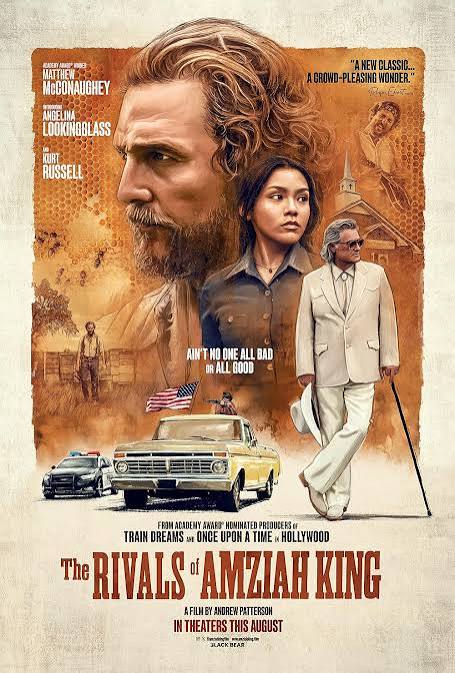
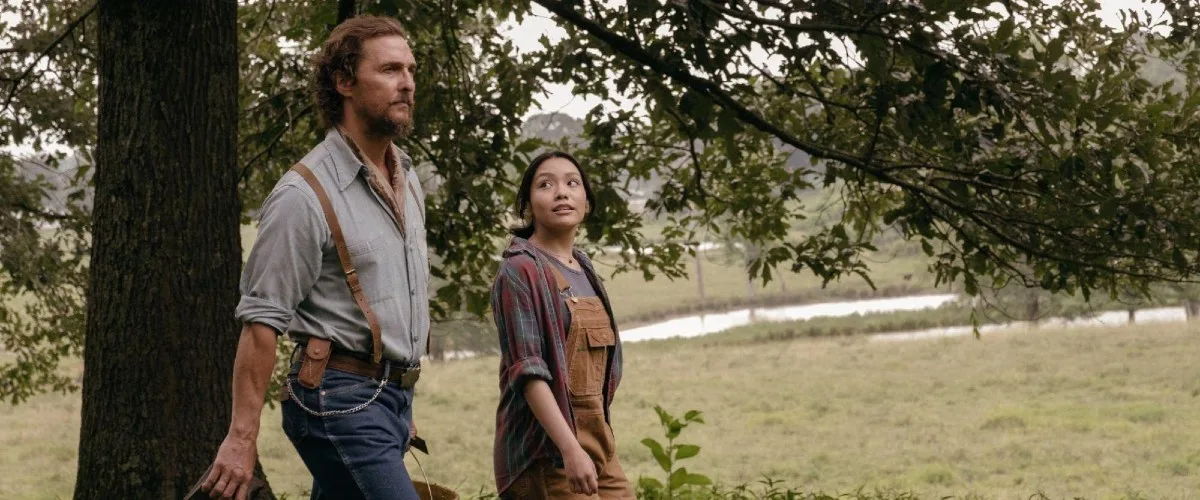
“The Rivals of Amziah King,” about a beloved small-town beekeeper and folk-rock musician whose hive is stolen by rivals, is good—so good that you might enjoy it even if you’re indifferent-to-negative on the brand that McConaughey has arguably become. His parched drawl, imploring eyes, devilish grin, and evangelical speaking style are perfect for the title character of this raucous, exciting, occasionally shocking, ultimately uplifting story of community, sacrifice, and shared values.
The movie takes its sweet time laying out the individuals and institutions in Amziah’s tight-knit Oklahoma town. It’s the sort of place celebrated in political ads as a little utopia where everyone looks out for everyone else, but here the description is true, up to a point. Writer-director Andrew Patterson hits the parallels between human communities and beehives mighty hard in both the writing and the editing (by Patrick J. Smith); the story lays out its interests so plainly from the get-go that we don’t need so much help figuring out the message. But this is as much a sermon delivered by a charismatic preacher as it is a country-fried folktale, and sermons aren’t known for subtlety. Besides, the organizing metaphor of humankind as insect hive is solid enough to survive any number of storytelling miscalculations, and to be fair, some moments which at first feel like metaphor overkill (such as Amziah’s explanation of the three main roles within a beehive, and the procedure for filling a vacancy) turn out to be examples of the movie making extra-sure every viewer has paid attention to a setup, so that when the payoff arrives, the audience reacts as one.
An opening credits sequence set at a drive-in burger joint leads into the first of many dynamic explorations of the nuts and bolts of beekeeping. A seemingly impromptu performance by Amziah’s band is cut short by local cops showing up to announce that a massive shipment of stolen honey—street value: $2 million—has been recovered, but they need Amziah and his pals to figure out who made it. The band heads to Amziah’s warehouse workspace and puts one of the stolen drums in a wax separator so they can uncover the unique mark that every manufacturer hides in their product.
This sequence mixes storytelling efficiency and a loose-limbed, easygoing approach to performance that’s characteristic of the film as a whole, setting up the crime elements while sketching major players in bold strokes. There’s a sensitive and erudite lawyer who goes by Rippy (Rob Morgan); a couple of gung-ho honey harvesters (Owen Teague and Cole Sprouse); Remmick (Jake Horowitz), a cynical, kinda greasy fella who seems like if he ended up in prison he’d become one of those hustlers who can get you anything; and a newcomer named Komar (Tony Revolori), who knows nothing of bees and honey but is eager to learn.
In theory, “Amziah King” is a crime thriller in a “sunshine noir” mode. It gives you what you expect from that sort of movie, including sudden, bloody eruptions of violence, and stout-hearted but secretly formidable good guys seeking justice from bad guys who wrecked their lives (Kurt Russell plays the baddest bad guy, Dob McCoy, an agriculture tycoon with a gangster mentality). But the movie takes a long time building to the moment where it jumps feet-first into the underworld. When the jump finally happens, you’ve got all the information you need to feel it and follow it. Patterson proved he knew how to make a movie with his feature debut, the self-financed science fiction thriller “The Vast of Night.” This project levels up in terms of resources but still maintains the scrappy, “just because we feel like it” spirit of artists with nothing to lose.
It’s also a literary triumph, packed with lines and phrases as musical as the lyrics sung by Amziah’s band. From Amziah describing Komar as “a combative little scoop of a man” and the mandolin as “a religiously iconic, almond-shaped instrument” to his guided tour of dishes at a local potluck dinner that reveal the human story behind each recipe and brand each one as “either the truth, or a lie,” Amziah is a pleasure to listen to and observe. He could easily be slotted into a novel by the late Charles Portis (True Grit, Norwood), who also had a gift for pushing comical rural archetypes to the brink of caricature without losing sight of their humanity, and wrote dialogue thrumming with wisdom and wit. (Describing a character in True Grit, Portis writes, “As he drank, little brown drops of coffee clung to his mustache like dew. Men will live like billy goats if they are let alone.”)
What might’ve seemed like a prelude to a mystery deepens when a young woman named Kateri (Angelina LookingGlass) appears at Amziah’s place. Amziah and his late wife Glenda used to take in foster children. Their ranks included Kateri and her younger brother, who loved having the Kings as guardians but got pulled away when King’s wife died and the judge wanted her placed in a two-parent household. Amziah is a born again Christian who chastises himself for cursing, and it’s implied that there was a time when he wasn’t this sunny and near-saintly. There’s more to both their stories. Each detail reinforces why these two characters are the way they are—Amziah with his flamboyant, showboating extroversion, which seems at least partly a reaction to the isolation he felt after losing his mate; and Kateri with her watchfulness, skepticism of everyone and everything, and reluctance to \ attach herself to any place or person, having escaped a chaotic, often violent childhood by sheer will.
The soft-spoken duets between McConaughey and LookingGlass give depth to a film that might otherwise have risked devolving into a parade of oddballs. You can tell how deeply the two actors respect each other by the unguarded, authentic delight on their faces whenever one watches the other hold the spotlight. McConaughey doesn’t treat his thirty-plus-year head start as a professional actor as an excuse to crowd out his co-star, but instead approaches the part with a levelheaded appreciation for the future star who’s sharing scenes with him.
Talk about a performer who shows up out of nowhere and instantly proves they’ve got what it takes to anchor their own films: LookingGlass has just two previous acting credits, one of which is a three-episode arc on the TV series “Dark Winds.” She’s an instant star of the same wattage as McConaughey, Jessica Chastain, Lupita Nyong’o, and other actors who rose from near-obscurity to stardom in the blink of an eye, and deserved to. LookingGlass is sure to be compared to Lily Gladstone in Martin Scorsese’s “Killers of the Flower Moon,” even though that film and this one have little in common, because she’s Native American (Oglala Lakota, Navajo, Seneca, and Kiowa Comanche). But to put it bluntly, LookingGlass should emerge from this project with far more industry mojo than Gladstone acquired from Scorsese’s movie because she isn’t playing a long-suffering object of treachery, but a sharp, resourceful young woman who repairs societal damage, seeks justice, and is tougher than anyone but Amziah realizes.
Kateri manifests her innate strength in a scene where she receives a piece of terrible news with a stoic acceptance that morphs into a steely resolve that is all the more exciting for being understated. Patterson wisely lets this moment dominate the second half of the scene by staying in close-up on LookingGlass and never cutting away once the actor has started to cook, likely because he understands what a gift he’s been given and knows better than to dilute its power. The most apt comparison to this closeup is—yes, really—the scene in “The Godfather” where Al Pacino’s Michael instinctively accesses the power he always carried within him, in a display of strength that his audience knows is legit because they feel it. After that, “The Rivals of Amziah King” is as much the story of Kateri coming into her own as a wunderkind leader as it is a loving portrait of Amziah and his town.
On the way to an exhilarating ending, “Amziah King” detours into narrative cul-de-sacs that a screenwriting teacher would slam as digressive and indulgent, but prove integral to the film’s unique personality. This is the kind of movie that will set the main plot aside and stage a four-minute jam session in a tiny kitchen, or carve out space for a narrated montage about how honey is harvested, confident that you’ll follow along because you enjoy the characters and trust the filmmakers. Even when the movie makes structural choices that seem like self-defeating miscalculations, they often reveal themselves in retrospect as promises that the film had every intention of keeping.