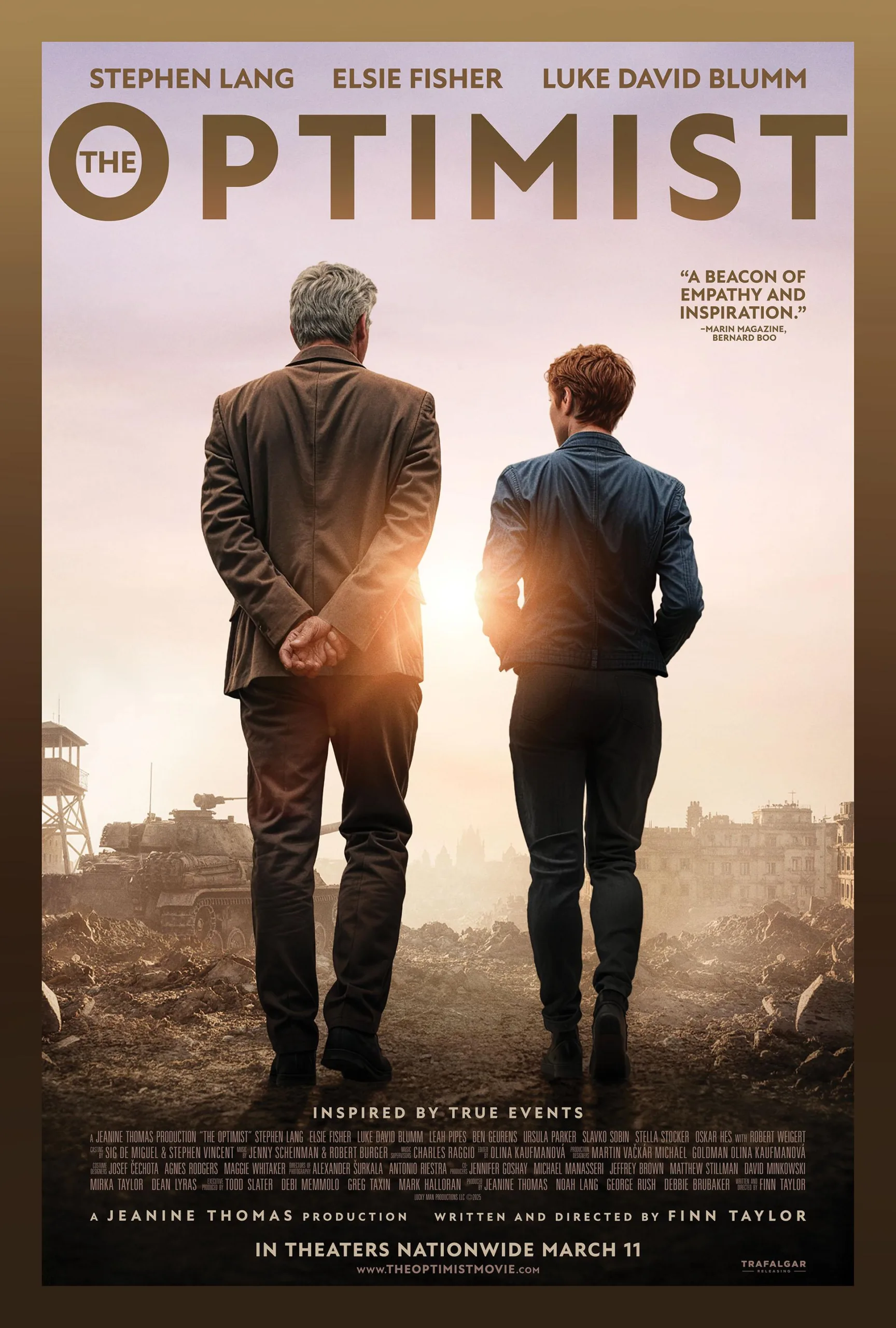

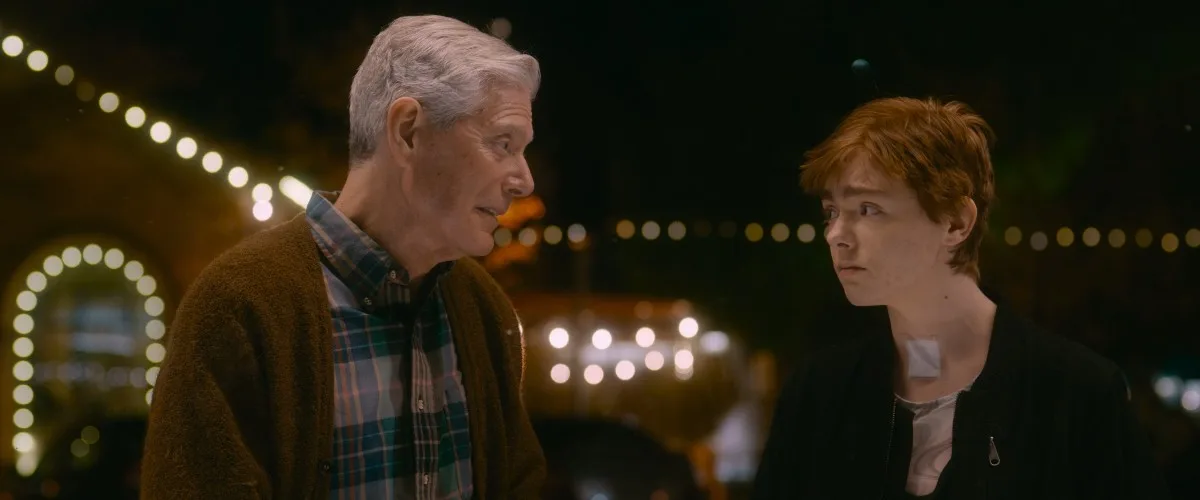
It’s yet another testament to Stephen Lang’s acting brilliance that we can accept him in “The Optimist” as a tall but otherwise physically unremarkable old man—even though we’ve seen him looking strong enough to strap a refrigerator to his back and carry it up a flight of stairs (“Avatar,” “Don’t Breathe”). Here, he plays Herbert Heller, a Czechoslovakian-American Jew whose terminal cancer diagnosis inspires him to tell the story of how he found his way from Nazi-occupied Czechoslovakia, including the terrifying and shameful incidents he’s never revealed to anyone.
Herbert is based on a real person who had a clothing store in San Rafael, California, and often spoke to local schoolchildren and history buffs about his experiences. He chose writer-director Finn Taylor to tell his story on film, but died in 2021 at 92, as the production was beginning. Lang doesn’t seem to have altered his physique to play the character, but his posture and movement sell the idea that he’s just another senior citizen whose story we don’t know. He moves like a man who thinks he’s still 25 and has to remind himself that he’s not; when Herbert walks briskly, then stops and looks around a room, it seems as if he might have a touch of vertigo. The accent is right, too—like that of a man born and raised in Eastern Europe who left for the United States as a young teen, but retained a trace of the old accent for the rest of his life.
Lang’s performance is one of two entirely successful elements in “The Optimist.” The other is Elsie Kate Fisher’s performance as Abby, who’s in rehab under the supervision of a counselor named Ruth (Robin Weigert) after a drug-related tragedy. Abby becomes Ruth’s assistant on her side project, recording interviews with Holocaust survivors. Ruth pairs Abby with Herbert as sort of an interviewer or confidant on camera, to make Harry comfortable enough to speak of the unspeakable. In time, she becomes good enough friends with Herbert to reveal the incident that landed her in rehab: after learning shameful secrets about her father, Abby made a catastrophic error in judgment that caused the death of a young woman she loved, a free spirit named Sabrina (Ursula Parker).
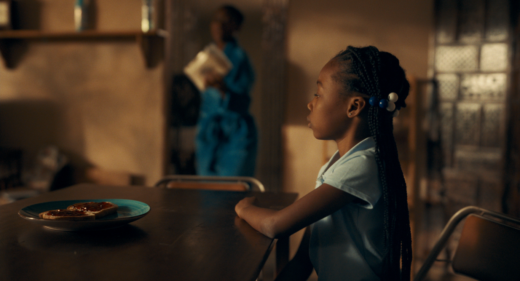
Fisher is a stone-cold professional who has only been alive 23 years and has been acting for 17 of them. She voice-acted little Agnes in “Despicable Me” when she was eight and has played her ever since, and she’s won lead roles in major films and TV series, including “Eighth Grade,” “Barry” and “Castle Rock.” Here, she captures the body language of a young woman who’s been ostracized and bullied for so much of her life that she can barely bring herself to make eye contact with her own reflection, yet has an inner strength she doesn’t appreciate until someone else points it out. There’s a specific kind of sadness that radiates from a small, skinny, or otherwise physically unimposing young person who’s smart enough to become the target of insecure brutes but not devious enough to beat them, and this performer nails it. You know girls like Abby.
Despite Lang and Fisher’s exemplary teamwork, “The Optimist” never overcomes its clunky plot or its inclination to teach rather than dramatize. It is so eager to share revelations, life lessons, and helpful hints with the audience that it can’t sustain an audiovisual groove for more than a few minutes at a time. Told nonlinearly, it seems fragmented or fractured. At times, it plays as if three movies, each potentially satisfying on its own, had been chopped into pieces and reassembled as a 95-minute montage.
Was the nonlinear structure superimposed during the editing process to rescue a movie that would have run three hours or longer if it had retained every scene at full length? Whatever the explanation (or justification), the cuts between different time periods—the present-tense scenes, which take place in the mid-aughts; Abby’s fairly recent tragedy; Harry’s experiences as a World War II concentration camp inmate in Czechoslovakia and an immigrant orphan in the postwar US—are maddeningly counterproductive.
Lang and Fisher are such absorbing speakers that an entire play-like movie could’ve been made of the two of them talking while the audience imagined their experiences. Or “The Optimist” could have been a feature-length film made up entirely of scenes of young Harry escaping the Nazis and reinventing himself, or, alternately, poor Abby going through her ordeal. Instead, we get a movie that gloms different time periods and filmmaking modes together, but lacks the rhythmic sense to make it all flow. Often Herbert or Abby will give the other a heartfelt preamble to an important anecdote, and just when the actors have us in the palms of their hands, the movie will cut to a flashback visualizing the story; alternately, it will immerse us in the past, then yank us back to the present, often uncannily at the very moment when you crave more of whatever you’re currently watching.
That having been said, there is no part of “The Optimist” that is less than sincerely presented and skillfully acted and shot. There are even a few sections where it weaves a spell, of a type that’s only possible in cinema—the kind that makes you lose track of real-world time and your awareness of yourself, and enter that waking dream state that film conjures better than any other art form.
The best of these sections follows young Herbert as he returns to Prague after escaping his tormentors and finds that the city itself has been broken and defiled by the Nazis, and most of its inhabitants transformed into cowards and betrayers. It’s just a series of actions and moments with a dash of narration, while, of all things, Jeff Tweedy’s “Love is the King” plays on the soundtrack. It’s impossible to imagine the thought process that led the filmmakers to believe that fusing 1940s imagery to an alternative rock song released in 2020 would work, but it does. Other moments in “The Optimist” are almost as beautiful. This movie is a mess, but it has soul.