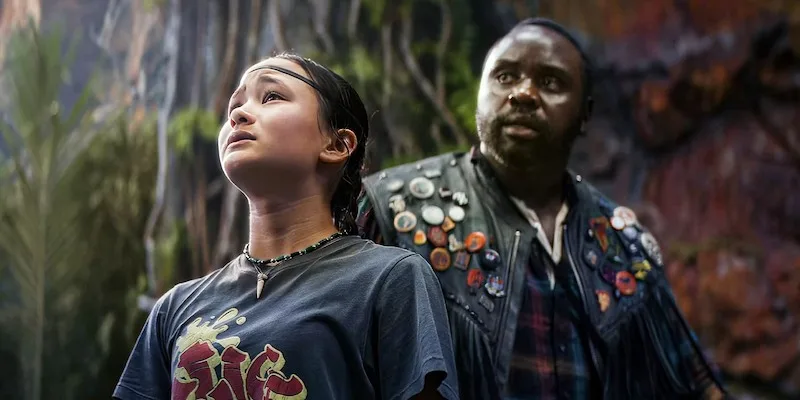
From Jean Harlow and James Dean through Simone Battle and Anton Yelchin, entertainment history is filled with instances of performers dying just as audiences had begun to appreciate how much they had achieved at a young age, and what incredible potential they had when they were taken.
Just added to that awful roll call: Kaylee Hottle, who was 18 when she died this week in an automobile accident in Jaynesville, Maryland.
Hottle costarred in “Godzilla vs. Kong” and its followup “Godzilla x Kong: The New Empire” as Jia, a little girl who lived alone on Skull Island, home of Kong and other giant creatures, and was the last known descendant of a nearly extinct indigenous tribe, the Iwi.
Jia had a powerful bond with the great ape and communicated with him through American Sign Language. The relationship was conveyed mainly by gestures and facial experessions and carried by Hottle’s acting and the visual effects crew. It’s easy to underestimate the degree of difficulty involved in humanizing a character whose most important relationship is with a nonhuman character that would remain an abstraction until months after principal photography had concluded. It requires imagination, focus, and an ability to take very precise directions while transforming the result into something that feels organic.
“When it comes to imagining Godzilla and Kong, that’s tough,” said Rebecca Hall, who played anthropological linguist Dr. Ilene Andrews in both films, a character who not only studies and protects Kong but becomes an adoptive mother to Jia. “That’s tough, because more often than not it’s a tennis ball on a stick.”
Hottle was herself deaf, born to an all-deaf family in Atlanta, Georgia. Her mother Ketsi is Korean-American, and her father Joshua is a white man descended from four generations of deaf people. She was educated at the Texas School for the Deaf in Austin and got into acting through TV commercials.
The assistant casting director on 2017’s “Kong: Skull Island” saw Hottle in her first commercial, for Convo, a video relay service with settings that let deaf or hearing impaired callers connect to sign language interpreters around the world, and suggested her to the casting director of “Godzilla vs. Kong,” Sarah Halley Finn, as a candidate to play Jia.
Hottle’s emotionally affecting performances in the two hit monster films—similar in feeling and plot function to the bond between the title character of “E.T.: The Extraterrestrial” and his human friend Eliot—set her on course to be the most sought-after hearing impaired actress since Marlee Matlin, who in 1987 became the first deaf performer to win an Oscar, as Best Actress in “Children of a Lesser God.” (Maitlin mourned Hottle’s passing on Instagram, stating, “May her beauty and talent be a memory for eternity.”)
Hottle’s exceptional work in “Godzilla vs. Kong” is the main factor that caused the follow-up to focus a central subplot on Jia: she learns that a part of her tribe survived, is thriving in a previously unexplored section of Hollow Earth, and wants her to leave Dr. Andrews and the surface world and “come home” to her cultural origin point. Jia’s story in the film mirrors that of Kong, who also believed himself the only survivor of a once thriving society but finds giant apes is living in the same section of Hollow Earth as the Iwi tribe. Unfortunately, it’s ruled by a despot known as Skar King who must be deposed before he can achieve his goal of rising to the surface and conquering the planet. Jia’s re-acceptance into her tribe plays a central role in Skar King’s defeat, because the Iwi are the heralds and subjects of the monster goddess Mothra.
The most moving scenes in the two films are anchored to Hottle’s performance. One is the moment in “Godzilla vs. Kong” when Jia comforts Kong, who is sedated and chained on the deck of a ship during a rainstorm, her tiny hand reaching out to him. The image evokes the “E.T.” poster, with its Sistine Chapel-like image of God and man touching fingertips, except the nonhuman side of the exchange is a finger the size of a cargo container.
“They literally had a foam hand with a pointy finger that they were just putting up towards her,” Hall told People Magazine, in an interview timed to the release of the second movie. “That was hard not to laugh at.”
The other great moment is the climactic sequence in the second film where Jia must decide whether to remain with her adoptive mother and become part of the Iwi tribe. That moment, like so many others, is carried entirely by minimal ASL exchanges and expressive closeups of Hottle and Hall.
Hall, her “Godzilla vs. Kong” costar Alexander Skarsgaard, and other participants in both productions learned ASL so they could talk to Hottle. Fala Chen, who played the chief of the Iwi tribe in “Godzilla x Kong,” also knew ASL before joining the film series; although not deaf herself, she learned ASL to play a mute girl in the 2008 drama “Moonlight Resonance.”
Hall paid tribute to her onscreen daughter in a post on her Instagram page that included multiple photos of her and Hottle in production. “Devastated to hear this news,” her caption read. “My heart goes out to your family. You will be missed, Kaylee.”
Hottle’s only other major credit was a guest appearance on an episode of the rebooted version of CBS’ “Magnum, P.I.” She was set to appear in “What Doesn’t Kill Us,” a fantasy adventure about disabled people becoming superheroes, but at the time of her death, the movie was still in pre-production, so her role will have to be re-cast.
Hottle used her Hollywood connections to advocate on behalf of deaf and hearing impaired people, and not just in the entertainment business. Teri Devine, associate director of inclusion at UK charity Royal National Institute for Deaf People, said Hottle used her platform to “raise awareness and inspire others to drive positive change for people who are deaf or have hearing loss” and “prove there are no limits to what people who are deaf or have hearing loss can achieve.”
Hottle was a passenger in the car that crashed and took her life. The local coroner’s office said she was killed by “multiple blunt-force injuries” caused by the impact, and ruled her death an accident. There were two other occupants: a driver and a second passenger. The driver taken to a nearby hospital and released with non-life-threatening injuries. The second passenger declined medical treatment. The sheriff’s office said excessive speed was thought to be a factor in the crash.
In a Facebook video post, Hottle’s father Joshua told the driver, “I have forgiven you. Don’t let this incident ruin the rest of your life.”
Her mother Ketsi said, “I still feel Kaylee is with us.”