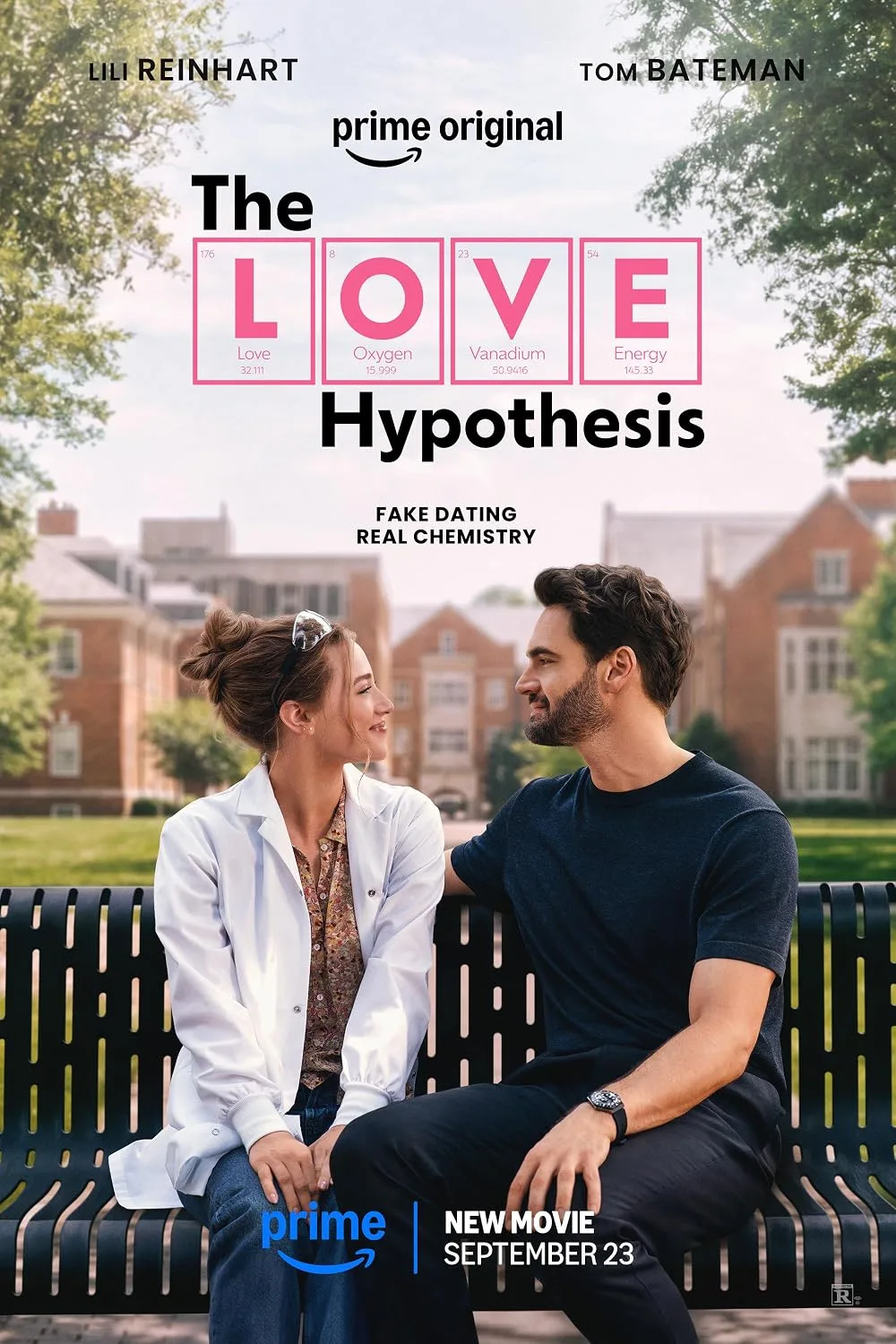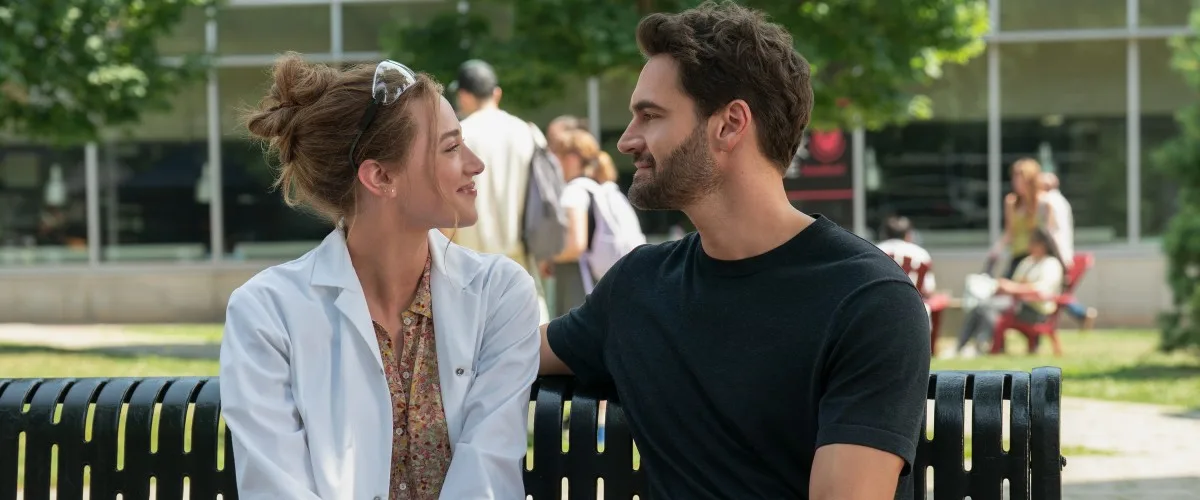
It’s a miracle of miracles: a new romantic comedy that’s actually charming! Based on the popular romance novel of the same name by Ali Hazelwood, Claire Scanlon’s “The Love Hypothesis” stars the always-great Lili Reinhart as Olive, a PhD candidate in cancer research who finds herself in a fake dating situation that soon blossoms into something real.
Scanlon was primed to be a savior of the genre a decade ago with her Netflix megahit “Set It Up” (2018)—which launched the careers of Zoey Deutch and Glen Powell—but followed that success up with the dreadful “The People We Hate at the Wedding” (2022). Here she’s back in fine form, effortlessly balancing a large ensemble of colorful side characters, while the undeniable chemistry of her leads (Reinhart and Tom Bateman) shines through thanks to the script’s classic rom-com patter.
We first meet the nervous Olive as she washes away pit stains before her interview for admission to a prestigious doctoral research program at Stanford. Wearing expired contacts, her vision blurs when an irascible voice tells her to get out of his lab bathroom. However, her innocent, fumbling charm soon thaws his icy demeanor, and the meet-cute ends in a sweet, anonymous pep talk.
The next two years fly by in a swift montage as we learn about Olive’s background, how she lost her mother as a teenager, and why she wants to cure cancer. During this swift sequence, we’re introduced to her BFF Anh (Rachel Marsh), who has all the confidence Olive lacks, as well as the warmth of a sister. We also meet Jeremy (Nicholas Duvernay), the object of Olive’s affection. When it later becomes clear that Jeremy is actually interested in Anh, the plot moves into motion.
Since Anh believes in girl code, she rebuffs Jeremy’s advances, despite their clear chemistry. Olive, who considers Anh family, lies and tells her friend she’s not in love with Jeremy and, in fact, has a new boyfriend. That night, when Olive claims she’s on a date, Anh tracks her down at the lab to confront her. In a panic, Olive asks a random man—Dr. Adam Carlsen (Bateman)—at a water fountain if she can kiss him so Anh will see it and believe her story.
This is meet-cute number two, and although it takes Olive a while to realize it, it’s obvious this is the same man from the opening scene. Not only that, he’s got an infamous nickname: Dr. Evil. See, he’s known for making his students cry, including Olive’s roommate Malcolm (Jaboukie Young-White), a member of Adam’s research team.
The next day, Adam calls Olive into his office and explains that he, too, could benefit from a fake relationship. While Olive is motivated by friendship, Adam needs to appear to have roots in the community in order to receive his annual funding. If this weren’t complicated enough, the script also throws in one more character: Tom (Arty Froushan), an old frenemy of Adam’s on whose team at Harvard Olive hopes to join so she can continue her research.
It’s a web of characters and convoluted plotting worthy of an old-school screwball comedy a la “Libeled Lady” (1936). Indeed, in its best moments, the film achieves something close to the magic of those fundamental films. In particular, Bateman’s arc as the coldly scientific, awkwardly antisocial Adam evokes screwball leading men like Gary Cooper in “Ball of Fire” (1941) or Henry Fonda in “The Lady Eve” (1941), finding exactly the right balance between his prickly behavior and haughty arrogance and his hidden sensitivities and warm heart. As in those films, it’s Olive who helps thaw his icy exterior and teach him how to behave in social situations.
But Reinhart is not going for a Stanwyck vibe. Instead, she has a completely her-own screen persona: a mix of eager intelligence, aloof reserve, and irrepressible charm she’s been perfecting since her breakout turn on Riverdale a decade ago.
In her hands, Olive’s various cliches melt away into a far more complex character than is likely on the page. Reinhart’s expressive eyes belie her character’s hidden sadness, adding a layer of melancholy to her selfless decision to put her friend’s needs before her own desires. She also crafts an easy chemistry with Bateman. Her Olive is as comically awkward and repressed as Adam; They’ve both channeled all their passion into their work for so long that they haven’t left much for personal growth. Yet, together, fake dating or no, they grow as people.
While the tone of Scanlon’s film is much sweeter, scenes between Reinhart and Bateman also harken back to the ‘90s teen classic “10 Things I Hate About You” (1999), where the right amount of friction between the would-be lovers adds fuel to the slow-burn fire.
My only real issue with the film is that although the side characters are introduced with fervor, once the film shifts focus largely to the fake dating, they re-enter only to serve the plot. In Ahn’s case, this almost isn’t an issue because Marsh has such a strong screen presence and imbues Ahn with far more interiority than her scant screen time should allow. Young-White, however, is not a strong enough actor to overcome the pile of underwritten cliches that make up Malcolm.
While Froushan’s Tom is the film’s weakest, most cliched character, he also serves as a pretty accurate depiction of the rampant misogyny that runs through not only higher education and STEM, but also just about every industry in which women are a minority. The film is also bookended with narration from Olive, likely a holdover from the novel, that is superfluous and could have easily been left on the cutting room floor.
Ultimately, though, like Leah McKendrick’s equally charming summer rom-com “Voicemails for Isabelle,” Scanlon’s film proves that the rom-com genre is not dead. It’s unfortunate, then, that the best entries languish on streaming platforms, while those deemed worthy of a theatrical release are either frustratingly bland or straight-up some of the worst films of the genre (or under-marketed, like Kat Coiro’s “You, Me & Tuscany“).
It’s a bleak indictment of the industry at large. But it’s comforting to know that at least some good rom-coms are making it through the gauntlet, with dedicated stars like Reinhart and directors like Scanlon leading the way.