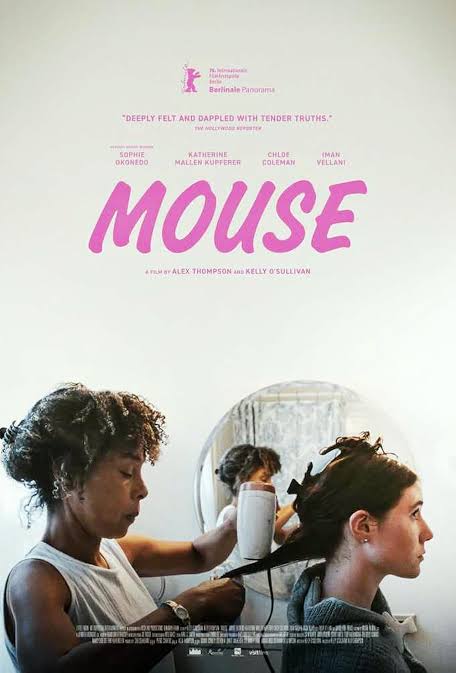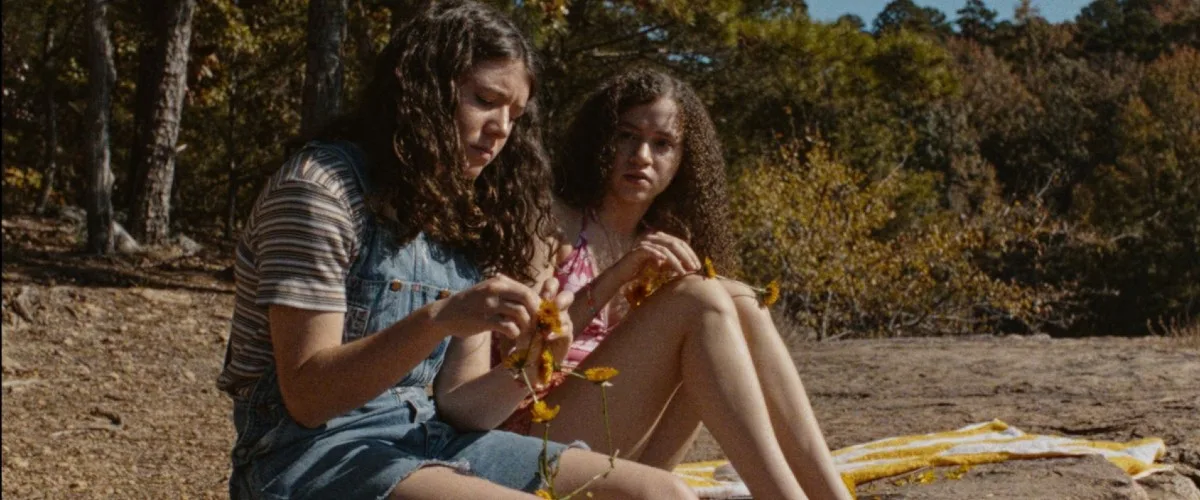
Friendship, especially in youth, can feel more like a sibling. When two only children find each other, their spark is similar to that of star-crossed lovers. “Not Friend, Best Friend.” Minnie (Katherine Mallen Kupferer) corrects her teacher when the two are speaking about her other half, Callie (Chloe Coleman). This defensiveness in the distinction is one I know well; my best friend is my sister, my other pea in the pod, both of us, like Minnie and Callie, being our single-mother’s only child. Rooted in the specificity of this identity, this hodge-podge familial structure, “Mouse” makes the rarity relatable.
Following the success of “Ghostlight,” co-directors Kelly O’Sullivan and Alex Thompson have not strayed from stories around grief told through tangibly complex characters. “Mouse” opens on the last day of school, and Minnie and Callie are about to enjoy all of the teenage rebellion that comes with the Summer before Senior Year. To kick things off, Callie hosts a sleepover at her house with other girls from their grade. As teen girls do, they play a backhanded game of “personal feedback,” where the not-so-nice girl Cara (Audrey Grace Marshall) takes the opportunity to tell everyone their unlikable features.
In this moment, the movie quite quickly establishes that without Callie, Minnie is perceived as a loser by literally everyone else. Yet in the eyes of Callie, so earnestly, purely played by Coleman, Minnie is no less than her co-star. Before they hit the hay, Callie gushes to Minnie about her 5- to 10-year plan following graduation: New York, Juilliard, struggling actress to big star, and they’d do it all together. The flash of fear across Minnie’s face signals this likely won’t be the case, but being seventeen is all about lofty ideas with your BFF.
The next morning, Minnie dips to get to work without saying goodbye; when she’s done for the day, she walks home into devastation. Callie was in a car accident. After it happens, no one standing around is actually crying. Some are silently sad or whispering of confusion; “Mouse” mirrors this acute moment in grief when shock strikes first. Like Minnie and Callie’s mom, Helen (Sophie Okonedo), we spend the rest of the movie trying to make our hearts whole again. Despite tear-filled eyes, the beauty of “Mouse” blooms from the way love evolves after loss.
O’Sullivan’s outstanding screenplay braids together these familial, romantic, and platonic connections of Minnie’s life, putting her through a whirlwind, almost accelerating her maturity. The movie positions Minnie at its core, juggling shifting dynamics with her mother, a new crush, and an unconventional friendship with her dead best friend’s mom. O’Sullivan’s words are so delicate in how they balance aiding the performers to express these complexities without stifling the space for them to show, not tell.
A significant part of the greatness of “Ghostlight” is Thompson and O’Sullivan’s collaboration with real life mother-daughter, Mallen Kupferer and Tara Mallen. “Ghostlight” established their on-screen ability to spotlight the nuance of harm exchange between moms and their teenage girl. With “Mouse,” Mallen Kupferer solidifies her status as a star on the rise, capable of elevating lead roles with fervor. She brings a shy, sheepish physicality to Minnie that is later recontextualized as sensitive and observant. Opposite of her, Okonedo exudes excellence, intentionally reserved while inserting a million and one thoughts behind her eyes. Her commitment to caring for Minnie is reciprocated. The two learn to be alone together, leading to some sense of accountability and regularity after the school day is over. Heartwarmingly, Helen becomes the first to know of Minnie’s first kiss.
This first kiss is not a run-of-the-mill high school rom-com girl-gets-jock type of thing; “Mouse” is quietly queer. Minnie’s video store clerk crush, Kat (Iman Vellani), is a key player in her becoming. Their young love brings levity to each of their lives, peppering comedy into the everyday to get by. Like the other relationships, the bumps and miscommunications make the movie hurt exactly like it would in reality. The movie itself stumbles ever so slightly in ensuring its editing pieces together the takes that best display the emotion it wants us to see from that character. It shoots for perfection, so that there’s no lack in clarity about their position in the conversation.
“Mouse” moves through time like waves shifting from low to high tide. The daze of bereavement blends everything together, but the movie blinks to the end of Summer and the start of the year. Time is tethered to the light that the movie so lovingly bends. Even at night, there is intention behind the yellowish-orange street lights that brighten the late-night car conversations; the lack of LED in the early 2000s washes grainy nostalgia over the screen. The crickets hum softly in the background like peaceful white noise of suburban Arkansas.
There is not much of a score besides the lingering of Helen playing the piano, strengthening every song selected for the soundtrack. Each needle drop is so uniquely 2002; the songs string together to form a ’90s kid’s Spotify daylist titled “teenage emo party Thursday afternoon.” Interestingly, the music is mostly heard in the busiest moments, when there are multiple characters on screen. In solace, in sadness, the air is empty while grief sounds off like a foghorn.
Easy as it may be, “Mouse” should not be reduced to a movie about girlhood. “Do you ever feel guilty about having fun?” Minnie asks Kat, struggling to hold happiness and sadness at the same time. The story submerges its characters and audience in a sea of contradictions like this, pointing towards hope whenever it can, knowing and showing that grief is nonlinear.
This review was filed from the Chicago International Film Festival. It opens on November 6, 2026.