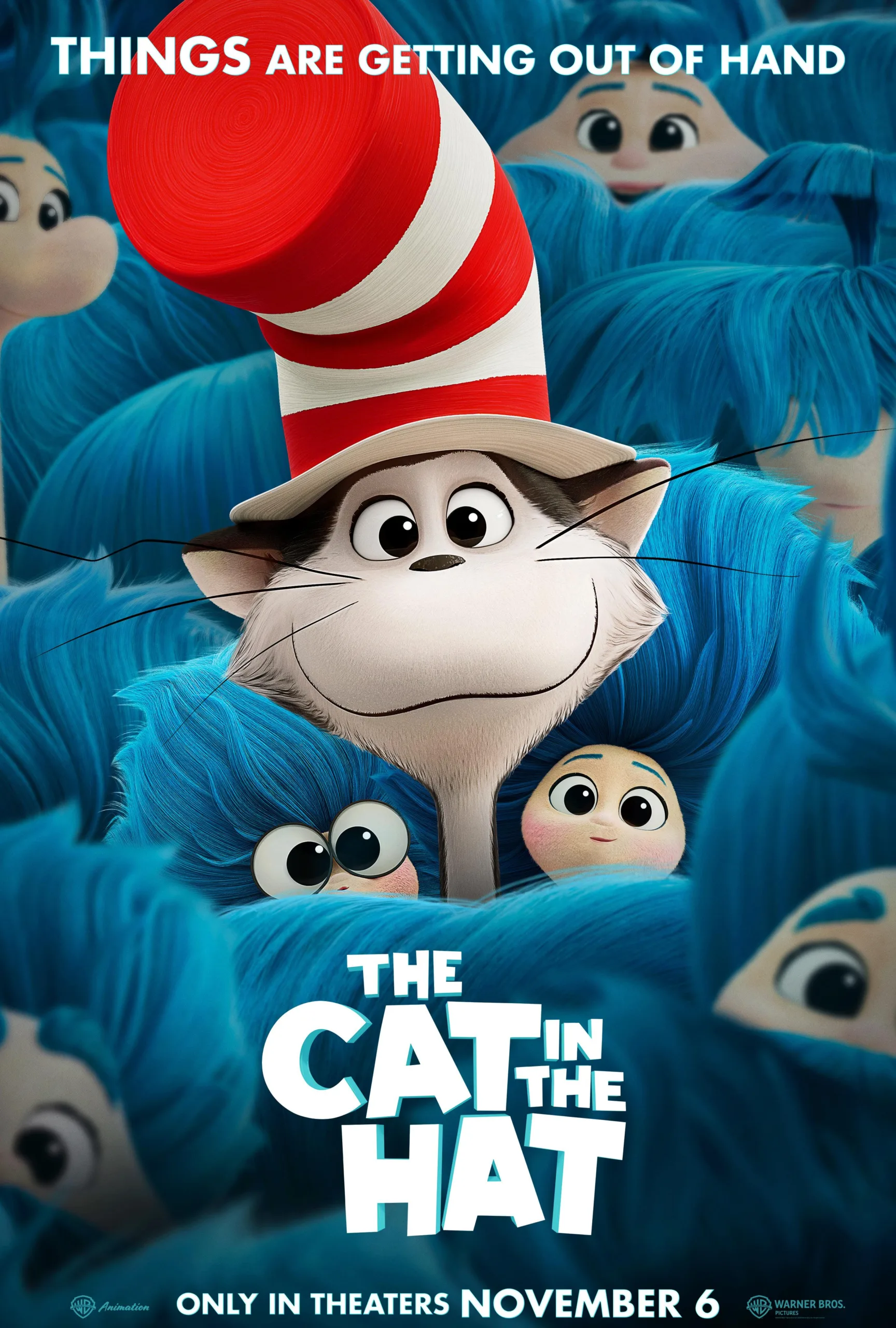
The Cat in the Hat, as iconic as he may be
could not escape the curse of being the latest IP
adapted to the screen with all the bells and whistles
but trades depth for excess, becoming superficial
The visuals are bright, the animation stunning
yet it is convinced that it’s far too clever and cunning
for the beloved source material that it puts to the screen
Settling for overstimulation; it’s less art, more machine
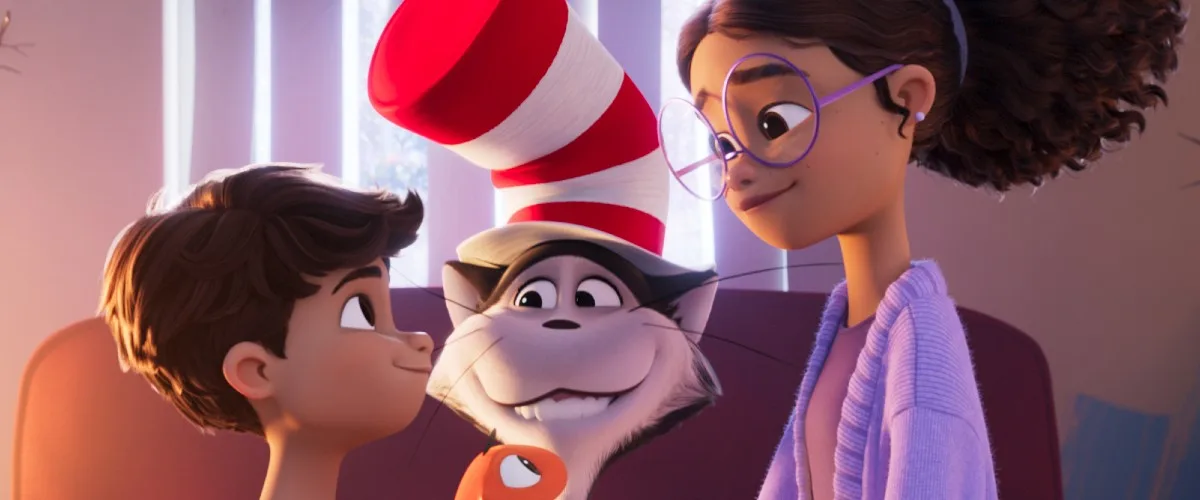
One can practically feel directors Erica Rivinoja and Alessandro Carloni shout, “This isn’t your parents’ The Cat in the Hat!” during their narratively busy and visually dazzling expansion of Dr. Seuss’ iconic book. Indeed, the opening moments speed-run a modified, tongue-in-cheek version of the original book’s synopsis, in which the Cat (Bill Hader) tries to entertain two children out of their doldrums. After deploying the same antics that he does in the book (“I can hold up the cup / And the milk and the cake! / I can hold up these books! / And the fish on a rake!), the Cat realizes that his clients are no longer paying attention, sucked into the endless scroll of their phones.
It’s a poignant opener, as Carloni and Rivinoja choose to animate the kids in black and white, with the Cat in his usual visual palette, underscoring the attempt to literally bring color into their lives. It poses a tribulation for both the feline and the audience: in a world of eternal distraction, where distractions ensure you’re never quite bored but also never fully entertained, what role does thoughtful, imaginative play have? It is clear the old Cat has to learn new tricks, and the creative team behind this adaptation takes the calling seriously, exploring how Seuss’ ideas still resonate in a world that has lost its wonder.
It’s admirable work, animated with vivacious passion and wit that certainly had the children in my screening howling in delight at the excess put to screen. At the same time, it’s arguably far too much for its own good, ironically becoming part of the problem it critiques by combating the noise with more noise.
The directing duo’s script deviates from the original book by creating an interconnected universe of all of Seuss’ characters, of which the Cat is one mischievous part. He is a part of the Institute for the Institution of Imagination and Inspiration, LLC, which has an inverted mission statement of what you might find in something like “Monsters, Inc.,” where creatures like him are tasked with entertaining kids.
The Cat’s co-workers are strangely shaped and have funny names (Bug in a Mug being a personal fave, followed closely by Pig in a Wig). While exploring the Cat’s workplace is a visual feast, much of the film’s humor comes from poking fun at office dynamics in ways so pointedly adult that it draws too much attention to its own intelligence. “A meeting with my boss and my HR representative. How fun!” the Cat exclaims when he is summoned after causing too much chaos for his previous job. “Being allowed in here is a privilege,” Gary (Bowen Yang), an III intern, says to the Cat when he takes him to the supply closet to retrieve the Go-Backer, “I should know because I come from privilege.” Unlike some of the best animated films for kids that speak to adults while still landing the punchline for the youngsters watching, some exchanges here stick out awkwardly from the film’s overall tone.
The Cat’s next task is to brighten the spirits of Sebastian (Tiago Martinez) and Gabby (Xochitl Gomez), whose mom, Carmen (America Ferrera), moved their family to Highland after taking on a new job. Gabby in particular has taken the move the hardest, and the Cat, being given one last chance to redeem himself by his boss, Mr. Hoogeboom (Giancarlo Esposito), finds an object called the Go-Backer, which he hopes to gift to Gabby so that she can go back in time and live before their family had to move.
For Gabby, the only balm for a confusing, disorienting present is to live in the shadows of past experiences, and, as expected, her arc is about learning to face the moment with courage and community, embracing its uncertainties as a gift. This is a rich, thoughtful message, especially worth hearing at a time when the world offers more reasons to retreat into the safety of past lives.
“The Cat in the Hat” is at its best when it uses its characters’ powers to visually show how memories become distorted in our grief. A scuffle over the Go-Backer causes the machine to fall into one of the three main moving boxes in Gabby and Sebastian’s house, which have become pocket dimensions due to the Cat’s magical powers. The trio goes on a fetch quest to find the Go-Backer, traversing through each box, which holds key items for each family member.
Perspective changes based on your size, and once the Cat, Sebastian, and Gabby enter a box, everything scales up in ways that make the familiar burst with novelty. Folded underwear become whale-like creatures that flap through the box, while old pasta crafts help guide the way. You never know how an item might take on new life, which is exciting. The film also clearly distinguishes the Cat’s world from the human world, and, in a clever note, Sebastian and Gabby slowly morph into the Cat’s animation style as they fall further into his world, showcasing the dangerous allure of living in fantasy.
The film’s ambition isn’t the problem; rather, it refuses to focus on one idea at a time, mistaking fast-paced movement for a natural escalation of stakes. There are no fewer than three villains in this story, with numerous other side characters from Sebastian’s fish Waffles (Matt Berry) and the Cat’s friend, Sherri (Quinta Brunson), who each have their own arcs that never quite gel with the main narrative. That’s to say nothing of the Things, the Cat’s silent, vermilion-colored helpers who exist mainly to slap each other (usually on the face or butt), make fart noises (the way they communicate), and act as a counterbalance to Universal’s Minions. In one sequence, when the Cat attempts to round up the various Things to their chagrin, he quips exasperatedly, “C’mon, I’m sure you’ll get your own movie soon.”
This is a microcosm of the film’s issues as a whole: this adaptation tries so desperately to transcend its source material that it forgets what makes its story so enduring.