Walter Thompson-Hernández’s imaginative coming-of-age film, “If I Go Will They Miss Me,” takes place in Los Angeles, near Watts, and concerns the love and adoration a son, Little Ant (Bondhi Dell), feels for his emotionally uneasy father, Big Ant (J. Alphonse Nicholson). The latter, recently released from his latest incarceration, has returned to discover his Little Ant isn’t so small anymore. His son is at the age where the dangers of the world—police profiling, gang violence, and drug dealing—can quickly derail his future. Is it worth Big Ant being home if, in his head, his presence unspools his son’s future? When his father leaves or is taken away, does he think about his son? The searching title of Thompson-Hernández’s soulful feature directorial debut, “If I Go Will They Miss Me,” is obviously a question. But to whom and by whom?
Before becoming a filmmaker, Thompson-Hernández began his career as a journalist. He reported for The New York Times and later wrote a book about the Compton Cowboys, a group of Black horseback riders whose equestrian interests have reshaped perceptions of Black folks for both the wider world and young African Americans. “If I Go Will They Miss Me,” which began as a 2022 short, plays with similar themes of unlikely heroism and the quest for role models via the fractured relationship between Big and Little Ant. That disconnection is further scrambled when contrasted with the bond Little Ant shares with his supportive mother Lozita (Danielle Brooks, an executive producer here as well).
Through the film’s complex and fragile interpersonal relationships, and its reflections on a rich community and the many anxieties of the people who lived within it, “If I Go Will They Miss Me” sits comfortably on a continuum of Black filmmakers that began with Micheaux and Spencer Williams, continued through Charles Burnett, then John Singleton and Spike Lee, and finds renewed life in the hands of Raven Jackson and now Thompson-Hernández. Its keen mix of magical-realist visual language, drawn from those neo-realist tools, offers an eloquent vision of Blackness.
Thompson-Hernández carefully places us within this Black family with Burnett-level honesty. Little Ant explains the many travails his father has experienced; when he was younger, he was also deeply creative. His father’s aspirations changed when he threw a brick from a roof in the direction of a janitor, hurting the custodian in the process. In this scene, Thompson-Hernández remixes Burnett’s masterpiece “Killer of Sheep.” But instead of the rooftop demonstrating how much freedom and joy these leaping kids feel, it brings Big Ant’s hopes down to the ground.
The film also winks at Burnett whenever Little Ant thinks of his mother and father, whose childhood courtship is depicted organically and whose current exhaustion is illustrated in slow dances between the two, set to Jon Batiste’s melancholic cover of “This Bitter Earth.” Within a few short scenes, Thompson-Hernández gives us everything about these characters with the speed of a seasoned director.
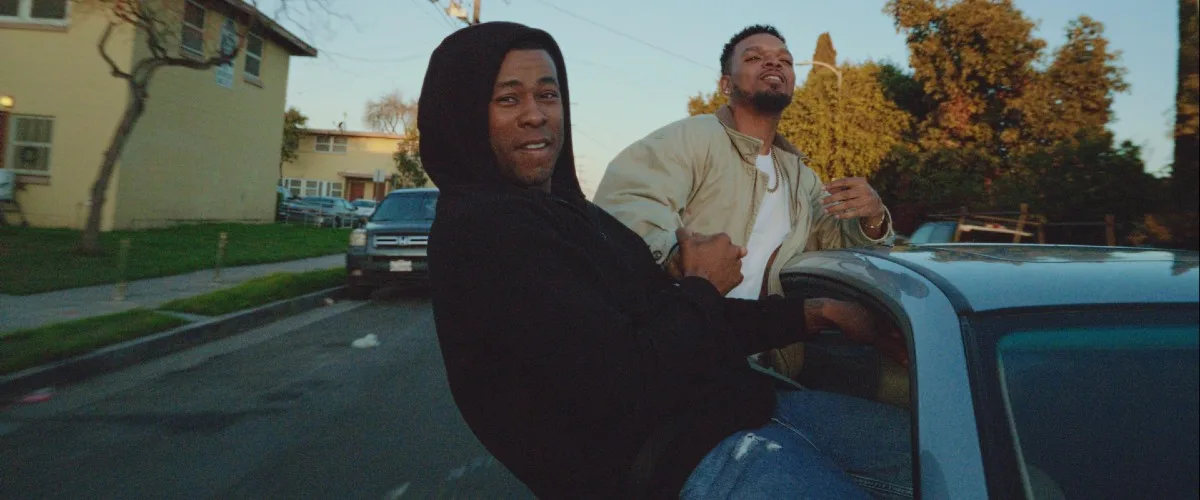
He also quickly, yet thoughtfully, plants us within the milieu of this neighborhood. Filmed in Watts’ Nickerson Gardens Housing Project, Thompson-Hernández and cinematographer Michael Fernandez photograph the area’s faded yellow walls, which probably once inspired optimism among its residents, and small front yards, with the intimacy of a warm memory. They give equal attention to the actual residents too, composing montages of portraits whose sole instruction to participants seems to have been to simply be. These images, sometimes taken within the neighborhood and in a studio, often recall Barry Jenkins’ equally humanist poses from “The Gaze.” Both seek, in a way, to protect the light within Blackness and, in this case, this rich multi-racial community.
The swirl of literary references within “If I Go Will They Miss Me” is also intriguing. Thompson-Hernández blends Greek mythology and African American folklore with the impulse Little Ant feels to find a glow in the darkest spaces. It’s easier for Little Ant to either see his father’s absence through the lens of a soldier compelled to defend his homeland, like Odysseus, and even better to imagine his dad’s real-life horse as Pegasus and his dad as Poseidon. That pedestal scares Big Ant. Nicholson’s imperfect father is fretful, elusive, shy, and ebullient, depending on whether he’s cheating on his wife, uplifting his daughter, or chastising his son for continually drawing him as a Greek god. Visions of Black children with arms outstretched haunt big Ant.
Here, once again, Thompson-Hernández remixes, taking the Flying African folklore—the belief that enslaved Black people were capable of soaring to Africa—and using it as an image of danger and death. Every kid Big Ant sees in his vision has died at the hands of systemic forces and inter-community violence. He imagines his son among these mostly nameless individuals.
“If I Go Will They Miss Me,” consequently, is about how we see the world. Big Ant sees flying as a sign of death due to his own traumas. He can only consider that if Little Ant were more like him, he’d be nothing. But Little Ant doesn’t have that baggage. As Little Ant, Dell remains mature and eager, searching for his dad’s approval even when that quest comes with betrayal. He sees flying as pure; he plays with toy planes and watches real ones as they soar above. The persistent roar of jets in the soundtrack often recalls the consistent hum of helicopters in “Boyz n the Hood.” But instead of foreboding, they portend possibility for Little Ant.
Most impressively, Thompson-Hernández doesn’t let his film be simply a father-son movie. He includes Black women in this film, landing a similar balance Jenkins struck with “Moonlight.” Lozita has a rich inner world: we meet her family and friends. She’s also given space to be funny and resolute, like when a drunken Big Ant slaps Little Ant. Rather than defend the violence, she promises to protect him. Because if this film is about seeing, then it’s Lozita who’s the most clear-eyed. She is the kind, loving, and attentive father Big Ant once was, and the broken man who’s replaced him. She also notices how Little Ant can’t help but be himself, unencumbered by life’s faults. Brooks is a force here, delivering these observations with a flick of her eyes or the disappointment in her voice.
In these actors’ hands, the title’s question finds meaning and perspective. Each one asks themselves and the world whether they can be acknowledged as having existed, having lived, and having loved one another. Thompson-Hernández assuredly records that they do. He compels them to embrace the belief that they are somebody and worthy of being worshiped. As Big Ant’s best friend JJ (a scene-stealing Myles Bullock) says, “embrace this shit.” “If I Go Will They Miss Me” approaches the viewer with open arms, unafraid of rejection and confident it’ll be accepted.