
Is there a greater horror than realizing that you don’t really know who you married? “Gentle Monster,” premiering on Netflix this fall after a festival run that included Cannes and Telluride, profiles this problem, creating palpable discomfort for its protagonist and its audience.
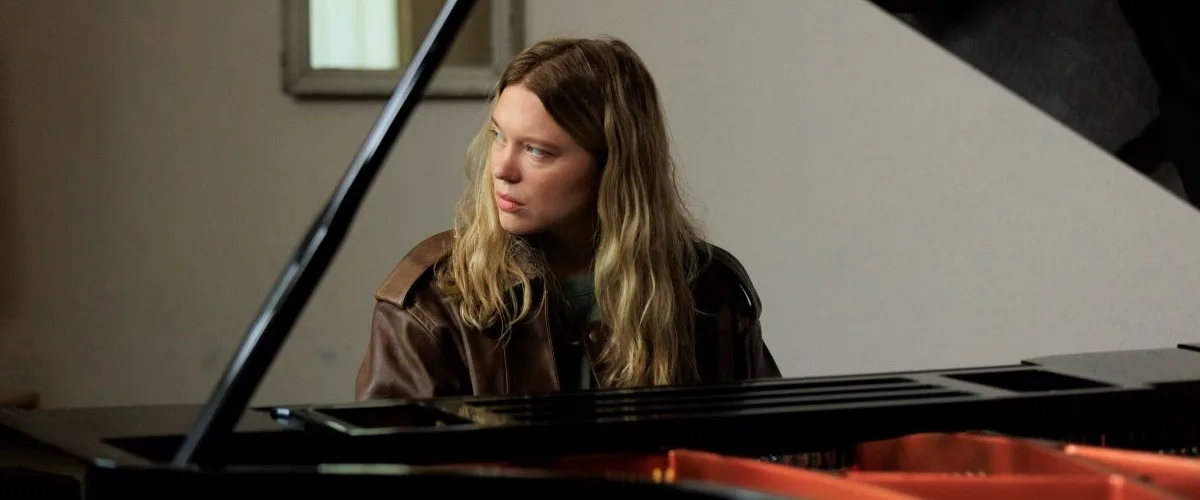
We’re introduced to Lucy (Léa Seydoux) playing pop melodies on the piano in a chic, lived-in European flat. Interestingly, Lucy’s music serves as the basis of the score and soundtrack, and other musical moments are woven into the character’s reality rather than scored over for spectators. The sound of heavy breathing interrupts this peace, and Lucy finds her partner, Philip (Laurence Rupp), having a panic attack in the foyer. Shortly thereafter, the couple and their son, Johnny (Malo Blanchet), move to the German countryside for a change of pace and scenery. The sun-soaked newness of this place generates false hope for what’s to come.
Lucy and Philip are both artists; she of music, he of cinema. While not overtly stated, their new home is an attempt to catalyze their creative output, particularly for Philip. He begins shooting vignettes and moments of his wife and son, but his gaze carries an unsettling, voyeuristic quality. The camera often positions itself at an angle to watch characters watching other people—the audience witnesses only a limited POV of the mess to come.
After a slow morning of working that sachets into intimacy, the Munich police department visits Lucy and Philip with a search warrant. Philip goes pale but does not resist their demands. They confiscate every hard drive, leaving Lucy confused and concerned. After following him to the police station, Lucy learns about his supposed crime from elevator signage; she reluctantly and harrowingly presses the button for Floor 2, the department dedicated to child pornography crimes.
Lucy becomes a contemplative shell as she tries to piece together the truth. The nature of the crime is so insidious, and so many pieces of the puzzle are missing. The main detective on the case, Elsa Kuhn (Jella Haase), is cold and detached. When Lucy reaches out for a semblance of solace or support, Elsa complains to her colleagues that this isn’t a part of her job.
From the moment we meet her, blasting rap music and hitting her vape on her way to ruin the Weiss family’s lives, it’s clear much more is on her mind than the workday ahead. We learn she is dealing with a withering father who keeps harassing his female caretaker. Repeatedly, Elsa tries to get the caretaker to stay, even bribing her with more money, and this dissonance is symbolic of a larger systemic issue where those in positions of power deem themselves exempt from doing what’s right rather than what’s easy. Notably, both Lucy and Elsa utter similar phrases like “It’s my job to…,” claiming a sense of control and responsibility that feels fleeting.
Keeping in mind that the central message is more about systems of coping and processing, it’s interesting how the film toys with time to emulate the non-linear nature of healing and moving on. Early moments in the film become murky in retrospect. When new information is introduced, it completely changes our original read of a moment—turning innocence into insidiousness. Light leaks lead us into these flashbacks, yet we remain alongside Lucy in the present, figuring out this new reality with her.
When Lucy finally talks to Philip, the camera is strategically positioned to look down at him but is level to her. Director Marie Kreutzer takes a stance on the morality of the situation, one which she is personally reckoning with after an incident with a former cast member of a 2023 production, “Corsage.” It is uncertain to what extent the details of “Gentle Monster” are pulled from the details of her experience. Yet pieces of Kreutzer’s method of moving on are what build Lucy. Like Lucy talking to the piano to navigate her feelings, Kreutzer returned to her set and her art.
Where “Gentle Monster” falls short is in its exploration of justice, whether that be formally within the legal system or interpersonal. Its emphasis on interiority is where it is strongest and most valuable; however, it remains a bit safe, as if the audience is also being protected from the true ugliness of both the crimes and the ripple effect of their discovery. Lucy confesses several times that she does not know who to turn to. She harbors second-hand guilt that becomes isolation.
The film suffers from not digging deeper into its themes and subject matter; even if it centers the plot on those affected, rather than those who commit crimes, it gives voice to an increasingly common, complex experience.
This review was filed from the Telluride Film Festival. It opens in theaters on October 30, 2026, and on Netflix on November 18.