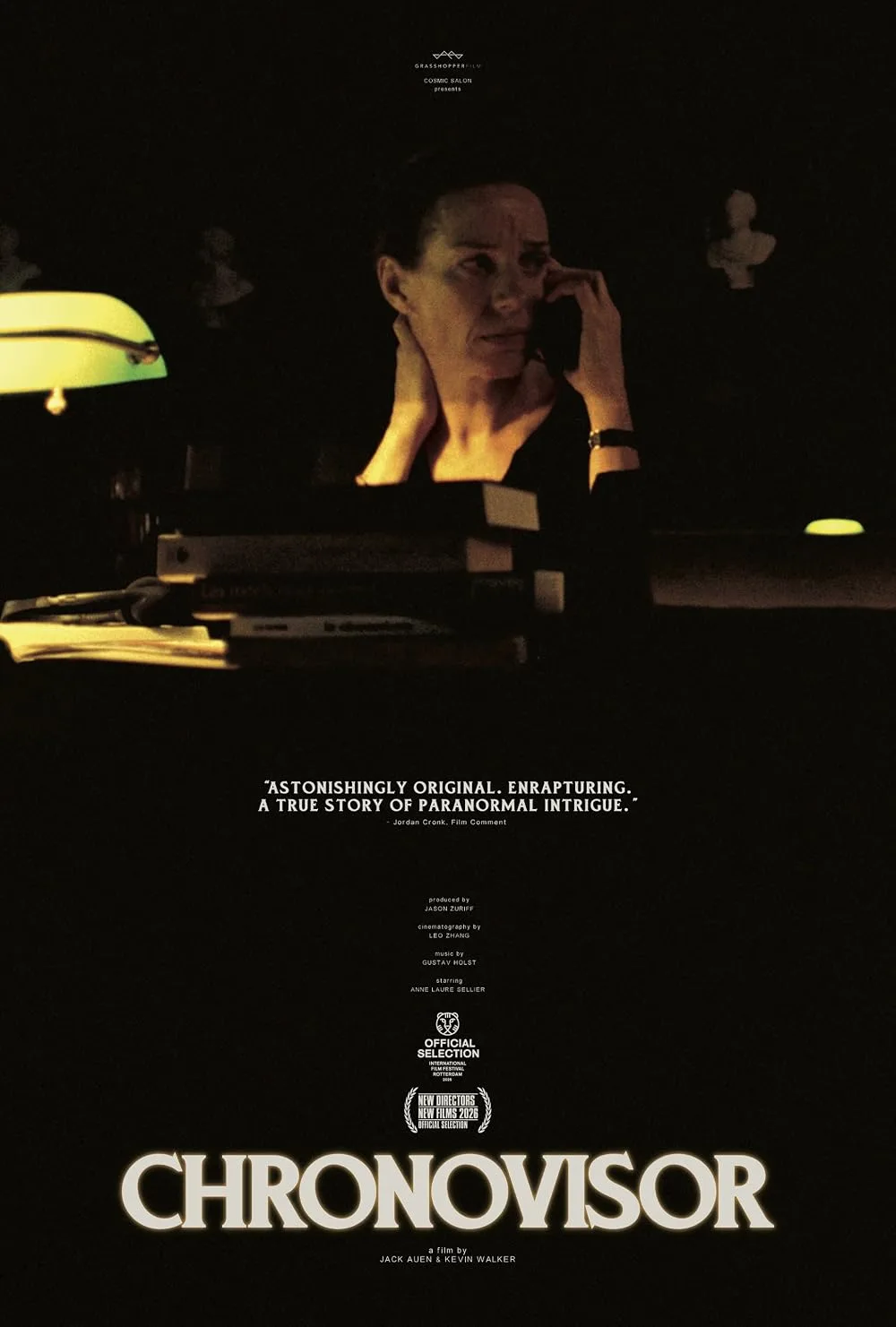
Kevin Walker & Jack Auen’s “Chronovisor” is a film about research. A simple statement for a complex film, perhaps, but every fiber of this feature debut is dedicated to the often engrossing (and occasionally exhausting) act of researching.
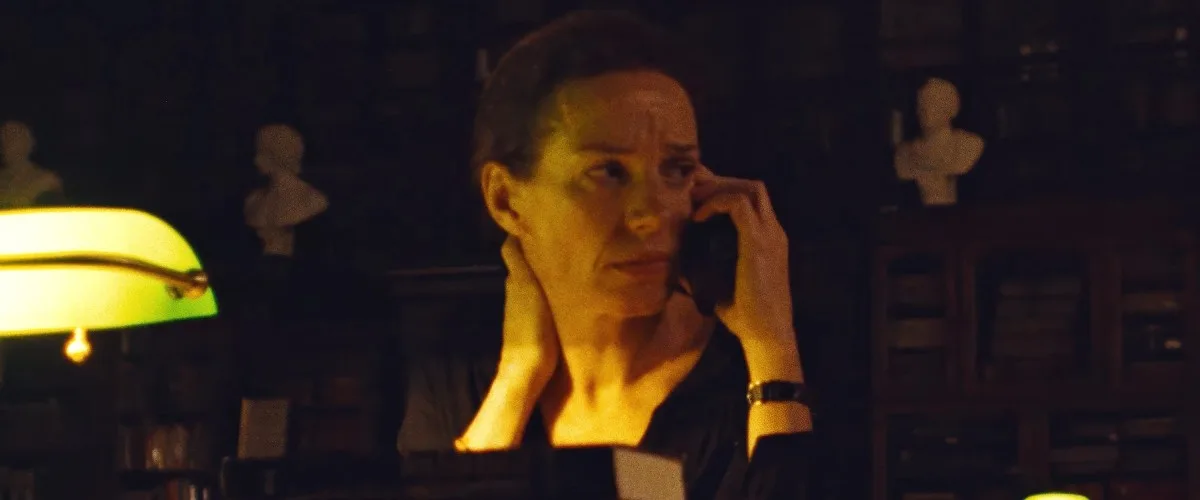
This filmmaking duo presents it through the commitment and drive of French academic Beatrice Courte (Anne Laure Sellier), who finds herself drawn into a scholarly quest to discover what exactly happened to the time-viewing machine known as the “chronovisor.”
Her research leads her down several paths, all connected to the Italian priest, philosopher, and musicologist Pellegrino Ernetti, who claimed to have used the machine to witness events like the crucifixion of Christ and a performance of Euripides’ lost tragedy Thyestes. The deeper she goes into her own research, tugging at different academic strings, the more consumed by the project she becomes.
The very notion of a “Chronovisor” is as far-fetched as that of any one of Dan Brown’s religious conspiracy paperbacks, both in reality and in the world of the film, but Courte approaches it with a dead seriousness. What precious few beats exist outside of her research, like Courte having conversations with fellow academics, feel purposely deadening and meaningless rather than motivating, only serving as a reminder of how much she longs to return to her mystery. In many ways, it feels like a piece of cosmic horror: journeys that will inevitably lead to destruction but are too irresistible to sidestep or escape.
This obsession and her quest for knowledge become key to the formal approach too, with Auen & Walker frequently limiting our gaze to hers. We doubt when she doubts, we feel her frustration when she hits a roadblock in her research, and we feel that same swell of hope when a new thread reveals itself. Though the notion of a film that largely requires reading every unspoken sentence that glows, translated from the original book being filmed, “Chronovisor” is often riveting in how it presents information.
It’s hard not to get caught up in the film’s descent into potential madness when it employs the same tactics as Michael Snow’s visual word experiment This Is So, quite literally dictating how much the audience gets to read and how quickly that information is doled out. That it is all complemented by one of the most compelling noir-ish scores in recent years, each note feeling of a piece with the unsettling mood the film has established and seemingly the myriad references to Ernetti’s musicology studies within (although I myself cannot say whether that was a direct influence on the score or not).
Everything about the atmosphere of “Chronovisor” works in tandem, but most interesting is how technology itself seems to exist in a liminal state, with different eras and means of documentation always in conversation with each other. Leo Zhang’s 16mm photography recalls the past, bringing beauty to the dark academic spaces that the film largely takes place in, while machines like those that make up the chronovisor itself and those that document sordid histories (VHS tapes alongside footage that resembles Lillian Schwartz’s video art, for instance) have a futurist bent to them. Courte, much like her directors, is willing to use any logistics and technology, from dust-covered books to the convenience of a cell phone call, to tell and discover more of this story.
Though the film is based in part on some kind of “real” historical rumors and on both Robert Burton’s book “The Anatomy of Melancholy” and David Bentley Hart’s short story “The Memory Palace” (from the collection Prisms, Veils), what is most impressive about “Chronovisor” is the sheer believability of the world it presents. Any given piece of information delivered to the audience, be it by way of text in a work or one of Father Ernetti’s associates, can exist as both true and false at once. The chronovisor itself is a piece of fiction, a viewer that allows those who wield it to witness any point in time, but these conspiracies exist in our world as well.
Though Walker & Auen list a number of influences in the credits—the six mentioned being Jorge Luis Borges, Umberto Eco, Iain McGilchrist, Louis Sass, Robert Bolaño, and Paul Auster—familiarity with their work is not quite necessary to appreciate what “Chronovisor” is going for. Though diving into works like the aforementioned, or having a vested interest in the pet philosophies of the characters and filmmakers, can certainly enhance the experience and further place one in Courte’s shoes, all one needs is a willingness to let the film guide them through the abundant information it offers.
The natural endpoint of this search for the chronovisor (by way of an ambitious, though ultimately expected, ending). It’s the one point of the film that feels like it’s holding the viewer’s hand as the descent into madness (and the feedback loop the film presents) becomes too literal for its own good. But the journey itself is what matters for Walker & Auen’s film, and every minute of that is too infectious to even look away for more than a mere moment, lest one risk the chance to get just one more piece of information.