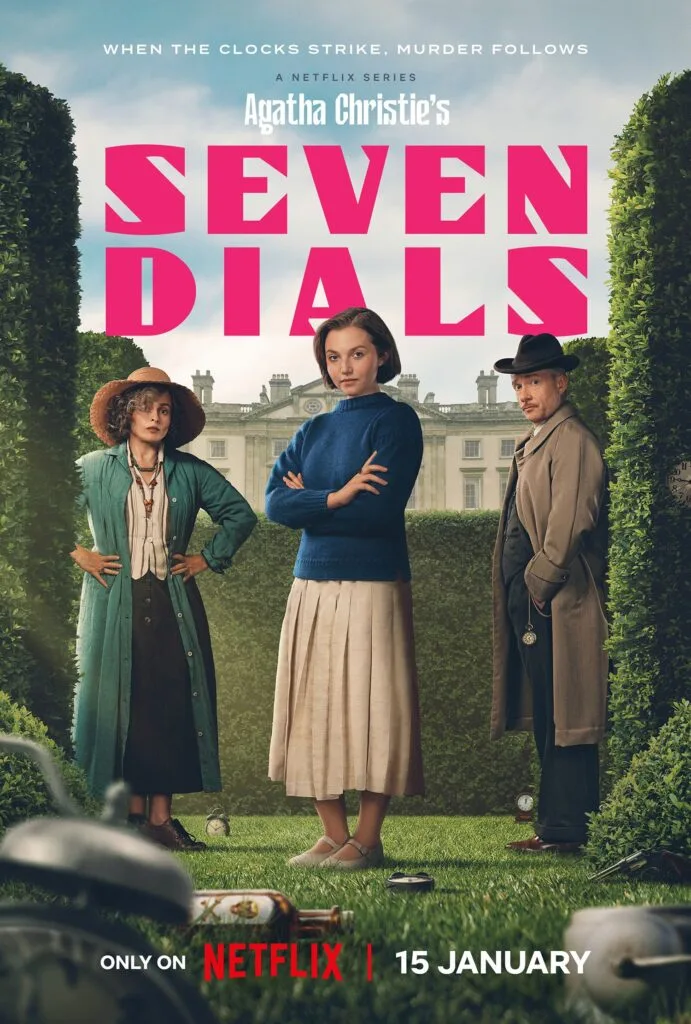
During her lifetime, Agatha Christie never hid her displeasure at the quality of film and TV adaptations of her novels. Though she herself wrote a letter in 1946 to legendary actress Joan Hickson saying, “I hope you will one day play my dear Miss Marple,” Christie died in 1976, eight years before Hickson’s TV premiere as the fluffy yet diabolical sleuth. But Joan Hickson’s terrific run as Marple ended in 1992. As a lifelong admirer of Christie’s works, it gives me no pleasure to report that the latest attempt to adapt the Queen of Crime’s work is a dismal failure: There’s no regard for Christie’s prose, no idea who the series’ audience is meant to be, and no goal except to further increase Netflix’s intellectual property resources.
For starters, it doesn’t help that the source material, “The Mystery of the Seven Dials,” starring amateur sleuth and plucky aristocrat Lady Eileen “Bundle” Brent, is one of Christie’s worst mysteries. (The novel was written during what the author referred to as her “plutocratic period”; because she’d begun receiving massive payments for American serialization rights, Christie used the time to write capers that were absolute rubbish compared to her Hercule Poirot/Miss Marple-based output.) Writer Chris Chibnall (“Broadchurch,” “Doctor Who”) chooses to complicate the novel’s straightforward plot by splitting the overall solution, but half of the eventual answer is so obvious that I deduced it within the first episode.
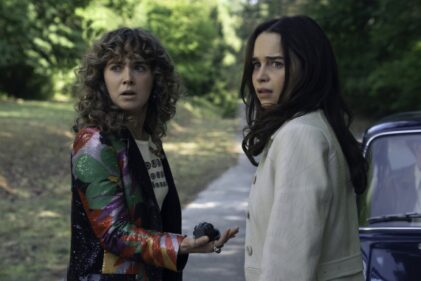
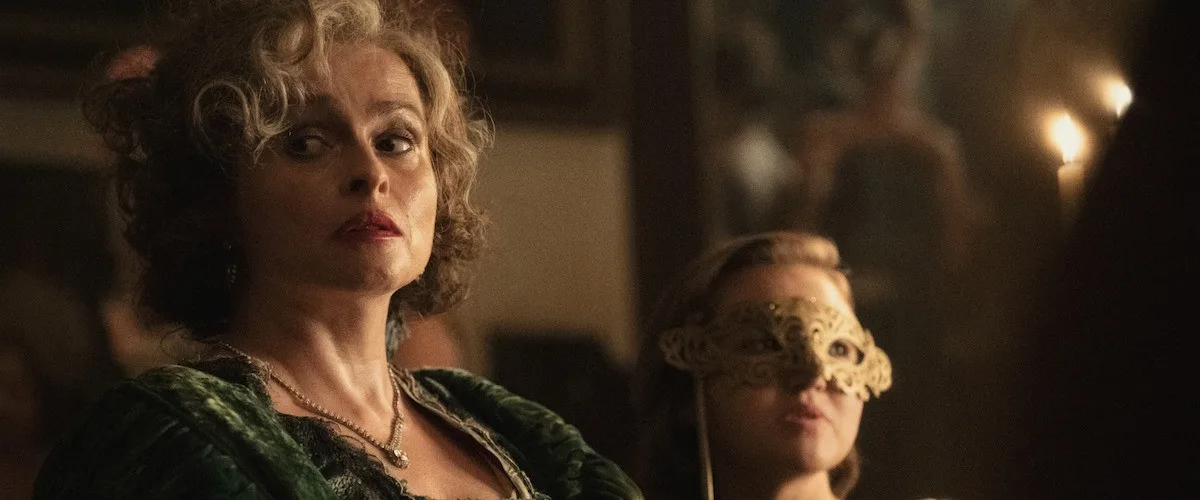
The opening is fairly standard for a modern-day Christie adaptation. England, 1925. A raucous masquerade party in the country. The hostess is a world-weary widow—Lady Caterham (Helena Bonham-Carter, largely on droll patrician autopilot)—putting on a smile for show as Foreign Office lackeys and nouveau riche industrialists vie for her attention. Her intelligent, curious daughter, Bundle (Mia McKenna-Bruce), observes it all from a staircase.
When a guest (Corey Mylchreest) is found dead in his bed the next morning, his wartime service at the Somme is declared a reason for his suicide. But Bundle does not believe it and, against her worried mother’s wishes, begins making enquiries with the help of her friend Jimmy Thesiger (Edward Bluemel). Along the way, she meets a mysterious man (Martin Freeman) who may or may not be on her side.
And that is all I’m permitted to say about the plot. One wonders if studios and streaming services realize what a hole they dig when they send critics lengthy lists of spoilers to avoid; when I’m unable to discuss the plot, I’ll discuss everything else, and almost none of it is good.
It is a truth universally acknowledged that different media have different demands on storytelling; what can be subtext in a novel must be conveyed differently visually. One of Christie’s go-to motifs was concealment within a pattern (“The ABC Murders” and “The Moving Finger” are the most famous examples of this); Chibnall references this briefly by showing the Foreign Office guests all wearing the same type of mask, the idea that anyone wearing the mask could have been the killer, if indeed a murder was committed.
But this was one of the few nods to Christie’s spirit the series actually contains; everything else feels like a generic hodgepodge, like rifling through several decades of gimcrack at a thrift store. Who is this series’ intended audience? The premise is ostensibly for mystery fans; the production design tells me this is set in the 1920s, but the acting, especially from the younger cast members, splits its time between posh, early-20th-century English aristocrats and Gen Z affectation. McKenna-Bruce does her best impression of Florence Pugh; Bluemel both looks and acts like a young Dominic Cooper. Freeman and Bonham-Carter do their damnedest, but for the zillionth time, if it ain’t on the page, it ain’t on the stage.
Chibnall—who knows better, having written entire seasons of wall-to-wall crime-based devastation as the creator of “Broadchurch”—and director Chris Sweeney’s creative decisions are equally frustrating. Occasional interesting choices in framing or dialogue are immediately abandoned in favor of mundane visuals that are no different from the next 10 below-average series on a streaming service. Joan Hickson and David Suchet are the standard bearers of Christie adaptations as Miss Marple and Hercule Poirot, respectively, and both of them simply immersed themselves in their creator’s characterization, aided by screenwriting that succeeded most when it did not try to overcomplicate its author.
But that dedication, or anything even halfway resembling it, cannot be found here. Instead, the only thing Netflix appears devoted to is snatching up books to convert into long-running intellectual property. “The Mystery of the Seven Dials” entered the public domain in January 2025. It doesn’t take a detective to see that the goal here is pure profit, not artistry.
Entire series screened for review.