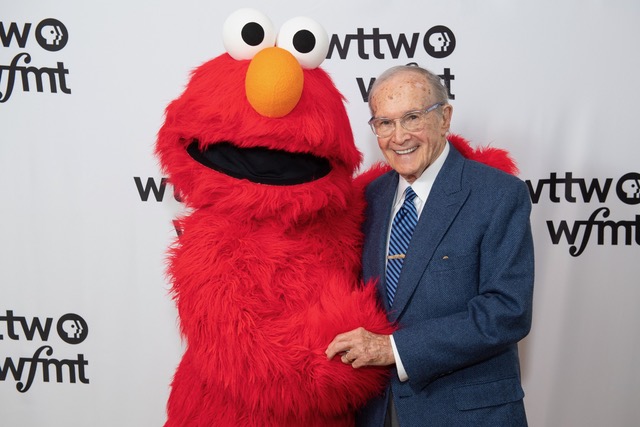
In honor of the 100th anniversary of his birth, some PBS stations will be re-showing Mike Leonard’s wonderful documentary about the remarkable life of Newton Minow. When he served as the Chair of the Federal Communications Commission, appointed by President Kennedy, he revolutionized television by expanding viewer choice through three major pieces of legislation: creating PBS, launching the first telecommunications satellite, and requiring all new television sets to provide access to channels on the Ultra-high Frequency band. Later, he championed closed captioning and helped secure the original funding for “Sesame Street.”
He mentored dozens of young people, including a summer intern named Barack Obama. He never rode in a cab without asking for the driver’s entire life story, and when his daughters visited his office, he made sure they met his friends, the elevator operator, whose daughter he helped get into college, and the mail delivery guy whose wife he helped with her immigration problems.
In honor of his centenary, we are re-publishing this tribute from his daughter, our contributing editor Nell Minow. The documentary is also available at no cost here.
On May 9th, 1961, my dad, Newton Minow, the then-35-year-old Chairman of the FCC, made three significant appearances. In Washington, he gave his famous “vast wasteland” speech to the National Association of Broadcasters, telling them that while “when television is good, nothing is better,” he expected them to do more to uphold their statutory obligation to serve “the public interest, convenience, and necessity.” Then he went back to the FCC office, where he met with Elizabeth Campbell to sign the original license for WETA, the first educational television station in the nation’s capital, now the producer of the Ken Burns documentaries and the nightly Newshour. And then he flew to Chicago to attend the father-daughter dinner for my Brownie troop.

Today, on his 96th birthday, I think, as I do so often, about how those three events defined his character: inspiring those around him to do better, supporting the visions of those making enriching cultural content and reliable news sources widely available, and always putting his family first. Over the next decades, this has been reflected in his efforts as a founder and board chair of PBS, as a member of the CBS board of directors, and in helping create the Commission on Presidential Debates (CPD), where he still serves as vice chair. He worked to require the V-chip and closed captioning, helped get the start-up funding for “Sesame Street,” and argued for the rescission of the radio license of a station that broadcast virulently racist and anti-Semitic programming. And he and my mom will celebrate their 73rd wedding anniversary this spring.

Dad was awarded our nation’s highest civilian honor, the Medal of Freedom, by Barack Obama, perhaps partly because President Obama met Michelle when he was an intern in my dad’s office, and they assigned Michelle to be his supervisor. His charming story of running into them on their first date at a showing of “Do the Right Thing” is here. An honor he cherishes almost as much is inspiring the name of the S.S. Minnow on “Gilligan’s Island,” the sinking ship on the three-hour tour, intended as an insult to my dad due to his criticism of television. He and “Gilligan’s Island” creator Sherwood Schwartz later exchanged cordial letters. My dad is always seeking common ground. He reached out to President Trump’s FCC appointee as soon as the nomination was announced. He said, “I know we do not agree on many issues, but let’s find one we can work on together.” They co-authored an op-ed about telemedicine.

He remains vitally involved in the issues of the day. My sister Martha, former dean of Harvard Law School, will be the first to tell you that the highlight of her recent book, Saving the News, is Dad’s introduction, titled “From Gutenberg to Zuckerberg.” In it, he talks about the profound challenges changes in technology pose for the public interest and the foundations of democracy. As always, he sees the opportunities as well. He is comfortable writing about AI algorithms and deep fakes, but always in the context of the unquenchable optimism and unshakable integrity that shine through everything he does. Once, he spoke to a group of young lawyers and told them that the most important thing was to earn the client’s trust. One eager attendee raised his hand with a question. “How do we do that?” “Well,” Dad said, “You can start by being trustworthy.” Happy birthday to the world’s best dad and a true and quintessentially trustworthy American hero.