Glengarry Bear Stearns

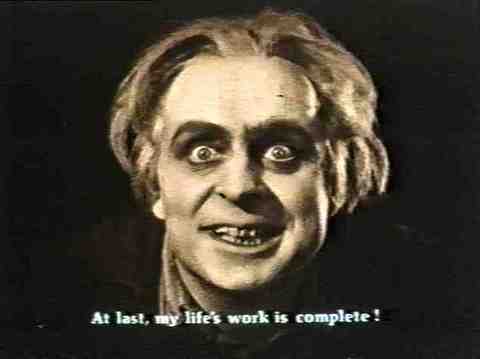
View image The politics of “Glengarry Glen Ross” in a nutshell.

Although I’m still reeling from the shocking revelation that David Mamet once considered himself a liberal (“David Mamet says he is not a brain-dead liberal anymore”), I find myself looking forward to his next (screen-)play more than ever, if only to see if I can detect an interest in ideological politics that I never noticed in his work before.

The week of his much-publicized announcement, history presented him with a perfect subject for a future writing project: the collapse of the investment banking film Bear Stearns and the last-minute bailout by the Federal Reserve, allowing it to merge with JP Morgan Chase. What a dilemma for free-marketeers! This could make for great drama in Mamet’s hands. Imagine a “Glengarry Glen Ross” in which Mitch and Murray are rescued from bankruptcy by the intervention of the federal government.

Mamet writes: “…a free-market understanding of the world meshes more perfectly with my experience than that idealistic vision I called liberalism.”

And: “[William Allen] White knew that people need both to get ahead and to get along, and that they’re always working at one or the other, and that government should most probably stay out of the way and let them get on with it.”

And: “… I began to question my hatred for ‘the Corporations’—the hatred of which, I found, was but the flip side of my hunger for those goods and services they provide and without which we could not live.”

December 14, 2012

TIFF 08: The Wrestler: Aronofsky + Rourke = Sweetness

What a sweet little movie “The Wrestler” is.

Warm. Endearing. Really nice.

This may be the first time adjectives like these have been applied to the work of Darren Aronofsky (“Pi,” “Requiem for a Dream,” “The Fountain”) or Mickey Rourke (“Johnny Handsome,” “Sin City”), neither of whom has an on-screen reputation as Mr. Charming. But there’s not a mean or cynical (broken) bone in this movie’s soft-bellied, soft-hearted, battle-scarred, age-tenderized old body.

December 14, 2012

Why movie critics make such darn good political pundits

One of the things film critics do for a living is to pay close attention to how people behave, and how that behavior is presented through visual media. This applies not only to actors playing characters, but to people who play themselves, in fictional or nonfictional settings, on and off the screen. It should come as no surprise to learn that some of our best movie critics have backgrounds in psychology.

When Bill Clinton said, “I did not have sex with that woman,” it now seems impossible to believe that he fooled anyone at that particular moment. But if any movie critic misread Clinton’s voice and body language, that critic should have been impeached. As opaque as the clumsy verbal gymnastics of George W. Bush and Sarah Palin may often be, behind the contortions it’s hard to avoid seeing the painful truth, which is simply that they don’t know what their own words mean, and even when they know what they’ve been told to say they don’t know how to communicate it. As actors, they’re thoroughly unconvincing: You can see the wheels turning inside their heads — only the gears aren’t even engaged. There’s a lot of whirring and spinning, but nothing happens. That can be excruciating to watch, but it’s also the stuff of modern comedy. Christopher Guest, Ricky Gervais, Steve Carell, Tina Fey, Jon Stewart, Samantha Bee, Stephen Colbert and the whole Judd Apatow crew come to mind.

Patrick Goldstein, writing in the Los Angeles Times, argues that film critics like Roger Ebert, sophisticated in their knowledge of media presentation and human behavior, make more insightful political pundits than the usual beltway-bubble spin-docs employed by television, radio, print and online outlets. In a piece called “From film critic to political pundit,” Goldstein writes:

To me, film critics, like TV and theater critics, are especially well equipped to analyze today’s politics, which is why Frank Rich made such a seamless transition from theater to media and political commentator. In fact, in some ways film critics are probably better equipped to assess the political theater of today’s presidential campaigns, since our campaigns are — as has surely been obvious for some time — far more about theater and image creation than politics.

December 14, 2012

Pretty Woman

Passed along on the Interwebs via Wiley Wiggins. I consider this to be a Lynchian companion piece to Sausage Party.

MORE CLIPS, UPDATES BELOW:

December 14, 2012

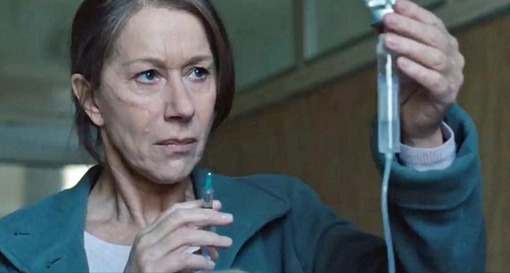
As plain as the scar on Helen Mirren’s cheek

I’ve never understood the pleasure (or the disappointment) some people seem to get out of trying to spot continuity errors in movies. Such a waste of time and attention. But I’ve seen this 30-second TV spot for “The Debt” starring Helen Mirren, Tom Wilkinson, Ciarán Hinds and Jessica Chastain several times this week (during “Louie,” “The Daily Show” and “The Colbert Report”) and this one’s so obvious it throws me for a loop.

One of the first things you notice is a nasty scar on the leading lady’s face. And in the TV spot it switches from cheek to cheek within seconds. We’re talking about Helen Mirren, people. This is not some minor detail like the level of liquid in a glass or a scarf shifting positions. It’s Helen Mirren’s face. In every shot but one the scar appears on her right side (our left). Did they flop the other shot for some reason? Just for the ad? Or is it shot in a mirror? I don’t know, but it’s… disconcerting.

UPDATE:

December 14, 2012

The Tina Fey-Palin scenario

We’ve gotta cash in on this quick, so here’s my pitch:

Tina Fey plays Sarah Palin as Tina Fey as Sarah Palin in a semi-remake of “Dave.”

Animal Control nabs Palin off the street, mistaking her for a stray pit bull whose previous owner tested makeup on animals. Palin is asked to host “SNL” the week before the election, but nobody notices she’s missing because the McCain campaign is so successful at keeping her away from the press that they forget where they put her. Security is airtight. Because Fey does a better Palin than Palin does, she is forced to do the show as Palin as Fey as Palin.

December 14, 2012

Whose fingerprints are on ‘Touch of Evil’?

Frame from the opening shot — of a pre-1998 version.

C. Jerry Kutner’s contribution to the Contrarianism Blog-a-Thon (“Why Murch’s ‘Touch of Evil’ Doesn’t Make the Cut!”) is generating some discussion over at Bright Lights After Dark. You should look into it.

Meanwhile, Jerry offers an update:

As it turns out, I wasn’t the first person to object to Murch’s version in print. Someone who commented at our blog noted that:

Chris Fujiwara covered some of this ground on the late, lamented, Hermenaut.

And after reading Fujiwara, I agree with him about Murch’s intercutting Susie’s first encounter with the Grandi’s with a scene between Vargas and Quinlan: “One wonders whether if Welles had been allowed to recut the sequence as he wanted, he might not have struggled with it only to conclude that the Susie scene played better uninterrupted.” – Another reason not to like the Murch cut!

The specific changes that were made [from Welles’ memo] are detailed by Laurence French — though oddly no mention is made of the recropping — which I consider to be the Murch cut’s most unforgiveable flaw.

I’ve read that “Touch of Evil” was shot “open aperture” (as many films are) at the standard “Academy ratio” (of 1.33:1 — or 1.37:1 for sound films, from about 1932 through 1953) even though the “intended” ratio when projected may have been 1.66:1 (mostly a European standard) or 1.85:1. The latter format was used for the 1998 “Touch of Evil” DVD which, Kutner argues, chops the top and bottom off Welles’ carefully composed full-ratio 35mm images. Normally, if a 1.85:1 film is improperly projected at the standard ratio, filling the screen from top to bottom, one usually sees boom microphones protruding into the upper part of the frame and other indications that one is seeing things that weren’t intended to be seen. That’s how you know it’s the projectionist’s fault, not the filmmakers’. But this was never the case with “Touch of Evil.” (Stanley Kubrick [“Eyes Wide Shut”] and James Cameron [“The Abyss”] are among the directors who, it is claimed, have composed at least some of their video-era films in wide screen and “full screen” ratios simultaneously, so the image would fill pre-16:9, non-HDTV television screens without losing anything.)

Indeed, in a May 24, 1958, letter to the editor of the New Statesman of London (reprinted at the bottom of French’s second page), Welles writes:

There was no attempt to approximate reality; the film’s entire ‘world’ being the director’s invention. Finally, while the style of TOUCH OF EVIL may be somewhat overly baroque, there are positively no camera tricks. Nowadays the eye is tamed, I think, by the new wide screens. These ‘systems’ with their rigid technical limitations are in such monopoly that any vigorous use of the old black-and-white, normal aperture camera runs the risk of seeming tricky by comparison. The old camera permits use of a range of visual conventions as removed from ‘realism’ as grand opera. This is a language not a bag of tricks. If it is now a dead language, as a candid partisan of the old eloquence, I must face the likelihood that I shall not again be able to put it to the service of any theme of my own choosing.As I read this, Welles states his clear preference for the “old black-and-white normal aperature” over the “new wide screens” that were introduced in the 1950s (along with new widescreen processes such as VistaVision, CinemaScope and the like) — and with regard to “Touch of Evil” in particular. The question (as one correspondent has posed it) was whether Welles really thought he could get away with making a 1:33:1 picture in the late 1950s. But even if he didn’t, he knew the prints would retain that ratio. And the 16mm prints shown by universities and film societies were full-frame. So, he must have known that the film was being seen that way before he died in 1985. I wonder if either of the early versions of “Touch of Evil” was on VHS or laserdisc by then…

UPDATE: Christian Liemke offers some 1:33:1/1.85:1 “Touch of Evil” frame comparisons here.

December 14, 2012

Coding in pictures: The Social Network

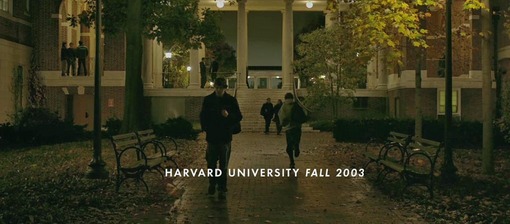
The first thing that happens after Erica (Rooney Mara) breaks up with Mark Zuckerberg (Jesse Eisenberg) in “The Social Network” is that he goes back to his residence hall. It’s a long, long walk, even though Mark takes it at a clip that’s closer to running. Why, after the rapid-fire skirmish in the opening scene, would the movie take so long to simply get Mark from the Thirsty Scholar, just off-campus, to Kirkland House?

Well, for one thing, it’s an opportunity to roll the opening credits. But at one point this was envisioned as the most extravagant sequence in the picture — and that’s saying a lot, given that it was directed by David Fincher (“Fight Club,” “Zodiac,” “The Curious Case of Benjamin Button”). According to Michael Goldman’s cover story in the October issue of American Cinematographer, the whole trek was designed to be accomplished in one long take, with multiple cameras stationed along the route. The footage (if you can still call it that, when the images are being captured on 16GB CF cards) would then be stitched together in post-production to create one seamless shot. There’s even a satellite map of the course in the magazine.

December 14, 2012

Mad Men in Tomorrowland: “Things aren’t perfect.”

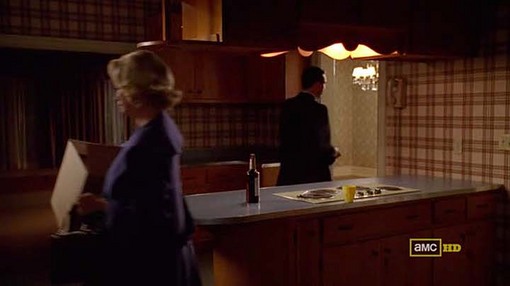
Let’s start at the end, that is with the last two shots of the “Mad Men” Season 4 final episode, “Tomorrowland.” The penultimate image is a beaut, with Don and Betty in the dark, empty kitchen of the house they once shared. Don is there to meet a real estate agent. Betty, the blonde in the blue Disney Evil Queen coat, has returned to box up some things she “forgot” from the cabinets in the guest bathroom. Don, characteristically, has a secret he hasn’t forgotten about — a fifth of whiskey stashed in the cupboard above the oven. They share a few sips from an old ornate bathroom cup and Betty, ostensibly speaking of the kitchen in her new house which she will probably have remodeled, looks Don in the eye and says, “Things aren’t perfect.”¹

Yeah, it’s a cliché (Betty almost always sounds like she’s reading a script), but in this context it’s also a wonderful moment, poignant and funny. Because she says it almost as though a) she believes “things” actually could achieve a state of perfection; and b) she thinks imperfections are shameful secrets and this is an intimate confession — never mind that Don knows perfectly well what a mess she is. His reply — which could be read as tender (letting her off the hook) or pointed — is delivered/deflected with a gentle smile and received with understanding: “So, you’ll move again.”

December 14, 2012

Why we are all doomed

Director Richard Kelly. (Note motion picture camera.) Not to be confused with suspected terrorist James Kelly. Or soap-operatic rapper (and little girl fancier) R. Kelly. Or “Singin’ in the Rain” dancer Gene Kelly. Or former Princess of Monaco Grace Kelly.

One of the things I love about “24” (not just this season, which is the best one ever, but in general) is the way it shows how people never cease being petty and self-centered, even in the midst of potentially catastrophic international crises in which millions of other people’s lives are at stake. What it all comes down to is this: In any crisis, office politics are probably more important than global politics. We see it all the time with our politicians’ egocentric defenses of indefensible ineptitude and gridlock caused by inter-agency squabbling (which the papers always call “turf wars”).

Now, here’s another example of bureaucratic bungling in the name of Homeland Security that shows why, as Jon Stewart recently observed, if terrorists have not yet attacked us since 9/11 it can only be because they are even more incompetent than our own so-called “security” apparatus: Director Richard Kelly (“Donnie Darko,” “Southland Tales”) is being investigated as a possible terrorist and may not be able to attend the premiere of his new movie at the Cannes Film Festival next week, where his film is in competition for the Palm d’Or. Why?

December 14, 2012

Tracing the image #2: The rebirth of ‘The Descent’

Whenever you watch a movie, you’re also probably watching just about every other movie you’ve ever seen. The images that flash by trigger associations in your brain — some of them deliberately planted by the filmmakers, others not. Still, you’ve got all these images and memories banging around in your head and they’re going to connect with something no matter what.

View image

As I wrote in my review of “The Descent” and subsequent postings, director Neil Marshall quite deliberately conjures up memories of other movies (especially, but not exclusively, horror movies) to evoke emotions and effects that have lingered in viewers’ imaginations.

Take the “rebirth” of one character, who emerges from the ground coated in blood, like a baby from the womb. This image resonates with memories from a number of terrific movies. Before I get to a more detailed discussion, the usual **SPOILER ALERT** is in order — not only for “The Descent,” but several of its antecedents, including “Deliverance,” “Carrie,” “Evil Dead 2” and “The Third Man.” OK, let’s give these movies a hand!

December 14, 2012

Poetry in motion — and it rhymes, too

View image The animated banners, archived, are worth the price of admission alone…

Jonathan Lapper offers an inspired free-associative montage/meditation on the moving part of the movies at Cinema Styles, which you must see. It’s called “Frames of Reference,” a little under seven minutes long, and it marvelously (too marvelous for words, obviously) orchestrates cinematic motion and memories to Oliver Nelson’s “Complex City.” (If you suspect you’re unfamiliar with the great jazz arranger, think “Stolen Moments” — which might make a great subtitle for this reference-packed short subject.) My favorite transition: From “Hiroshima, Mon Amour” to “Citizen Kane.” You’ll see why.

And now, for fans of Richard Lester, Peter Sellers and Spike Milligan (and Leo McKern and Graham Stark and Norman Rossington…), my own movie reference: “Frames of Reference” is “The Tracking, Exploding, Kissing, Watching, Crashing, Throwing, Fainting, Dancing, Drinking, Flying, Falling Backwards Film,” though not necessarily in that order. And that’s not the half of it….

December 14, 2012

Robert Zemeckis returns to reality

I packed my bags last night, pre-flight

Zero hour, 9 a.m.

And I’m gonna be high as a kite by then.

— Elton John & Bernie Taupin, “Rocket Man” (1972)

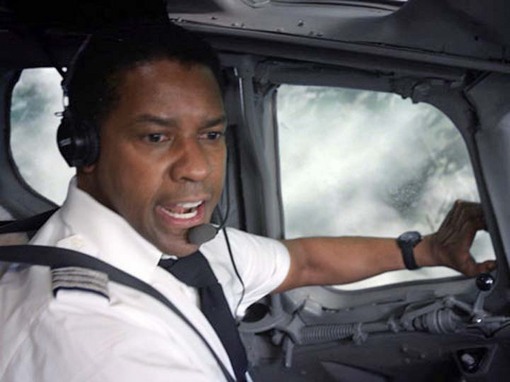
Cinema, for me, has always been something like music composed with photographic images. Others see it more like “action painting,” and we’ve seen a lot of discussion in recent years about what J. Hoberman and others have called “post-photographic cinema,” in which computers have replaced cameras, and animation has replaced photography, as the primary means of creating images on a screen. (Hoberman: “With the advent of CGI, the history of motion pictures was now, in effect, the history of animation.”) “Flight” is Robert Zemeckis’s return to live-action photography for the first time since “Cast Away” (2000), after a series of IMAX 3D animated adventures: “The Polar Express” (2004), “Beowulf” (2001) and “A Christmas Carol” (2007). It’s also a return to making movies aimed at an adult audience — and one that proved to be a different, and more interesting, than the movie I’d seen advertised in the trailer.

(spoilers)

December 14, 2012

Waiting for the end of the world

Overheard after a trailer for the redundant apocalyptic spectacle “2012” at the 2:30 p.m. matinee of “Inglourious Basterds” at the Regal Thornton Place Stadium Cinemas in Seattle, WA, August 22, 2009, spoken unironically by a male in his early twenties:

“I’m tired of watching the world end.”

Me too.

December 14, 2012

Ad blurb pwnage

“500 Days of Summer will own you.”

— Peter Travers, Rolling Stone

I have not been able to find the context in which the cutesy ad blurb above originally appeared. It’s not in Travers’ review at RollingStone.com. Maybe he spoke it, or something like it (“It will own you”), in video or podcast remarks. I’ve seen it used in web ads and TV spots. But, really, what was Travers trying to communicate by employing this phrase? That the movie vanquishes you, the viewer? (At least he didn’t say “pwn.”)

What’s the adjectival form of “n00b”?

December 14, 2012

National Society: The last best critics awards for 2010

Above: Best supporting actress winner Olivia Williams, “The Ghost Writer.”

“The Social Network” has swept the major critics’ groups honors (following NY and LA) with its best picture award from the National Society of Film Critics. From the NSFC website:

The Society, which is made up of 61 of the country’s most prominent movie critics, held its 45th annual awards voting meeting at Sardi’s Restaurant in New York City. 46 members voted. Scrolls will be sent to the winners.

BEST PICTURE

*1. The Social Network 61

2. Carlos 28

3. Winter’s Bone 18

BEST DIRECTOR

*1. David Fincher 66 – The Social Network

2. Olivier Assayas 36 – Carlos

3. Roman Polanski 29 – The Ghost Writer

BEST ACTOR

*1. Jesse Eisenberg 30 – The Social Network

2. Colin Firth 29 – The King’s Speech

2. Edgar Ramirez 29 – Carlos

BEST ACTRESS

*1. Giovanna Mezzogiorno 33 – Vincere

2. Annette Bening 28 – The Kids Are All Right

3. Lesley Manville 27 – Another Year

December 14, 2012

A very funny (’cause it’s true) poem about critical thinking

From Taylor Mali on “Russell Simmons Presents Def Poetry” in 2002:

In case you hadn’t noticed,

it has somehow become uncool

to sound like you know what you’re talking about?

Or believe strongly in what you’re, like, saying?

Invisible question marks and parenthetical (you know?)’s

have been attaching themselves to the ends of our sentences?

Even when those sentences aren’t, like, questions? You know?

December 14, 2012

North by Northwest: Long shots as close-ups (Part 1)

View image An extreme close-up — up Thomas Jefferson’s nose, that is. Wee Roger O. Thornhill and Eve Kendall are in long shot.

For the Close-Up Blog-a-thon at The House Next Door:

When is a long shot a close-up? When it’s part of an Alfred Hitchcock cliffhanger sequence on Mount Rushmore in 1959’s “North by Northwest,” that’s when.

View image Full profile of Roger on right, as Eve drops right out of the bottom of the picture. The most prominent facial feature in the shot is Jefferson’s schnoz (this could almost be microphotography, if you thought of it on that scale), with Abe Lincoln looking on in semi-Bergmanesque three-quarter profile from below his predecessor’s nostril.

View image Mr. Washington is ready for his close-up now, with a teeny henchman standing to the left of his cheek and miniscule Roger and Eve hanging out between him and Jefferson.

View image Mr. Lincoln. And Leonard. (That would be a tiny Martin Landau.)

Hitchcock is having so much fun with scale and perspective here that I chuckle with delight (even as I tense up) every time I see the, uh, climactic sequence, which ends with an insertion shot — both long shot and close-up, depending on how you look at it — that’s so naughty, so pornographic it will have to wait until after the jump….

December 14, 2012

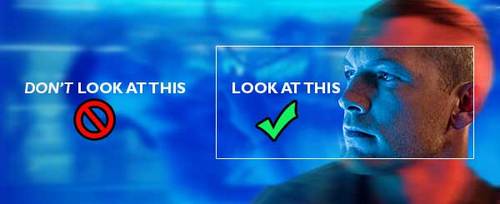
Avatar 3D headaches: Look at this! Don’t look at this!

The eyestrain I got from watching James Cameron’s “Avatar” reminded me why I think so-called “3D” cinema is still a cheap-looking gimmick that hasn’t improved since the View Master was introduced at the 1939 New York World’s Fair. Upon returning home from the movie I wrote:

[Each] layer looks flat, stacked in front of or behind some other layer. So, people for example look like cardboard cutouts rather than rounded figures. What’s worse, if the camera’s depth of field holds something out of focus in the foreground or background, you can’t do anything about it. If you look at something that’s closer or farther away, your eyes have a natural tendency to bring it into focus. 3D camerawork frustrates that instinct. Regular old 2D imagery, on the other hand, does not trick your eyes into trying to focus on something they can’t, because both eyes are always looking at the same plane. All around, fewer headaches.

Martin Anderson has since published a piece at Shadow Locked called “How to avoid getting a 3D headache while watching Avatar,” discussing the problem of stereoscopic photography and illustrated with 2D examples from Hitchcock and Ridley Scott:

December 14, 2012

From the Museum of Outmoded Technology

It’s the player piano roll, the 8-track cartridge, the Apple Newton, the Microsoft Bob (or Microsoft Sidewalk) of its day — the 1981 RCA SelectaVision Capacitance Electronic Disc! Basically, it looked like a grooved black vinyl LP in a plastic sleeve, but it played video instead of music: “The magic of the RCA VideoDisc, a simple, affordable record that, like magic, can bring not just sound, but sound and pictures — clear, beautiful pictures — right into your living room! A record that can bring you ‘Casablanca’… or Miss Piggy… or Woody Allen… or ‘The Godfather’…” My favorite moment in the promo above is when Jesus approaches Rod Steiger and the chorus sings: “Bring the magic home — with R-C-A!” Remember, too, RCA was the company that brought you the [ahem!] miraculous new Dynagroove and Dynaflex long-playing record formats.

Like its flat circular competition, the silvery 12-inch pre-CD/DVD optical storage disc systems known as DiscoVision or LaserDisc, you also had to turn it over to play, say, the “second side” of a feature film. Discs cost $15 and players between $299 and $500. Sans remote, apparently. None of these new LP-sized disc systems quite caught on with the general public. Soon, Compact Discs would set the standard for optical storage at a diameter of 122 mm (about 4.72 inches), which would also be used for CD-ROMs, DVDs, and DVD-Rs. The question of why digital information of any sort should be encoded onto a cumbersome physical object (requiring needlessly complex delivery systems including shipping, packaging, storage space, a player/recorder separate from the media itself…) is the a technological challenge “home entertainment” companies are still trying to figure out.

View image “Our master video tape has gone to Mastering Control…”

The above is a six-minute overview (“Bring the Magic Home” — look for the trademark skip/stutter in the “Lady Sings the Blues clip), archived by databits, who offers quite a collection of ancient technology guides and promos at YouTube. To watch a guided tour of the SelectaVision production process (including a peek inside the lab with a guy in a shower cap), you can (as they used to say in the early days of the World Wide InterWebs), click here (for Part 1) and here (for Part 2).

“To the people behind the scenes, the people at RCA, it begins with raw materials as pure as those used in medicines — plus a myriad of parts and procedures.”

December 14, 2012
subscribe icon

The best movie reviews, in your inbox