Opening Shots update & lexicon

I still have plenty of excellent Opening Shots submissions to edit and post — and I’m doing my best to get frame grabs to accompany them whenever I can. (Quiz answers coming soon, too.) To no one’s surprise, “Star Wars” (1977) has been the most popular nomination — and for good reasons. But do keep ’em coming. I think of new brilliant opening shots every day, so if your initial ideas have already been mentioned, keep thinking. (Or, if you’d care to add to the discussion of a particular shot, Comments have supposedly been enabled on certain posts — though I have to approve ’em first.)

A few notes about terminology, just so we can be sure we’re all speaking the same language:

shot: a continuous image on film, from the time it begins (when the camera is rolling) until a cut (or fade out or dissolve) takes us to the next image. Sometimes the word “take” — as in continuous shot — is used interchangeably, although it is more specifically used to refer to one of several attempts to “get” a certain shot during filming. The editor often chooses between several takes of a given shot, and may cut them into shorter shots, or inter-cut different takes with other shots.)

pan: when the camera pivots horizontally, usually on a tripod. If a shot is strictly a pan, the camera does not move from its location, it just swivels — as if you were standing still and turning your head. It can, of course, be used in various combinations with any of the other techniques below. The opening shot of “Psycho” is a simple pan. Later, a zoom and a crane shot are used in the opening sequence.

tilt: like a pan, but a vertical movement rather than a horizontal one. The camera does not “pan” up the exterior of a skyscraper from a position on the sidewalk across the street; it “tilts” up. The last shot of Robert Altman’s “Nashville” is a simple tilt up to the empty sky.

dolly shot: a shot in which the camera actually moves — usually when mounted on a dolly or a crane, and often on tracks which have been put down to ensure a smooth-gliding and precise movement.

tracking shot: sometimes used interchangeably with “dolly shot,” but technically a shot where the camera moves with, or “tracks,” another moving object in the frame — whether from above, below, ahead, aside, or behind. (See opening shot of “Birth” — which also appears to use a crane and a Steadicam.)

crane shot: a movement where the camera is mounted on a crane (and sometimes a dolly as well), usually to rise above, or descend to, the scene of the primary action. Lots of movies end with crane shots that raise up on a crane and sometimes dolly back at the same time (think of “Chinatown” or “Silence of the Lambs”).

handheld shot: any shot in which the camera operator simply holds the camera manually, whether standing in one place or moving around within the scene. Often characterized by a certain shakiness that we’re used to experiencing as more immediate, immersive, or documentary-like than a solid, mounted camera, which can feel more detached and “objective.”

Steadicam shot: a Steadicam is a gyroscopic device that, as its name indicates, can be used to eliminate the shakiness of handheld shots for a smoother, more fluid movement — as if the camera is floating on air. (See “Halloween” for a dazzling example.) In a landmark shot at the beginning of Hal Ashby’s “Bound for Glory” (photographed by Haskell Wexler), the Steadicam operator is actually on a crane and lowered to the earth, where he steps off and continues the shot at ground level.

zoom: a zoom lens is simply a sliding telephoto lens that smoothly enlarges or reduces the size of objects in the frame optically, like looking through a adjustable telescope. The camera doesn’t necessarily move (though it sometimes does that at the same time), but appears to magnify or decrease whatever it’s looking at. As you zoom in on something, the image appears to “flatten.” (Recall the famous shot of Omar Sharif riding toward the camera across the desert in “Lawrence of Arabia” — he never really seems to get any closer because of the long telephoto lens that is used.) The dizzying “Vertigo” effect (after Hitchock’s innovation in that film) involves dollying in and zooming out at the same time (or vice-versa) — an effect employed memorably in a shot of Roy Scheider on the beach when a shark is sighted in “Jaws.”
December 14, 2012

Wi-Fried in Urbana

The Illini Student Union wi-fi network has been down since late Friday/Saturday morning, so I’ll have to file more when I get back home (I’m between planes in Chicago now, on airport wi-fi). I think the Saturday convention of student scientists on the U of I campus (and/or the massive rain-storm the night before) may have overloaded the system.

Overheard in the hall outside one of the science convention meeting rooms, one student to another: “Well, should we just go back to our anti-social lives then?”

December 14, 2012

Speaking of framing…

I’m in the process of tracking down, rescuing and reposting all my video essays that disappeared along with iKlipz when the latter died unexpectedly earlier this year. This one, about M. Night Shyamalan’s “Unbreakable,” came to mind when posting Richard T. Jameson’s comments on framing and John Carpenter’s “Halloween.”

December 14, 2012

Letting Go of God

View image: Julia’s new CD: A beautiful loss-of-faith story.

A personal note: I hope you’ve seen my dearest friend Julia Sweeney’s “God Said ‘Ha!'” (Roger Ebert’s review here), which is available on DVD. And I hope you’ve seen her stage monologues, “In the Family Way,” about her decision to adopt her daughter, Tara Mulan Sweeney, from China (my photo account of the journey itself is here, with my text written in Borat-esque Engrish); and, especially, “Letting Go of God,” about her messy breakup with the Almighty, which she has performed in LA and New York (she’s about to do nine shows through October 29 at the Ars Nova Theatre — right next to “The Colbert Report”!) — and abridged one-night engagements in a few other cities, including Seattle and Austin, where she did Q&As afterwards with Ira Glass.

You may have heard a small excerpt from “Letting Go of God” on Glass’s “This American Life” NPR show, the most popular episode in that broadcast’s history. But now — for the first time! — you can obtain a double-CD of the whole show (which comes with a beautiful booklet transcription of the piece) — as well as a separate, single-CD recording of “In the Family Way.” I’m so proud of, and moved by, Julia’s accomplishments that I could do a dance — which I indeed do, but in private.

Some of the happiest moments of my life have been working and playing and collaborating and consulting with Julia in various respects over the last 30 years of our enduring friendship — on various projects for stage, print, TV and movies — and I’m delighted to be listed as an Extra Special Creative Consultant on “Letting Go of God.” The CDs go on sale at her web site October 25 (my birthday). “Letting Go of God,” like “God Said ‘Ha!’,” will become a film of some kind (Julia is still playing around with ideas for how to shoot it). Here’s an excerpt — two of my favorite passages (although others are considerably funnier) — that just happen to address this blog’s core subject. No, not movies — critical thinking:

God requires faith. Faith does not require evidence, right? But the more I thought about it, my faith was based on evidence. The evidence of how I felt when I prayed. The evidence of everyone believing in God, almost everyone I had ever met from the time I was a kid. The evidence of what I had been taught by other people I trusted, admired, and who ultimately had authority over me.

So, my faith in God was based on evidence. Well then, how could I not examine that evidence? But how did I examine anything? How did I know what I knew? I had to know! […]

I thought of Pascal’s Wager. Pascal argued that it’s better to bet there is a God, because if you’re wrong there’s nothing to lose, but if there is, you win an eternity in heaven. But I can’t force myself to believe, just in case it turns out to be true. The God I’ve been praying to knows what I think — he doesn’t just make sure I show up in church. How could I possibly pretend to believe? I might convince other people, but surely not God.

And plus, if I lead my life according to my own deeply held moral principles, what difference did it make if I believed in God? Why would God care if I “believed” in him?

It’s a funny, informative, enlightening and suspenseful struggle if, like Julia (and me), you’re inclined to Question Authority and figure things out for yourself. (Which is not to say you’ll necessarily share Julia’s conclusions — and she doesn’t expect you to — just that you’ll appreciate the switches, setbacks, false peaks and hard-won lessons of the journey…)

December 14, 2012

The arrival of The Prisoner, then and now: “We Want Information!”

AMC’s re-do of the classic British TV series “The Prisoner” gets under way Sunday night, following the conclusion of “Mad Men”‘s third season last week. The new version stars Jim Caviezel as Number Six and Ian McKellen as Number Two. (The great Leo McKern played Number Two a couple times in the original series, and there were some other repeats as I recall, but generally there was a new Number Two each week.)

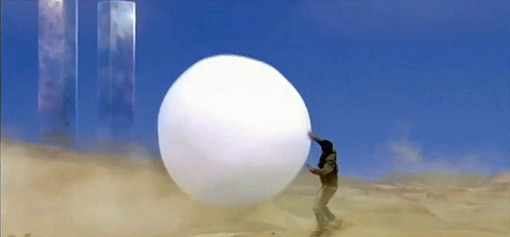
From the teasers it appears that the new version (tagline: “You Only Think You’re Free”) takes place in a desert suburb of Dubai rather than a quaint seaside village. (Actually, the new “Prisoner” was shot in Cape Town, South Africa, and Swakopmund, Namibia.) The big white bouncy billowy security devices are back. But I’m most interested in the opening credits sequence, because I became so enamored with the ritualistic nature of the earlier one, as you can see from the following obsessive video analysis originally published in 2008:

(Rescued and reposted months after the death of iKlipz caused all my video essays to disappear from the web. Originally published — with more on “The Prisoner” here.)

December 14, 2012

Obligatory Oscar analysis!

View image Pan looks into the future. What does he see?

I’m thrilled to report that Roger Ebert will be filing his own analysis of this morning’s Oscar nominations, too. In the meantime, here’s what I got:

Last summer, according to most industry prognosticators, this whole Oscar race thing was supposed to be all over already. Before its release, Clint Eastwood’s “Flags of Our Fathers” was widely expected to be greeted with flowers and statuettes. The combination of Eastwood and Paul Haggis (screenwriter of the last two Best Picture winners, Eastwood’s “Million Dollar Baby” and Haggis’s “Crash”) made the Red Carpet look like a cakewalk. “Letters From Iwo Jima” wasn’t even on the release schedule for 2006, so as not to interfere with “Flags”‘ Oscar chances. Martin Scorsese’s “The Departed” (2006) on the other hand, was cheered as a “return to his (generic) roots, ” a straight-up commercial cops-and-crooks movie to follow up his prestige-picture Oscar bids, “Gangs of New York” and “The Aviator,” but not something seriously For Your Consideration.

Meanwhile, the Christmas roadshow release “Dreamgirls” was positioned as the “Chicago” nominee, a glitzy musical that took years to get to the big screen (the stage version played on Broadway more than 20 years ago), and was thought to be a shoo-in for a Best Picture nomination.

Don’t you love it when the conventional wisdom is just wrong?

Story continued at RogerEbert.com

December 14, 2012

Oscars: No comment (almost)

Except… really, was there a worse-directed movie than “Slumdog Millionaire” this year? (“Jumper”? “Speed Racer”?) I didn’t get around to watching it until this week because, as I mentioned in Toronto last fall, Danny Boyle has long been on my “Life is Too Short for…” list. But this one seemed unavoidable.

I regretted my decision from the opening sequence, which intercuts an interrogation on “Who Wants to Be a Millionaire” with the eye-candy torture (beating, high-voltage toe-shocking) of a kid who’s tied up and suspended from the ceiling — all with thudding music (just like the TV game show!) and Dutch angles galore. (The television show is black and blue; the torture chamber is orange and red — all glossy as can be.) This is Danny Boyle, slumming. Like its title, “Slumdog Millionaire” is so picturesquely “gritty” it’s oleaginous. Even the cruelty is pristine. Casting is skin-deep: The good characters are pretty, the mean ones are distinguished by cosmetic irregularities, the slimy ones are… slimy-looking. At times it’s like watching the reincarnation of Alan Parker.

Not since “Crash” — or possibly “Mississippi Burning” — has a movie packaged brutality in slicker, shinier, tighter shrink-wrap. It’s asphyxiating. You will never have to worry about what you are supposed to feel and when you are supposed to feel it because the movie will always feed you the answers, then smack you when it’s your cue to emote. You can “surrender” completely to the experience (it demands nothing less), and you needn’t worry that you will be given an idle moment in which you will be left to feel, or breathe, on your own. This is the kind of mechanical spectacle people like to call an “audience picture,” but that’s simply because it doesn’t allow any space for non-autonomic responses. Don’t even get me started on the schematic, dramatically flat structure (game show question followed by flashback to how how the contestant learned the answer)…

Oh, I forgot I wasn’t going to comment. Sorry. But, wow, I was unprepared for how much I detested “Slumdog Millionaire.”

(Above: It’s a movie, it’s a game show, it’s a t-shirt.)

Stories on reactions to “Slumdog” in India, where it opened Jan. 24:

Critics rave over ‘Slumdog Millionaire,’ Indian public mixed (AFP)

Indians don’t feel good about ‘Slumdog Millionaire’ (Los Angeles Times)

“Why Slumdog fails to move me” (BBC)

I have no issues with Boyle’s cheery depiction of the resilience of slum children and the sunny side of slum life: it is part of the unchanging popular oriental stereotype of poverty equals slums equals dirty, smiling children. Been there, seen that. […]

My quibble with Slumdog Millionaire lies elsewhere. […]

I suspect what Boyle tries to do is a Bollywood film — the dirt-poor lost brothers, unrequited love — with dollops of gritty realism. But at the end of it all, it is a pretty callow copy of a genre which only the Indians can make with the élan it deserves. The realism skims the surface, and in spite of some decent performances, style dominates over substance.

December 14, 2012

Zweiundzwanzig: Meine 22 beliebtesten Filme, 2000-2009 (Best o’ Decade — UPDATE!)

As I always like to say, “Everybody Loves Lieblingsfilme.” I know I do, which is why I made this list of my 22 favorite films of the ’00s. No, that is not entirely true. I made the list because the estimable Milan Pavlovic, editor of the German Filmzeitschrift Steadycam (and for whom I wrote this profile of Barbara Baxley’s Lady Pearl in Robert Altman’s “Nashville”) asked me to.

He asked others, too, and the aggregate findings will be published in a future issue of Steadycam. The important thing to remember here is that these are favorite films. Sure, everything on my list is also an accomplished work of art, but these are the movies I love, that have had the most personal impact on me, that I have found most moving and exhilarating, that have permanently ingrained themselves into my psyche — whether they’re anybody else’s idea of the “best of the decade” or not:

Now updated with links to my previous noodlings, where available:

1) “No Country for Old Men” (Coens, 2007)

2) “The Three Burials of Melquiades Estrada” (Jones, 2005)

3) “Caché” (Haneke, 2005) [Opening Shot]

4) “Zodiac” (Fincher, 2007) [Opening Shot] See also: Hurdy Gurdys and Aqua Velvas, The “Dirty Harry” Scene, Three Kinds of Violence.

5) “A Serious Man” (Coens, 2009)

6) “Mulholland Dr.” (Lynch, 2001)

7) “Brokeback Mountain” (Lee, 2005)

8) “Pan’s Labyrinth” (Del Toro, 2006)

9) “Birth” (Glazer, 2004)

10) “24 Hour Party People” (Winterbottom, 2002)

(continued…)

December 14, 2012

Three faces of Margaret

Let me indulge my passion for operatic drama for a moment and say that I’ve seen Kenneth Lonergan’s “Margaret” four times now (the theatrical version and the new “extended cut” on DVD, twice each) and, while I’m watching it, I feel like I’ve never before seen a movie that fully recognized what human behavior is like. Sure, the focus is entirely on a certain demographic slice of human beings — mostly middle- to upper-class, educated, New York-dwelling, Judeo-Christian-atheist white people — but these people are alive and ragged and messy in ways few movie characters are allowed to be. (The characters, and the lives the movie depicts, are messy; the movie itself is exquisitely shaped according to its maker’s vision, and that was apparent from the theatrical cut.)

Of course, all movies are stylized and all characters, whether documentary subjects or fictional, are creations (of writers, directors, actors, editors, cinematographers and others) presented to us in a frame. Yet there are dimensions to the interactions in “Margaret” — the longing to be understood, the perverse impulse to (deliberately?) misinterpret someone else, the desire to inflict emotional sabotage on yourself or another person just because you can — that movies so often overlook in an effort to provide clear and clean drama in which everybody announces, bluntly and correctly, exactly what they mean to say.

In other words, as Lisa Cohen might say, “Margaret” calls bullshit on most other movies.

December 14, 2012

Don’t let this affect your opinion of Juno…

View image … whatever it may be.

UPDATED (below): There’s Ellen Page on the cover of Entertainment Weekly next to the headline: “Juno: The Little Movie That Did.” Subhead: “How a Teen Rebel Delivered Oscar’s 100 Million Dollar Baby.” This is when I feel a little sorry for people who didn’t see the movie back when they could still at least feel like they were discovering it for themselves — even if the “Little Movie That Could” was just a Fox Searchlight marketing ploy all along. Anyway, it turned out to be a great way to sell the movie: 4 big-time Oscar nominations (Best Picture, Actress, Director, Original Screenplay) and triple-digit milliones in theaters. (And that’s a digit that can’t be undid.)

Game blogger Surfer Girl even started a hilarious rumor that “Juno: The Video Game” was in development, “the most realistic teenage pregnancy simulation to date, for Playstation 3, Xbox 360, PC, and Wii. Crave could not get Ellen Page for the game, so in her place will be Jamie-Lynn Spears. For portable fans, a track-and-field title set in the Junoverse will hit DS and PSP.”

(Just imagine wielding a Wii pork sword. Can you impregnate Juno — and win?)

The post was labeled “joke,” but that didn’t stop Gamespot News from reporting it as a really maybe sorta true story, straight outta DICE Summit. (BTW, just above the “Juno” item, Surfer Girl offered this: “For the Blu-Ray release of ‘There Will Be Blood,’ Backbone Entertainment is working on ‘an epic milkshake drinking adventure’ that will feature the likeness of Daniel Day-Lewis, it will take up an estimated 5GB and feature at least twenty hours of slurping action, plus multiplayer.”)

“I drink your milkshake!” is the golden ticket that will sell this thing with the people who are too lazy to read reviews and don’t care that much about awards. It’s simple, it’s viral, it’s primitive…it will travel. Make the “I drink your milkshake” T-shirts, hand out the buttons and bumper stickers, cut the TV and radio ads that emphasize the line over and over, and sell this brilliant but undeniably gnarly film as a kind of half-melodrama, half-hoot.”

— Jeffrey Wells, January 9, 2008

The proper response to this hype and hoopla would be: “So what?” It’s all after-the-fact anyway, and it has nothing to do with the movies themselves. Although, at least, the now-ubiquitous “I drink your MILKSHAKE!” catchphrase from “TWBB,” which by now even USA Today has reported as a viral phenomenon, was inspired by the delivery of a line that’s actually in the movie. (The brief “Friend-o” fad seems to have passed.)

December 14, 2012

Greetings from Boulder

Wish you were here! Sorry I haven’t posted for a while. A death in the family, followed by the Conference on World Affairs (where I’m going through “Chinatown” with the audience, as well as serving on other panels) has kept me from my laptop. (See article in the Boulder Daily Camera.)

Roger Ebert (who is greatly missed this year — but promises to be back for the 60th CWA next year) has been maestro of the Cinema Interruptus program for about the last 30 years. Maura Clare, the CWA’s incomparable Conference Coordinator and Director of Public Affairs, sent me a list of all the amazing films Roger has shown over the decades, which I thought I’d share with you:

1970 – 1974 – No films were shown. Most panels were about an hour long, and were series titled. Roger participated in panel discussions about Unisex, The Future of X-Rated Films, Meditation, The Devil’s Advocate: Moving Pictures, TV: The Man With the Power Saw, and Prurience.

75 – Using the series title Persona, CITIZEN KANE was shown and discussed by Roger every day at the Fox Theater on The Hill. In Addition, Roger participated with others on series titled What the Declaration of Independence Does Not Mention: A Right to Property, The Mythology of the American Experience, The Changing Understanding of What is Human and What is Natural in Human Nature, Created Equal but Everywhere Unequal.

76 – NOTORIOUS (the first Uninterruptus/Interruptus) every day at 4 pm at the Fox Theater on the Hill, using the series title How to Read A Movie.

77 – THE THIRD MAN every day at noon in the Memorial Forum, using the series title Decoding a Movie

78 – 8 1/2, every day at noon in the Memorial Forum, using the series title Analyzing a Film.

79 – LA DOLCE VITA (first of plan to study LA DOLCE VITA at least once every decade) every day at noon in the Memorial Forum, using the series title Analyzing a Film.

80 – AMARCORD every day at noon in the Memorial Forum, using the series title Analyzing a Film.

81 – CRIES AND WHISPERS every day at noon in the Memorial Forum, and the series title changed to Films.

82 – TAXI DRIVER every day at noon in the Memorial Forum, series title Analyzing a Film.

83 – LA DOLCE VITA every day at noon in the Memorial Forum, series title Analyzing a Film (second of every decade study).

84 – Roger did not arrive until Tuesday, and using the Fiske Planetarium Tuesday through Friday he discussed two Werner Herzog films, GOD’S ANGRY MAN and HUIE’S SERMON, one Ranier Werner Fassbinder Film BITTER TEARS OF PETRA VON KANT, one Louis Malle film MY DINNER WITH ANDRE, Errol Morris’s GATES OF HEAVEN and Les Blank’s WERNER HERZOG EATS HIS SHOE. All these were at noon.

85 – CASABLANCA every day at noon in the Memorial Forum series title Film.

86 – THE TREASURE OF THE SIERRA MADRE every day at noon in the Memorial Forum series title Film.

87 – THREE WOMEN every day at noon at Macky Auditorium (first Macky use), series title Analyzing a Film.

88 – THE THIRD MAN every day at noon at Macky Auditorium series title Analyzing a Film,

89 – OUT OF THE PAST every day at noon at Macky Auditorium series title Film.

90 – RAGING BULL every day at noon Macky Auditorium series title Film.

91 – CITIZEN KANE every day at noon Macky Auditorium series title Analyzing a Film.

92 – SILENCE OF THE LAMBS every day at 4 pm (first 4 pm showing) Macky Auditorium series title Film.

93 – JFK every day at 4 pm Macky Auditorium series title Analyzing a Film.

94 – LA DOLCE VITA (third of every decade study) every day at 4 pm at Macky Auditorium series title Analyzing a Film.

95 – There was no CWA in 1995.

96 – PULP FICTION at Muenzinger Auditorium every day at 7 pm (designated 19:00 in the program) series titles no longer used.

97 – FARGO every day at 7 pm (19:00 in program) at Macky Auditorium.

98 – DARK CITY (film selection changed after program went to press, program says VERTIGO) 7 pm at Macky Auditorium.

99 – VERTIGO every day at 7 pm at Macky Auditorium.

2000 – CASABLANCA every day at 4 pm (first 4 pm scheduling) Macky Auditorium.

01 – FIGHT CLUB every day at 4 pm at Macky Auditorium.

02 – MULHOLLAND DRIVE every day at 4 pm at Macky Auditorium.

03 – FLOATING WEEDS Sunday then Tuesday through Friday, 4 pm at Macky Auditorium; TOYKO-GA Monday only 4 pm at Macky.

04 – THE RULES OF THE GAME every day at 4 pm at Macky Auditorium.

05 – LA DOLCE VITA (fourth of every decade study) every day at 4 pm at Macky Auditorium.

06 – THE LONG GOODBYE every day at 4 pm at Macky Auditorium.

December 14, 2012

Basterd ancestry

Laird Jimenez, Thomas Swenson and staffers at Seattle’s famous Scarecrow Video have put together a list of movie references and influences they have found in Quentin Tarantino’s “Inglorious Basterds.” In the introduction (“Before They Were Basterds, Jimenez opines that “IB” is perhaps Tarantino’s “most deft handling of reference and homage yet…. Some of these films are directly referenced in the film, others are only evoked, while others still are films we simply felt should go on the list.”

A few samples:

Action in Arabia

Featured in Tarantino’s list of top five WWII pictures, also stars George Sanders on whose film persona the Archie Hicox (Michael Fassbender) character seemed to be modeled.

Battleship Potemkin

Eli Roth watched this for inspiration before making the “Nation’s Pride” film within the film, and the famous gunshot to the eye image appears recreated in “Nation’s Pride.”

Le Corbeau

Shows at Shosanna’s theater, Le Gamaar. A classic anti-collaborationist satire from director Clouzot. This film got Clouzot in trouble with the resistance and the Reich.

December 14, 2012

Opening Shots: ‘Beware of a Holy Whore’

View image: Dieters at the beginning of the shot.

View image: Dieters at the end of the shot.

From Scott Gowans, Web Manager, WOSU Public Media, Columbus, OH:

I had been reviewing films for four or so years before I decided to take some film courses at Ohio State. One intensive, joyful seminar was the work of Rainer Werner Fassbinder, whose films had just been re-mastered and were showing in pristine condition at the Wexner Center on campus. His work is both frustrating, fascinating, illuminating, and always puts me on edge. For anyone who doesn’t get him or his work, I understand, and I’m also sorry. He’s hard to watch and abstruse, but when you get it, nothing looks the same anymore. My professor hates the way society attached the term ‘genius’ to anybody who shows above-average intelligence, but he had no problem with putting Fassbinder in the same class as Goethe and Shakespeare.

One opening shot sticks with me, though I could site others. The first shot in “Beware of a Holy Whore��? has the camera at waist-level looking slightly upwards at Deiters (played by avant-garde filmmaker Werner Schroeter), who has brown hair spilling over his shoulders, and is dressed in a black cowboy suit. Behind him is sky. Deiters, whose role in the film is an odd photographer, delivers a soliloquy about Goofy (the cartoon character) in drag, who teaches kindergarten, gets beaten up by his students, meets Wee Willy, a gangster who is “the size of a 3-year-old,” takes the crook home, and feeds him. Though the police arrest Wee Willy, Goofy refuses to accept that his new friend is less than perfect.

December 14, 2012

Kill Bill — not Jim

I’ll be in the hospital most of Friday for my AV node ablation (see my latest film — a little thing I like to call “Biventricular Implantable Cardioverter-Defibrillator” — at right), but should be out this evening, when I will make an effort to approve comments. So, please, keep ’em coming in.

Meanwhile, although it might not have been the natural choice on the eve of a surgical heart procedure, I watched “Kill Bill Volume 1” last night, an experience I found thrilling (Tarantino and Robert Richardson know how to create images), though not at all involving. But that’s the kind of movies Tarantino makes. They are abstract art, not strong stories, not emotional experiences. I thought of Hitchcock, who said his films are not slices of life but slices of cake. Tarantino makes candy necklaces, tasty chunks strung together — little climaxes without much overall dramatic shape. Sometimes it’s a little like ADD De Palma (love that split-screen sequence in the hospital), but Tarantino does not waste a single shot. Every single image has a place, a reason to exist in that particular context (see Dogme 09.8 #1, 3, 4, 5, 8, 9, 10), and it’s so satisfying in contrast to the random mish-mash action editing of… well, you know the movies I’m talking about. Tarantino’s eye makes me delirious with movie love.

Best of all, in Volume 1 there’s not much stilted, wordy dialog to distract from the excellence and exuberance of the filmmaking. I’d like to see Tarantino do a silent film someday — only music on the soundtrack. His music selections, as always, are dynamite, though sometimes too short and inconsequential (see Dogme 09.8 #6 about “segues using snippets of pop tunes that fade out just as they’re getting started”). I’d like to see him really stretch out and develop more whole sequences around a piece of music instead of just a tiny piece of a piece of music. (Only reservation: the music during the first part of the fight in the snow between Uma Thurman and Lucy Liu was too slight and slick to fit the gravity of what should have been the climactic confrontation of Volume 1.)

More on Volume 1, Volume 2, “Inglourious Basterds” and other topics of interest after my ablation. (Sing along with the Ramones: “I wanna be ablated!”)

JE: Back from hospital, in recuperation mode. I’m feeling much better… Not dead yet!

December 14, 2012

‘The Scream’: Now more than ever

This pretty much says it all.

Edvard Munch’s purloined “The Scream” has been recovered in Norway, more than two years after it was stolen. One of the signature images of our time (I always think of the ending of Roman Polanski’s “The Tenant,” or Phillip Kaufman’s “Invasion of the Body Snatchers” — or, naturally, “Home Alone”), the painting expresses…. well, you can see how it speaks to the era in which we live. Reuters reports:

By Marianne Fronsdal

OSLO (Reuters) – “The Scream” and another stolen masterpiece by Norwegian artist Edvard Munch were recovered by police on Thursday, two years and nine days after gunmen seized the paintings from an Oslo museum.

“‘The Scream’ and ‘Madonna’ are now in police possession,” police chief Iver Stensrud told a news conference. “The damage is much less than we could have feared.”

He said the pictures were recovered on Thursday afternoon in “a successful police operation” but dodged questions about how it was done. He said no ransom had been paid “as of today.”

“The Scream,” Munch’s most famous work, is an icon of existential angst showing a terrified figure against a blood-red sky. “Madonna” shows a bare-breasted woman with long black hair.

December 14, 2012

Trash and Art: Critics on/of Pauline Kael

Pauline Kael

A follow-up on contrarian criticism, from an Artforum section published in 2002, after the death of Pauline Kael, called Prose and Cons:

Gary Indiana:

When Artforum invited me to write 800 words on Pauline Kael, I asked the editor why we couldn’t dispense with 799 of them, as I could certainly summarize my opinion of Ms. Kael with even greater economy than that with which her opinions had for so many years been splashed across movie ads and even, for a time, theater marquees. Besides, the definitive autopsy on Ms. Kael’s oeuvre had already been performed, twenty-one years earlier, in the pages of the New York Review of Books, by Renata Adler (“The Perils of Pauline”), and I consider Adler’s an impossible act to follow. I have a fond memory of devouring that essay with Susan Sontag, peering over each other’s shoulder, in the donut shop that used to occupy the corner of Third Avenue and Fourteenth Street, both of us nearly gagging with laughter at the sly, inexorable trajectory of every sentence, the devastating conclusion of every paragraph, the utterly damning thoroughness with which Ms. Kael’s grotesquely inflated, even sacrosanct reputation had been laid out like a corpse for burial. […]

The coercive effect of Kael’s technique was not simply contrarian, which might have had its praiseworthy aspects; “For Keeps” makes it clear, as Adler noted years ago, that this is a critic who brooks no contradiction and turns herself into a pretzel to stun the reader into agreement that a worthless film has moments that outshine, and outmerit, actual masterpieces, if for no better reason than that the film was made by one of the directors she routinely fawned over, like De Palma. When it suits her, Kael does a complete volte-face and fetishizes the transcendent artistry of De Sica’s “Shoeshine,” for example, or treats us to an extremely long, extremely ill-informed analysis of how things work in Hollywood to explain “why today’s movies are so bad.” It is, perhaps, the absence of any real sensibility rooted in any consistent method of analysis that makes Pauline Kael’s collections of reviews the kinds of books I don’t like having in my house. She’s not a real voice but more like a suet of arbitrary, extemporized pronouncements. She is Gertrude Stein’s Oakland; There’s no there there.

Paul Schrader:

Pauline changed criticism in a number of ways:

… Taking film criticism to the average filmgoer. She wrote for people who went to movies, not for those who read magazines–a technical distinction, but an important one. […]

She validated film reviewing. Difficult as it is to believe today, at the height of America’s countercultural upheaval movies truly mattered: It mattered which movies were made, which movies audiences saw, and what they thought of the movies they did see. Godard was important, Bunuel was important, Paul Mazursky and Hal Ashby were important. Art was not happening in the museums; it was in the streets and movie houses. Kael was the pied piper of reviewers who made readers believe that movies, even disreputable movies, were important. If movies were important, it followed that movie reviewing was important.

A considerable achievement, and I wish I could say a wholly beneficial one. Cultural history has not been kind to Pauline. She was able to rail against critical snobbery and High Art, defend mass-audience taste and extol “trash” because she never feared for culture. She knew that there would always be standards. Because she had standards. She appreciated great art and literature and opera; no amount of “trash” could change that.

Not long before she died, Pauline remarked to a friend, “When we championed trash culture we had no idea it would become the only culture.” That’s exactly the point. She and her foot soldiers won the battle but lost the war. Mass taste has become acceptable taste, box-office receipts the ultimate measure of a film’s worth. The pop films Kael most loved, such as “Hud” (1963), if made today, would be considered art-house fare.

Geoffrey O’Brien:

Returning to her writing after so many years, I’m still puzzled by a central ambivalence in her judgments that seems to gravitate around the notions of “art” and “trash.” In her celebrated essay “Trash, Art, and the Movies” (Harper’s, February 1969)–the closest she came to a general statement of intentions–she wants to celebrate the gaudy pleasures of cinematic vulgarity: “I don’t trust anyone who doesn’t admit having at some time in his life enjoyed trashy American movies…. Why should pleasure need justification?” She directs withering scorn at those stuffed-shirt humanists who admire “Judgment at Nuremberg” or “Wild Strawberries” but can’t appreciate “The Thomas Crown Affair” (1968). But she’s equally at odds with anyone who likes trash a little bit too much, likes it enough to think that “trash” is perhaps a term of doubtful use: “If an older generation was persuaded to dismiss trash, now a younger generation, with the press and schools in hot pursuit, has begun to talk about trash as if it were really very serious art.” It doesn’t help that her examples of yesterday’s kitsch now mistaken for art are “Shanghai Express” and — amazingly for someone who would go on to grossly overpraise the Hitchcock imitations of Brian De Palma — “Notorious.” She goes in circles on this theme, churning up perplexities about pleasure and puritanism, bourgeois complacency and radical transgression, without ever coming to a comfortable resting point. What is clear is that there is no party of which she wishes to be a member; if she has to declare for anything it will be the sovereignty of her own taste.

Comments, anyone…?

December 14, 2012

Jumping the snark: The Juno backlash (backlash)

View image A teenage romantic fairy tale.

I’m a little confused about precisely where we stand at this very moment in the “Juno” backlash cycle, but I predict the anti-backlash backlash will begin any moment now if it hasn’t already. The movie was warmly embraced at the Toronto International Film Festival (OK, the director is the son of the rich and famous Canadian director of “Stripes” and “Ghostbusters”) and was greeted with predominantly positive reviews when it opened in December, although some critics, me included, thought it got off to a grating start. Roger Ebert even named it his favorite movie of 2007. My 16-year-old niece says it’s her favorite film “ever.”

Then came the inevitable backlash after the movie was no longer a “discovery”: Why was this snarky teen comedy getting all this attention — even Oscar buzz? (BTW, I’ve been doing occasional Google searches for “Juno”+”snark” since before the movie opened in December and the latest total is “about 26,500 results.”) Arguments lit up all over the place. At Sergio Leone and the Infield Fly Rule, Dennis Cozzalio chose it his worst film of the year. On rock critic Jim DeRogatis’s Chicago Sun-Times blog, he accused the movie of “glib insincerity,” suggested it could be seen as “anti-abortion and therefore anti-woman, despite its arch post-feminist veneer,” and declared, “As an unapologetically old-school feminist, the father of a soon-to-be-teenage daughter, a reporter who regularly talks to actual teens as part of his beat and a plain old moviegoer, I hated, hated, hated this movie” (“Why ‘Juno’ is anti-rock,” “More Juno Fallout,” “And even a little bit more Juno”).

December 14, 2012

The Apatow schlub: Too ugly for the girl?

View image Mila Kunis and Jason Segel in “Forgetting Sarah Marshall.”

“Forgetting Sarah Marshall,” starring and written by Jason Segel (“Freaks and Geeks,” “Undelcared,” “Knocked Up”) opens April 18. Last month, after an early screening, Jeffrey Wells at Hollwyood Elsewhere revealed that the idea of “marginally unattractive guys — witty stoners, clever fatties, doughy-bodied dorks, thoughtful-sensitive dweebs and bearish oversize guys in their 20s and 30s” playing “romantic leads” just doesn’t wash with him (“Eclipse of the Hunk?”).

“Question is, what if this starts to manifest in realms outside Apatow World?” he frets. God forbid. Upon seeing Segel’s upper torso at the beginning of “Forgetting Sarah Marshall” (this is before all the rest of him is bared to the world in a painfully funny break-up scene), Wells says:

I immediately went, “Oh, sh-t…I’m stuck with this dude for the whole film.” Segel is an obviously bright guy with moderately appealing features, but he also has a chunky, blemished ass and little white man-boobs, and he could definitely use a little treadmill and stairmaster time and a serious cutback program regarding pasta, Frito scoop chips, Ben & Jerry’s and Fatburger takeout. I don’t relate to this sh-t at all, I was muttering to myself.

December 14, 2012

Stephen Colbert on the role of artists in popular culture

After Bruce Springsteen referred to “present company included, the idiots rambling on on cable television any given night of the week” in an interview with something called Soledad O’Brien (what is a Soledad O’Brien, and why was Springsteen having an interview with it?), Stephen Colbert was outraged. He offered these Words of Wisdom — something to keep in mind during the summer movie season, as well:

“All Soledad did was ask a perfectly legitimate valid question about whether artists should do anything other than entertain us! I’ve said it before: Popular music should be a series of meaningless cliches strung together by a pleasing melody to help pass the time during long commutes or loveless marriages.”

C’mon, people: Isn’t willful vacuity, and the lack of any ambition other than the monetary, the very recipe for what makes life so worth living?

December 14, 2012
subscribe icon

The best movie reviews, in your inbox