

Archives

How many Beyonci does it taketo blow out a Super Bowl?

by Tom Shales
Okay, now we know: God DOES “care” about the Super Bowl, as people were wondering during the big build-up to the game — the one that began around Thanksgiving, 2012. Yes, God cares; He HATES it. And that’s why He (or, yes, She) turned off the lights on Super Bowl XLVII in New Orleans Sunday night and left everybody standing there and waiting for the second half to continue. Maybe it was a kind of Old-Testament warning — ya think?

Late-Night: Later Than You Think
By Tom Shales
Jimmy Kimmel still comes across like a guy who crashed a party and got caught at it, yet adamantly refuses to leave. He has no real business being there — hosting a late-night network talk show, that is — and may even know in his dark little heart that he’s out of his depth, but he’s gotten away with it for ten years, so why pull out now? Since he’s probably making $25 million a year or so, and ABC has agreed to underwrite the subterfuge, it’s hard to imagine Kimmel voluntarily getting the hell out of Dodge.

Obama’s Declaration of Independence
By Tom Shales
There was the tense sensation that actual news might break out at any moment — but we knew it would be just as well if it didn’t. The Second Inaugural of President Barack Obama, which occupied most of Monday on broadcast networks and cable channels, was actually rather compelling for an event which had little reason to exist.
Outguess Ebert on the Oscars

View image (Sun-Times illustration)
Roger Ebert is pretty darned good when it comes to predicting the Oscar winners. (I, on the other hand, have never, ever won an Oscar pool. I’m terrible at it.) This year, he also agrees with most of the choices he thinks the Academy is going to make. So, what do you think? Visit RogerEbert.com, vote for your personal favorites, and enter the Outguess Ebert contest to predict the winners. You won’t win an Oscar, but you could win one of seven trips to Mexico, or a copy of Ebert’s “Movie Yearbook 2007.” (Unless you live in Florida, where you are disenfranchised from participating in the contest because of your own laws. Maybe it’s Katherine Harris’s fault, I don’t know.)
An excerpt from Ebert’s Best Picture prognostication:
Martin Scorsese has made better films than “The Departed,” but then he has never made a bad film. The prospect of a great young director, Alejandro Gonzalez Inarritu, winning his first Oscar is matched by the possibility that Scorsese will win a much-delayed one. With the loss of Robert Altman, is any active director more senior and better than Clint Eastwood? And what a pure, stark war movie he has made in “Letters From Iwo Jima.” His conception is so original — two movies (the other is “Flags of Our Fathers”), one in English, one in Japanese. Both considering the same battle, both detached, low-key, lacking in action cliches.
No movie is harder to make, in a technical sense, than a comedy. But what a priceless one Jonathan Dayton and Valerie Faris have made in “Little Miss Sunshine.” It has this combination of the transgressive and the risk-taking of this particular American genre, with Alan Arkin leading the parade as a vulgar but family-loving grandpa.
And what an achievement from Stephen Frears in “The Queen,” where Helen Mirren bares everything in an original closeup that asserts she “is” the Queen, not an imitator, but an embodiment.
And yet Oscar voters often prefer serious, big-themed subjects of the kind seen in “Babel,” a powerful group of international stories in which the secret human connections only gradually unfold. But the big upset could be “Little Miss Sunshine” because it touched something deep in the American psyche, and had people identifying with this odd family who pulls together when it matters the most.
Prediction: “Babel”Preference: “Babel”

Let’s have a real discussion about gun violence
“As a country, we have been through this too many times…”
— President Obama, December 14, 2012
It was a busy week of business-as-usual in the USA:
Tuesday, December 11: A man killed three people (including himself) and wounded another in shootings at the Clackamas Mall in Portland, OR.
Lincoln: “It’s true because it works”
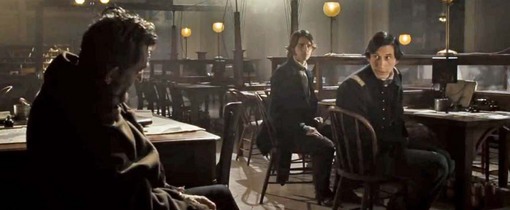
At the heart of Steven Spielberg’s “Lincoln” is a quiet scene between President Abraham Lincoln (Daniel Day-Lewis) and two young men, Samuel Beckwith (Adam Driver) and David Homer Bates (Drew Sease), in an otherwise empty telegraph cipher office. Lincoln has to make a crucial decision: Does he consider a peace proposal from a Confederate delegation on its way to Washington, and thus perhaps immediately end the bloody Civil War that has claimed the lives of more than half a million Americans, knowing that it would doom his attempt to pass the Thirteenth Amendment to the Constitution, officially banning slavery in the United States? Or does he try to legally solidify and extend his Emancipation Proclamation by getting the Thirteenth Amendment passed during a narrow window of opportunity (during the lame duck session of Congress between his re-election and second inauguration) at the cost of extending the war?
The private lives of Jodie Foster
(AP photo)
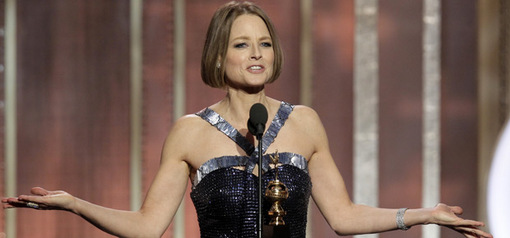
Near the end of her remarkable Golden Globes speech, a monologue overflowing with teasing language and sly pop-culture references, actor-director Jodie Foster mentioned a dog whistle. Although she sometimes seemed to be speaking extemporaneously, while also incorporating pre-crafted phrases designed to say exactly what she intended to say (and, equally important, what she had no intention of saying), I thought the message, addressed primarily to those who have pressured her to publicly acknowledge her lesbianism for so many years, was clear and unambiguous — except for the parts she deliberately wanted to leave ambiguous. And it’s pretty much the same message she’s been repeating since she was in college:
I value my privacy. Everything about being a performer makes it difficult to protect and maintain that privacy. I’ve been pressured to talk about my private life as a woman, formerly in a same-sex relationship with Cydney Bernard, who is raising two sons. And this is as much of a public “coming out” statement as you’re going to get from me.
Django Unchain my heart (and set me free)
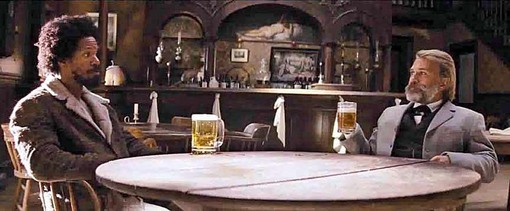
Quentin Tarantino has found his actor in Christoph Waltz — someone who can speak Tarantinian fluently and still make it his own. When Waltz uses a self-consciously ostentatious word like “ascertain” (as in, “I was simply trying to ascertain…” — the kind of verbiage QT is as likely to put in the mouth of a lowlife crook as a German dentist, or a Francophile plantation slavemaster, for that matter), it sounds right. As someone to whom Tarantino’s dialog often sounds cliche-ridden and cutesy, it’s a pleasure to hear Waltz saying the words in character rather than simply as a mouthpiece for the writer-director.
Oh, stop. This isn’t sounding the way I want it to.
The Kill Hole: An adventure about remorse

I had the privilege of watching Mischa Webley’s curiously entertaining first film, “The Kill Hole” (2012), at the Black Harvest Film Festival in Chicago. This carefully crafted movie has begun winning awards at festivals across the country, and rightly so. Its director and producer Zach Hagen is congenial and it is a very good movie. It keeps leading you in one direction, in order to sneak up on you in the other.
Rise of the Planet of the Apes
After watching Tim Burton’s remake of “Planet of the Apes” (2001), I concluded there was no need for another “Ape” movie to ever be made. Thirty-three years of progress in makeup technology didn’t help the latter version become any better than the one that inspired it. That’s why, hearing there would be a “Rise of the Planet of the Apes” a decade later, I had no expectations and feared the worst, but the results were pleasantly surprising. We often associate the word “remake” with a lack of creativity so when an exception turns out, it’s important to look back and try to understand the reasons behind this.
A portside gallery of thwarted Destiny

“Port of Shadows” begins a revival run at the Music Box on 1/25, and is in the Criterion Collection.
Noir revolves on a shorthand of recognition; a cruel fact expertly utilized by Marcel Carné, when he cast two of the most identifiable of French film stars in his 1938 classic, “Port of Shadows” (Le Quai des Brumes). A pressing fog floods Le Havre in the director’s pre-WWII drama, but even in the thickest mists, Jean Gabin and Michel Simon, then catapulted to fame recently in “Pépé le Moko” and “Boudu Saved from Drowning” could never find secrecy from their characters’ shame-ridden pasts.
Peering into the Darkness of the Labyrinth
The star of Kathryn Bigelow’s “Zero Dark Thirty” (2012) is Kathryn Bigelow. This film is intensely suspenseful, even though we already know the narrative and its ending, or perhaps because we already know. Its drama is all the more compelling because, when listing out all the plot points, this is actually a very straightforward, almost dull story about a chase that, when it completed, was mostly irrelevant. Even the raid on Usama bin Laden’s compound was more of a careful trek through a labyrinth than a shootout. Moreover, we know what happens; we are now watching how.
Insanity Set to Pop Culture Deconstruction
* “Detention” is available on Blu-ray and Amazon Instant, and “Girl Walk//All Day” is available for free on Vimeo.
In its drift from one receptive viewer to the next, a cinematic motif or choice soundtrack selection bristles at the prospect of first exposure. Luis Bacalov’s titular, Elvis-aping ballad for “Django Unchained” washed recently for the first time over many filmgoers’ ears, and thus became their primary recollection. The same can and should not be said, however, about the western’s mid-climax “duet” from 2Pac and James Brown later on, which aimed for adrenaline but landed on awkward bafflement instead. Call that disappointing instance decoupage or mash-up, but a post-modern cut-and-paste can also work wonders under the right framework: Two remarkable films from 2012 – Joseph Kahn’s madcap teen genre “Detention” and Jacob Krupnick’s feature-length music video “Girl Walk//All Day” – operate on the opposite assumption; that their usage of pop culture sources finds audiences second-hand, and in doing so ensure their unique re-appropriation attains an euphoric fusion overall.
