There’s something sexy about nonviolent crime and those willing to commit it. Whether it’s the “Ocean’s” franchise or a movie with more to say, like “How to Blow Up a Pipeline,” the intrigue and acceptance of the main characters’ wrongdoings hinge on their commitment to sticking it to the man. Little fish attacks big fish; it’s the bully’s turn to get shoved in a locker.
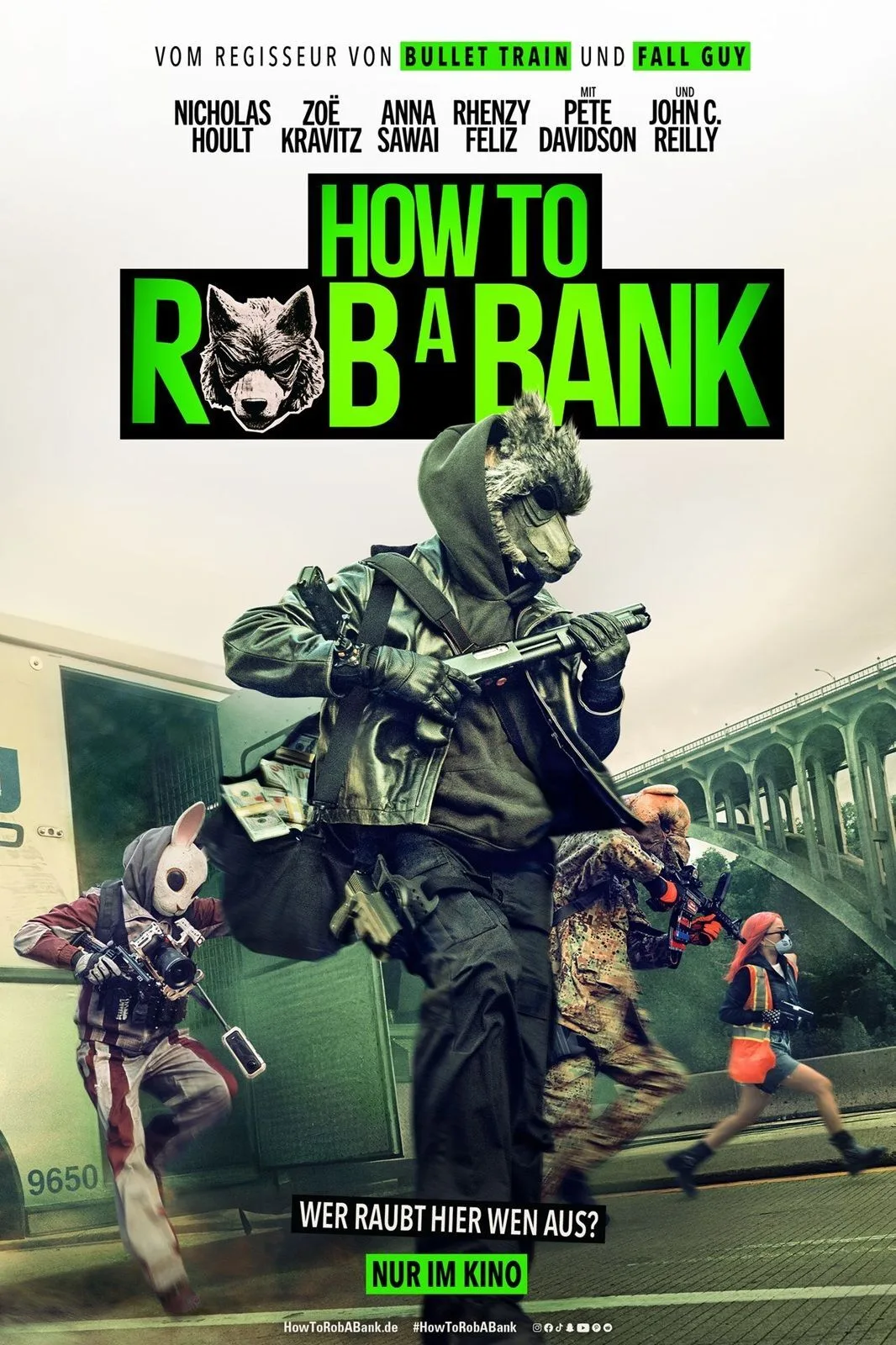
Exactly as it says on the tin, “How to Rob a Bank” is about snatching money from institutions, but it also swings softly at bigger societal commentary on corporate greed and inequitable, unaffordable healthcare. Its present-day setting in Pittsburgh, the true American city of steel, gives it an overt pro-union, pro-worker lens. Yet it wields none of its place’s history. “How to Rob a Bank” ambitiously sets its lens on disrupting the future.
The film introduces us to the Who’s Hungry gang as they orchestrate a heist. At the same time, they’re setting up several GoPros to capture their crime and make content. As the guerrilla group goes about their shenanigans, disguised in thrift-store ensembles and masks from Etsy, local and federal law enforcement remain dumbfounded by their antics.
This Tom and Jerry game pokes fun at the lead investigator, Detective West (John C. Reilly), for his lack of understanding of the online landscape. He taps a former hacker-slash-professor, Raegan Gardner (Zoë Kravitz), who’s serving a house-arrest sentence for creating a dangerous surveillance algorithm, for help in return for wiping her record. The old-school and quasi-cop duo work together to uncover the identities behind Who’s Hungry. Reilly and Kravitz’s chemistry is comedic and caring. The two are perfectly cast, and Kravitz in particular brings the energy of her previous work in Hulu’s “High Fidelity” remake and Steven Soderbergh’s “Kimi.” Raegan’s stoner chick persona leads one to think she’d be secretly supporting the punk agenda, but ultimately both she and Detective West remain underwhelmingly neutral about their role and power in the overall case.
Breaking the silver-screen barrier, the ringleader, Ryan (Nicholas Hoult), addresses his audience by stating how important they are; almost like a double entendre, the movie speaks to both its fictional audience and those in the theater. This focus on the audience is intriguing, adding depth to an otherwise standard money-heist flick. Pandering to a younger generation by contentifying the plot makes it easy for “How to Rob a Bank” to one day be screened as a 212-part TikTok series. The camera is constantly on the move and is only stationary during the Who’s Hungry video shoots for their webpage. While this is visually jarring, it’s distinct. The chopped editing and decorative animations amplify the need for a bit of brainrot to enjoy the movie.
Director David Leitch strategically brings his action-flick experience to realize the content’s cinematic possibilities. His choices build tension and pick up the pace, but they conflict with the film’s dialogue-heavy writing. Leitch knows how to show the story, while writer Mark Bianculli’s script is focused on spelling out every detail, leaving no trust in the audience they apparently wish to influence.
“How to Rob a Bank” balances how reference-heavy it wants to be. It explicitly cites films like “Point Break” and weaves in imagery from artists like Banksy to create a semblance of cultural competency. It even has a Bonnie-and-Clyde-like couple at the heart of the story: Ryan and his college sweetheart, Emi (Anna Sawai), are also the heart of Who’s Hungry. Their colleagues in crime, played by Pete Davidson and Rhenzy Feliz, band together around their mutual need to support their families and frustration with late-stage capitalism. Mary Vernieu and Lindsay Graham Ahanonu’s impeccable casting is most evident in the film’s antagonist, Mr. Walton (Christian Slater), the douchebag banker who drove Emi and Ryan into unpayable debt.
Slater’s smarmy persona serves well in any perpetrator context. He is perhaps best known for his bad-boy roles, so it’s both comical and symbolic that he has aged into more buttoned-up roles, playing the mature characters he once gave trouble to. In the end, the audience only ever knows a curated portion of each character’s life, which is mostly revealed during an interrogation scene. A decision that reinforces that “How to Rob a Bank” is truly about the power of perception and knowledge, particularly in the age of the Internet.
The movie shuffles through many mini cameras, showing us every angle. Each cut is washed in a hyper-realistic, super-saturated filter, but it’s revealed that this pop-comic-like style is solely for the Who’s Hungry YouTube channel. The reality of the story remains intentionally flatter, leaning on the power of its sound design. Like the sudden volume spikes in television commercials, every YouTube segment in the film was exponentially louder.
The soundtrack—which makes good use of its licensing fee by using songs from Billie Eilish and Skepta/Fred Again… at least twice—also overpowers much of the dialogue, overwhelming our ears while forcing our eyes to feast on the hyperdigital design of Who’s Hungry visuals. The cyberpunky animated play nods to video game graphics, and this futuristic-surrealist style makes the mess more fun. Celluloid burnouts serve as out-of-place transitions, but this added visual complexity complements the genre-spanning mixtape.
It’s hard to take “How to Rob a Bank” too seriously, yet it still has the potential to spark conversation. Its watered-down radical ideology matches its love for everyday Internet vernacular. Where it’s strongest is in its focus on Gen Z trends and interests, packaging its empty calories in a way that is most digestible to the new wave of moviegoers: snippets and soundbites and sex appeal, oh my!