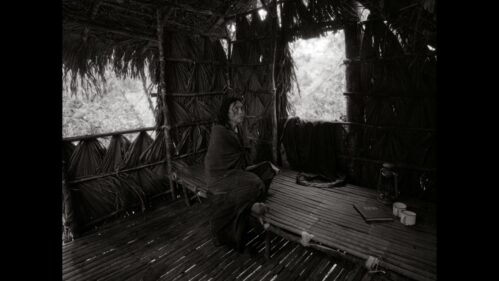


Depicting otherness is instrumental in crafting horror. There must be an us and them, an in-group and out-group. Monster movies used to be the genre’s bread and butter, making it easy to pick sides. From Universal’s depictions of Dracula and Frankenstein’s Creation to non-humanoid terrors like King Kong and Godzilla, the zombie may seem meager in comparison. But something magnetic about it endured, appearing far more regularly than its counterparts across the decades and tapping into something latent in our fears and cultural sensibilities. Maya Annik Bedward, in her newest documentary, “Black Zombie,” traces its origins and explores the impact of Haitian spirituality on Hollywood’s primarily white fear.
Bedward’s documentary is more of an anthropological study than a highlight reel, focusing less on examples of portrayal and more on the monster’s origin. On the surface, zombification is about the loss of humanity: a body without a soul. Reduced to violent gluttony, it is the embodiment of hacking death to the very worst end. But underneath the sinew, it is rooted in the culture of Haitian vodou and the history of enslavement. Zombies are victims. To become one is to be put back into slavery for eternity, depersonalized and unable to cross over to the afterlife.
Saint-Domingue was a French colony (now modern-day Haiti), often called “the pearl of the Caribbean” because of the wealth it generated through sugar production. However, it was also called a “powder keg.” From 1659 to 1801, enslaved Africans outnumbered white colonists about 17:1, and the fear of their power in numbers resulted in extreme measures of brutality to keep them repressed. From this cruelty and overwork, the zombie was born: a person robbed of spirit and will, toiling away with unfocused, soulless eyes, living in a shell of humanity. Both a physical and spiritual imprisonment, the mythical zombie is synonymous with the robbery of autonomy.
Ironically and yet unsurprisingly, this Haitian spiritual belief was itself colonized, both proving the principle of the zombie whilst villainizing the figure and overall culture behind it. The first use of the word “zombie” in the English language was by author and occultist William Seabrook, who introduced the concept to the Western world. Yet he viewed their existence not as tragedy, but as monstrousness, and wrote a novel, White Zombie, that posited the fear of its contagion onto innocent whites. The film adaptation of the novel marked the birth of the spiral, where zombies and vodou become synonymous (though a vodou priest himself tells us the opposite: they are, in fact, the difference between possession and dispossession) and are equated with villainy.
“Black Zombie” does stop short of the zombie canon, mostly concluding with 1968’s “Night of the Living Dead.” This feels like a supreme omission of other notable areas of opportunity, like Nia DaCosta’s claim on the “28 Days Later” franchise, or even Michonne in “The Walking Dead,” who, in addition to being a Black female protagonist, is first introduced walking in the woods with literal Black zombies trailing behind her by chained collars. Concluding the film at popular culture’s most familiar starting point, rather than using extra run time (at only 90 minutes, they could afford it) to contextualize modern depictions, is simply disappointing.
The wealth of interviews ranges from researched to random, featuring figures in Haitian vodou practice and Slash (who, despite having a pretty basic zombie fandom growing up, doesn’t contribute much). The spiritual leaders are far more interesting and involved, describing their relationship with the faith, culture, and its sensationalized dissemination (not only through media, but tourism to cities like New Orleans). In one clip with priest Erol Josue, he tells the filmmakers, “I want to trust you.” This active apprehension about whether his testimony will be given credence or blanket voyeurism is an integral moment to the ethos of the film—will “Black Zombie” be a good faith dossier on the co-opted and colonized Haitian history, or another exploitative, bloodthirsty side show?
Bedward’s film is thankfully the former, weaving together a thoughtfully constructed anthropological history. While modern-day blind spots burden the film, “Black Zombie” stays true to its motivation: lifting the cloche on the erasure and exploitation that founded one of horror’s most iconic figures.