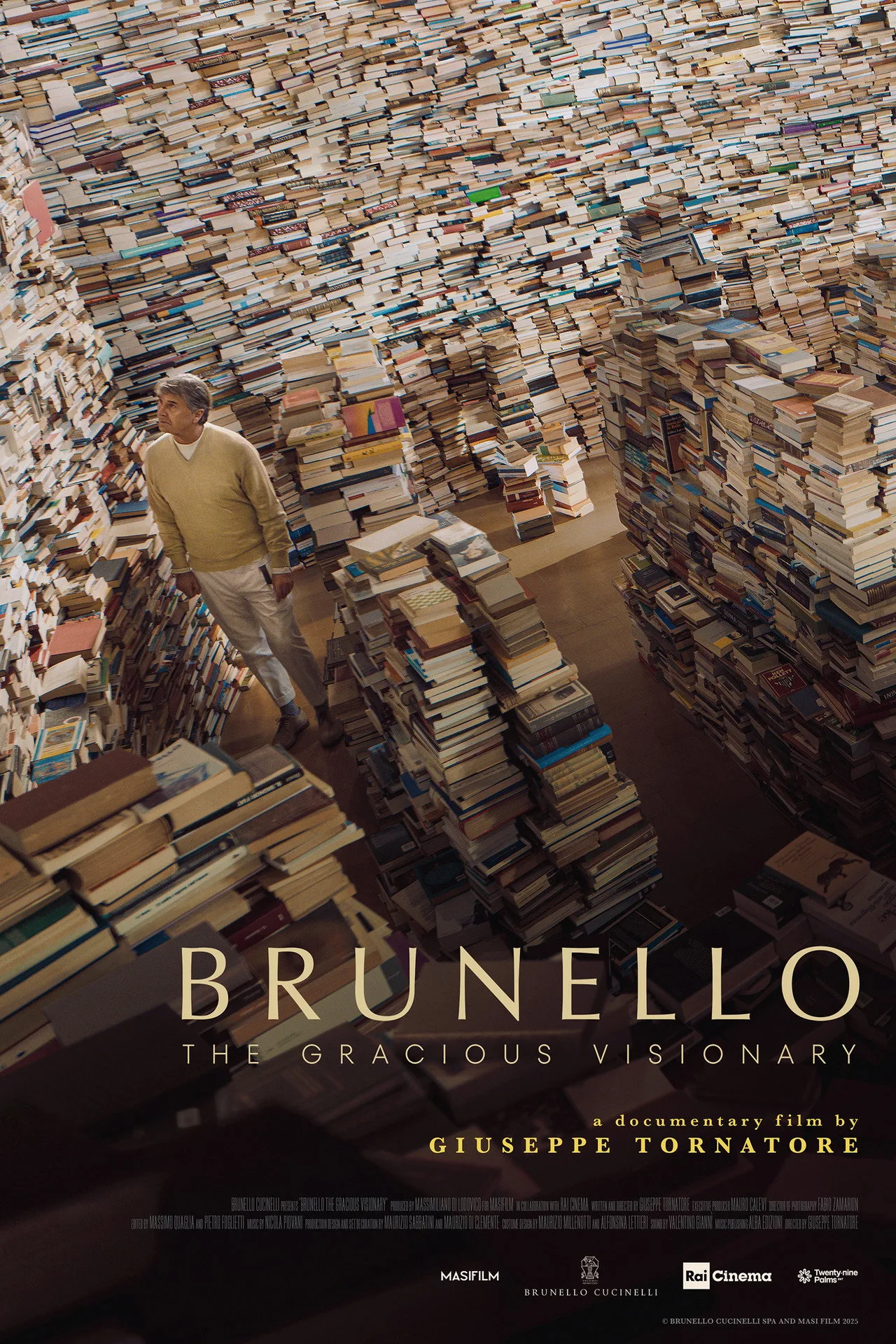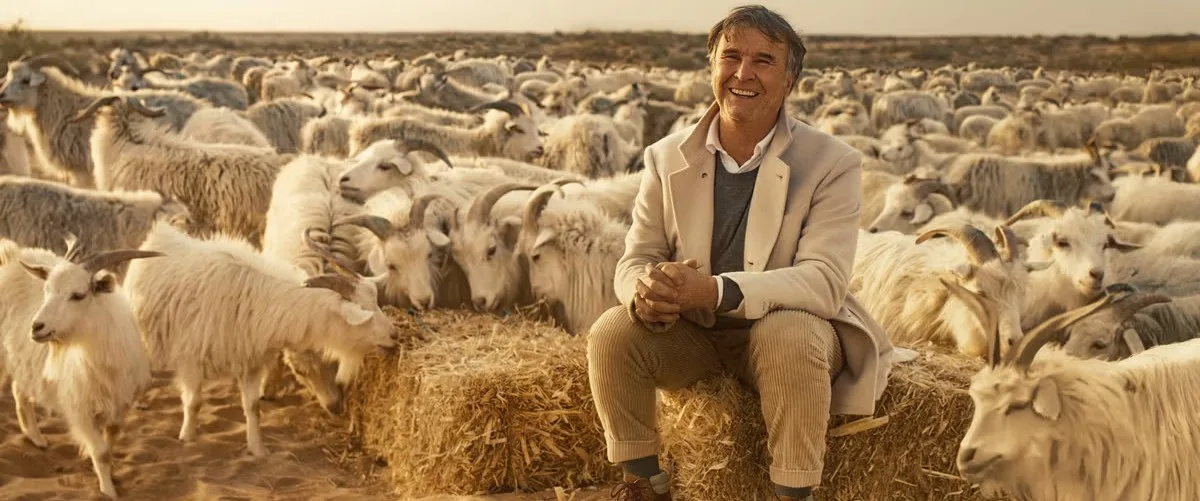
One would hope that even the nicest person alive would be embarrassed by a subtitle like “The Gracious Visionary” if it were attached to a documentary about his life and work and he actively participated in making it and had a piece of the profits. Or even if it weren’t.
But once you’ve begun watching “Brunello Cucinelli: The Gracious Visionary,” about the Italian fashion designer Brunello Cucinelli, it feels correct. Twisted, but correct. Like most movies nowadays, it kicks off with a series of animated logos for various companies that helped finance the picture. Then comes the official logo of Cucinelli’s fashion business. This is followed by “Brunello Cucinelli Presents,” and finally “A Production by Brunello Cucinelli Spa Masi Films.”
The next two hours and seven minutes will be of little use to anyone who doesn’t already know a lot about Brunello Cucinelli. The movie starts with Cucinelli wandering at night through an estate, presumably his, that’s been lit up by torches, free-associating about fire. “Fire is silence. It’s a symbol of creativity. A symbol of profound human civilization. Always romantic.” And so on. Is that the guy whose name is in the title? What does he do? Manufacture waterproof matches? Sell propane and propane accessories? Design flamethrowers?
More than half an hour later, an Esquire editor becomes the first interviewee to state that Cucinelli is an influential fashion designer. Granted, we picked that up earlier by way of subtle context clues, such as nearly every person in the movie wearing Brunello Cucinelli clothing. But this and other failures of basic nonfiction storytelling are as numerous as they are conspicuous.
From its testimonials by Oprah Winfrey, Patrick Dempsey and other celebrities to its lush flashback dramatizations of Cucinelli in younger incarnations, it bears less relation to a proper work of nonfiction cinema, with a point-of-view and some integrity, than an epic-length version of the sort of video that would be shown at a funeral, or a shareholder meeting. The latter seems very likely to happen if it hasn’t already. The Cucinelli company went public on the Milan Stock Exchange in 2012, but the Cucinelli family still owns a controlling interest. One talking head who extravagantly compliments Cucinelli is identified as “Investor and Board Member.”
Cucinelli glides through this advertisement for himself with a wise smile, twinkly eyes, and a trove of aphorisms and anecdotes that he’s obviously told so many times that he could recite them while knocked out by general anesthesia during surgery. One scene intercuts footage of Cucinelli in two different locations, telling the story of his first trip to New York City, where Barney Pressman, founder of Barney’s, decided to stock his pullovers; the story is so rehearsed that the edits between locations are seamless. I bet they could have cut in the middle of a sentence and the scene still would’ve flowed perfectly.
Cucinelli seems likable, polite, pious, ethical, and philanthropic, the best possible version of a billionaire. If so, good for him, and good for us. But the way the movie continuously insists upon both Cucinelli’s greatness and his goodness, his importance and his humility, raises an eyebrow. Who takes part in such a self-administered tongue bath, much less helps pay for it? Was there no one in this man’s circle imbued with sufficient trust and authority to take him aside and warn him that buffing one’s own halo isn’t good PR?
Nonfiction cinema seems to be reaching a critical mass of projects about famous people that are produced and creatively controlled by the subject, and/or corporate entities that are in business with them. Think of such recent music-driven docs as “Paul McCartney: Man on the Run” and “STAX: Soulsville USA,” which are co-productions of the filmmakers and the various entities that distribute the artists’ music, which means that whatever their merits as storytelling or journalism, their primary purpose is advertising. That’s the case here as well. The director of this movie is Giuseppe Tornatore, who made one of the sweetest, most beautiful movies of all time, “Cinema Paradiso.” I hope he was well-paid. Advertising is supposed to be where the money is.
We are told that, like some other culturally significant figures, including Martin Scorsese, Cucinelli wanted to be a priest when he was young. He obviously didn’t go that route. But he said yes when the priest of his hometown church asked, on his deathbed, for Cucinelli to renovate their church, and he not only renovated the church but the whole town. Impressive, yes? Absolutely. But it would have been even more impressive in the context of this film if Cucinelli weren’t the one introducing this piece of information.
Also: a drama about the life and death of Jesus Christ is performed each year on the streets of Cucinelli’s town. He acted in it once. He also funded it. Guess what character he played.
The movie seems to suggest that the church’s loss was the runway’s gain, which is weird in its own way. It also takes pains to pose him like a politician in a campaign ad, put the camera on the ground to make him look seven feet tall, and generally bathe him in a holy aura so insistent that it might make those familiar with the Bible think of the good book’s many stern admonitions against this sort of behavior. For now, let’s go with Mark 7:21-23: “For whoever exalts himself will be humbled, and whoever humbles himself will be exalted.”