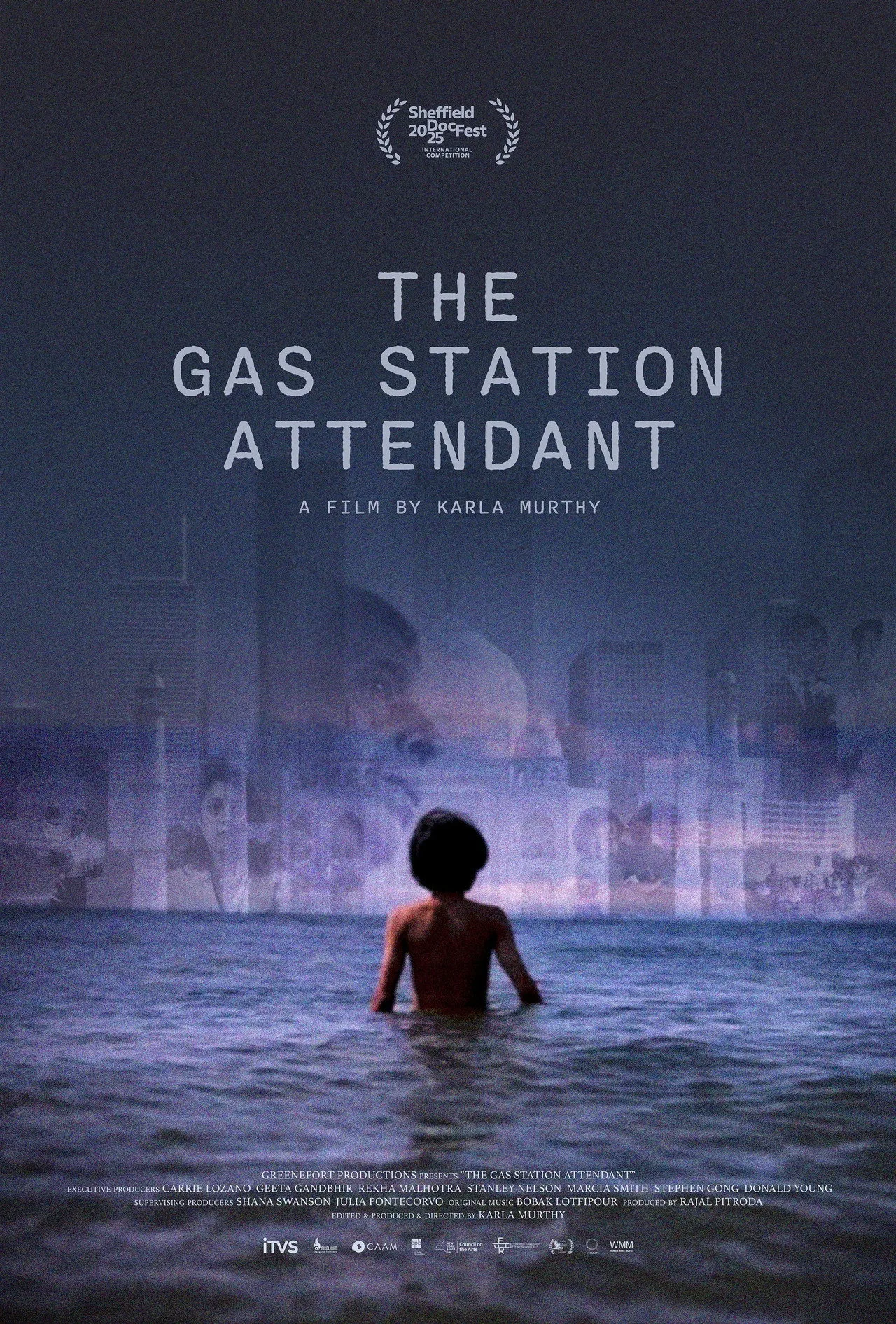


Plenty of movies have told the story of an immigrant who came to the United States with nothing and became rich and famous. Not too many have told a much more commonplace story: the immigrant who spent many years just trying to survive, and finally reached a level where they didn’t constantly have to struggle. That’s the story told in Karla Murthy’s documentary “The Gas Station Attendant.”
The subject is the filmmaker’s father, H.N. Shantha Murthy, who escaped a life of deprivation in Bangalore, India, emigrated to the United States, and settled in Houston, Texas. He goes by Shantha. His story is told, as in so many personal documentaries, through present-tense interviews and iPhone video; photographs both modern and archival, and home movies captured in different formats. The journey begins in the tiny Indian village of Hababe and ends in a suburb of the fourth largest city in the United States. We get glimpses of every phase, including the earliest, thanks to Super 8mm footage from the mid-20th century.
No new cinematic ground is broken here, and sometimes the narration strains to make Shantha’s story illustrate a larger point or articulate a unifying principle. But the sincerity of the exercise wins out. This is a loving portrait of a good man and, from all appearances, a daughter who carried her father’s values forward.
The early phases of his story are filled with the sorts of misfortune that made Charles Dickens’ books so engrossing. He grew up homeless on the streets of Bangalore. His first job was as a child, at a restaurant. He worked seven days a week from 6 a.m. to midnight every day and earned $25 a week. He slept on the street at night and went right back to work the following morning. He tells his daughter that he often considered walking into the sea and drowning himself, “but something kept telling me, ‘Don’t.”
But there were great strokes of luck, too. Shantha came to the U.S. because he was working at a hotel in Mumbai when an American couple from Houston, identified here as Mr. and Mrs. Kern, checked in during the wee hours of the morning, famished. Food service had ended for the day. Shantha leveraged his connections within the hotel and obtained two hot meals for the guests. That’s how he ended up in Houston.
Stories about immigrants often include a scene where an immigration officer fills in their arrival form with a name that’s misspelled, misheard, or assigned. A variant of that happens here: the initials H.N. are on the form because his full name was too long to fit into the little box. Shantha accepts this with good humor, as he does many things that don’t go his way. After being homeless in Bangalore, nearly everything is an upgrade.
He attempted a lot of different professions before settling on running a Houston gas station. The rest didn’t work for one reason or another. He opened and closed multiple restaurants, did a very brief stint as an engineer at Boeing, and tried being a jewelry salesman, which entailed a lot of traveling to jewelry vendor conventions. He didn’t sell much jewelry, but he made a lot of friends by remembering the names of people he met and being extravagantly generous to them. Shantha would talk to another person just once at a convention, then decide on a gift for them and give it the next time their paths crossed. This attitude carried over to the convenience store. As one customer observes, “Nobody who comes to this store is a stranger to him.”
The filmmaker’s own story is intertwined with her father’s, and it has its own tragedies. She’s a mixed-race child of an Indian father and a Filipina mother, and often felt isolated being part of the only foreign-born family in their subdivision. Her mother died when she was very young, under circumstances with a sad connection to the origin story of the Taj Mahal, a building that some wrongly assume to be a palace but is actually a mausoleum. Her mother finally got to see the Taj Mahal on a family trip to India, during which she kept her terminal cancer diagnosis a secret from the children. Their father remarried, again to a Filipina woman, and although the movie doesn’t go into a lot of detail, we intuit that it was a tough adjustment that turned out pretty well, all things considered.
Any adult viewer who has observed their own relationship to a parent evolving over time will relate to this movie. It’s obvious from the warm tone of Karla’s narration and her tendency to give Shantha’s every decision, including disastrous ones, the most flattering spin possible, that she adores him. The feeling is mutual. Karla is now an independent adult living in New York with a spouse and children of her own. They speak to each other as peers.
But it’s notable that, in the home videos where Karla is a girl, a teen, or a twentysomething, Shantha talks to her as if she’s a little bit wiser than she is, always with a baseline of warmth and gentleness that some people never hear from their own parents. Like so many of Shantha’s choices, this one was good for the sake of being good, but also paid dividends further down the road. He was raising the kind of child who would grow up to make a biography like this one.