John Wilson‘s HBO series “How To with John Wilson” was an original and disarming achievement. It drew on old-school, observation-based documentary filmmaking, first-person YouTube and Instagram videos, and the type of humor showcased in the monologues that double as reported editorials on “The Daily Show” and “Last Week Tonight.” The common thread is a willingness, perhaps eagerness, to digress from the main point, usually to get a laugh, but sometimes to follow a stray thought just to see where it leads. Wilson polished that particular approach until it gleamed.
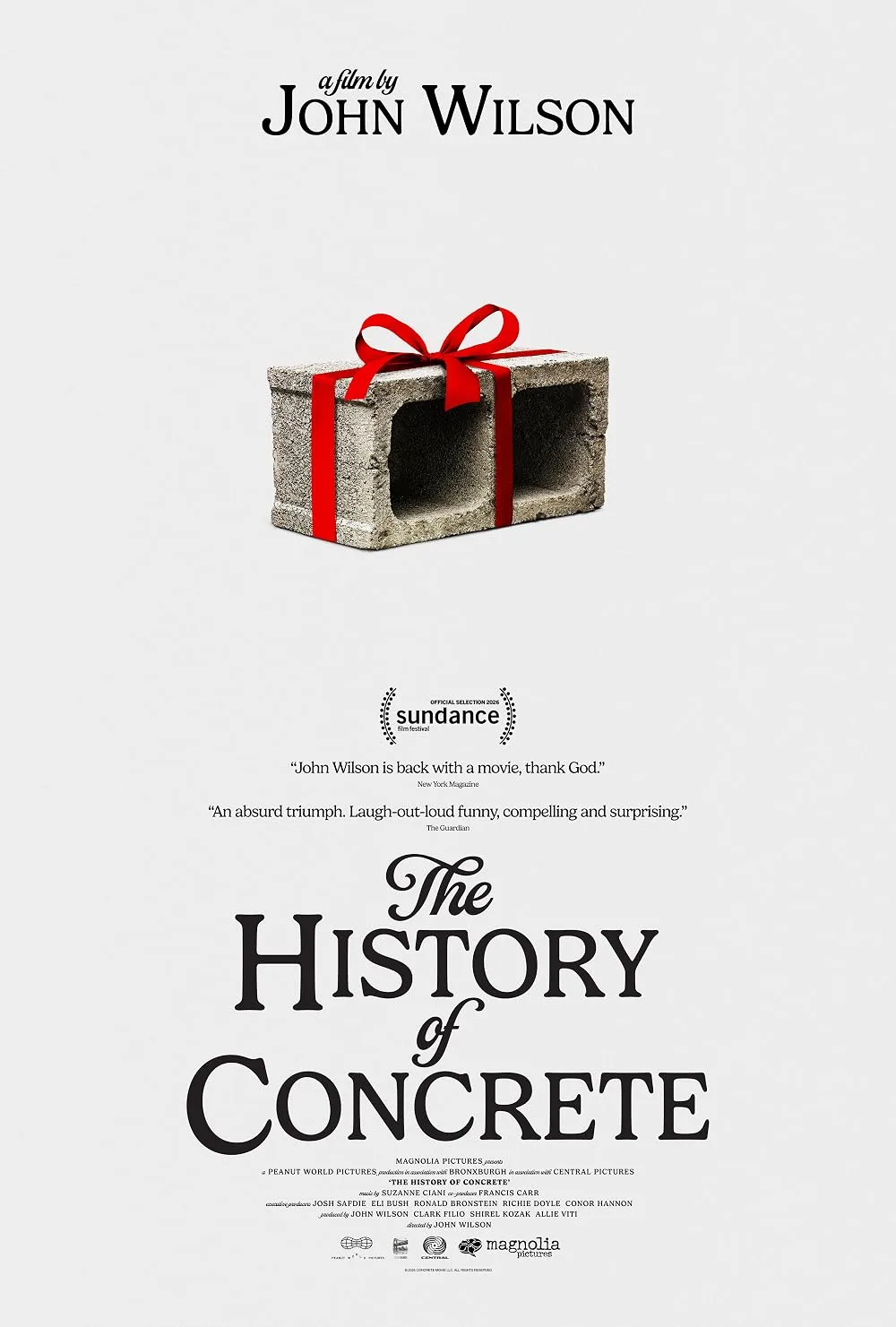
Wilson’s feature film “The History of Concrete” is essentially a long episode of his HBO series, with proportionately more details about his personality and private life. Does it ramble and sidetrack itself more often than episodes of the series did? Or is this feeling merely the byproduct of watching Wilson’s filmmaking for slightly less than two hours instead of HBO’s 30 minutes? It’s hard to say. Either way, watching it produces a feeling akin to the one experienced when visiting Wikipedia to learn about a specific subject, clicking the hypertext link on a descriptive term or proper name contained within it and being taken to another page, and repeating the ritual until you don’t remember why you went there in the first place, and have to backtrack to figure it out.
The main topic, as stated in the title, is the history of concrete, but that ends up taking up only a small portion of the movie. Another third, probably, follows Wilson as he struggles to get a film about the history of concrete financed after the end of the show that briefly made him semi-famous, a condition he details with self-deprecating humor. He shows us royalty checks for less than a dollar, a clip from Jeopardy! in which the contestants have no idea who he is, and snippets of Zoom calls with potential investors that go nowhere because they expect a, well, concrete plan, but Wilson’s aesthetic is organic, seemingly rooted in settling on a topic and winging it from there.
Wilson does the Wikipedia rabbit-hole thing again here, but he also leaps from his personal life to those of his interview subjects, friends, and acquaintances. It’s hard to draw the line between ‘digressive’ and ‘scattered,’ but the movie crosses it more often than not.
The first twelve minutes recap the director’s life after his show ended. There’s a segment on awful celebrity AI voice impersonators, an account of him buying the house he once rented and turning it into below-market apartments for artists, and lots of characteristically Wilsonian “grabbed” shots of mundane images and moments that go for a cheap but satisfying laugh (like the closeups of street signs for “Buttzville” and “Titman,” and a shot of a rooster crossing the concrete floor in the fire station’s garage. This material will interest Wilson fans but will likely bewilder anyone who sees the movie’s thumbnail on a streaming platform and clicks it hoping to learn all about concrete.
For the record, concrete has only been around for about 130 years. People first used it for streets in a small Ohio town. There is a difference between cement and concrete. Cement is the most important ingredient in concrete, a grey powder produced in a kiln, while concrete itself is a blend of cement, water, sand, and stone. Not all concrete is the same color or strength. This explains what Wilson calls “rogue mounds” of dissimilar concrete slathered over cracks in smooth, flat concrete poured by professionals.
You know those dark spots on sidewalks and streets in every city? That’s dried chewing gum that was spit out by humans. Wilson gets some fun details out of these spots. At a drive-in fast-food place, we learn that, based on the placement of gum clusters, drivers spit theirs out before ordering their food (to be understood while speaking), but passengers spit it out at the pickup window (because gum plus fast food is gross). There’s a Gum Busters guy in New York who pressure-cleans gum spots off sidewalks. Wilson interviews him. He has a private-label Gum Busters wine that he stores in his garage. Sommeliers will not approve.
In some sections, Wilson seems to circle closer and closer to a dazzling revelation or connection, such as when he uses the idea of concrete to talk about the fantasy of permanence and the reality of decay. When concrete is used as an adjective, it signifies solidity, density, and heft: something you can see, measure, and depend on. This clashes with the reality of concrete, which, as the many closeups of cracks, rubble, and rogue mounds indicate, is as impermanent as any other substance, though harder to destroy than most.
And so there’s irony in the tradition of celebrities adding their handprints, footprints, and signatures to the front walk of the Chinese Theater in Hollywood, as well as the difficulty of protecting not-yet-dry sidewalk squares from people who are determined to write curse words, their initials, or their sweetheart’s name. “One can understand the temptation to defile something so flat, so level,” Wilson says, over closeups of just-opened jars of peanut butter that haven’t met a knife yet. Bits like these are special. The observations about the cultural differences between New York and Los Angeles, or the difficulty of getting funding for any feature-length documentary unless it’s about a music star? Not so much.
But this is to be expected. Wilson practices a kind of art that is inherently hit-and-miss. The opposite of concrete, at least in descriptive language, is abstract. This word better suits Wilson’s nonfiction, which careens from point to point and thought to thought, rarely settling in one place for long.