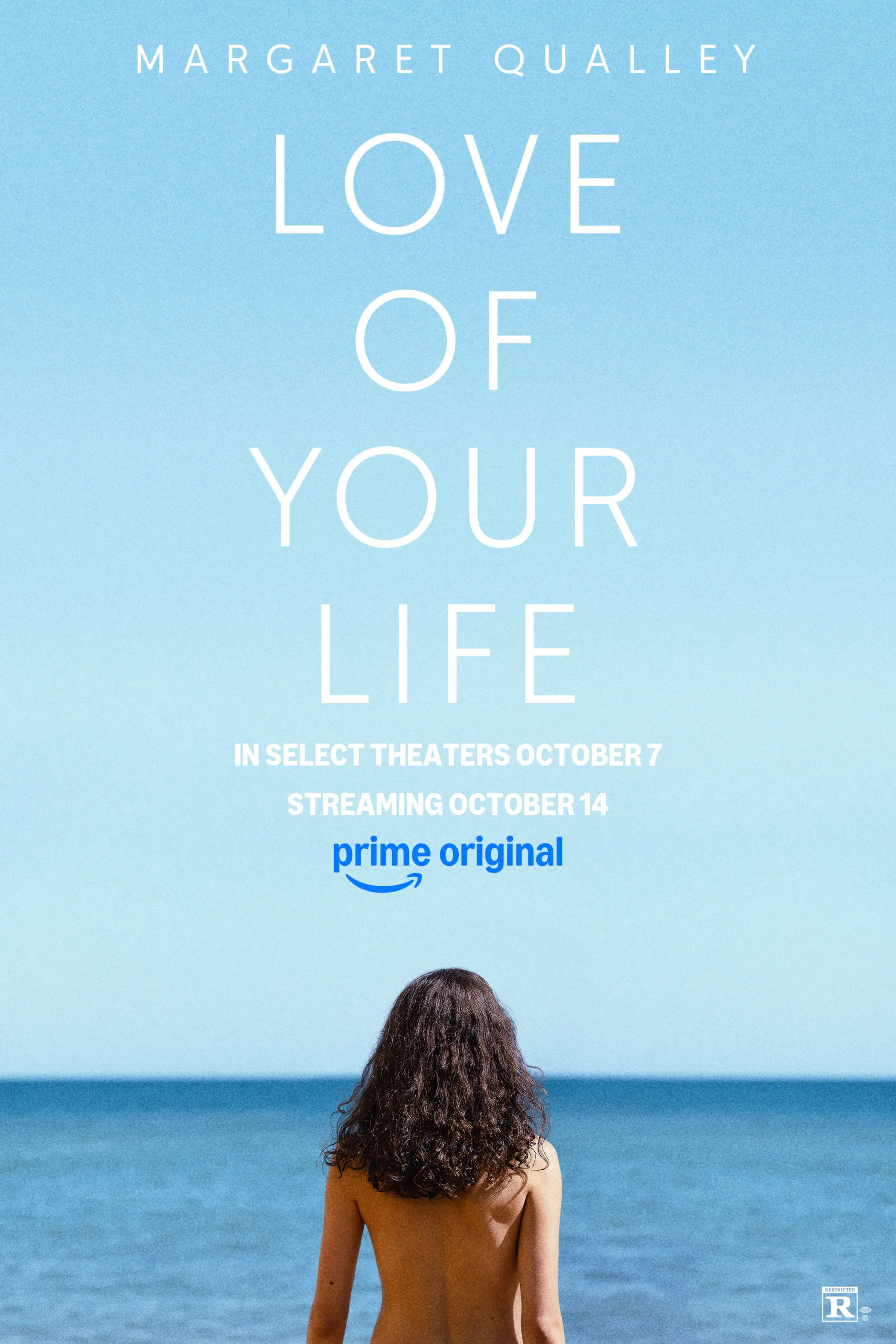


Oscar-nominated cinematographer-turned director Rachel Morrison‘s sophomore feature “Love of Your Life,” is a romantic drama for our end of the world times. Set just before and after the COVID-19 pandemic, it traces the romantic and emotional journey of a young woman who was on the frontlines of the pandemic and suffered an unimaginable tragedy over the course of a decade. For a film with such a weighty and timely premise, it’s a shame that it’s just not very good.
Using chapter headlines to delineate the year, the film follows Maya (Margaret Qualley) from age 26 until her mid-thirties. We first meet her during a long shift at the Boston ER where she works. Although she’s dead tired, she’s not headed home. She’s got to meet-cute first. Cue Charlie (Gabriel Basso), from whom she buys a side table. He’s immediately overly friendly, saying she’s familiar in a special way. She rebuffs his advances at first, but after finding an old cassette recording that he made, she’s smitten.
Maya is an ER nurse who we learn in an exposition dump date montage (set to one of the many great songs on the film’s soundtrack, which is probably the best thing about the film) was the product of a one-night stand during her estranged mother’s youth; she’s never really known parental love, so she doesn’t believe in romantic love and thinks it’s irresponsible to have children when the world is in such a bad state. Charlie is a MENSA smart PhD student whose thesis would take too long to explain so the film conveniently never does, and who was adopted into a close-knit Boston family as a baby. He seems to make friends with everyone he’s ever met.
After meeting his generic close-knit family, the only one of whom we spend any amount of time with being his mother Ruth (Catherine Keener), Maya says she never knew this kind of family could exist but she “gets it now.” Like most of the film’s scenes, it uses short-hand dialogue and broad emotional beats to hit its marks rather than find anything kind of specificity to either Maya or Charlie’s worlds. “You were my dream come true, the dream I never knew I had,” she says as they exchange vows at their surprise wedding during Charlie’s thirtieth birthday. The scene is handsomely shot in candlelight as their charming apartment is filled with Charlie’s millions of friends. Maya’s best friend Jason (Patrick Schwarzenegger), largely added to the story so Maya has someone to abandon later on, tells us what we’re supposed to know about Charlie’s gregarious nature. But, again, we’re not really shown it through anything specific.
The one specific thing we do learn about Charlie–that he has asthma–is of course a plot device. When the pandemic hits, Maya is on the frontlines. We see her ER become swarmed with beds. We watch as she treats patients with so much empathy and kindness, only to have them code out during the same shift. This sequence is the most dynamic in the film, with its urgent tension in the ER and then the comedown as Maya goes through the decontamination routine back at their apartment.
Maya tells Charlie he should go to his mom’s house, to be safe, but he loves her so much he wants to stay with her. Soon, he wakes up sick and resists going to the ER as long as possible. Things escalate quickly and Maya has to say her goodbyes to Charlie over FaceTime, as she’s not allowed into the hospital. Again, this sequence is brutal and an important reminder of just how bad it was in the hospitals, while at the same time people refused to wear their masks or truly quarantine, probably leading to the deaths of a lot more people than should have died. After his violent death, Maya blames herself, but it’s made worse when Ruth shows up at her doorstep and literally blames her for her son’s death.
The second half of the film takes Maya to Portugal, a place she intended to visit with Charlie, where we know she’s depressed because she wears black eyeliner, drinks too much, and goes to bed with random men every night. Once again, broad strokes paint a pretty generic picture. That is, until she meets cute again when a man named Felix (the impossibly charming Aaron Pierre) accidentally burns his hand at a friend’s birthday party in the bar where she’s eating alone. The two trauma-dump–Felix lost his brother to suicide; the specifics of this, and even really how close they were, are once again left underdeveloped. But soon they are in a relationship that makes Maya feel like she is “in someone else’s life.” Their whirlwind courtship takes her to London, where she meets his young daughter and ex, getting a glimpse at yet another family that she might have a chance to be a part of should she commit.
That is, until Jason randomly re-appears in her life, causing her to crash out once again, and also exposition dump to Felix the sordid details of what happened after Charlie’s death. Here, at least, we get specifics. But as Maya finally opens up, Qualley’s face is not capable of bringing out enough internal emotions to sell her completely obliterated mental state. There’s nothing in her eyes, just a whole lot of various serious blinks. The casting also doesn’t help, as Basso is not memorable enough to haunt the film as the titular love of her life. Once he’s out of the picture, and especially once Pierre enters it, it’s easy to forget what was supposed to be so alluring about Charlie. Morrison clearly didn’t trust the audience either as she uses flashback to their first date to remind you of their alleged chemistry.
Once Maya goes through therapy and makes the journey back to the U.S., we know she’s going to confront Ruth. That’s just how this kind of film plots itself out. The lines that screenwriter Julia Cox strapped Catherine Keener with are some of the most banal platitudes about life and death and love and grief that have perhaps ever been uttered on screen. They are so saccharine that a performer as seasoned as Keener can’t even add a layer of depth to them with her intonation.
During this final sequence, I couldn’t help but think of Dianne Wiest’s Oscar-nominated turn in John Cameron Mitchell’s “Rabbit Hole.” As her sadness threatens to overwhelm Nicole Kidman’s grieving mother character, her own mother (Wiest) talks to her about the weight of grief, the way it always stays with you, and how you grow with it. The speech is so profound and poetic it has stayed with me for the last fifteen years, and honestly has been a scene I have turned to a few times as I moved through my own grief after my father died last year.
I doubt I’ll think about “Love of Your Life” ever again.
This review was filed from the Toronto International Film Festival. It opens on October 9, 2026.