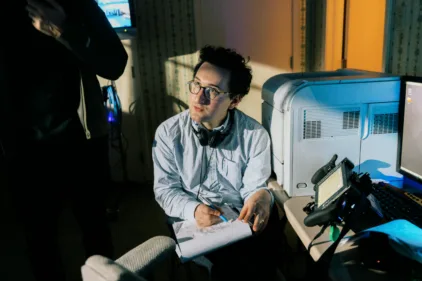
Imagine a heist movie told entirely from the lens of the prototypical “man in the chair”—”Ocean’s 11,” if all eleven guys were Eddie Jemison. If so, you might get the proverbial gist of director Ronan Corrigan’s “LifeHack,” a cyber-heist thriller in the spirit of Iain Softley’s classic ’90s flick “Hackers,” but updated for the more attention-addled, tab-splitting Internet age we actually live in. The screen-life genre is nothing new, and if producer Timur Bekmambatov (“Unfriended,” “Searching“) has his way, he’ll keep shoving new entries down our throats until we begrudgingly accept one. Credit, then, goes to Corrigan and his cast for making “LifeHack” a far cry from the dregs of something like last year’s Ice Cube-led Amazon commercial “War of the Worlds.”
The film opens with a rather confusing spin on the convention of opening text cards that define a term central to the movie’s fabric: Ostensibly, “LifeHack” opens with one—”script kiddie, noun“—but the following text isn’t the actual definition? Instead, it reports that the average age of people accused of cybercrimes is around 15. Minor complaint, though, as we cut to a Zoom hearing for young 19-year-old Kyle (“Wednesday”‘s Georgie Farmer), whose Internet access is being adjudicated for cybercrimes committed two years prior.
We then flash back to those events, as Corrigan sweetly sweeps us through a montage of Kyle’s budding friendship with a foursome of fellow terminally online teens: Sweet Alex (“Doctor Who”‘s Yasmin Finney), whose developing relationship with Kyle forms some of the film’s more patient moments; Roman Hayeck-Green’s comic relief, Sid, and innocent college hopeful Peter (James Scholz). Flitting through “Counterstrike” matches and Discord chats, we experience their friendship the same way a lot of Gen Zers of a certain stripe do: amid absolute information overload while doing two or three other things simultaneously.
But we also see exactly what kind of extracurricular activities Kyle and his gang get up to: pranking Internet scammers by tracking down their real identities through a mix of social engineering (e.g., trawling social media) and good old-fashioned code monkey stuff. But with bills rising and tuition mounting, Kyle proposes pulling off the crime of the century: ripping off Cockney tech douche Don Heard (Charlie Creed-Miles), who boasts of having millions in crypto when he’s not mouthing off on Joe Rogan-like podcasts.
Like any good heist movie, Corrigan practically ushers us through the performance of the scam while the crew is devising it; it’s here that the screen-life conceit works wonders, as Kyle et al. frantically flip through DM convos and bank account homepages as they bluff their way through customer service hotlines to dupe Heard’s phone for access, interacting with Heard’s estranged daughter Lindsey (Jessica Reynolds) to do so. These stretches are fascinating in their inventiveness, with Corrigan playing with the limitations of seeing these kinds of crimes only on screens, yet manifesting them in ways that feel tangible and legible to the viewer. The pace may be a little relentless for those used to more methodical movies in this genre, but it suits the kind of nano-second response times you need to pull off a cybercrime like this.
Of course, the plan goes off without a hitch, and the quartet of Reddit Robin Hoods enjoys their ill-gotten gains in a frenzy of online shopping carts. But they’re soon wrapped back into Heard’s orbit, care of Lindsey, who’s discovered their crime and, rather than turn them in, wants them to go further: daddy’s cut her off, and she wants them to take even more of what he’s got left. Naturally, the risks rise along with the reward, resulting in a larger set piece that expands beyond the screen and plays out in meatspace (albeit still told through security-camera and FaceTime footage).
These moments are thrilling, in no small part because Farmer and his costars manage to build some genuinely respectable chemistry despite never sharing a physical space. Hayeck-Green’s broadness sometimes makes Sid a little grating, but it also tracks for the kind of in-over-their-head tech kids we’re following: It’s more than their finances at stake, it’s their futures. These are small gains, of course, and the film often suffers from the limitations of the screenlife format—the pace can get overwhelming, and the heist’s logistics can be hard to buy, even though its tactics are grounded in many real-life hacking techniques.
It may feel like damning with faint praise, but “LifeHack” is easily one of the more tolerable screenlife thrillers of recent vintage. It could be because Corrigan at least somewhat captures the walled-off loneliness that can befall the generation of kids who’ve been glued to screens their entire lives, or because he’s found ways to glom the suspenseful beats of a heist movie onto the restrictions of a MacBook interface. We may not always be able to escape the technological hell of our modern lives, but at least films like this try to assemble something exciting out of their brain-numbing mundanity.