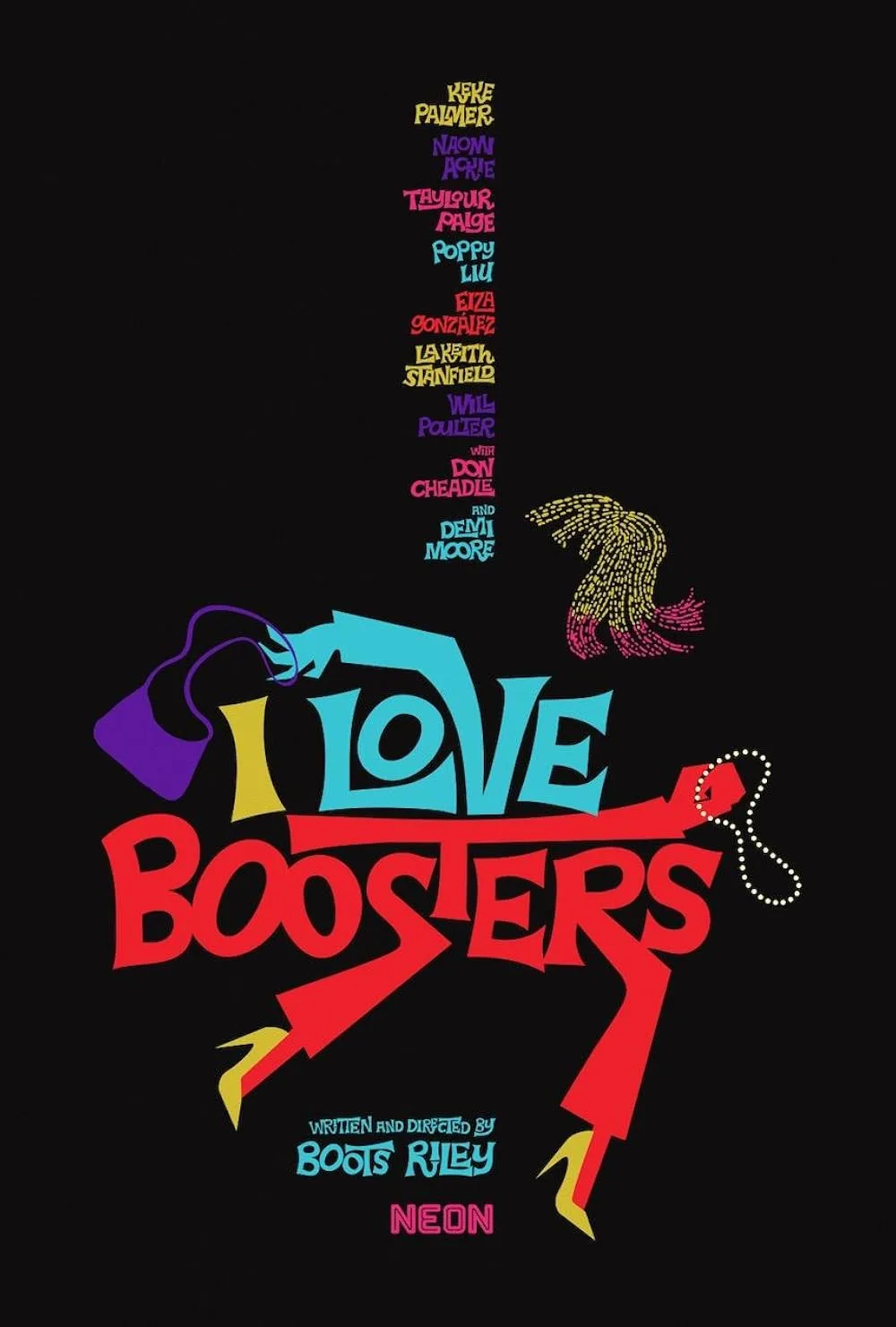

Almost eight years after his incendiary and brilliant “Sorry to Bother You,” Boots Riley is back with another righteous middle finger to capitalism dressed in the fashion of a surreal comedy. It’s a remarkably clichéd critical device, but there truly is no doubt that you won’t see another movie like “I Love Boosters” this year, a film that feels like it sprung fully-formed from Riley’s dreams and past creative visions. A film bursting with ideas, some of them never find a way to fully connect, either to each other or the audience, but that’s where the endlessly charming Keke Palmer comes in to hold Riley’s vision together when it threatens to burst apart. “I Love Boosters” is a wickedly clever skewering of the moral rot at the center of the fashion industry delivered with enough vision to make your eyes hurt.
Inspired by a song of the same name by Riley from his band The Coup’s 2006 album Pick a Bigger Weapon (if you’re unfamiliar with The Coup, allow yourself a few hours to rectify that, especially the excellent Steal This Album and Party Music), “I Love Boosters” stars Palmer as Corvette, a woman trying to make ends meet by squatting in an old chicken restaurant and leading a group of shoplifters who target the popular brand Metro and its eccentric designer Christie Smith (Demi Moore).
They have routines—most involving distracting the underpaid clerks with a white woman faking illness or outrage—that lead to apartments full of stolen clothes that they then resell at a discount. Corvette’s crew includes Sade (Naomi Ackie), a woman who has been entranced by a pyramid scheme called Friends Being Friendly run by a hilarious Don Cheadle, and the supportive Mariah (Taylour Paige). One of the visuals that Riley returns is Corvette seeing a giant ball of bills and other worrisome things rolling down the street like a snowball. There’s always a new bill to pay, and one day they’re going to crush Corvette.
Corvette hopes that she won’t be a booster for long, even sending one of her personal fashion designs to Metro, and getting a job at one of their stores. In one sense, she’s a symbol for how many people out there can be equally enchanted and disgusted by a capitalist operation. Even people who know about the horrible conditions in which their clothes and smartphones are made want the latest products. And yet Riley and Palmer thread a needle with Corvette. She’s no dummy. She’s not suckered in by the bright monochromatic colors of Smith’s designs—she understands the push and pull of wanting to be a part of an industry that’s morally repugnant. And Palmer allows that dichotomy to inform her choices as she tries to dismantle a broken industry from within.
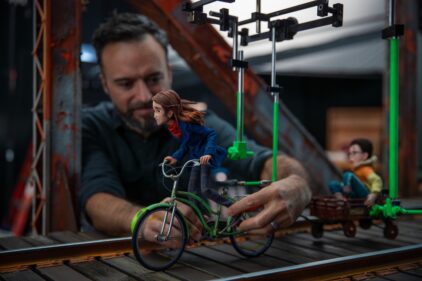
How does she do that? I wouldn’t even know where to start, but I know that it includes stop-motion animation and time travel. As he did with the divisive final act of “Sorry to Bother You,” Riley turns the volume up on the surreal meter way past eleven, once again turning on a sort of hip-hop satirist persona that almost recalls parodists like Jonathan Swift. It’s almost as if he saw some of the pushback to the insanity of the final act of “Sorry” and took it as a challenge.
“I Love Boosters” goes to so many impossible, ridiculous places that Riley sometimes feels like he loses a grip on the messaging just because he’s having so much fun finding new ways for characters to play with his impossible toys in this colorful sandbox. There’s a recurring bit involving an impossibly sexy character played by LaKeith Stanfield that doesn’t fit as snugly with the rest of the flick, and a few of the jokes in the back half don’t land with the same wit as the first. It also becomes clearer that the excellent Ackie and Paige aren’t going to be given quite as much to do as you’d hope. Ackie gets a subplot about her fading friendship with Corvette that has no time to develop, while Paige has even less to play.
Despite those missteps, there’s just something invigorating about seeing an artist like Boots Riley given the freedom to just go for it. It doesn’t need to always make sense to remain consistently entertaining, and, again, it helps to have a ludicrously magnetic cast to hold pieces together that a lesser ensemble would let come apart. It’s important that everyone involved with a film as insane as this one commits to its creator’s vision, and that’s true of every single player here, especially Palmer and Moore at opposite ends of the moral spectrum: Corvette is the true creator, Christie is merely one of those businesspeople with a talent for cultural theft.
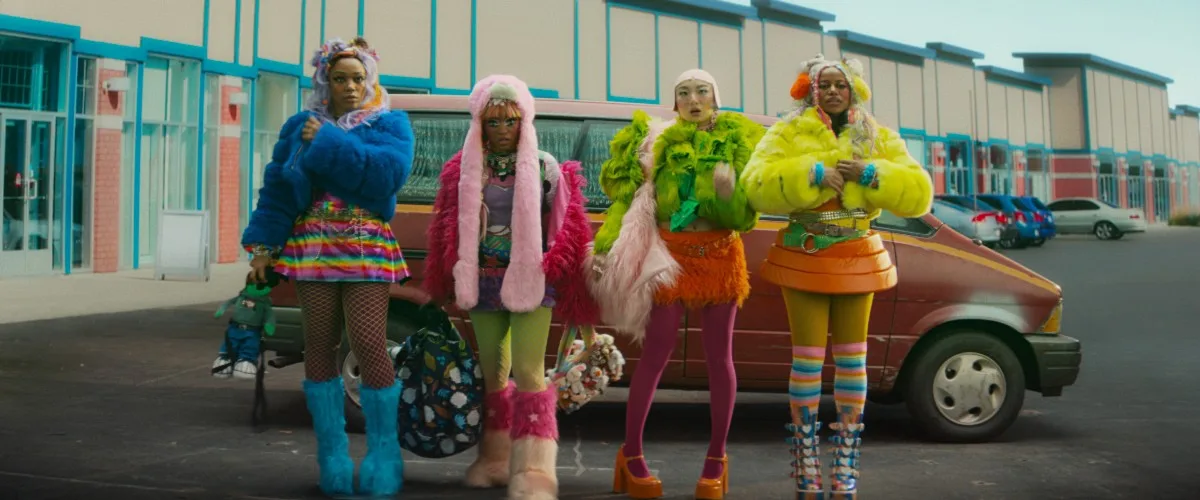
When it comes to the craft of “Boosters,” cinematographer Natasha Breier gives it a vibrant visual language, but the stars of the show are the consistently wild costume design and a truly killer score by Tune-Yards, one that uses recurring themes in such a catchy way that they’ll get stuck in your head. “I Love Boosters” can be so much fun to look at and listen to that those too-often-overlooked elements can pick up the weight when the rest of the film falls apart. It’s eye candy with a sour message, a movie as colorful as the red candies that Corvette pops and leaves at her crime scene, but one that’s equally angry about the broken system that uses Chinese labor to create clothes that normal people couldn’t possibly afford.
As with all great satirists, Riley uses the light of the impossible to illuminate the truth of everyday life. Whether it’s a Bay Area building that tilts at such an angle that people struggle to stay upright in it or a magical device that can do increasingly impossible things out of a sci-fi movie, Riley understands that satire can embed messaging in the whimsy. You’ll walk out of this one feeling boosted.
This review was filed from the world premiere at the SXSW Film Festival. It opens on May 22, 2026.