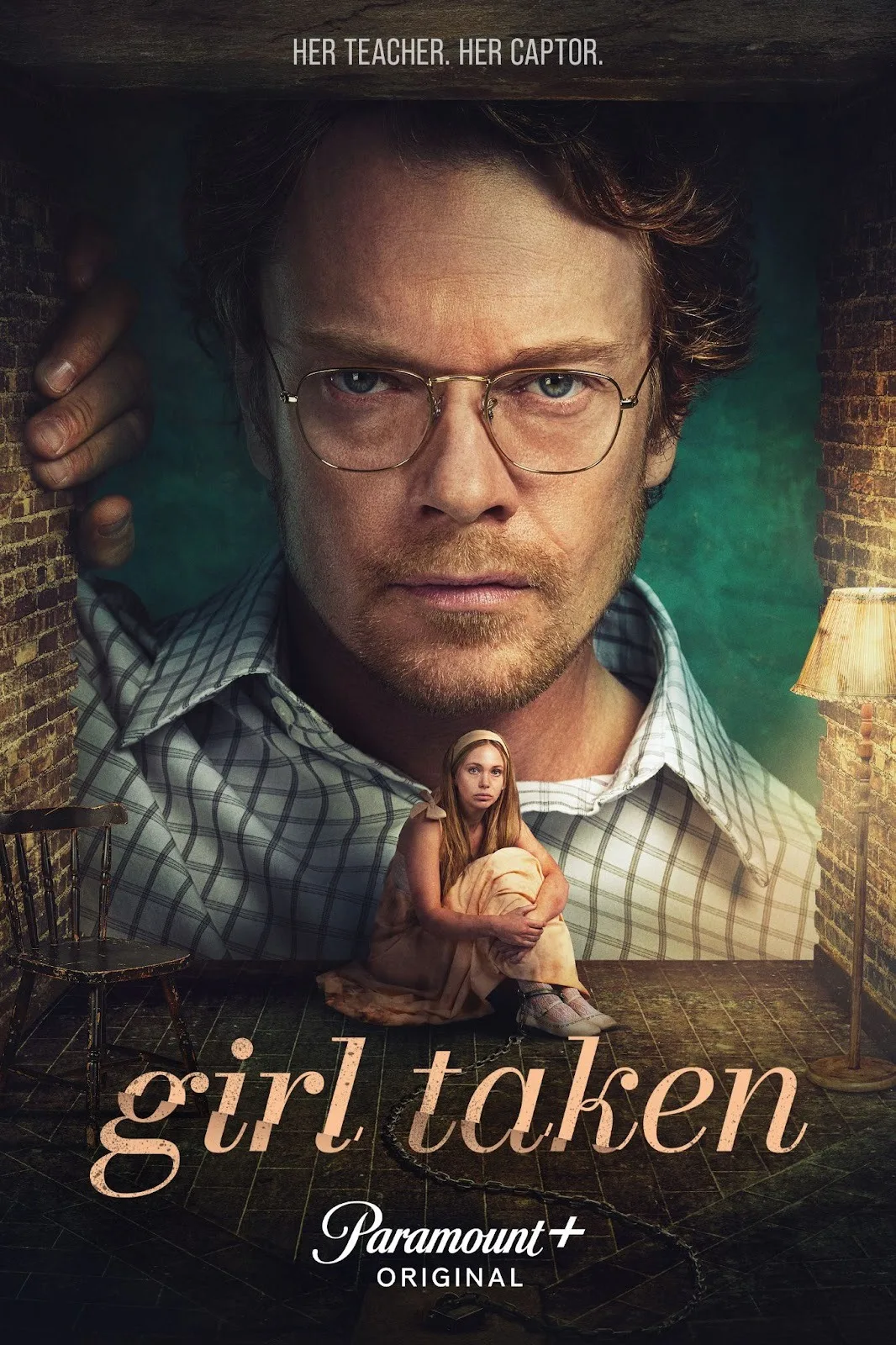

TV crime dramas, in this writer’s humble opinion, tend to fall into three categories: either they’re terrible from the jump and do not improve; they start off decently and mostly stay that way; or, the rarest of them all, they’re brilliant all the way through. “Girl Taken,” a new British Paramount+ series, has the dubious distinction of being in a new fourth category: starting off shockingly well, and then dropping drastically in quality by the third episode, never to recover.
Based on Hollie Overton’s novel Babydoll, the series is not part of TV’s recent spate of whodunits (“Poker Face,” “The Residence,” “Mare of Easttown”), nor an even more recent wave of complex whydunits (“The Beast in Me,” “Task”). We know who the bad guy is from the moment we set eyes on him. Rick Hanson (Alfie Allen, giving it his all) is a trusted teacher in a small town. Like all sociopath predators, he smiles quietly when giggling girls call him “Mr. Handsome,” but privately encourages graduating senior Abby Riser (Delphi Evans) to call him Rick and attend university, earning her trust with flattery, reminding her that her family—twin sister and free spirit Lily (Tallulah Evans, Delphi’s sister in real life) and their single mother Eve (Jill Halfpenny)—has a limited vision for her future, but he really (barf) sees her. It is only by accident that Rick, later the same day, kidnaps Lily, not Abby, and keeps her chained in the basement of a cottage.
The story, at that point, splits into three: Lily, trapped; Eve and Abby’s disintegration as a family unit, waiting for years for Lily to be found as both become addicts, and Rick manipulating his wife Rachel (Niamh Walsh), cop Tommy Shah (Vikash Bhai in a woefully underwritten role), and, it is suggested, the next victim as Lily “ages out” of his interest. The writing for Eve and Abby’s story doesn’t give Halfpenny or Evans much to do except weep or shout, so as much as this series is meant to be about the pain and resilience of a family experiencing a heinous crime, it’s Rick’s story that’s far more interesting, purely because Allen is a better performer.
To make matters worse, neither Tallulah nor Delphi Evans possesses the talent necessary to convey the unimaginable terror experienced by anyone held captive or the agony of their loved ones. Their performances are what I’d expect from teens in an average high school play, not actors on TV. Halfpenny is an experienced actor, but Eve’s characterization is reduced to being an emotionally toxic drunk, regularly bulldozing the hopes of her daughters with pointed barbs. Walsh finds some lovely, heartbreaking beats as Rachel reckons with the realities of her relationship, moments I remembered from my own past with an abusive ex, but this too is truncated in favor of interminable shots of mist-covered forests and long, empty roads.
In some ways, I felt a bit cheated by the narrative structure of “Girl Taken.” Its initial willingness not to shy away from the crime’s brutality, aided by some very nimble editing choices, made me quite hopeful for the show’s overall quality. But as it turned out, the writers did not have many ideas for maintaining that momentum. Yes, the first two episodes really go there, but atrocities committed against a child and the broader community are one thing, and a psychological thriller about trauma and justice is quite another. There are some quiet moments, especially between Abby and Wes (Levi Brown), Lily’s boyfriend at the time of her disappearance, that could have been developed further, but directors Laura Way and Bindu de Stoppani skip the contemplative in favor of the combustive.
Still, despite my own dim view of the series, “Girl Taken” may well invite comparison to “Adolescence,” another story about what happens when a broken social safety net combines with parents who think feeding, housing, and clothing their children count as sufficient supervision. But the analogy is cursory. “Girl Taken” never dwells on how any of this came to pass—Eve’s neglectful parenting and existing reliance on alcohol is barely hinted at before everything falls apart, the school’s culpability in hiring a monster is never spoken of, and there is a single (just one!) mention of mental health treatment in all six hours of “Girl Taken.” Forget Paramount+, this is a series barely fit for the Lifetime Network.
Entire series screened for review.