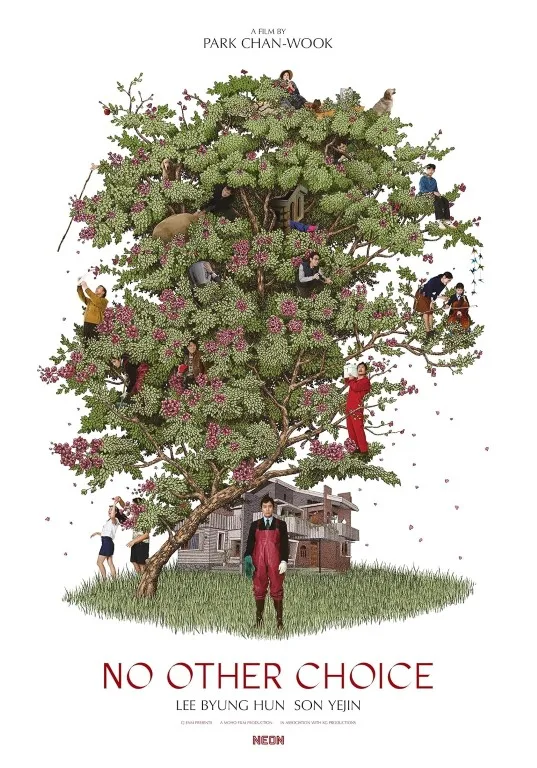

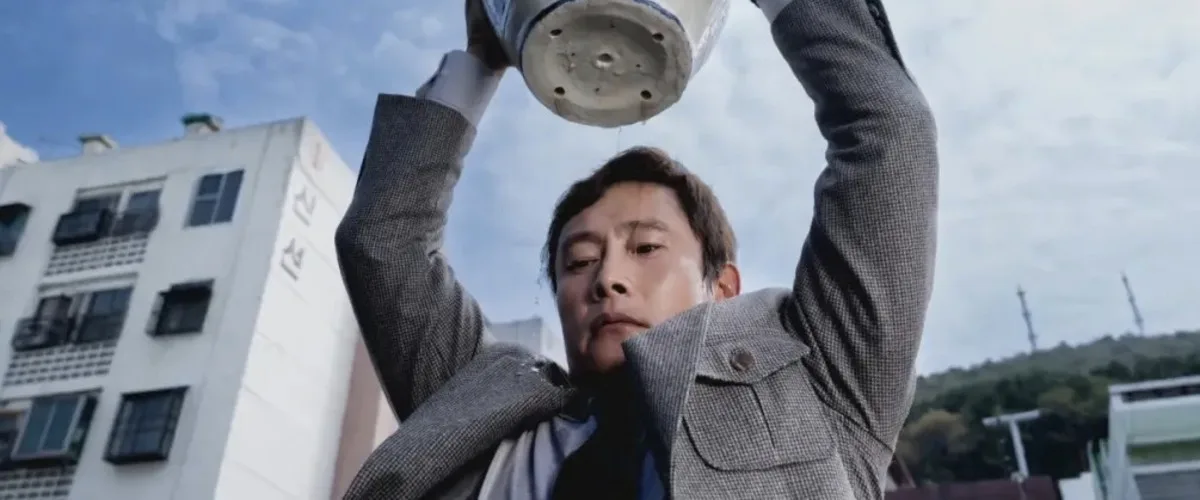
Park Chan-wook knows exactly where to put a camera. There is a scene in the middle of his newest, the hysterical and razor-sharp “No Other Choice,” in which Lee Byung-hun’s anti-hero Yoo Man-su is about to cross a line from which he cannot return. He points a gun wrapped in plastic in a hand covered in oven mitts at a sleeping man. He turns up the music before he shoots to hide the gunfire, but the man wakes up. Barely heard over the music, the two argue over how Man-su’s victim never listens to his wife, and that he’d be happier if he just took her advice. As a catchy tune fills the air and the two men bicker, his wife sneaks up behind Man-su, ready to knock him out before she hears his defenses of her. The sequence, including the slapstick physical altercation that follows, is a standalone work of art, a reminder of Park’s stunning ability with blocking, framing, pacing, and unpredictable plotting. The movie around this scene may be a few minutes too long, but it’s a minor complaint about a wickedly entertaining piece of work.
The director of “Decision to Leave” and “The Handmaiden” retells Donald Westlake’s 1997 thriller The Ax (already made once by Costas-Gavras in 2005) for an era dominated by conversations about workforce shrinkage in the age of A.I. It doesn’t seem coincidental that Park has made a film about a man who attempts to remove all of his competition at a time when stories about the extinction of the human worker in favor of an A.I. one make new headlines every week. It’s a deceptively clever movie, a pitch-black comedy that sometimes plays like a vicious episode of Looney Tunes but also hides commentary on how workers are being forced to go to extremes to stay alive when they’ve been given no other choice.
It opens in happier times for Man-su and his family, including a supportive wife, Lee Mi-ri (a fantastic Son Ye-jin), two beautiful children, Si-one and Ri-one, and two gorgeous dogs. As they celebrate their perfect lives outside of their perfect home, storm clouds appear on the horizon. The symbol becomes real when Man-su is downsized from his paper company, forced back into a brutal job market. Man-su realizes that the only way to beat the competition for the job he wants is for them to be unable to apply for it, so he puts in motion a series of plans to literally eliminate his competition.
What starts as relatively playful and almost silly, a tone enriched by Lee’s layered performance that mingles Man-su’s desperation, intelligence, and broken pride, eventually gets much darker. Let’s just say there comes a point for most viewers when they remember this is by the guy who made “Sympathy for Mr. Vengeance” and “Oldboy.” He’s not afraid to find humor and entertainment in the dark underbelly of mankind. And yet “No Other Choice” also feels like one of Park’s angriest films, a commentary on what happens when fragile masculinity is fractured by corporate greed. Something has to give.
Before he can even figure out what to do next, Man-su’s life is turned upside down. The dogs are at the relatives’, the house is on the market, and the family even has to cancel Netflix. Through all of this turmoil, Lee Byung-hun gives what appears likely to be the most underrated performance of 2025. The star of “Squid Game,” “The Good, the Bad, and the Weird,” and “I Saw the Devil” is at his career-best here, deftly walking a tightrope of likability, relatability, and morbid humor. He understands Yoo Man-su down to his bones, capturing a guy who is clearly very smart but also acting out of fear that everything he has worked for will disappear if he doesn’t do everything possible to hold onto it. There are so many ways this performance could have gone wrong—too desperate, too morbid, too slapstick—but Lee avoids all of the traps, working in unison with Park to give a perfectly calibrated performance.
And then there’s what fans of Park have come to expect, especially in recent works: breathtaking compositions. Collaborating with cinematographer Kim Woo-hyung, Park has made one of the most visually striking films of the year. Again, he knows where to put a camera.
There’s something so rewarding about going to a movie and giving yourself over to a master like Park Chan-wook, someone whom you trust through all the twists and turns of a film as tonally complex as “No Other Choice.” It’s so easy to see all of the places where this unique gem could have gone wrong, and so satisfying to see it only make good choices from beginning to end.