
As adults, it’s tempting to look back on our younger years with a sense of wistful nostalgia. No responsibilities, no aches and pains, a full life and future ahead of us, nothing but friends and play and freedom. But for those of us who too easily forget that adolescence is, to be honest, a bitch, look no further than Charlie Polinger’s debut “The Plague,” a harrowing psychological thriller that transplants the tyranny of puberty to the anxieties of modern boyhood. It’s set in 2003, with the clothes and music and “Eighth Grade”-level early aughts awkwardness to match. Still, its twisting of bullying culture and the competitiveness of young boys portends all of the violent masculinities on display even today.
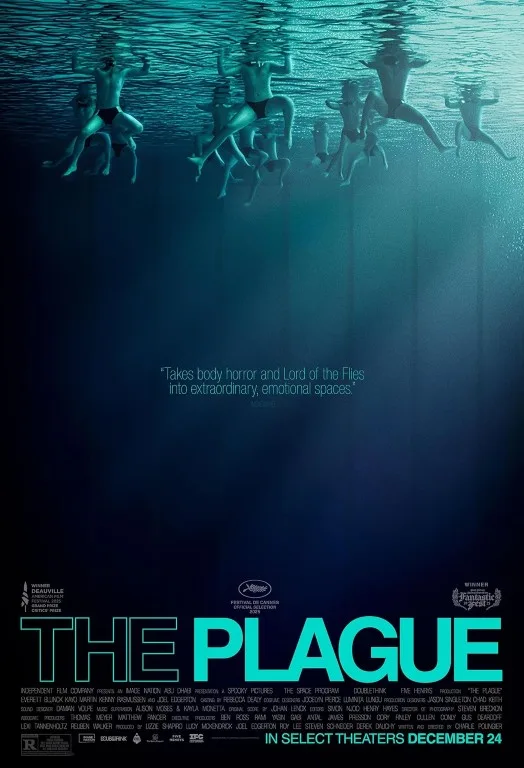
“The Plague” isn’t a horror movie per se, but it moves with the mood and music of one. Take its opening shot, the first of many that situates its young, innocent bodies in the great equalizer of water (in almost all cases, a large athletic swimming pool), the camera underwater watching limbs flail around in the blue while everyone’s heads are obscured above the surface. There’s a disorientation that happens when you try to navigate your body in water; you’re spindly, uncertain, consistently just a little bit afraid you’re going under. Right away, between these shots (courtesy of Steven Breckon’s unsettling cinematography) and Johan Lenox’s unsettling, vocal sample-heavy score, you already feel like you’re drowning.
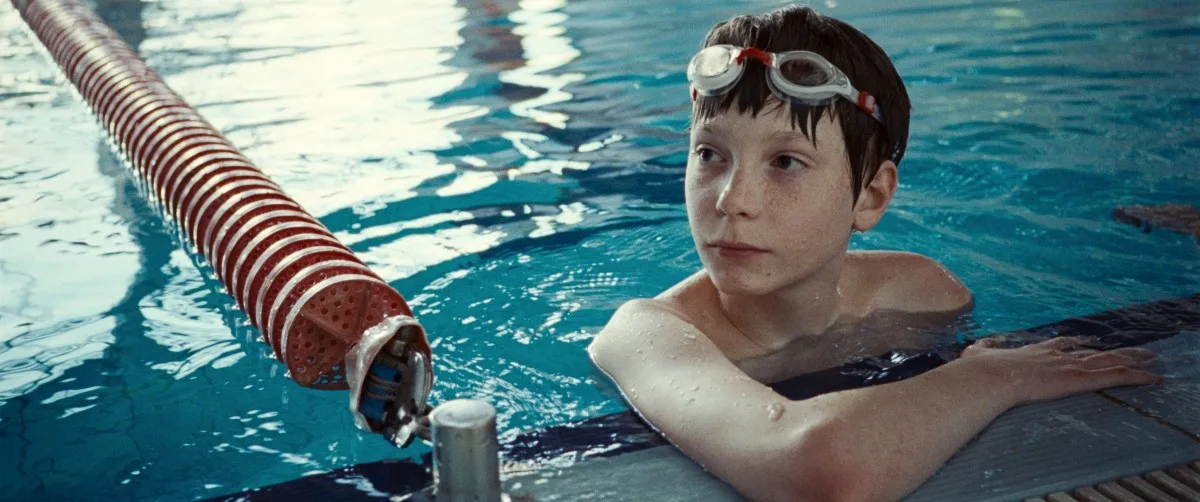
That’s certainly the case for young Ben (Everett Blunck), a sensitive, gangly 12-year-old trying desperately to fit in among the more confident grab-assery of his peers at the all-boys water polo camp in which the film is set. As Polinger’s sparse script (and Blunck’s suitably effective performance) tells us, he’s from Boston, the product of a difficult home life, and is notably more empathetic than his peers. When the boys’ coach (Joel Edgerton, who also produces) asks the boys what water polo is, he thinks it’s about “working together as one big family”; the other boys, especially their prankster ringleader, Jake (Kayo Martin), are more concerned about drawing dicks on Coach’s whiteboard. He’s the kind of kid who’d appreciate one of those Wells for Boys.
But as he continues to navigate the confusing and often arbitrary social codes of the group, he bumps into one of Jake et al.’s more cruel-seeming rituals: The systematic ostracization of the other weird kid in the group, the paunchier, awkward Eli (Kenny Rasmussen), whom they claim has “the plague.” If you touch him, you get it, and your “brain turns into baby food,” Jake gleefully explains to Ben. The dilemma is crystal clear: Eli might just be the one oddball whom Ben actually likes, but is so terrified of losing the group’s social capital to defend him. Plus, as the film keeps enticingly ambiguous right alongside him, he’s maybe just a little bit worried the plague is real. It’s a lot of pressure to put oneself under, and as Jake and the kids keep prodding at him to conform, the steam starts to build and build and build until it releases in ways that might genuinely elicit gasps.
It’s a nifty, efficient way to establish this “Lord of the Flies”-esque battleground of social mores and prepubescent masculine posturing, and Polinger teases these agonies out with perfectly assured direction and a surprising command of his young performers. Each test of Ben’s ability to hang with the crew plays out like a horror sequence: cafeteria seat placements, group shower etiquette, vulgar boasts about sex and masturbation. It’s all so overwhelming for Ben, and Polinger captures that anxiety in each unsettling close-up and jump-scare sound design choice.
Blunck’s performance is astonishing, all hunched shoulders and nervous smiles in the first half as he tries to roll with Jake’s emotional punches, and it’s doubly tragic to see the ways his physicality shifts and curdles into something more desperate and angry by the film’s devastating final act. But attention must also be paid to Martin, whose chaotic streak and child-star twinkle in his eye conveys hidden depths of cruelty and contrarianism that would make anyone, child or adult, go insane. A preternatural expert in detecting weaknesses in his prey, Jake is a true enfant terrible, whose greatest sin is that he might be the model with which others style their own nascent masculinity.
“Your actions are not neutral!” Edgerton’s coach barks at the boys mid-film, a thesis that “The Plague” plays out with stomach-churning intensity. Just as the boys flail for balance in the deep water of the pool, so too do they scramble for acceptance and dominance in the cutthroat, competitive, unfeeling interpersonal dynamics men and boys are often socialized into. (Crucially, Polinger contrasts the boys’ poolside flailing with an extended, beautiful undersea ballet with a group of female synchronized swimmers, who gracefully navigate such social waters by comparison.)
Ethics and scruples can easily dissipate in the seductive fog of an angry mob, and the movie’s true terror lies in Ben’s turmoil over reconciling his deep need to belong with the moral codes he’s already established for himself. He doesn’t want to become one of these boys, but he relishes what it feels like to be one. Even if he has to (in maybe more ways than one) cut away the parts of himself that conflict. “The Plague” never really comes down one way or the other on whether its titular contagion is real. Then again, it doesn’t have to; the real plague is puberty, and the toxic codes young boys play out not just to belong, but to dominate. In that sense, it’s one of the scariest movies of the year.