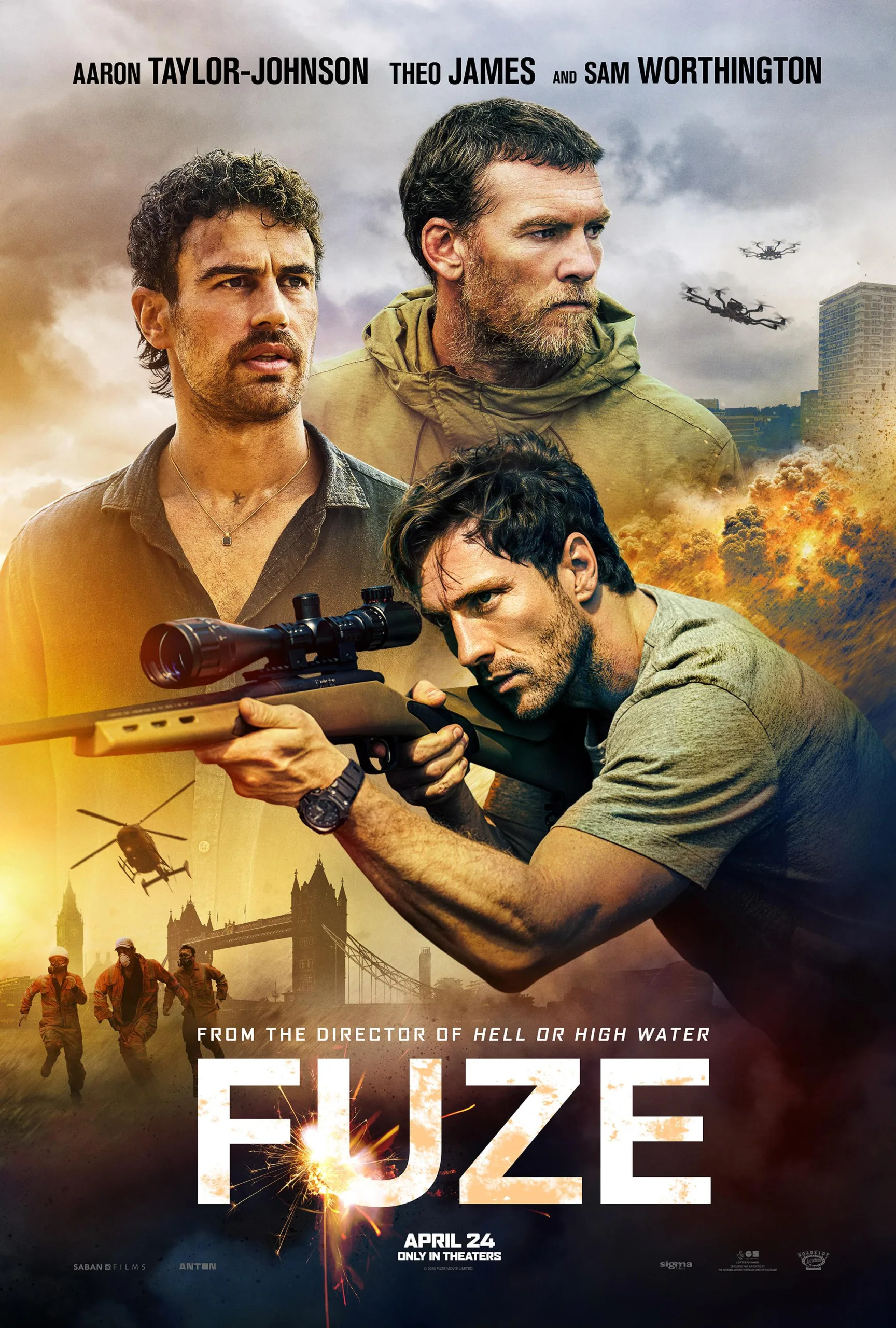


After a relatively expected explosion in this twisty heist thriller directed by David Mackenzie, Sam Worthington, one of an orange-jumpsuited crew of bank robbers, says to his accomplices, “Stick with the plan.” That’s pretty standard issue dialogue in a heist picture, and so the viewer might believe they have a better than fair inkling of what that plan is.
A good part of the fun of this movie, though, is that what the viewer thinks is probably wrong. In addition to serving up heaping helpings of suspense and action, “Fuze” abounds in twists.
Digging up the street in central London, a construction crew comes across an unwelcome sight: an unexploded bomb, presumably a subterranean remnant of the WWII blitz. Aaron Taylor-Johnson’s army Major Will Trantor is quick on the scene; his remote police assist is Gugu Mbatha-Raw’s Superintendent Zuzana. The area is efficiently evacuated lest the bomb go off before Trantor and his team can render it a dud. This leaves said area open to a crew of bank robbers who use the unusual event as cover for a sophisticated smash-and-grab operation. Minus the smash—they break into the bank’s vault from behind, drilling through it with giant cylinders that provide nifty visuals to be sure. The robbers are led by a surly and furrow-browed Worthington, and the robbery/bomb defusing portion of the movie cuts between three locations: the inside underground rear of the bank vault, the pit with the bomb on it, and the police HQ, whose various high-tech monitors provide key, if initially enigmatic, clues to the action.
Did I say three locations? I meant four. As the story unfolds, it raises questions, mainly why does the film keep cutting to a meek-looking man taking his aging parents to Hyde Park on an uncommonly lovely London day? We will find out.
Written by Ben Hopkins (although director Mackenzie gets a shout-out for “additional material” in the end credits), the movie hides its ultimate tricks in plain sight; it’s one of those movies where you don’t so much feel cheated by the twists as emotionally vindicated when they are unveiled. Director MacKenzie began his feature career with a beguiling art-noir picture called “Young Adam” in 2003, and one of the things that still sticks out from that film (which starred Ewan MacGregor and Tilda Swinton; Swinton’s daughter Honor has a small role in this picture) was its exceptionally effective use of silence. Mackenzie still has the knack, as his depictions of post-evacuation streets demonstrate. These are, of course, informed by the fact that we viewers are waiting for at least one threatened explosion.
With his 2016 classic “Hell or High Water,” set in Texas during an economic drought (and written by future modern Western king Taylor Sheridan), Mackenzie proved he could direct a knotty crime picture that brought some sociopolitical relevance along for the ride. Here, the commentary is more on the down-low (and it would be a spoiler to detail how), but it’s still present. And Mackenzie’s choice of exit music is first-rate.