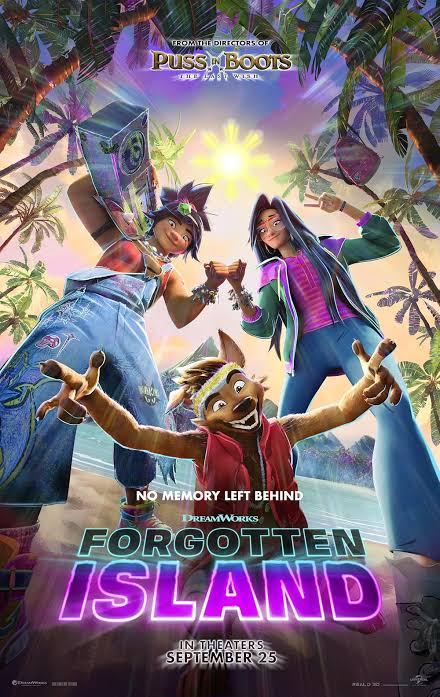
“Forgotten Island,” a fantasy adventure built around the friendship between two teenage girls, is another winner from the team that oversaw “Puss in Boots: The Last Wish.” It does an equally honorable job of tackling issues you might not expect a family-friendly animated feature to address.
The team behind it is Joel Crawford and Januel Mercado, who co-wrote and co-directed. Mercado, a Filipino-American from Stockton, California, took the creative lead. It’s a unique film: a candy-colored immersion into both Filipino folklore and animation’s rich international history, equally impressive for its scope and its light touch. Non-Filipino viewers will likely learn a lot about Mercado’s culture and upbringing, but the movie never feels like school because every reference is embedded in the main characters’ personalities and the journey they take together.
The two girls are Jo, an orphaned tomboy who lives with her doting grandmother Lola Fatima; and Raissa, a model student who wants to be a scientist someday. The story begins with Lola and Raissa as elementary schoolers. They meet when Jo tells her classmates a folktale her grandmother once told her about the forgotten island of Nakali (“Nakalimutan”) and the terrifying monster that lives there: Manananggal, a bat-winged, demonic creature with a scary silhouette for the ages. When Jo socks a kid who made fun of her story and is sent to the principal’s office, she has her first conversation with Raissa, the only classmate who (verbally) defended her.
What initially seems an unlikely friendship blossoms into something closer to sisterhood, and proves strong enough to sustain their transition to adolescence (at which point singer-songwriter H.E.R., aka Gabriella Sarmiento Wilson, voices Jo, and Lisa Soberana takes over as Raissa). There are a few models for this kind of bond in cinema, but they typically involve two boys. One’s a friend with prodigious gifts, destined to achieve great things. The other is likely to stay where they grew up, and deal with that knowledge either by defending and encouraging their high-achieving friend or burying their head in the sand.
Jo, unfortunately, does the second. Even though she loves and supports Raissa, she stays in denial about what’s about to happen to their friendship until Raissa tells her, point blank, that she’s about to leave their town for the United States to attend Caltech. The movie gives us the mandatory sequence where the outbound friend is celebrated with a going-away party and the friend who’s about to get left behind doesn’t show up, until, at long last, she does, and all seems forgiven, at least for the time being.
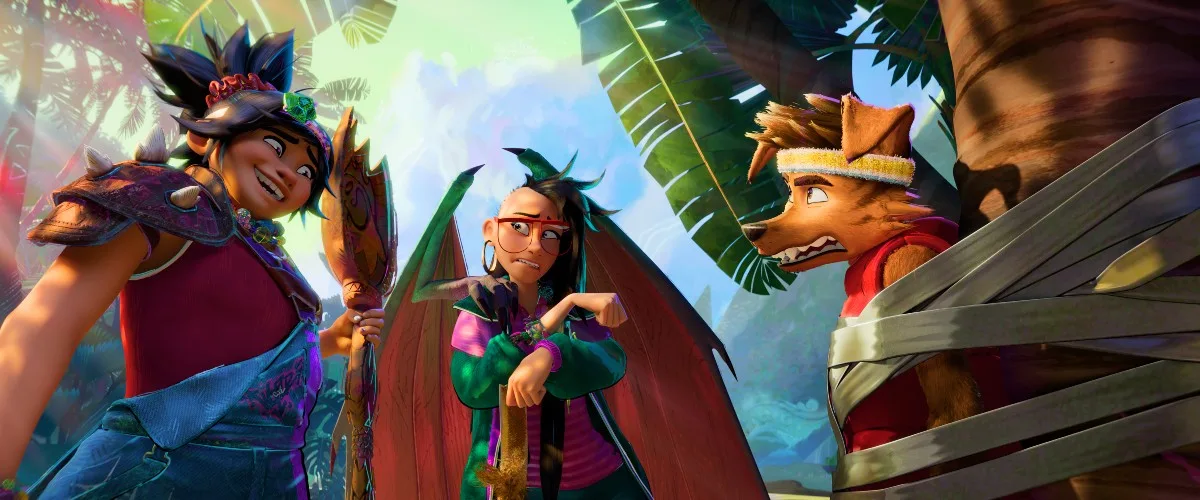
Then the movie takes a leap into fantasy, through the plot of “The Hangover,” as the girls leave the party to spend private time together and end up in Nakali via an enchanted sand dollar (previously described by Grandma) that washes up on the beach. The girls are stranded in Nakali and can’t find the sand dollar. They’re also two days away from the going-away party, which means they have no memory of the preceding 24 hours and must retrace their steps and fill in the blanks if they’re to have any hope of going back. Also: half of Raissa’s head is shaved (the explanation is wilder than anything you can imagine), and Raissa has two claws attached to her shoulders that lead to arms that end in batlike wings.
The wings belong to Manang (Filipino actress and singer Lea Salonga), a Manananggal. She wants them back even though they loathe and fear their owner and prefer to stay on Raissa’s shoulders. The friends are saved by Batiba (Jenny Slate), an example of a plump, tree-dwelling female spirit, the Batibat, which collects others’ prized mementos because they’re infused with the memories of their owners. (Slate’s baby-lady character voice is one of the most striking in this impressive ensemble, evoking Melanie Griffith, Jennifer Tilly, and Mae Questel, who originated Betty Boop.) But Batiba has her own agenda, one that adults will intuit long before it surprises and unnerves the little ones in the audience.
The supporting cast of creatures is a delight. Most have never been seen in movies before, either as taxonomic or personality types. There’s Raww, a charmingly hapless but untrustworthy weredog (not werewolf, fortunately) voiced by Dave Franco, who is afflicted by sudden, uncontrollable transformations that are usually partial (a dog head on a man’s body, etc.) and tend to be triggered by dog-coded actions like throwing a stick.
“The Good Place” costar Manny Jacinto plays Bungi, a large Tiyanak baby demon, a spoiled scaredy-cat who doesn’t want to leave his mommy (even though she’s elderly and desperately needs a break) but ends up joining the group, often but not always to its detriment. Kevin McCann voices Mermahn, Prince of the Kataw people, who’s drawn as one-third “Aladdin” genie, one third Atlantean, and one third proudly fey nightclub performer (he’s got plump, glossy lips and big, fleshy pecs, and the yellow starfish pasties on his nipples can talk and have strong opinions on things).
The result seems like a deliberate attempt to refute a notion, suggested by Pixar boss Pete Docter in a Wall St. Journal profile, that recent Pixar movies drawn from the (typically nonwhite) filmmakers’ life experiences failed to become hits because they weren’t “universal” enough. “We’re making a movie, not hundreds of millions of dollars of therapy,” he said. The comment targeted Pixar’s critically acclaimed but financially disappointing run of culturally diverse features, including “Soul,” “Luca,” “Turning Red,” “Elio,” and “Elemental.”
The latter probably shouldn’t have been lumped in with the bombs, since it became a word-of-mouth hit after a soft opening. Maybe half of those movies shouldn’t, honestly, since they were released during or soon after the pandemic, when the entire industry was wounded and lost. But the takeaway for artists and viewers is clear: “universal” equals male Caucasians born in the United States, and any story that doesn’t originate from that perspective is considered an example of “forced diversity” or “DEI” or some other Twitter cliché.
“Forgotten Island” carries itself as if these kinds of conversations don’t exist, and anyone watching the movie is the intended audience and can be trusted to imagine themselves in the world being presented. The emotional predicaments are translatable and relatable. And the movie itself is goofy, groovy, exciting, sometimes scary, and ultimately moving. It’s also a two-hour encyclopedia of animation, with plentiful nods to Studio Ghibli, Ralph Bakshi, Genndy Tartakovsky, and Walt Disney’s “Fantasia” (especially the “Night on Bald Mountain” sequence and the problematic dancing “Chinese” mushrooms, which are audaciously reclaimed here and somehow merged with the Smurfs). Last but not least, it’s a parable everyone can interpret, about how life’s twists and turns affect relationships we once thought were permanent.
Where the shadow falling over “The Last Wish” was fear of death, here it’s the idea that friendships, even very close ones, have a lifespan, and that even though changes in circumstance or geography might not completely end the friendship, it will alter it and make it less central to daily life—and that’s not only a bearable disappointment; it’s a natural part of growing up that almost everyone has had to deal with.
The movie is so imaginative, energetic, and sincere that it should be fun for just about everyone. But the ideal audience might be preteen and young teen viewers who haven’t considered what lies ahead for their friendship and could benefit from a story that acknowledges how devastating that kind of change can be, but also how mundane and survivable it is.