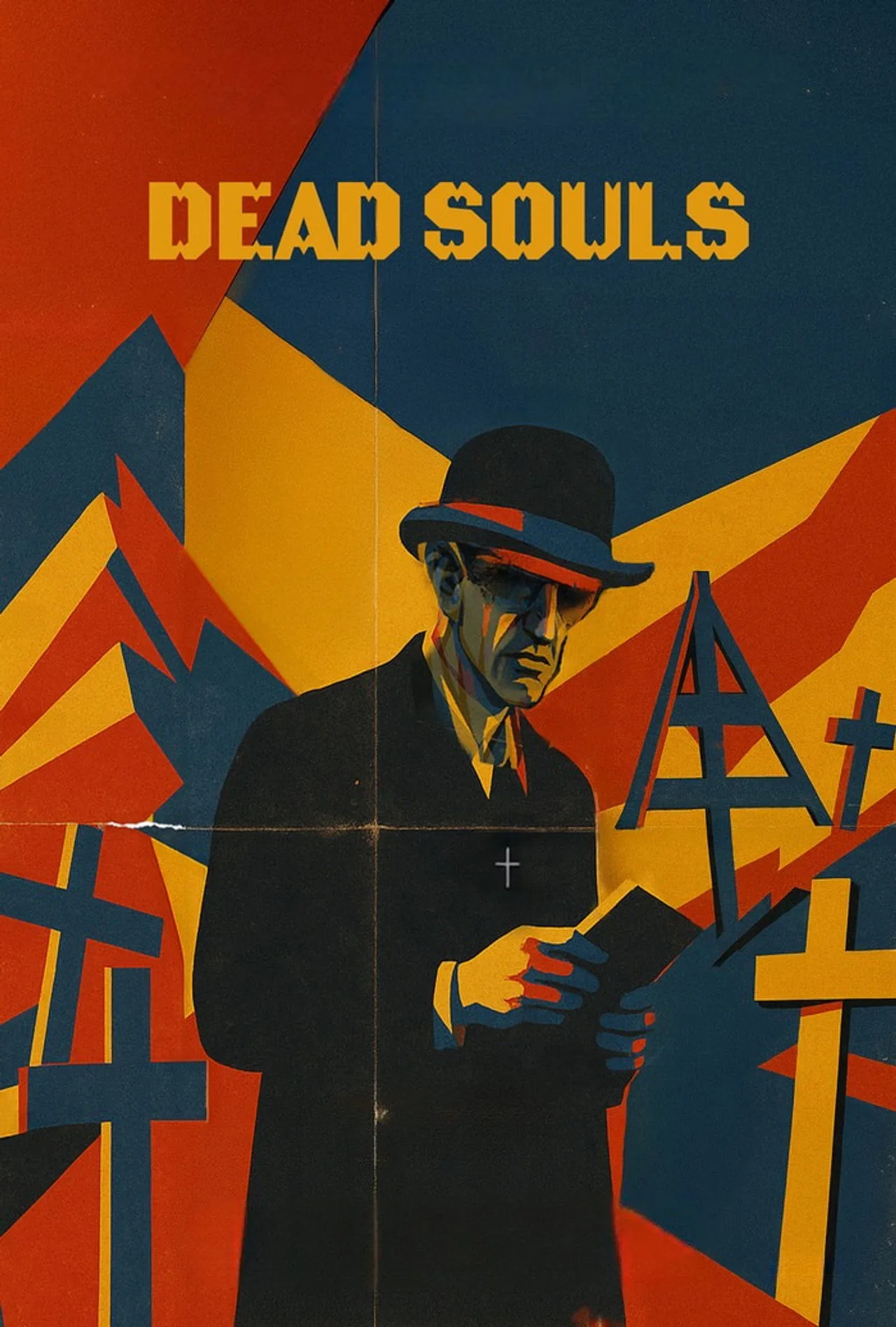

British filmmaker Alex Cox has indicated that his latest film, “Dead Souls,” will be the capper of a career that started off with a bang in the mid-80s with such cult classics as “Repo Man” and “Sid & Nancy” before going off into stranger areas following the critical and commercial failure of “Walker,” his brilliant, frighteningly prescient and largely misunderstood take on America’s past and present misadventures in Central America over the years. If this turns out to be the truth, Cox has chosen to go out on a high note with an offbeat and proudly political riff on the spaghetti Westerns of old that serves as an inspired summation of the themes and attitudes that have driven his work throughout the years.
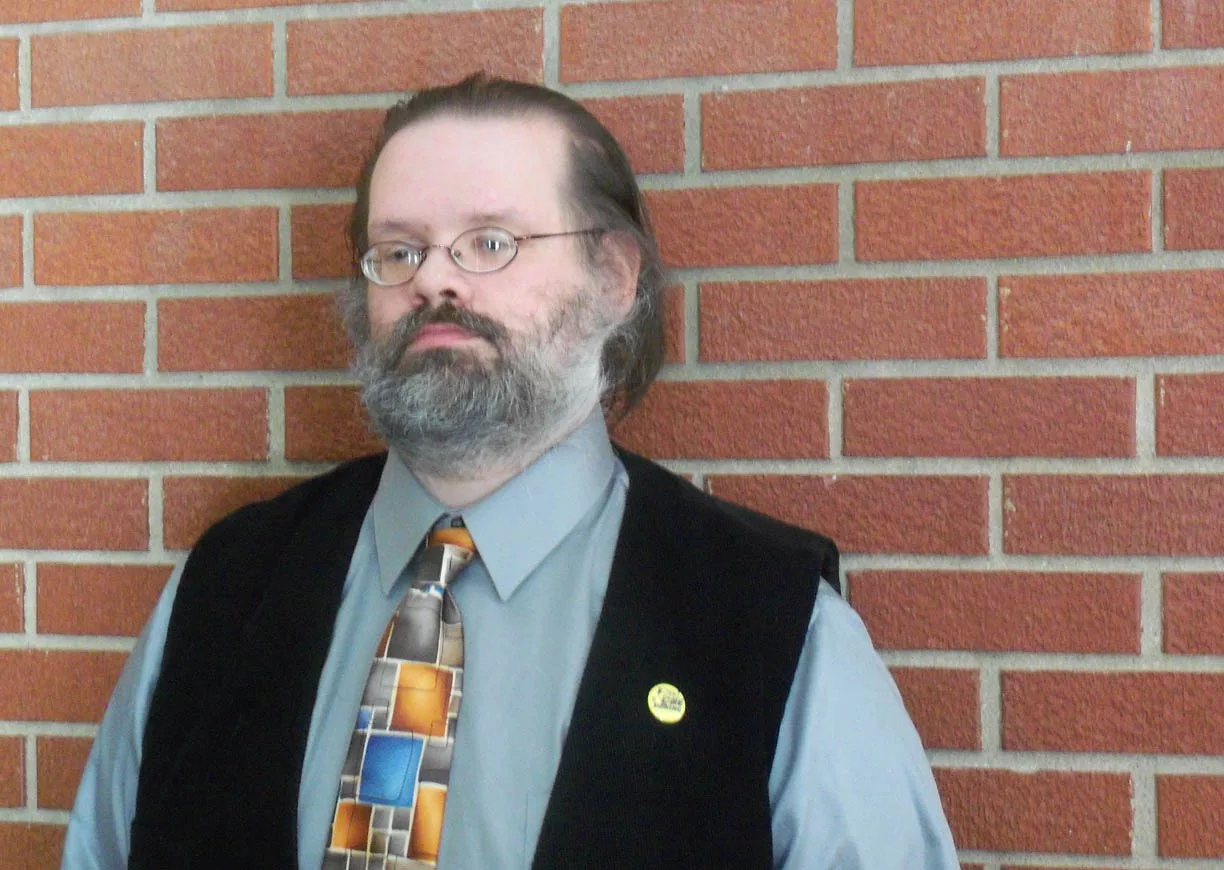
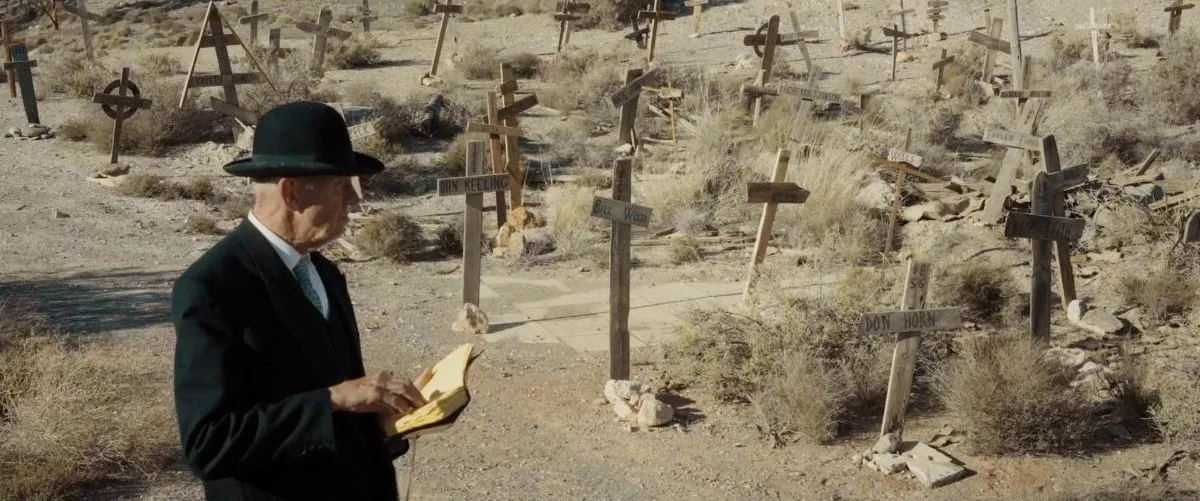
Set in 1890, Cox himself stars as Mr. Strindler, a courtly, well-dressed man who, as the story opens, arrives in a small border town in Arizona that seems to have been designed to eat those who look like him for breakfast. Nevertheless, after checking into the local hotel, he begins ingratiating himself with a number of the town bigwigs, including the mayor (Eric Schumacher), the sheriff (Brendan Guy Murphy), and the owner of the local mine (Ted Falagan), by showing that he has money to spare during a card game that he is careful not to win. Having established himself, Strindler starts going around town, ferried about by Borracho (Zander Schloss), the grizzled local who knows everything about everybody, to visit the most prominent citizens with an odd proposition—he will pay them good money for the names and birthdates of the Mexicans who have either died in their employ or on their land.
Why is he doing this? He never comes out and explains why. Indeed, with each encounter, he changes up his explanation of who he is, at various times claiming to be a census taker, a representative of both the U.S. and Mexican governments, a reverend, and even part of the funeral industry. The people he is dealing with don’t seem to care much—between their day-to-day exploitation of Mexican workers and a past massacre that is only hinted at, there are a lot of names to sell, and by passing them on to Strindler, they can theoretically rid themselves of any personal guilt they may feel and make a tidy profit at the same time. As time goes on and Strindler’s cash begins to dwindle, some of the townspeople begin to get a bit suspicious of both him and his motives, eventually leading to a young hothead known as The Kid (Shayn Herndon) challenging him to a duel in the streets. While I won’t tell you how that turns out, I can say that this is the point where the film takes a decided turn for the weird. How weird? Put it this way—it finds room for both a musical number in which a number of characters (living and dead) suddenly burst into a rendition of “Streets of Laredo” and a stop-motion animation sequence, and neither of those quite qualifies as its most audacious leap.
Oddly enough, the basis of “Dead Souls” is a 1842 book by Nikolai Gogol that has been reconfigured in the mode of all those spaghetti westerns that were cranked out back in the 60s and 70s for which Cox has a well-known affinity—not only did he shoot a good portion of the film in Almeria, Spain, where many of those films were made, but he also collaborated on the screenplay with Gianni Garbo, an Italian actor who appeared in a good number of them as well. Admittedly, no one is going to mistake this film for any of the epics directed by Sergio Leone—most of the film consists of a couple of people talking to each other, and there are only a couple of moments involving violent gunplay, played more for laughs than thrills. However, despite working on a small budget, he manages to conjure up the kind of sweaty, scuzzy atmosphere that helped make those original films subvert the cliches of old-fashioned Hollywood westerns. If it lacks the operatic excesses of this particular subgenre, it does an interesting job of recasting those elements into something closer to an intimate chamber piece.
Although this might make the film sound like a sort of companion piece to “Straight to Hell,” his delightfully bizarre 1987 contemporary take on the genre, it bears closest comparison to the aforementioned “Walker.” Like that film, this one uses a story set in the past as a way of commenting on current issues, tackling everything from immigration (with Strindler at times coming across like an ICE agent, albeit one only interested in targets who are already dead) to the way in which practically anything—even one’s death—can be reduced to just another commodity to the ways in which history can be manipulated by those in power. Also like that film, it isn’t exactly subtle in how it goes about it. The results are quite funny at times, but this is not meant to be a spoof by any means; beneath the offbeat nature of the film in general and Cox’s performance in particular (whose enigmatic turn comes across like a hybrid of William S. Burroughs and Stan Laurel) is a real sense of anger about how things are today that is both striking and hard to shake.
Clearly, “Dead Souls” is not a film for everyone—it is unlikely to bring any of the moviegoers who bailed on Cox for refusing to simply rehash “Repo Man” over and over back into the fold. That said, there must still be a few daring souls out there looking for something different—and a film that takes a 19th-century excoriation of Russian bureaucracy and transforms it into a caustic take on contemporary issues filtered through the lens of an old Sergio Corbucci programmer certainly qualifies as “different.” If this does prove to be Cox’s final directorial effort, it is nice to see him going out literally guns a-blazing.