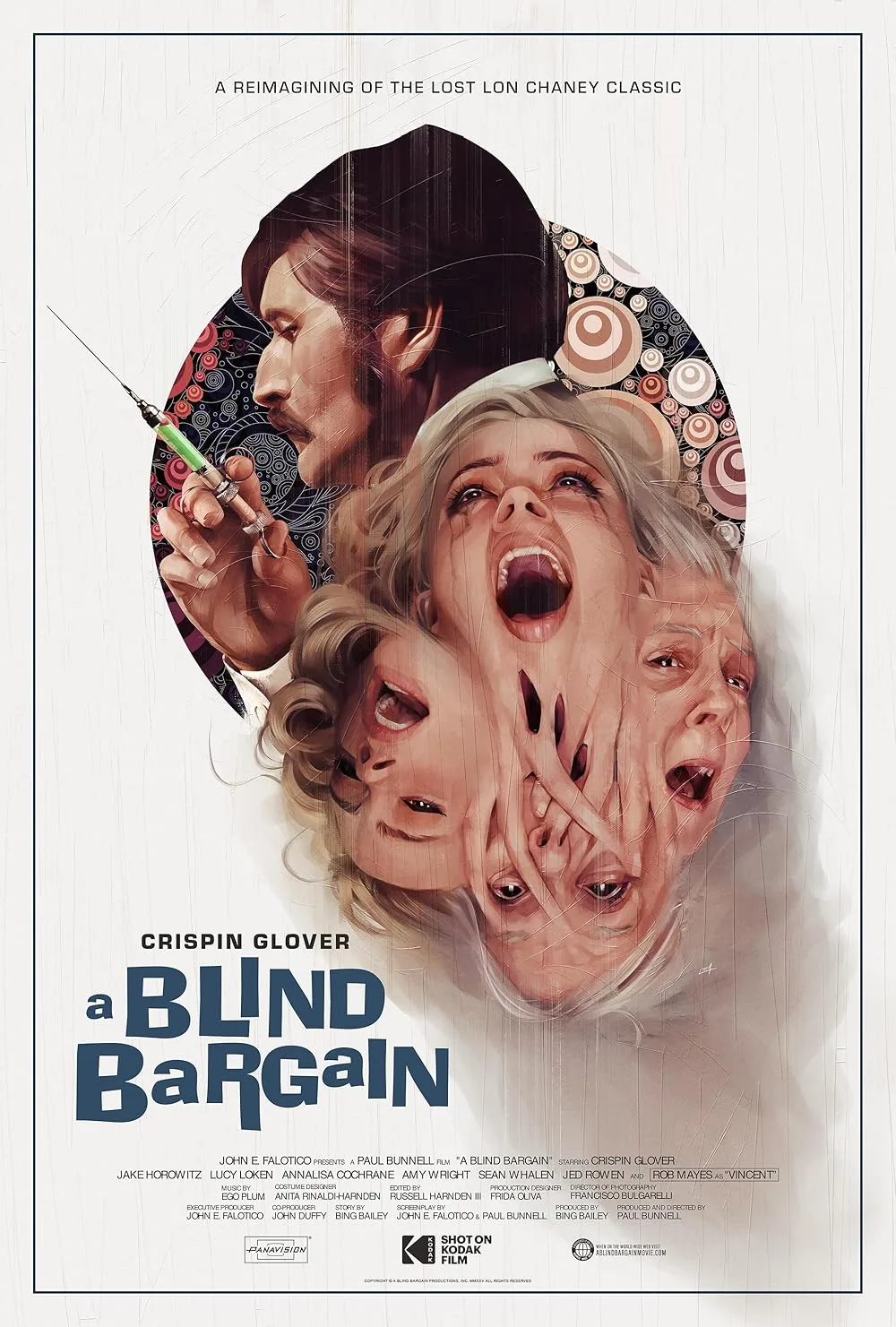
It’s been a couple of days since I screened it, and I still don’t know what to make of “A Blind Bargain,” an unusual and not-all-there homage/remake to the lost 1922 Lon Chaney horror drama of the same name.
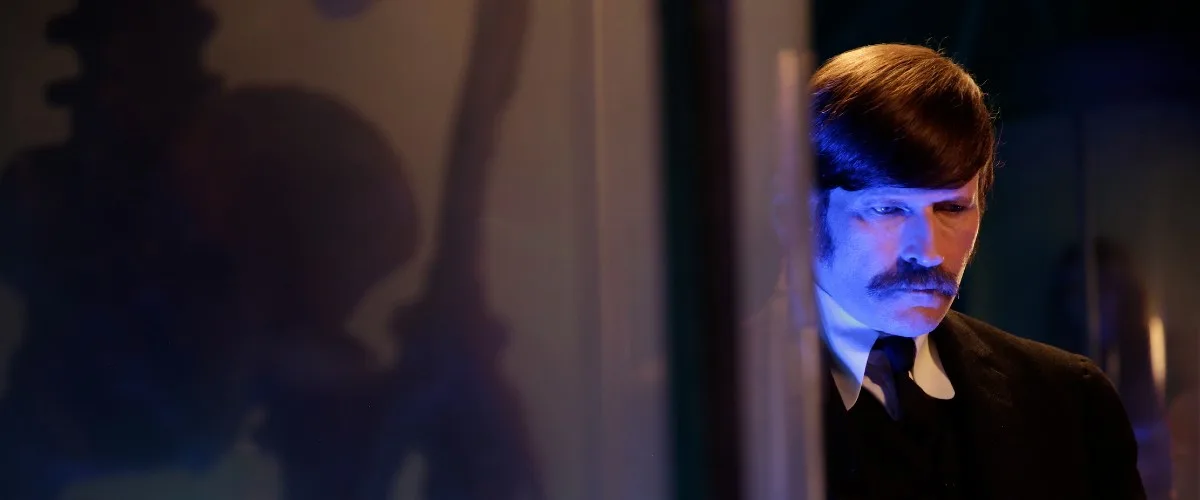
I expected something off-kilter since weirdo king Crispin Glover plays the Chaney role as Dr. Gruder, the head of a shifty wellness center that destroys patients’ bodies and ruins their lives. What I couldn’t predict from this year’s latest “The Substance”-sploitation project was how stilted and chintzy its line readings and period setting would respectively be. It’s still sometimes fun to puzzle over what’s going on and why in this unusual and occasionally eerie thriller, set in 1970 Los Angeles and following a desperate junkie who sells out his unsuspecting mother for Gruder’s experiments.
Granted, that spirit of morbid curiosity runs counter to the O.Henry-style moralizing hinted at in the movie’s aphoristic title, which warns us that a blind man shouldn’t “bargain for a suit of clothes,” as one character puts it, since “he doesn’t know what he’s getting into.” But if you approach “A Blind Bargain” with an open mind, you might find yourself so intrigued on the way up that you won’t mind being inevitably let down.
The makers of this new “A Blind Bargain,” including director Paul Bunnell, were wise not to let their distracted and unevenly divided plot focus on Gruder, Glover’s characteristically twitchy and secretive villain. Instead, we follow Gruder’s two patients, the desperate Vietnam vet Dominic (Jake Horowitz), who wants money for drugs, and his hapless elderly mother Joy (Amy Wright), who wants Gruder’s rejuvenating treatment.
The best scenes in “A Blind Bargain” trail after Dominic’s poor life choices, and then his mother’s bewildering connection with Gruder, as they each lead us to the movie’s underwhelming and generic finale. Wright is particularly affecting in a role that would otherwise be easy to overlook, and Horowitz is pretty good, too, once his weaselly antihero protagonist gets a little wind in his sails and tries to impress Dr. Gruder’s fetching assistant, Nurse Bannister (Lucy Loken).
“A Blind Bargain” loses its strange allure whenever its creators get distracted by side characters who, at best, only wind up sinking both Dom and his mom deeper into their two-pronged identity crisis. It’s especially hard to know what to make of any scene featuring Vincent (Rob Mayes) and his gang of flamboyant heavies, who live to emasculate Dominic and also shake him down for money. And don’t get me started on Logos (Jed Rowen), Dr. Gruder’s sullen and imposing-looking assistant, who develops an unrequited crush on Joy.
Vin’s cartoonishly unpleasant behavior leaves one wondering why we’re spending so much time with this burly thug, who’s largely defined by his by-now retro wardrobe and strutting macho energy. I mean, yes, somebody’s got to keep after Dominic, given all the grief he puts his poor mother through. But this guy’s neither charming nor funny enough to be worth so much screentime. Maybe he’s ostensibly amusing because he’s a dated genre movie trope? Logos’s scenes elicit the same confusion, not because it’s hard to imagine the appeal of yet another misunderstood monster, but because it’s hard to see the pulpy lyricism or cheesy humor that might make Rowen’s character endearing.
That said, if you’re going to see “A Blind Bargain,” you likely won’t be wondering about Glover’s equally undercooked performance and wispy character. Glover’s built up such an overwhelming mystique of only partly-sensible oddness that he can afford to coast on his well-honed reflexes. Everything else about “A Blind Bargain” that underscores either its period setting or melodramatic underpinnings leaves one wondering who this movie’s for and why its sense of humor is so inaccessible.
The movie’s jagged tone and cheesy sensibility will likely trip up anyone looking to understand why a modern remake of a lost silent movie is set in the 1970s. Given the tacky, vintage-clothing-shop aesthetic, it seems like Los Angeles in 1970 was the stylistic bleeding edge (or death knell?) that separated a Utopian sort of 1960s exoticism from the gaudy, overproduced birth of the 1970s’ post-hippie cool. That line of thought kind of makes sense, even if too many scenes with Vin and Logos also leave one wondering what about the original “A Blind Bargain” appeals to these eccentric filmmakers, who chose to shoot their homage with Kodak film for some reason.
At minimum, “A Blind Bargain” will keep you scratching your head throughout, if not to ask yourself what it’s all about, then to wonder if maybe the filmmakers will eventually arrive somewhere unexpected. You can probably guess the answers to both questions, but maybe seeing for yourself will change your mind.