Tina Fey is a genius

I defy you to tell the difference between her character and the Governor of Alaska, who has been busy lowering expectations all week. The main difference, of course, is that Fey is still in front of TV cameras, while Palin can no longer be found. Anywhere.

And the most brilliant stroke: Palin herself provided much of the material. She writes her own comedy and all Fey has to do is perform it the way Palin does. Fey isn’t doing a caricature (like Dana Carvey’s George HW Bush), but is giving a performance of uncanny accuracy (closer to, say, Helen Mirren in “The Queen“).

December 14, 2012

“There is no god!!!”

View image “There is no god!!!”

Thanks for all the terrific, thoughtful suggestions for my hypothetical Atheist Film Festival (below) — “Freddie Got Fingered” (either “proof” of the absence of god, or a devastating comment on the divine sense of humor), “Contact,” “Wise Blood,” all of Buñuel, “Grizzly Man,” “Crimes and Misdemeanors”… Don’t stop now!

View image [Reverse zoom.] Whimpering: “I’m so sorry. Forgive me.”

I think a slam-bang opening for such a festival would be one of my favorite underrated films of the 1980s, Anthony Perkins’ 1986 “Psycho III,” which begins with a black screen and a hair-raising scream of anguish: “There is no god!!!” What’s more, we soon learn that it is the cry of a devastated novice, and that (even better) she’s played by Diana Scarwid! (That’s Christina Crawford to you “Mommie Dearest” fans — and something tells me Perkins was one, too.)

View image [Reverse zoom, cont.] Stronger: “Give me a sign. Help me.”

View image [Static shot.] Silence.

Before we know it (in the third shot — or the fourth, if you include the blackness between the Universal logo and the statue of the Virgin), we’ve smudged the line between “Psycho” (1960) and “Vertigo” (1958), looking up into a California mission belltower. A few vertiginous shots and a maniacal sniveling nun (and a few nice ones) later, and the movie is off to a rip-roaring psycho-vertiginous start.

View image Psych– er, Vertigo?

The nuns approach Maureen (the hysterical novitiate) and attempt to coax her down from the archway where she is poised to throw herself, Kim Novak-like, from the tower. “There is no god!” Maureen cries again — not in rage but in despair, as if she’s just discovered a shattering, horribly disappointing truth.

The crazy nun raves: “You wretched girl! How dare you!”

The eldest nun tries to snap her out of it: “Please Maureen, you mustn’t. You have an obligation to Him!”

“I have nothing,” Maureen says dejectedly. “I am nothing!”

View image Another blonde, another belltower…

And then all hell breaks loose.

That’s just the first four minutes, before the titles. And it’s not giving too much away to say that Maureen becomes Norman Bates’ very first girlfriend. They’re a match made in… wherever.

View image Inverted crosses, anyone?

“Psycho III” is a joy, a sequel that understands the original from the inside out. It’s a celebration, a satire, a revisitation, and a deeply felt, detail-perfect homage to Hitchcock’s bleak masterpiece. (I’d say “Psycho” is not so much an atheistic work as a nihilistic one. The specificity of the opening sequence perversely indicates the randomness of the particular story the movie chooses to tell. And Simon Oakland’s psychobabble wrap-up at the end mocks not only psychology but any and all belief systems.)

View image Nun: “You have an obligation to Him!”

Novice: “I have nothing. I am nothing!”

I’ve always thought of “Psycho” as a family black-comedy — a horror sitcom. And, from the perspective of 1986, Perkins reminds us of how funny “Psycho” (and Norman) is. “Psycho III” strikes the perfect balance between horror, tragedy, and camp.

The screenplay is by Charles Edward Pogue, who is also credited with co-writing David Cronenberg’s horror / comedy / romantic version of “The Fly” (“Be afraid — be very afraid”) the same year — and the clever, underrated remake of “D.O.A.” in 1988. And the rest of the crew is top-of-the-line, including such Clint Eastwood vets as D.P. Bruce Surtees (“Dirty Harry,” “Night Moves,” “Risky Business,” “Pale Rider”) and the late production designer Henry Bumstead (“Topaz,” “Mystic River,” “Flags of Our Fathers,” “Letters From Iwo Jima”). The score is by Carter Burwell (“Miller’s Crossing,” “Barton Fink”) and the producer is Hilton A. Green — second unit / assistant director on “Psycho” and “Marnie.”

If you want to discover Maureen’s fate — and see just how wittily and poignantly “Psycho III” pays attention to the details of its source — check after the jump.

Meanwhile: Any more candidates for the Atheist Film Festival? (I’ve tried to refine what I mean by an “atheist film” — as opposed to an anti-god or anti-Christian film — in a comment here.)

December 14, 2012

What is your favorite Scorsese Picture?

Martin Scorsese and a big gold pizza. (DGA photo)

In honor of Martin Scorsese’s victory at the Director’s Guild over the weekend, here’s another poll using a different software application. This one’s more compact: Just use the drop-down box and enjoy. When you view the results, you have to click your browser’s “back” button to return here. This isn’t an easy choice for me (probably between “New York, New York” and “King of Comedy”)…

What is your favorite Martin Scorsese Picture?

Mean Streets

Italianamerican

Alice Doesn’t Live Here Anymore

Taxi Driver

New York, New York

The Last Waltz

Raging Bull

The King of Comedy

After Hours

The Color of Money

The Last Temptation of Christ

GoodFellas

Cape Fear

The Age of Innocence

Casino

Kundun

Bringing Out the Dead

Gangs of New York

The Aviator

The Departed

View Results

Free poll from Free Website Polls

December 14, 2012

TIFF: The war over there

View image Christian Bale in Werner Herzog’s “Rescue Dawn.”

For the first half of Werner Herzog’s “Rescue Dawn,” the fictionalized movie based on his documentary 1997 “Little Dieter Needs to Fly,” I wasn’t sure if Herzog had tamed the commercial feature or if it had tamed him. By the end, I felt it was the most harrowingly realistic and unsentimentalized P.O.W. film I’d ever seen.

The story is “inspired by” Dieter Dengler, an American Navy pilot (born in Germany) whose plane crashed in 1965 in Laos, where there wasn’t supposed to be any bombing and before there was a “War in Vietnam.” U.S. “military advisors” were there, supporting the South Vietnamese, but as far as most Americans were concerned, “war” hadn’t broken out. Dengler survived the crash, was captured by Laotians, and held in what he and his fellow captives believed to be a Viet Cong camp. By the time Dengler arrived, some of the handful of Americans and Vietnamese interred there had been detained for more than two years already.

December 14, 2012

Hannibal Lecter, critic eLectercuted at Super Bowl

View image “Electrifyingly terrorific!”

From MediaPost:

Famed film producer Harvey Weinstein, now co-chair of The Weinstein Company, formerly the co-founder of Miramax Films, was worried about the copy in a commercial for his forthcoming film “Hannibal Rising.” The spot featured a voiceover saying, “The most terrifying thriller of the new year.”

Weinstein changed his mind late on Saturday night and called Les Moonves, chief executive of CBS. Weinstein thought it better to change the word to “electrifying,” so as not to scare the kids on Sunday Bowl Sunday. […]

The comment “the most terrifying movie of the new year” was from Maxim magazine’s film reviewer, Pete Hammond. But Moonves and Weinstein said they “worked” with the critic to change it to “electrifying.”

Worked with the critic? You mean that they changed his mind concerning what he said? This is shocking — critics can “change” their quotes for some movie commercials, or in the case of Sony Pictures Entertainment some years ago, studios can completely make a quote up — as well as the critic….

December 14, 2012

Altman: Life beyond the frame

“Nashville” 25th reunion. (photo by Jim Emerson)

When the doctor says you’re through

Keep a’goin!

Why, he’s a human just like you —

Keep a’goin!

— Haven Hamilton (Henry Gibson) in “Nashville”

View image 24 of your favorite stars.

Give me a Leonard Cohen afterworld

so I can sigh eternally

— Kurt Cobain, “Pennyroyal Tea”

It’s true that all the men you knew were dealers

who said that they were through with dealing

every time you gave them shelter

— Leonard Cohen, opening lyrics for “McCabe & Mrs. Miller”

View image “Nashville” 25th reunion. Note gigantic Oscar at right; Altman got his own, regular-sized one six years later. (photo by Jim Emerson)

“However, the cortex, which is dwarfed in most species by other brain areas, makes up a whopping 80 percent of the human brain. Compared with other animals, our huge cortex also has many more regions specialized for particular functions, such as associating words with objects or forming relationships and reflecting on them. The cortex is what makes us human.”

— John J. Ratley, M.D., “A User’s Guide to the Brain: Perception, Attention, and the Four Theaters of the Brain”

I’m not sure what, if anything, meaningfully connects these fragments to the passing of Robert Altman — or his films, as alive now as they ever were — but they were all things I encountered during a day spent thinking about Altman and, to my surprise, not wanting to speak out loud about him to anyone. I talked to my mother on the phone. She asked hesitantly, “Have you heard any news today?” “Yeah,” I said, and changed the subject. What can I say that isn’t trivial? (Rhetorical question, please.)

In this state of grief, nothing I’m writing or thinking about Altman is adequate, or even makes much sense, in large part because a whole moviegoing lifetime of engagement with his movies (beginning at age 15) has so profoundly shaped who I am and how I experience the world. Like hundreds, thousands (millions?) of cinephiles and cinephiliacs, I found life (and, paradoxically, shelter) in Robert Altman’s movies. “Nashville” is my church, to which I return again and again for joy, insight, inspiration and sustenance. (I haven’t written about it for years, but I also know that I’m almost never not writing about “Nashville.”)

To this day, I am in some deep but irrational sense convinced that the characters in “Nashville” (even though I know they’re played by 24 of my very favorite stars!) continue to exist outside the parameters of the movie itself. I’ve met and interviewed, for example, Ned Beatty, but there’s Ned Beatty the actor and then there’s Delbert Reese, who is someone else entirely. Delbert exists, imaginatively independent of the great actor (one of my all-time favorites) who inhabited him in “Nashville.” (This is most unlike the other most-influential movie in my life, Roman Polanski’s “Chinatown,” made just the year before “Nashville,” which is as “closed” a film as “Nashville” is “open.” “Chinatown” ends so definitively that, “Two Jakes” aside, any life beyond the final frame is unthinkable.)

Right now I just want to share another fantastic memory: In 2000, I heard there was going to be a 25th anniversary reunion screening of “Nashville” at the Academy of Motion Picture Arts and Sciences’ Samuel Goldwyn Theater in Beverly Hills. I’d moved back to Seattle by this time, but I bought tickets the moment they became available (for five bucks apiece) and went to LA for the event: My favorite movie, in a pristine print, in one of the finest movie theaters in the world, with most of those 24 favorite stars in attendance. It was… transplendent (as a Shelley Duvall character once said). I’ll post an update with IDs later, but for now, see if you can identify the people onstage (taken with a now-primitive, but still beloved, Canon Digital Elph)

Pauline Kael’s famous, ebullient review of “Nashville” here reminds us how exciting and innovative the movie was in 1975.

Principal population of “Nashville” after the jump:

December 14, 2012

The Golden Age of Cinemania is Now

View image I like to watch and learn.

Alas, Manohla Dargis wasn’t fond, as I was, of Eric Rohmer’s “Romance of Astrée and Céladon,” Juan Antonio Bayona’s “The Orphanage” or Ira Sachs’ “Married Life” — all of which (and more, as usual) are being repeated after their Toronto showings at the New York Film Festival.

But in her overview of the NYFF, she reminds us of the importance of film festivals — and the word-of-mouth generated on the web — to the viability of world cinema in the US market:

[The NYFF’s] willingness to go beyond its comfort and perhaps even its geographic zone feels especially urgent now because it won’t be long before the old art-house faithful start slipping away like Antonioni and Bergman. Cinemania is alive and well on the Internet, notably in blogs, where young movie nuts rant and rave and help cultivate one another’s cinematic interests. This is heartening, but film — especially the kind that distinguishes this year’s edition of the New York Film Festival — needs more than passion. It needs an audience, a paying public. If we don’t cultivate a new generation of movie lovers who get excited at the very idea of a Hou Hsiao-hsien film, we may as well hold a memorial service for foreign-language-film theatrical distribution right now.All too true. When I was in college, programming the student film series, local art-house exhibitors understood that showing foreign and specialized films (even older Hollywood movies)to students on campus for a buck-and-a-half per double bill on Friday and Saturday nights wasn’t a form of competition or a threat to their ticket sales. It was a way of building an audience for them. Today, that kind of evangelism is happening right here, on the World Wide Internets. (That was the goal of the recent “Top Foreign-Language Films Poll — to spread the word, get people started..)

I was relieved, and gratified, that so many cinephiles younger than me still cared about Bergman and Antonioni, and still had so much to say (and even more they were willing to discover) about them when they died. I wonder, in fact, if perhaps the giants (or dinosaurs) like Bergman and Antonioni matter more to people in their 20s, 30s than they still do to people of their own, or my, or Jonathan Rosenbaum’s generation.

Which (by free association) reminds me of this essay by Rick Perlstein (“What’s the Matter with College?”) in Sunday’s New York Times Magazine.

You used to have to go to college to discover your first independent film, read your first forbidden book, find freaks like yourself who shared, say, a passion for Lenny Bruce. Now for even the most provincial students, the Internet, a radically more democratic and diverse culture — and those hip baby-boomer parents — take care of the problem.I’m one of those people who never wanted to stop going to college. Make that “never wanted to stop taking classes” — because, even though it took me a while to consciously realize it, the day I stop learning (or wanting to, anyway) is the day I’m dead. I submit that the greatest classroom the world has ever known is now (literally) at your fingertips. My class schedule isn’t temporally or geographically definable, but it’s virtually round ’round the clock, just about wherever I am. How about you?

December 14, 2012

Journey to the Center of the Dump:Wall-E, color & close-ups

Color can be used sparingly — even in family-friendly animation.

I don’t hear NPR’s movie critic Bob Mondello all that often anymore (’cause I’m not in my car as much as I used to be), but I’ve never heard him more excited than when he reviewed “Journey to the Center of the Earth” last week. Not the new Brendan Fraser 3D one, but the 1959 version with James Mason, Pat Boone, Arlene Dahl and Diane Baker.

Although Mondello’s greatest enthusiasm by far is for the 1959 film, his best lines describe the 2008 production: “It’s considerably more “real”-looking — in a differently fakey way…. It’ll just show you what Hollywood used to do, and do well, done well.” Well put. As I was saying about movie blood, what we accept as “realistic” isn’t necessarily realistic at all. It’s as much a convention of the times we live in as anything else. Much of the groundbreaking CGI of today isn’t much better than it was ten years ago, and a lot of the old CGI — which seemed so convincing at the time — now looks… well, better than the rubber octopus in “Ed Wood,” but dated nevertheless. Even some of the great special effects movies like “Jurassic Park” (1993) don’t look much more sophisticated than “King Kong” (1933) these days.

Meanwhile “Wall-E” (and “Finding Nemo”) writer-director Andrew Stanton sounds like a really savvy filmmaker. He told Terry Gross on Fresh Air about a lot of the brainstorming that went into “Wall-E,” and I had another one of those NPR “driveway moments” during this part of the interview:

December 14, 2012

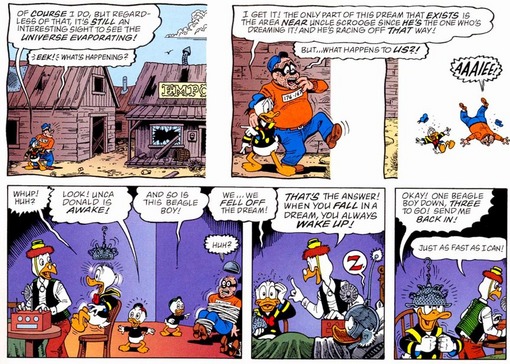
Inception of Inception: The Scrooge McDuck comic

Is this where it all began? Did Disney really implant this idea in Christopher Nolan’s subconscious, the way it implants things in everybody’s? Read the full comic here, or download as a .pdf. Don’t stop reading in the middle or you’ll get stuck in limbo.

(via I Watch Stuff)

December 14, 2012

Former President Jar Jar

What would pundits and stand-up comedians do without their “Star Wars” analogies? Maureen Dowd liked to refer to the former vice president as “Darth Cheney.” She recently asked George Lucas if that comparison was a mischaracterization:

Lucas explained politely as I listened contritely. Anakin Skywalker is a promising young man who is turned to the dark side by an older politician and becomes Darth Vader. “George Bush is Darth Vader,” he said. “Cheney is the emperor.”

Amy Davidson, at the New Yorker’s News Desk, is having none of it (“Close Read: Dark Forces”):

December 14, 2012

The Re-forgotten Lost Devil Girls Trailer of Ed Wood!

Now, for the penultimate time! Ten years in the development vault! Dripping wet from the subcutaneous epidural labs! Writer-Producer-Director-Hyphenate Andre Perkowski and Terminal Pictures Presents the previously unclaimed, unfulfilled trailer for Edward D. Wood Jr.’s “The Devil Girls”!!! You’ll thrill to their prevailing sex urges for lust, dementia and forbidden entertainment!

December 14, 2012

Ebertfest 2008: The year without a Roger?

View image The eponymous Roger Ebert.

I’m in Urbana. My bag isn’t. (It’s an old canvas backpack thing that I never should have checked anyway. Now I’m paying for it.) I’ll be reporting from Ebertfest this week, but I’m heartbroken that, for now at least, Roger won’t be here. In case you haven’t checked out his brand new, under-construction blog, Roger Ebert’s Journal, please do so. Roger writes:

The 10th Anniversary Ebertfest begins tonight in Urbana-Champaign. It is with some melancholy that I write these words on a legal pad in a hospital bed in Chicago. After consulting with my doctors, I have decided it may not prudent to try to make the journey today with a fractured hip….

December 14, 2012

Salt: It’s a movie! It’s a spy! It’s a nuclear antiproliferation treaty!

Phillip Noyce’s (and definitely Angelina Jolie’s) lean and unpretentious “Salt” is proof positive that dumb summer thrillers don’t have to be stupid. That is, it revels in absurd implausibilities that are as outrageous as in the movie playing the next auditorium down the hall (and the one next to that), but it never breaks a sweat trying to convince you that it’s anything other than what it is. The difference between “Salt” and most ludicrous trying-too-hard action movies is a matter of grace under pressure: a veteran director with a firm command (and respect for) the integrity of screen space; a stripped-down screenplay that gives you just enough exposition to create suspense and keep you guessing about what’s going on (What’s she doing? Why is she doing it? Does she know why she’s doing it?); and an iconic leading lady whose poise is exceeded only by her stubborn resilience.

And then there’s her face, which is the real subject of the film. You won’t find a more thrilling moment in summer movies than the shot — “Queen Christina” via “The Scarlet Empress” — of Jolie’s Evelyn Salt, wearing a Russian fur hat and wrap, standing on the Staten Island Ferry, with Ellis Island in the distance. The camera moves in on her from behind, causing the distant silhouette of the Statue of Liberty to sweep across the horizon from right to left, then swings around her into a breathtaking close-up profile. The whole movie is contained in that shot, from a far shot of the abstract Lady Liberty, into a close-up of another statuesque lady of questionable loyalties. (I couldn’t help but think of Truffaut dollying around the stone bust of the Greek goddess with the serene, unreadable expression in “Jules and Jim” — Jolie’s Eve(lyn) being as mysterious and even more deadly than Jeanne Moreau’s Catherine who, after all, was not CIA.) The shot has nothing to do with the plot; it just serves to get Salt to a rendezvous with a Russian sleeper cell. But it’s a great movie-star moment, the kind of image you could imagine being built around Garbo or Dietrich or Ingrid Bergman.

December 14, 2012

Haven Hamilton lives!

But I am deeply saddened to report that the great Henry Gibson has died. “Laugh-In” (“A Poem… by Henry Gibson”), “The Long Goodbye,” “Nashville,” “Mullet” (a short), “Magnolia”… he has always been an inspiration to me.

I am in Boulder with my friend Julia Sweeney for a CWA-related athenaeum, talking to students about comedy, critical thinking, death… and any and all other subjects, depending on where the conversations lead. I’ll be back this weekend and plan to write more about Henry Gibson then. R.I.P.

December 14, 2012

Beware of all jokes requiring punch lines

U.S. Senate apologizes for slavery and segregation: http://bit.ly/G46Cu. Bob Byrd breaks down on Senate floor. “Too soon. Too soon.”

I think that’s a funny joke. Normally, I find set-up/punch-line jokes the lowest form of humor (far below puns and slapstick in their paucity of imagination), and I regard them warily, not unlike the way Thoreau viewed “all enterprises that require new clothes.” But I cracked up when I saw this tweet from Robert A. George. To find it funny, I guess you’d have to know that Senator Robert Byrd (D-WV) is very, very old, and that he was a member of the Ku Klux Klan in his youth. But in the ad hominem ’00s, many people would first look at the identity of the joke teller before deciding if it was humorous.

Robert A. George, eh? Wait a minute — he’s a conservative and a libertarian! He’s black! He’s a naturalized American citizen, born in Trinidad (and Tobago)! He’s a Catholic! He’s a blogger, a Twitterer, a Facebooker, a New York Post columnist, a stand-up comedian, a comic-book geek! Soooooo, of course he’s going to make that joke about Bob Byrd, right?!?!

December 14, 2012

Star-struck: Movie criticism or astrology?

View image Keep your feet on the ground and keep reaching for the stars…

“One of the most genuinely confounding films to come along in years… This is not a film occurring in an alternate or imaginary reality; rather, it is a film of no reality, that is, a picture that changes the rules of its universe strictly according to its creators’ whims. Hence, the film is likely to inspire even more heavy thinking on the part of cultural theorists than ‘The Matrix’ did.”

* * *

“A lot of fluorescent, 7-Eleven-tinted images flash by, any of which could easily be removed or re-arranged without significantly disrupting the film’s continuity, because it has none. If you can determine the spatial relationship between Speed’s Mach 5 (or Mach 6) and any other race car for more than a few consecutive seconds, then good for you. As on the TV series, the pictures don’t seem to move so much as repeat — movement with no momentum.”

* * *

“‘Speed Racer’ is not a feature film in any conventional sense… Whatever information that passes from your retinas to your brain during ‘Speed Racer’ is conveyed through optical design and not so much through more traditional devices such as dialogue, narrative, performance or characterization.”

* * *

“Alas, this radicalization of film language, while certainly impressive to behold, yields heretofore un-dreamed of levels of narrative incoherence, but hey, not every experiment succeeds.”

* * *

“One of the more blatantly anti-capitalist storylines to come down the cinematic pike since, I dunno, Bertolucci’s ‘1900.’”

* * *

“”Speed Racer” is a manufactured widget, a packaged commodity that capitalizes on an anthropomorphized cartoon of Capitalist Evil in order to sell itself and its ancillary products.”

* * *

Three of the above quotations are taken from a three-star review of “Speed Racer.” The other three are from a one-and-a-half-star review. Can you tell which is which? Perhaps the tone gives something away, but the descriptions of the movie, what it does and how it works, are strikingly similar. Clearly both of these critics saw the same movie, although one found the experience less daring, less exhilarating, than the other.

December 14, 2012

A-C-T-I-N-G

View image John Candy as Steve Roman as Juan Cortez — now that spells good acting.

Ever since December, when Kristin Thompson posted this (“Good Actors Spell Good Acting”) on the blog she shares with her husband and co-author David Bordwell, I’ve been meaning to link to it. This is my favorite kind of article, leading you fluidly from one intriguing idea to another — and you never quite know where it’s going to take you. Not only does it begin with an account of how bits of movie dialogue (from “Rio Bravo,” “His Girl Friday”) have entered her life, and the lives of her friends and colleagues, but it then segues into a great quotation from Steve Roman on SCTV (playing Juan Cortez, the first Puerto Rican Chief Justice of the US Supreme Court in the dramatic television series, “There’s Justice for Everybody”) : “It’s got good actors, and that spells good acting.” And, from there, to this:

Almost invariably we use this line when we come across one of those films that receive highly positive reviews largely because of one great performance. You know the kind: Charlize Theron in “Monster,” Halle Berry in “Monster’s Ball,” Hillary Swank in “Boys Don’t Cry,” and more recently Forest Whitaker in “The Last King of Scotland” and Helen Mirren in “The Queen.”

Usually I avoid such films, because the reviews tend to plant the idea that they are primarily actors’ vehicles. I enjoy good acting as much as the next person, but I want the rest of the film to be interesting as well.

Are there any film classics that are truly great solely for the acting? It’s hard to think of any. Maybe “The Gold Rush,” which is stylistically fairly pedestrian but which is redeemed by Chaplin’s inspired performance. Maybe “Duck Soup,” also quite undistinguished for much of anything other than the Marx Brothers cutting loose without being saddled with the sort of plots involving young, singing lovers that MGM would soon foist upon them. Maybe a few others. Usually, though, we tend not to think of a performance, however dazzling, as adding up to a great film.

That’s a good point to keep in mind during Oscar season, when “best acting” is often confused with “most acting.” The performances that win awards tend to have as much to do with the roles as they do the actors. Sure, the player has to deliver, but give a decent actor a juicy character (and a sympathetic director) and you’re talking Oscar bait. If just about anyone had played Jennifer Hudson’s mistreated chunky diva in “Dreamgirls,” an emotive-showpiece part if there ever was one, and had not gotten an Oscar nomination, that alone would have made the film a miserable failure. Fortunately for the investors, Hudson was able to do what she was hired to do. (Twenty years ago on Broadway, it was another Jennifer H. — Holliday — who became a star playing the same role and singing the same showstopper song.) Robert Altman liked to say that casting was the most important part of making a movie, but nobody would say that his movies are interesting just for the performances. It’s how he captures and presents them that matters just as much.

December 14, 2012

Hitler on Leno

Of this I do not tire. Go ahead and click. You know what you’re about to see — but the subtitles are exceptionally humorous.

December 14, 2012

The Social Network: Communicating in code

“When an individual enters the presence of others, they commonly seek to acquire information about him already possessed. They will be interested in his general socio-economic status, his conception of self, his attitude toward them, his competence, his trustworthiness, etc. Although some of this information seems to be sought almost as an end in itself, there are usually quite practical reasons for acquiring it. Information about the individual helps to define the situation, enabling others to know in advance what he will expect from them and what they may expect from him. Informed in these ways, the others will know how best to act in order to call forth a desired response from him.”

— from “The Presentation of Self in Everyday Life” by Erving Goffman (1959)

Relationship status:

Interested in:

— Facebook (2004)

The actual Mark Zuckerberg is said to have taken fencing when he was at Harvard. That’s what the movie Mark Zuckerberg is doing in the opening scene of David Fincher’s “The Social Network” — only he’s doing it with words and attitude, over a beer at the Thirsty Scholar, with his soon-to-be-ex-girlfriend. The verbal thrusts and parries, feints and ripostes, zip by at 4x fast-forward. It’s like a compressed version of an Aaron Sorkin screwball comedy dialog scene, written as self-parody. Only not quite. The speed and affectlessness is part of Mark’s code, and part of his character’s DNA.

Once you adjust to its breakneck tempo, the scene becomes a fascinating back-and-forth about communication in code, and the infinite ways it can misfire. “The Social Network” is about a lot of things — notably the American social and economic system, built on class privilege, money, networking, sex, entrepreneurialism, self-presentation/self-promotion; and the age-old patterns of friendship, misunderstanding and betrayal between collaborators in any creative or business enterprise — all of them forms of code, understood by insiders and incomprehensible to outsiders. Mark has a valuable insider’s understanding of computer code, but is an outsider when it comes to most of these other areas. And yet he has an acute analytical intelligence that allows him to deconstruct these codes and notice elements that others who are closer to them might take for granted.

December 14, 2012
subscribe icon

The best movie reviews, in your inbox